ZOPA (zone of possible agreement): what it is, examples and how to calculate it
The range in which buyer and seller can close a deal, and how to find it before you negotiate
ZOPA (zone of possible agreement, zona de posible acuerdo in Spanish) is the range in which buyer and seller can close a deal that works for both of them.
This concept is useful for any marketing professional who wants to design effective, dynamic negotiation strategies.
What is ZOPA?
ZOPA is the space or range in which two parties (buyer and seller) can reach a mutually beneficial agreement.
For example, it could be the space where the price the buyer is willing to pay and the minimum price the seller is willing to accept overlap.
Within this zone, there is potential for both parties to reach an agreement and benefit mutually, achieving shared goals and objectives.
A ZOPA example with numbers
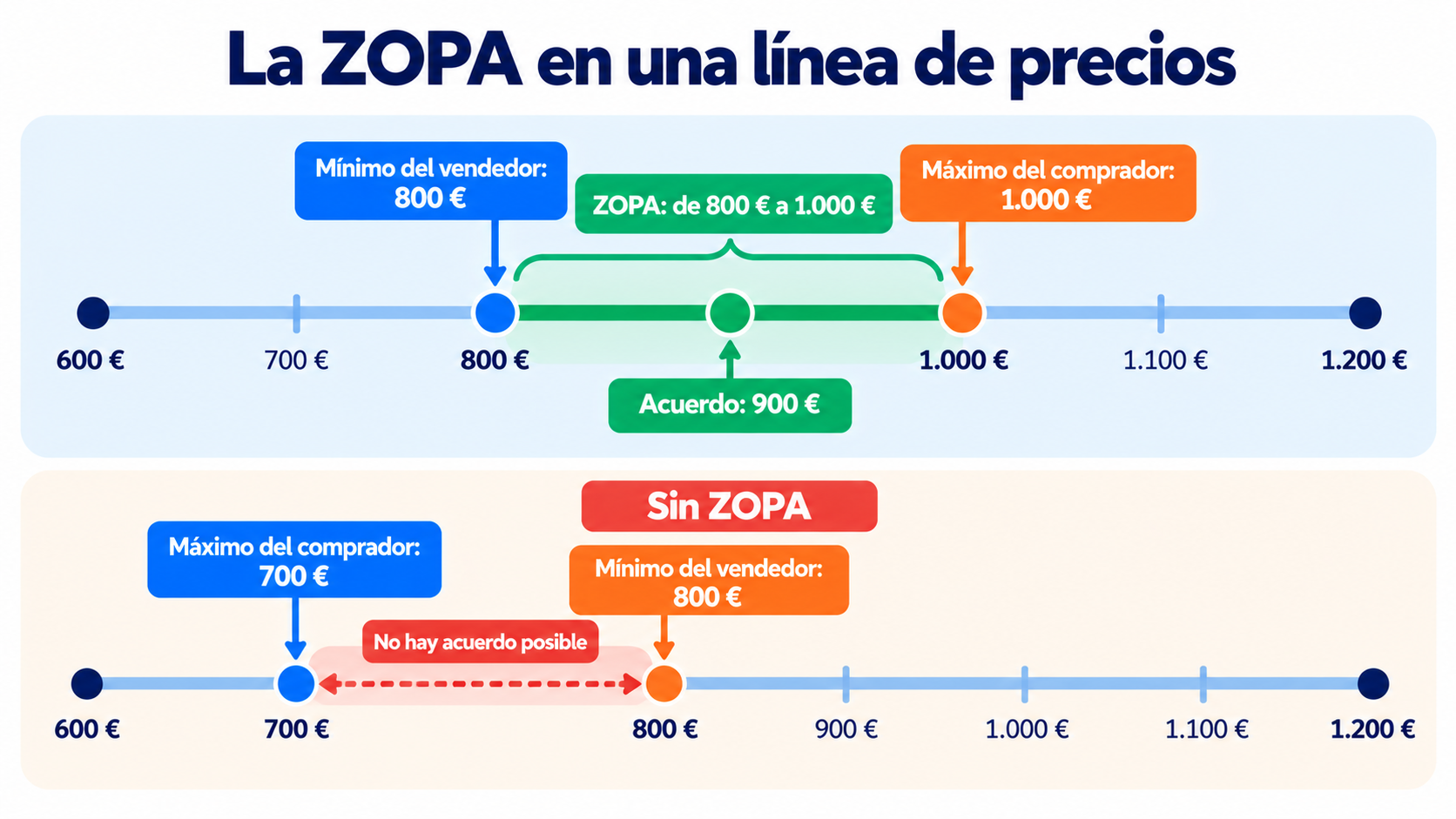
An agency sells a newsletter design service. The least it will accept, its reservation point, is €800. The company that wants to hire it can pay €1,000 at most.
The ZOPA runs from €800 to €1,000. If the company could only pay €700, there would be no ZOPA and no possible deal.
| Concept | What it is | In the example |
|---|---|---|
| Seller’s reservation point | The least it will accept | €800 |
| Buyer’s reservation point | The most it will pay | €1,000 |
| ZOPA | The space between the two | From €800 to €1,000 |
| BATNA (MAAN in Spanish) | What you’ll do if there’s no deal | Another client or another agency |
| Closing price | Where the deal ends up, within the ZOPA | For example, €900 |
Find the offer your customer will accept
Try different offers with A/B tests in Mailrelay and find out which discount works without giving away your margin. Start for free.
ZOPA, BATNA and reservation point
ZOPA can’t be understood without two other negotiation concepts. The reservation point is the least each party will accept before walking away from the table. The ZOPA is the space between the two parties’ reservation points.
BATNA (best alternative to a negotiated agreement) is what you’ll do if there’s no deal. In Spanish, it’s known as MAAN (mejor alternativa a un acuerdo negociado). It was popularized by Roger Fisher and William Ury in their 1981 book Getting to Yes.
The better your alternative, the higher you can set your reservation point. That’s why it pays to know your BATNA before negotiating and to estimate the other party’s.
How to calculate your ZOPA in 4 steps
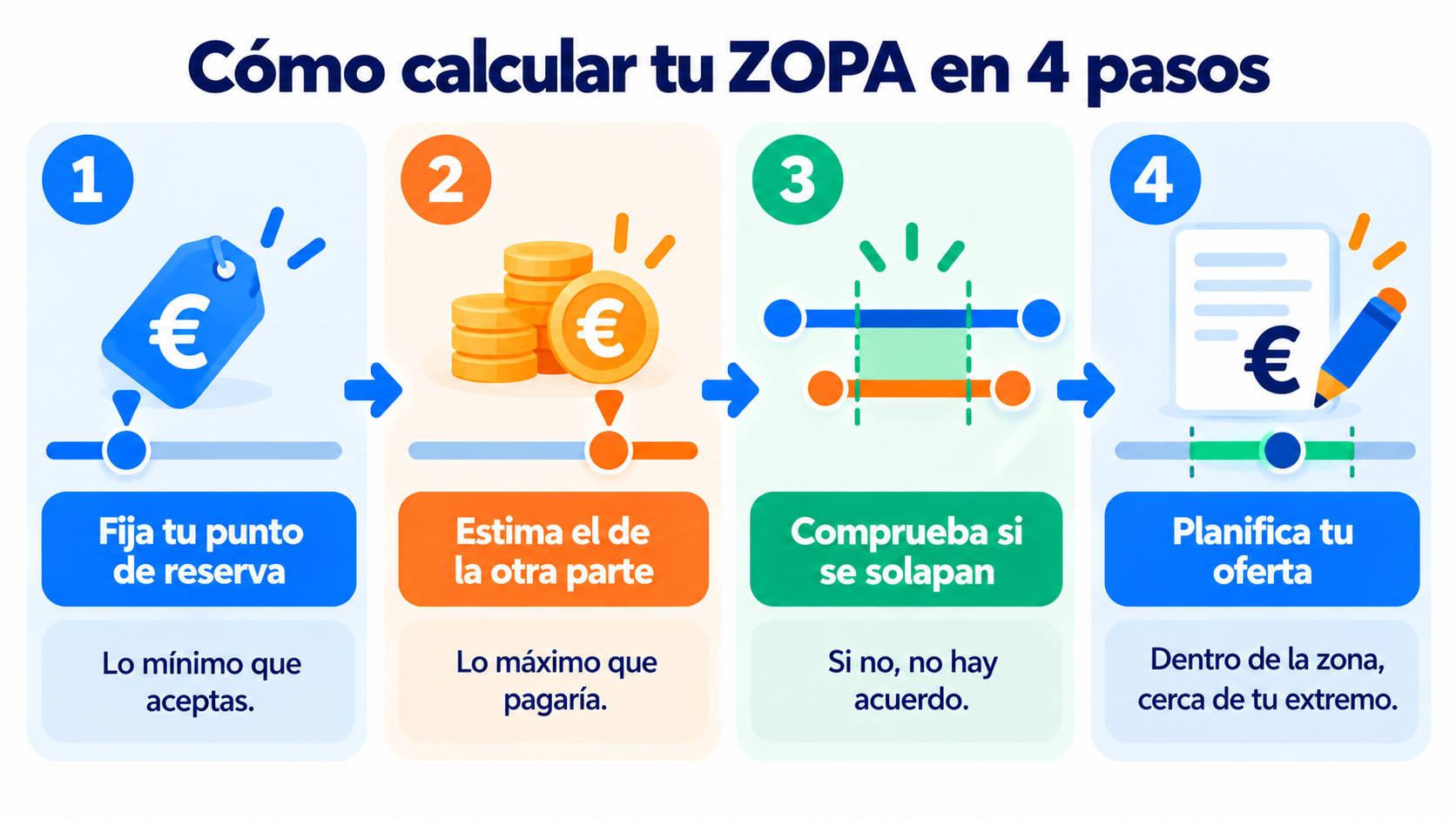
Before you sit down to negotiate, or launch an offer, follow these steps:
- Set your reservation point: the price below which it isn’t worth it for you, based on your direct costs and your alternative.
- Estimate the other party’s: their budget, what they would pay a competitor and how much of a hurry they’re in.
- Check whether they overlap: if there’s no overlap, there’s no ZOPA and it’s better not to force the deal.
- Plan your first offer and your concessions within the zone, close to the end that favors you.
Connection between ZOPA and email marketing
In the context of email marketing, ZOPA becomes a valuable component.
Through emails, brands can communicate directly with their consumers and negotiate offers, prices and services.
It is within these exchanges that brands look for common ground, a space where the customer’s expectations and the company’s aspirations meet.
In practice, it’s about finding the ZOPA.
For example, a fashion company could send emails with exclusive offers to its subscribers.
Here, the ZOPA would be the range of prices and discounts in which both the customer and the company would benefit.
If this zone is correctly identified and leveraged, email marketing becomes a powerful tool to reach agreements that drive sales.
To apply it to your email offers:
- Calculate your maximum discount based on your margin. That’s your reservation point.
- Segment your subscribers by how price-sensitive they are. Someone who buys without a discount doesn’t need the biggest one.
- Run A/B tests to see which offer converts best without cutting your price more than you need to.
- Measure which discount sells the most and adjust your next campaign.
ZOPA and SMS marketing
Similarly, SMS marketing intertwines with the concept of ZOPA.
Through text messages, companies can reach their consumers quickly and directly, offering promotions, discounts, and news.
The effectiveness of this strategy lies in finding the right ZOPA, where the interests of both parties align.
Exploring the relationship between the zone of possible agreement and SMS marketing reveals a range of possibilities for companies looking to increase their impact and connection with customers.
An SMS with a special offer can be the starting point for more detailed and personalized negotiations, where the ZOPA plays a decisive role in the success of the conversation.
Why identifying the ZOPA matters in digital marketing
Identifying the zone of possible agreement allows brands to stand out and build meaningful relationships with their consumers.
Both email marketing and SMS marketing are direct, personal channels for communicating with customers.
And by using these channels strategically, possible agreement zones can be discovered and explored, thus generating successful negotiation opportunities.
How Mailrelay helps you
ZOPA helps you find common ground with your customers and close deals that work for both sides. In your campaigns, that means offers that convince without giving away your margin.
With Mailrelay, you create segments to send each group the offer that suits it, compare offers with A/B tests and schedule automations, which are also included in the free account.
You can also send SMS for quick offer alerts. And the free account includes 80,000 emails a month and 20,000 contacts.
Bring each customer the offer that suits them
Segment your subscribers and send each group its best offer. Up to 80,000 emails a month for free with Mailrelay.
Frequently asked questions
What does ZOPA stand for?
It’s the acronym for zone of possible agreement. It’s the range of prices or terms within which the two parties can close a deal.
What happens if there’s no ZOPA?
If the most the buyer will pay is below the least the seller will accept, no deal is possible. Each party falls back on its alternative (BATNA).
What’s the difference between ZOPA and BATNA?
The ZOPA is the zone in which an agreement can be reached. The BATNA is what each party will do if there’s no deal, and it helps set their reservation point.
How is the ZOPA calculated?
You compare the least the seller will accept with the most the buyer will pay. The space between the two is the ZOPA.
Is ZOPA only useful for negotiating prices?
No. It also works for deadlines, payment terms or included services, and for deciding how far a discount goes in your campaigns.