Storydoing
The story brought to action in marketing
Storydoing is a marketing strategy that takes the art of storytelling one step further, turning those narratives into real experiences that the public can live firsthand.
Instead of just telling a story, as traditional storytelling does, storydoing proposes acting it out: the brand ‘leads by example’ and makes its message tangible through concrete actions.
In this way, the consumer stops being a passive spectator to become an active protagonist of the brand’s story.
In short, it is about moving from words to action, getting the audience to live the story instead of just listening to it.
· What is storydoing?
Storydoing can be defined as a marketing strategy focused on creating experiences linked to the history and values of the brand, actively involving the public.
Unlike storytelling —which consists of narrating persuasive stories to communicate brand values—, storydoing materializes those values in the real world through meaningful actions and experiences.
The goal is to generate a deeper emotional connection by having people participate in the brand’s story firsthand.
In practice, this implies that the company designs initiatives, events or activities where its message comes to life.
“Actions speak louder than words sums up this approach very well.
For example, if a winery wants to apply storydoing, it will not just stick to ads telling how special its wine is, but could organize immersive visits to its vineyards so that people can see, smell and taste the winemaking process for themselves.
Thus, consumers associate the brand with a real and memorable experience, not just with a traditionally told story.
In short, storydoing humanizes the relationship between the brand and its consumers by inviting them to form an active part of its universe.
It is no longer just about transmitting a message, but about creating experiences that reflect the brand’s identity.
In this way, the public connects with the brand more authentically and feels firsthand what the company wants to communicate.
· Differences between storytelling and storydoing
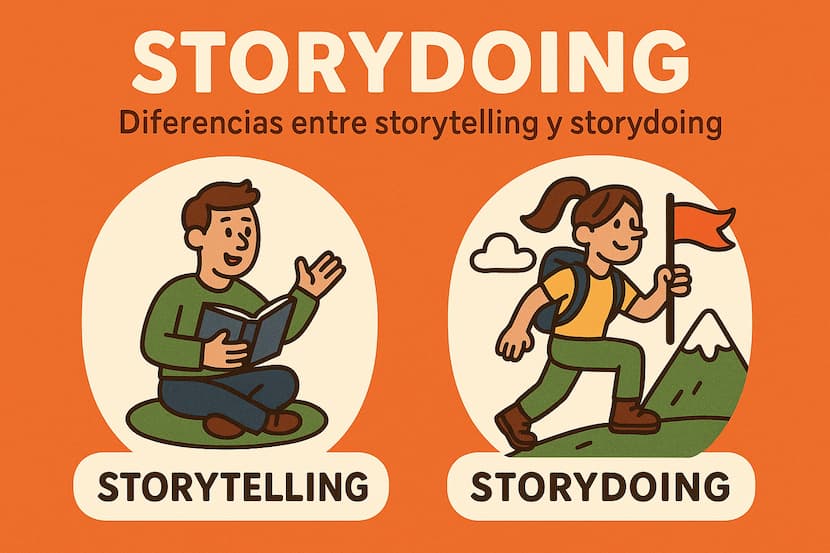
Although storytelling and storydoing share the purpose of emotionally connecting with the audience through brand narratives, their approaches differ significantly.
Below we highlight their main differences:
> From narrator to protagonist:
In storytelling, the brand tells a story to the public, in storydoing, the brand makes the public part of the story.
That is, storytelling communicates values through stories, while storydoing creates experiences where those values are put into practice and the consumer actively intervenes.
> Unidirectional vs. participatory:
Storytelling is usually a more unidirectional process – the company transmits a message and the audience receives it.
On the contrary, storydoing seeks consumer participation, encouraging them to interact, collaborate or generate content around the experience.
Communication stops being a brand monologue to become a dialogue with the public.
> Intangible vs. tangible:
Storytelling stories can excite, but they remain in the narrative or symbolic realm.
However, storydoing offers tangible actions that demonstrate the brand’s values. The idea is to make the brand’s promise a reality: not just saying “what we are,” but showing it through actions.
This usually involves some specific event, product or initiative that embodies the central message.
> Momentary vs. lasting impact:
A good story can remain in memory, but a lived experience leaves a deeper and more lasting mark.
By directly involving the senses and emotions, storydoing tends to generate a more solid brand recall over time.
When a consumer participates in something extraordinary related to the brand, it is more likely that they will remember it and talk about it years later, reinforcing the emotional bond.
It is worth mentioning that storytelling and storydoing are not mutually exclusive, but complementary.
In fact, for storydoing to work, it usually requires a storytelling base: it is necessary to have a good story or purpose that serves as a guide for actions.
If the brand doesn’t have a solid narrative that defines its values, the actions will be meaningless.
As is often said, there can be no effective storydoing without good prior storytelling.
In other words, first you have to know what story you want to tell, and then look for a way to bring it to real life.
Many campaigns combine both approaches: they use storytelling to give context and meaning, and storydoing to materialize it and amplify its effect.
· Benefits of storydoing for your brand
Implementing storydoing in a marketing strategy can bring numerous benefits.
The advantages of making the public live the brand’s stories instead of just listening to them are very clear. Below, we review the most outstanding ones:
> Greater involvement and engagement:
By involving consumers, storydoing achieves a much more engaged audience.
People who live a brand experience tend to interact more and feel a stronger bond, which stimulates brand recall and its message.
In essence, there is no longer a passive public, everyone becomes an actor in the story.
This active participation usually translates into higher levels of engagement and emotional connection.
> Creation of community and brand ambassadors:
When the experience is positive, participants often share their experience with others and organic conversations are generated.
This favors word of mouth and the creation of a loyal community around the brand.
Satisfied consumers become spontaneous brand ambassadors who recommend and defend it.
Unlike hired influencers, these ambassadors are motivated by genuine affinity and are usually more loyal in the long term.
> Enhanced reputation and credibility:
A brand that practices what it preaches will gain credibility.
Storydoing shows the audience that the company really practices its values instead of just proclaiming them in advertising.
That coherence between discourse and facts improves the brand’s reputation and generates trust.
In addition, when users themselves share content and opinions about the experience (for example, by publishing photos or reviews of what they experienced), that external validation adds even more credibility for future customers.
> Competitive differentiation:
In markets saturated with advertising messages, offering a unique experience is a powerful differentiation factor.
Storydoing helps to stand out from the competition because the brand stops ‘selling a product’ to offer something more (a memory, an experience, an emotion) that others are not offering.
This contributes to a more positive positioning in the consumer’s mind: the brand is associated with innovation, authenticity and closeness, highly valued attributes nowadays.
Memorable experiences are usually shared massively on social media and personal conversations.
For this reason, storydoing campaigns tend to achieve more mentions in media and networks without additional investment.
A striking event can go viral, reaching a much wider audience than initially planned.
In a way, users themselves act as loudspeakers for the campaign, which is equivalent to free advertising for the brand.
This can also imply appearances in the press or blogs if the action is striking or innovative enough.
> Better loyalty and emotional bonding:
Living something alongside a brand generates a feeling of belonging.
The public feels the brand closer and part of their life, which strengthens loyalty.
Customers who have had meaningful experiences are more willing to repeat the interaction with the company, remain loyal and more easily forgive any mistake, because there is a closer and more emotional relationship with the brand.
In the long term, this can translate into an increase in customer lifetime value and a solid customer base that sustains the brand.
> More efficient return on investment:
Although organizing experiences can imply an initial investment, the cost of dissemination is often lower than in traditional campaigns.
As we already mentioned, by generating organic notoriety and content shared by users, the company can save on paid advertising.
The participants themselves and the media multiply the campaign’s reach.
Therefore, the ROI (return on investment) tends to improve: money is invested in creating the experience, but less is spent on ‘pushing’ the message, since it spreads on its own.
> Brand humanization:
Storydoing helps the brand to be perceived as more human and approachable.
Campaigns stop being intrusive ads to become experiential stories that speak of values and benefits in a non-theoretical, but experiential way.
The public does not mind participating because they do not feel they are being sold something directly, but rather that they are sharing something with the brand.
This improves the company’s image, which goes from being a commercial entity to an experience facilitator.
Overall, these advantages explain why many companies are adopting storydoing as part of their strategy.
Today’s consumers ‘no longer want to see ads, they look for reality and experience’, and this methodology responds exactly to that expectation.
· Challenges and possible disadvantages of storydoing
While storydoing brings numerous benefits, it also involves some important challenges and considerations to take into account:
> Requires creative and logistical effort:
Launching brand experiences is not as simple as creating a social media ad.
It involves planning events or actions that may require logistics, coordination with third parties, permits, etc.
Creativity plays a crucial role in devising something relevant and attractive; not all companies internally have creative teams or resources for this.
In short, executing storydoing entails more work and sometimes a greater investment of time and money than a traditional campaign (although the return later compensates for it).
> It is neither immediate nor 100% predictable:
The results of storydoing are usually more medium or long term.
Building a loyal community or changing brand perception through experiences takes time, don’t expect a sales peak the day after your event (although it could happen if the action was very successful).
Furthermore, as it depends on the public’s reaction (if they will share, get involved), there is always a margin of uncertainty.
A storydoing campaign may not go viral or generate the expected engagement if it doesn’t connect well with the audience.
In traditional advertising, the brand controls the message more, here control is shared with the public, for better and for worse.
> It must be authentic or it can backfire:
Perhaps the most critical point is consistency and authenticity.
For it to work, storydoing must be based on real brand values and a credible story.
If the company undertakes an action that the public perceives as forced, fake or merely opportunistic, the reaction can be negative.
Social networks amplify both the good and the bad: just as they can viralize a success, they can also expose an inconsistency.
For example, a brand that speaks of sustainability but whose experience demonstrates the opposite, will be accused of inconsistency or posturing.
Being credible is essential, otherwise, the story will fail and reputation can be damaged.
> Not all brands can apply it easily:
Storydoing is usually more natural for certain types of businesses.
Consumer product or lifestyle companies, with communities of enthusiasts (sports, music, fashion, food, tourism, etc.), have more opportunities to create events or challenges where people want to participate.
In contrast, brands in highly technical or B2B sectors might find it more difficult to design attractive experiences for the end consumer.
This doesn’t mean it is impossible, but it does mean that the scale and type of experience must be adapted according to the brand’s context.
Also, if it is a new company with no established audience, it may first need to build awareness via storytelling before launching into large storydoing actions.
> Operational and message risk:
Organizing experiences with real people involves a certain loss of control: there is always a risk that something will not go perfectly (bad weather at an event, low participation, setbacks in execution) or that the message will be misinterpreted.
You must plan very well to minimize these risks, have alternative plans and make sure the action effectively communicates what was desired.
Likewise, it is advisable to measure the results (satisfaction surveys, social media monitoring, impact on sales or brand metrics) to evaluate if the initiative met its objectives or what to improve.
In short, storydoing is not a magic wand that should be used lightly.
It needs to be part of a well-thought-out strategy, aligned with the brand’s identity and available resources.
If done correctly, the rewards are high, but if done carelessly, it can turn into a useless expense or, worse, a stumble for the company’s image.
The key is to plan, know the audience and maintain authenticity at all times.
· How to implement a storydoing strategy?
If you are wondering how to put storydoing into practice, here we propose a step-by-step structure to implement it successfully in your marketing strategy.
These steps will help you design a consistent and effective storydoing campaign:
> Define your brand’s story and values
It all starts with being clear about what you want to tell.
Identify your brand’s central story: its purpose, its core values and the key message you want to convey.
Ask yourself: What do I want to communicate about my product, service or brand?
This answer will be the narrative foundation upon which you will build the experience.
For example, maybe your message is “our products inspire creativity” or “we want to empower people to live healthier”.
Make sure it is an authentic and relevant message for your corporate identity.
At this stage you must also define what you want to achieve with the campaign (improve awareness, build customer loyalty, launch a product, etc.) and what you want the public to feel or do after living the experience.
Having clear objectives, message and values will give you a compass for the next phases.
> Know your audience and context
The next step is to understand who you are going to offer the experience to.
Analyze and know your target audience in depth.
What are their interests, motivations and aspirations? What kind of experiences would they value or enjoy?
Creating one or more buyer personas (semi-fictional profiles of your ideal customers) can be useful to put a face to that audience and design something in line with their tastes.
Also research what the public currently thinks of your brand and how it is positioned.
Questions like “What values are associated with my brand today?” or “What do people expect from us?” will give you clues to focus the action in an authentic way.
Don’t forget to analyze the context and trends: relevant cultural events, social movements, or even seasons of the year that may influence the reception of your story.
The more aligned the experience is with the reality and interests of your audience, the more impact it will have.
> Design a meaningful experience
With the story defined and the audience in mind, it is time to unleash creativity and plan the storydoing experience itself.
Think about what kind of action could embody your message in a memorable way.
Here the possibilities are broad: live events, challenges for users, interactive installations, solidarity actions, creative contests, surprising demonstrations, etc.
The important thing is that the activity reflects the brand’s values in a clear and attractive way.
For example, if the value to be conveyed is adventure, a brand could organize an extreme competition or an outdoor experience, if the value is solidarity, perhaps a campaign where clients participate in a volunteering effort promoted by the company.
Make sure the experience has an element of novelty or surprise (WOW factor) to generate enthusiasm, but without losing consistency with the brand.
Also plan the practical details: location, duration, participants, collaborators, etc., always focused on making it easier for the target audience to be able and willing to get involved.
Remember: the experience is king, it has to be something that people really want to live and share.
> Invite active participation
A good storydoing is not just about holding an event and having people watch, but about making the public participate.
From the design stage, include mechanisms to involve people actively.
It can be as simple as having attendees perform an action (e.g. write their own messages, choose between options, collaborate with each other) or as elaborate as co-creating something together with the brand.
The idea is that they feel they are part of what is happening, not mere observers.
You can also lean on social networks to extend participation: for example, creating a hashtag and encouraging users to upload related content, or broadcasting the experience live and inviting the online audience to interact.
Another tactic is to offer incentives for participating, such as symbolic rewards, recognition (e.g. highlighting the best contributions) or exclusive benefits linked to the experience.
The important thing is to cultivate an environment where the public feels like a protagonist and an ambassador at the same time.
> Communicate and amplify the story
Although the storydoing ideal is for the story to spread on its own through those who live it, in practice you must give communication a strategic push.
Define which channels you will use to make the call known (if it is a specific event) and to amplify the results later.
Social networks are usually natural allies of storydoing, due to their potential for virality.
Prepare attractive audiovisual content that documents the experience: photos, testimonial videos, event summaries, etc., and share it on the media where your audience is (Instagram, YouTube, TikTok, LinkedIn, digital press, etc., as appropriate).
A real story well told in video format can continue to excite those who were not present and serve to extend the reach.
In addition, connecting with some relevant media or influencer (who genuinely fits with the action) can give you additional coverage, as long as authenticity is maintained.
When you talk about it, highlight the human aspect and the emotion of the experience rather than the product itself; the goal is to inspire others with what happened.
For example, if your campaign was a sports challenge sponsored by the brand, tell the overcoming stories of the participants rather than the characteristics of your energy product.
> Measure, learn and reinforce
After implementing the strategy, dedicate time to evaluating the results and learnings.
Did you achieve the proposed objectives? Here it is key to have previously defined which metrics matter: it can be the number of participants, social media mentions, media reach, increase in some brand metric (recall, positive perceptions), or even the impact on sales if applicable.
Collect feedback from the participants: their opinions, what they felt, what they would highlight about the experience.
This information will help you understand the true emotional impact achieved and detect areas for improvement.
Also analyze any operational challenge that arose (Were there logistical problems? Did people understand the message?).
With all this, draw conclusions to reinforce future actions.
Storydoing doesn’t have to be an isolated thing, ideally, it is part of a continuous brand philosophy of involving its community.
Therefore, after a successful initiative, think about how to keep the story alive.
Perhaps you can provide continuity on social networks, create a series of related events, or at least integrate elements of what was learned into the brand’s daily communication.
Each storydoing cycle will allow you to further refine the connection with your audience.
· Examples of storydoing: brands that make their story live
To better understand how storydoing works, there is nothing like seeing real cases. Several recognized brands have successfully implemented this approach, turning their values into actions that have left a mark on the public.
Let’s look at some notable examples:
> Red Bull: adrenaline turned into experience
One of the pioneering and emblematic companies of storydoing is Red Bull.
This energy drink brand has always sold more than a drink: it sells a bold and adventurous lifestyle.
Instead of just saying it in ads, Red Bull puts it into practice by organizing and sponsoring extreme experiences that embody its famous slogan ‘Red Bull gives you wings’.
An iconic example is the Red Bull Stratos project: in 2012, the brand financed and promoted Felix Baumgartner’s stratospheric jump, who broke records by jumping from an altitude of more than 39,000 meters.
This feat, which was broadcast live to the world, literally gave wings to the brand and showed its spirit of taking human limits to the next level.
Millions of people followed the event with amazement, and to this day it is remembered as one of the most spectacular marketing campaigns in recent history.
But Red Bull didn’t stop at a single event.
It has built an entire universe of content and events around extreme sports, music and urban culture that continually reinforce its brand story.
For example, it annually organizes the Red Bull Cliff Diving series, high diving competitions, and the Red Bull Music Festival, among other global events.
It also produces content through its magazine The Red Bulletin and its YouTube channel featuring extreme sports videos.
In all these initiatives, Red Bull appears not only as a drink, but as the facilitator of extraordinary experiences, making its target audience (young adrenaline lovers) live that intrepid philosophy.
Thanks to this consistent storydoing approach, Red Bull has achieved a lasting emotional connection: its consumers feel part of the adventure and the brand is firmly positioned as synonymous with action and energy.
> Dove: real beauty in action
Dove, the personal care products brand, is another benchmark in applying storydoing, especially aligned with its values of self-esteem and real beauty.
For years Dove positioned itself with a storytelling focused on breaking beauty stereotypes and celebrating diversity (its well-known ‘Real Beauty’ storytelling campaign).
To bring that message to life, Dove has carried out several initiatives that directly involve real women, making its message of self-esteem experienced firsthand.
A very famous case was the “Real Beauty Sketches”.
In this campaign, Dove invited several women to participate in an experiment: a forensic artist drew a portrait of each one based first on how they described themselves, and then a second portrait based on how someone else described them.
By comparing both drawings in a video, the participants (and the audience) could see the marked difference: women tended to be very critical of themselves, while strangers described them more positively and beautifully.
This emotional experiment, which spread widely in 2013, moved millions and brought to life Dove’s message about self-image: “you are more beautiful than you think”.
The tears and smiles of the participants upon seeing their portraits spoke louder than any slogan.
In addition to this viral campaign, Dove has implemented educational programs and self-esteem workshops for young people, through its Self-Esteem Project, taking its mission beyond advertising.
By doing this, the brand moves from discourse to social action: it not only communicates the importance of self-esteem, but also offers real tools to cultivate it.
The women (and men) who interact with these initiatives become part of Dove’s story, while the brand reinforces its credibility and authentic commitment to the cause.
By using storydoing, Dove managed to differentiate itself in a market saturated with empty beauty promises, building a deeper and more trusting relationship with its audience.
> Coca-Cola: sharing happiness
Coca-Cola is a brand that has historically told emotional stories linked to happiness and togetherness.
In recent years, it has taken steps towards storydoing with campaigns where that happiness is put into practice in real situations with consumers.
A well-remembered example is the ‘Happiness Machine’ campaign (and variants such as the ‘Happiness ATM’).
In one of these actions, Coca-Cola installed special vending machines in public places that gave away something unexpected to those who interacted with them, but with one condition: they had to share that gift with someone else.
In the case of the ‘happiness ATM’, people received money or vouchers to, for example, invite someone else to eat, buy something for a family member or do a good deed.
These experiences were filmed and then broadcast, showing the authentic reactions of surprise and joy from people when giving and receiving happiness.
Coca-Cola’s genius was to turn its campaign slogan (“Open Happiness”) into something tangible: for a few minutes, those who stumbled upon those machines lived a happy situation that they later told others, either on social media or in person.
The brand thus managed to associate itself in real life with acts of generosity and positive moments, beyond the consumption of the drink itself.
Other Coca-Cola actions included machines that only worked if two people collaborated (encouraging friendship) or that customized bottles with names to invite sharing.
All these storydoing initiatives reinforced its positioning as the shared happiness brand, generating enormous spontaneous conversation rates and affection towards the brand.
Coca-Cola showed that even in an everyday product, magic can be created by involving consumers in small joyful adventures.
> Other brands and approaches
There are many more examples of storydoing, from large and small companies, each adapting experiences to their own universe.
For example, the pen company BIC held store opening events where it invited attendees to draw their own “banknote” with its pens, which they could then use as a shopping coupon.
The goal was not to sell that day, but for the public to play and create with the product, living the creativity that BIC promotes.
The result: a fun experience that made participants remember the brand with a smile and associate it with imagination.
Another interesting story is that of TOMS Shoes, the footwear brand that adopted the ‘One for One’ model: for every pair of shoes sold, they donate another pair to a child in need.
TOMS transformed its proposal into a concrete act of solidarity in which it directly involves the customer (buying equals helping).
This concept inspired millions and turned its buyers into participants in a social cause, beyond wearing shoes.
The lesson here is that storydoing can also manifest itself in the very shape of the business, making social responsibility part of the brand experience.
Likewise, brands like Patagonia practice storydoing aligned with their ecological values: from campaigns to repair and reuse clothing (instead of selling more) to open environmental activism.
Every action reinforces the story they tell about caring for the planet, showing that they take their principles seriously.
Patagonia’s customers, many of whom are nature lovers, thus feel identified and proud to support a brand that practices what it preaches.
As we can see, regardless of the sector or size, storydoing can be applied in various ways.
The key is to find that intersection between the brand’s values, creativity and the experiences that will resonate with your audience.
When that formula is achieved, the impact can be extraordinary: the brand transcends its product or service to occupy a place in people’s lives and memories.
· Conclusion: from storytelling to storydoing, a new way to connect
Storydoing has positioned itself as a natural (and necessary) evolution in the world of marketing and brand communication.
In a time when consumers demand more authenticity, participation and emotion, this approach offers an effective response: turning promises into facts and stories into experiences.
It is not about discarding storytelling, but rather strengthening it with actions.
In fact, the winning formula is usually good storytelling + excellent storydoing.
First defining a powerful story and then bringing it to life in a way that invites the public to join in.
For a more human and memorable marketing, it is time to ‘leave behind just telling stories’ and dare to make them happen.
Brands that manage to implement storydoing manage to differentiate themselves, win the hearts of their audience and build communities of loyal customers.
Of course, it entails challenges and requires authenticity, but the results –in reputation, reach and emotional connection– are worth it.
In short, storydoing invites brands to talk less and act more, creating moments alongside their customers that tell a story by themselves.
What are you waiting for to incorporate it into your strategy? As a good storyteller would say: this story is just beginning, and you can be a part of it. It is time to take action!