List fatigue: why your subscribers get tired and how to win them back
The signs that your list is tired of your emails and what to do before the unsubscribes and complaints arrive
List fatigue (fatiga de lista in Spanish) is the wear and tear on a subscriber list that receives more emails, or less useful emails, than it wants. You notice it because subscribers open less, click less and start unsubscribing or marking your emails as spam.
It doesn’t happen overnight. It’s a weariness that builds up with every send, which is why it’s hard to see until unsubscribes shoot up.
What is list fatigue?
A list gets tired when what you send is no longer worth the time the subscriber takes to read it. It can be down to the volume, the content or both at once.
It’s also called email fatigue, or people talk about a tired list.
It’s worth not confusing it with related concepts:
| Term | What it is | What causes it |
|---|---|---|
| List fatigue | The whole list loses interest in your emails | Too many sends, or sends that aren’t relevant |
| Decision fatigue | The reader freezes when faced with an email with too many options | Lots of offers or buttons in a single email |
| Inactive contacts | Subscribers who haven’t opened or clicked in months | Fatigue, changing interests or abandoned addresses |
| Churn rate | Customers or subscribers who leave over a period | Many causes, fatigue is one of them |
Why does a list get tired?
The most common cause is frequency. According to the UK DMA’s Consumer Email Tracker 2023, “too many emails” is the top reason for unsubscribing, at 57%. It’s followed by lack of relevance and not remembering signing up.
Behind it there is usually one of these situations:
- Sending more than you promised. The form said “one email a month” and now three arrive every week.
- The same email for everyone. Someone who bought yesterday gets the same offer as someone who has never bought.
- Repetitive content. Always discounts, always the same format, nothing the reader hasn’t already seen.
- Sending spikes. Campaigns like Black Friday, with several emails to the whole list in just a few days.
- No control for the subscriber. If the only choice is to receive everything or unsubscribe, many choose to unsubscribe.
Signs that your list is tired
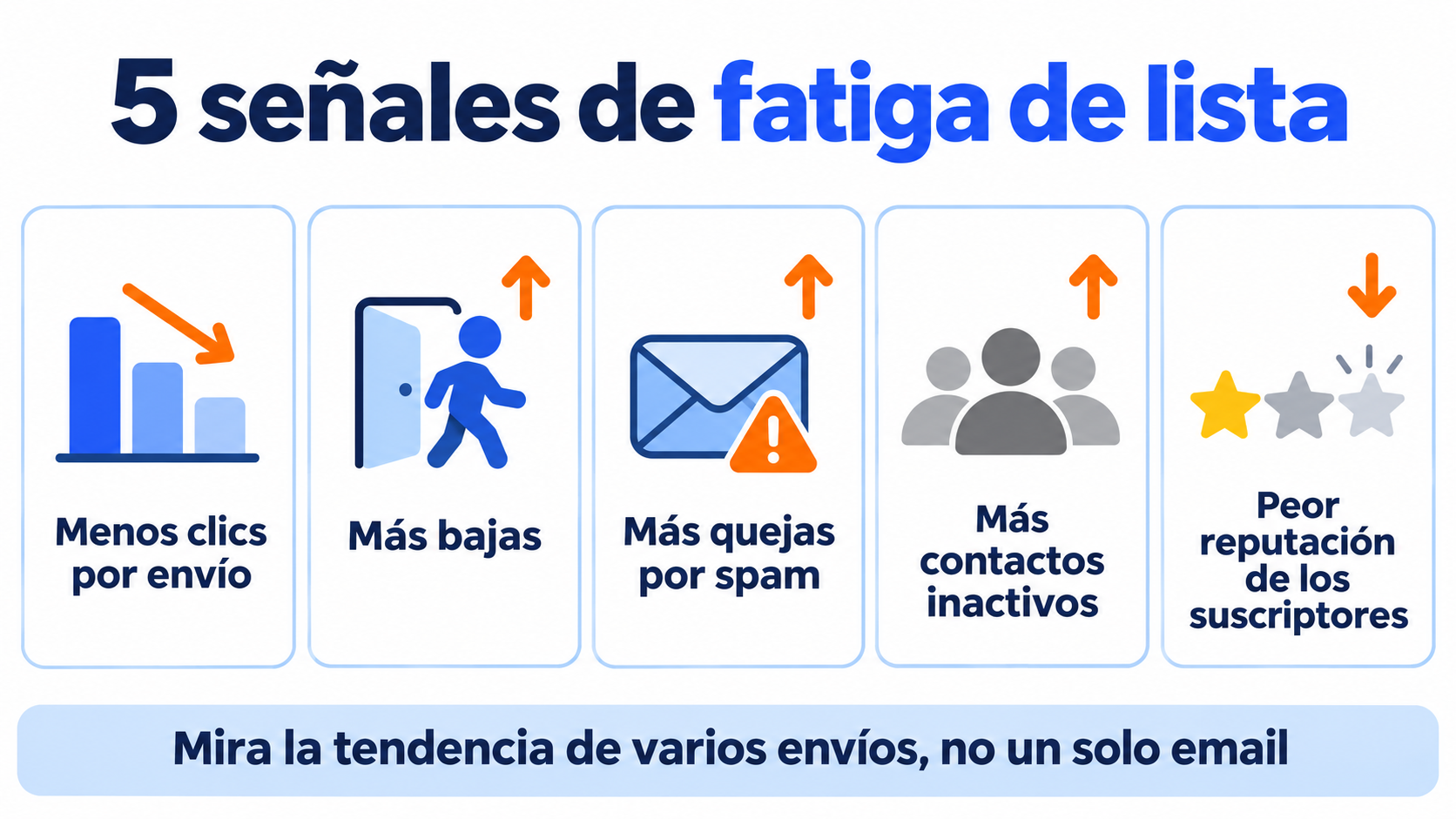
Fatigue shows up in the trend across several sends, not in a single email. These are the metrics worth keeping an eye on:
| Signal | What it indicates | Where to check it |
|---|---|---|
| Clicks per send drop | The content is less interesting | Statistics for each campaign |
| The unsubscribe rate rises | More people would rather leave | Statistics for each campaign |
| Spam complaints go up | Some people can’t find the unsubscribe link or no longer recognize you | Complaints report and Gmail Postmaster Tools |
| The inactive group grows | More and more contacts don’t react to anything | Segment by activity |
| Subscriber score drops | There is less engagement per contact | Each contact’s score |
Watch your campaign statistics. If you see opens dropping sharply, or unsubscribes or spam complaints rising, these may be signs that your list is starting to get fatigued. If so, change your content strategy and test different sending frequencies. These adjustments are necessary so you don’t lose all the work you’ve put into your list by wearing it out completely.
Jose Argudo, CMO at Mailrelay
That said, look at opens together with clicks and unsubscribes. Since 2021, Apple Mail records an open even if nobody reads the email, so a steady open rate can hide a tired list.
Spot a tired list in time
Track clicks, unsubscribes and complaints for every send and segment by activity, on the free account too.
What are the consequences of list fatigue?
The most visible one is that you lose subscribers. The less visible, and more expensive, one is that your emails stop reaching the inbox.
Gmail, Outlook and Yahoo look at how recipients react. If many people ignore or delete your emails without opening them, your sender reputation drops. And Gmail asks bulk senders to keep spam complaints below 0.3%.
In the end, fatigue also affects the people who do read you, because your emails reach everyone less reliably.
It also costs money: you’re paying to send to contacts who aren’t going to read you.
How to prevent and recover a tired list
There’s no ideal frequency that works for everyone. What works is testing small changes, measuring and adjusting. These are the measures that help the most:
- Keep your promises. Say on the form what you’re going to send and how often, and stick to it.
- Let them choose. A preference center lets subscribers reduce the frequency or choose topics instead of leaving.
- Segment by activity. Write more often to those who click and less to those who haven’t reacted in weeks.
- Offer something different in every send. A tip, some news or a useful fact, not just discounts.
- Don’t go months without writing to your list. A list that receives nothing for a long time goes cold and, when you come back, the unsubscribes and bounces arrive.
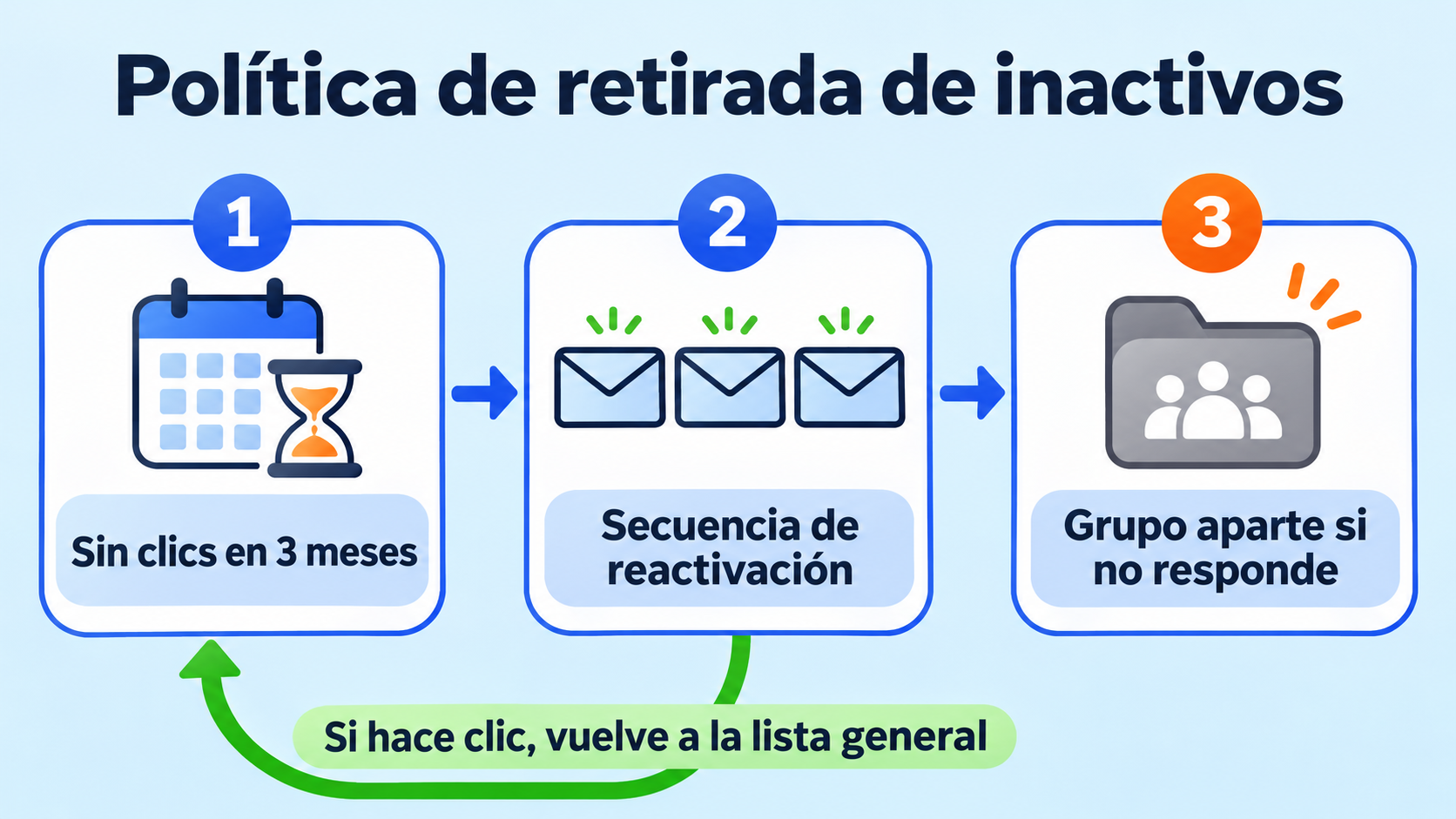
- Have a sunset policy. Decide what you do with those who stop responding.
A simple sunset policy has three steps. First, you identify those who haven’t clicked in about three months. Then you send them a short winback campaign of two or three emails. And if they don’t respond, you move them to a separate group that you write to very rarely or not at all.
Before reactivating anyone, check when they stopped opening. If many did so at the same time, review what you changed at that point: maybe the problem isn’t the list, but what you send it. And for the rest of the cleanup tasks, such as bounces and fake addresses, there’s list hygiene.
An example of list fatigue
Imagine an online cosmetics store with 12,000 subscribers. In October it goes from one email a week to three, to get ready for Black Friday.
In the first few weeks, sales go up. But by mid-November clicks per send have fallen by almost half and unsubscribes have tripled. Some customers also mark the emails as spam.
The store reacts like this: it goes back to one weekly email for the whole list and keeps the extra sends only for those who clicked in the last month. It also adds a link in the footer to choose the frequency. Three weeks later, clicks recover and unsubscribes return to their usual level.
How Mailrelay helps you
In Mailrelay, each contact has a “Subscriber score”, from 1 to 5 stars, calculated from their opens and clicks. You can use it to create a segment with contacts of two stars or fewer and handle them separately.
With groups, you separate active contacts from inactive ones. And with an automation that starts “When a subscriber is added to a group”, you send the reactivation sequence without doing it by hand.
Each campaign’s statistics show you clicks, unsubscribes and complaints so you can see the trend from one send to the next. Mailrelay removes bounces, unsubscribes and complaints from your sends. Inactive contacts are up to you.
You get all of this with the free account, with up to 80,000 emails a month and 20,000 contacts.
Send less, but to those who actually read you
Separate your active contacts from inactive ones and reactivate them with an automation, without paying anything.
Frequently asked questions
These are the most common questions about list fatigue.
What is a “tired list”?
It’s the expression for a worn-out list: one that has received so many emails, or such unhelpful ones, that it barely reacts anymore. It’s another way of referring to list fatigue.
How often can I send without tiring my list?
It depends on your business and on what you promised when you collected the contact. Start with the frequency you announced, change it gradually and watch the clicks and unsubscribes for each send. We explain it in what is the ideal sending frequency.
Are list fatigue and decision fatigue the same thing?
No. List fatigue is the weariness built up from receiving too many emails. Decision fatigue appears within a single email, when it offers so many options that the reader doesn’t choose any.