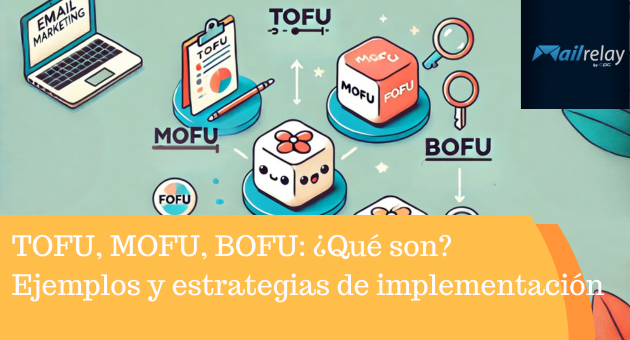
TOFUs, MOFUs and BOFUs may sound like strange terms if you’re hearing them for the first time, but they’re key elements of any effective email marketing strategy.
These acronyms refer to the stages of the sales funnel, which is the path a user follows from discovering your business to making a purchase.
Each stage (Top, Middle, and Bottom of the Funnel) has a clear objective and requires specific content to accompany the user in their decision.
Imagine you sell online courses.
TOFU (Top of the Funnel) would be the moment you attract visitors who are interested, using informative content such as an article about the importance of learning digital marketing.
MOFU (Middle of the Funnel) is when you start building trust by offering a free ebook or an exclusive webinar in exchange for an email address.
Finally, BOFU (Bottom of the Funnel) is when you offer a limited-time discount or show testimonials from satisfied students to drive the purchase decision.
In this article we will look in detail at what each stage is, concrete examples, and how to implement effective strategies to make the most of your email marketing.
What is a sales funnel?
A sales funnel is a model that describes the process a potential customer goes through from the first contact with your company to making a purchase.
It’s called a “funnel” because, although many users start the process, only some of them reach the end and become customers.
· Why is it important in email marketing?
Understanding and using the sales funnel is essential in email marketing because it allows you to deliver personalized and relevant messages depending on the stage each contact is in.
This way, you can increase the chances of conversion by offering the right content at the right time.
For example, sending an aggressive offer to a user who is just discovering your brand could be counterproductive, while for someone ready to buy, a timely discount can make all the difference.

Stages of the sales funnel: TOFU, MOFU, and BOFU
Each stage of the sales funnel has specific characteristics and particular objectives that determine the most effective type of content.
Let’s look at each one in detail:
· What does each term mean?
- TOFU (Top of the Funnel): this is the first stage of the funnel, aimed at attracting visitors interested in learning more about a topic or need. Here the goal is to capture attention and spark curiosity. For example, you can publish a free guide on your blog about “The benefits of learning programming”.
- MOFU (Middle of the Funnel): in this middle stage, users already know your brand and want to dig deeper into how you can solve their specific need or problem. The goal is to earn their trust. For example, you can offer an exclusive webinar called “How to master Python in 30 days”.
- BOFU (Bottom of the Funnel): this is the last stage before the purchase. Here, the user is seriously considering buying your product or service, so the goal is to make the final decision easier with specific content and offers. For example, you can email testimonials from satisfied customers and a special limited-time discount to enroll in your advanced course.

TOFU (Top of the Funnel): Capturing attention
The main goal of TOFU is to capture the user’s attention and generate initial interest in your brand or product.
It’s the awareness and attraction stage.
Ideal types of content for TOFU:
- Educational blog articles
- Attractive infographics
- Short explanatory videos
- Social media posts
For example, if you sell eco-friendly products, an article titled “5 simple ways to reduce your ecological footprint” would be ideal.
Email marketing strategies for TOFU:
- Offer free downloadable content in exchange for the email address.
- Send newsletters with valuable educational content.
- Run welcome campaigns that introduce your brand to new subscribers.
· Practical example of a TOFU campaign
Imagine a campaign that invites users to download a free ebook on “Practical tips for starting an urban garden” in exchange for their email.
Later, you send newsletters with additional related content to strengthen the relationship and foster continued interest.

MOFU (Middle of the Funnel): Generating interest and trust
The central goal of MOFU is to nurture the relationship with interested users and consolidate trust in your brand as an effective solution for their needs.
Ideal types of content for MOFU:
- Educational and practical webinars
- Case studies
- Detailed guides
- Product or service demonstrations
For example, if you offer financial advisory services, you could host a webinar titled “5 proven strategies to improve your personal finances.”
Email marketing strategies for MOFU:
- Automated series of educational emails
- Invitations to exclusive webinars
- Sharing success stories relevant to the user
· Practical example of a MOFU campaign
A campaign could include a sequence of emails inviting the user to a live webinar on personal finance management, followed by emails highlighting testimonials and success stories, strengthening their interest and trust.

BOFU (Bottom of the Funnel): Closing the sale
The goal at this last stage is to facilitate the purchase decision through compelling content and concrete offers.
Ideal types of content for BOFU:
- Special offers or discounts
- Testimonials from satisfied customers
- Comparisons and advantages of the product or service
For example, you can send an email highlighting a promotion for a limited time, along with positive testimonials from satisfied customers.
Email marketing strategies for BOFU:
- Emails with personalized offers
- Reminders of promotions about to expire
- Emails with satisfaction guarantees or easy returns
· Practical example of a BOFU campaign
A BOFU campaign could include an email offering an exclusive discount valid for just a few days, along with a link to success stories and video testimonials to reinforce the purchase decision.

How to integrate TOFU, MOFU, and BOFU into your email marketing strategy
Properly integrating the TOFU, MOFU, and BOFU stages into your email marketing strategy involves understanding your users’ behavior and delivering relevant messages at the right time.
· Importance of segmentation
Segmenting your contact list according to the stage of the funnel they are in allows you to send specific and personalized messages, significantly increasing the effectiveness of your campaigns.
For example, you could have differentiated segments for users who downloaded an ebook (TOFU), users who attended a webinar (MOFU), and users who visited your pricing page (BOFU).
· Use of automations and workflows
Automations are key to efficiently managing each stage of the funnel.
You can create automated workflows that guide the user from one stage to the next through specific actions.
For example, after downloading an ebook (TOFU), the user automatically receives an invitation to a webinar (MOFU), and later an exclusive offer (BOFU).
· Recommended tool: Mailrelay
Mailrelay is an ideal platform to implement these strategies easily and effectively.
It offers advanced features to segment contacts, create complex automations and send personalized campaigns at each stage of the funnel, making it easier to turn contacts into customers.

Practical tips to optimize each stage
Some general best practices would be the following:
- Always keep the objective of each message clear and focused according to the stage of the funnel.
- Use clear and direct calls to action (CTA).
- Ensure that the content is relevant and provides real value to the user.
- Perform frequent tests and adjustments to improve effectiveness.
· Common mistakes and how to avoid them
- Sending generic messages: always personalize the content according to the stage and the user’s needs.
- Excessive messaging: avoid overwhelming your contacts; find the right balance in your sending frequency.
- Ignoring metrics: constantly analyze your campaign results to make timely adjustments.
- Neglecting content quality: ensure each piece of content is clear, attractive, and useful to maintain subscribers’ interest and trust.
Conclusion
Properly implementing the TOFU, MOFU, and BOFU stages will allow you not only to attract more interested users but also to turn them into loyal and satisfied customers.
Take advantage of the available tools, like Mailrelay, segment properly, and continuously optimize your email marketing strategy to achieve better results.
Start applying these concepts today and take your business to the next level!
The way you write each message at each stage of the funnel has a big influence on the results; we explain it in detail in email copywriting: how to influence the customer’s intuition.

Jose Argudo
CMO at Mailrelay. Writes about email marketing, copywriting and conversion for small businesses and entrepreneurs.