SWOT analysis: what it is, how to build the matrix and a practical example
The tool for seeing at a glance what you do well, what isn't working and what you can take advantage of
A SWOT analysis is a tool for studying the situation of a company, product or project based on four factors: Strengths, Weaknesses, Opportunities and Threats. It helps you make decisions with a clear picture of where you stand and what surrounds you.
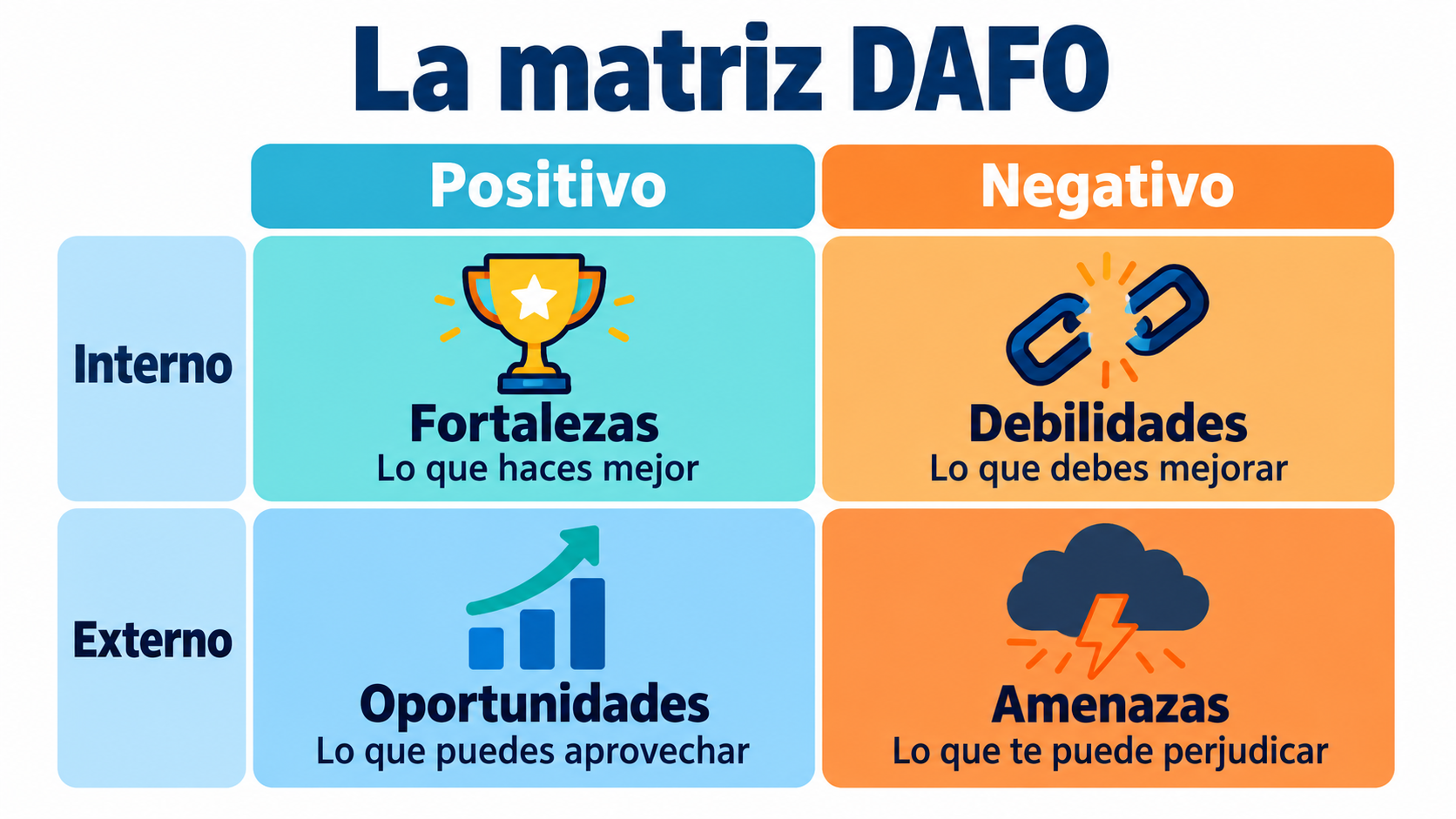
It’s summarized in a four-box table: the SWOT matrix. The top two look inside the company. The bottom two look outward.
What does SWOT stand for?
Each letter stands for one of the four factors:
| Letter | Factor | Type | Key question |
|---|---|---|---|
| W | Weaknesses | Internal, negative | What do we do worse than the competition? |
| T | Threats | External, negative | What market changes could hurt us? |
| S | Strengths | Internal, positive | What do we do better than anyone else? |
| O | Opportunities | External, positive | What changes can we take advantage of? |
Internal factors depend on you: team, pricing, product or processes. External factors are out of your control: competition, laws, technology or customer habits.
SWOT in other languages: DAFO, FODA and DOFA
In Spanish it’s called DAFO (Debilidades, Amenazas, Fortalezas, Oportunidades). It’s the same tool with the letters in a different order. SWOT was created in the United States in the 1960s.
In Latin America, FODA and DOFA are also used. All four acronyms mean the same thing. If you want to look at each factor separately, we cover it in our DOFA analysis entry.
What is a SWOT analysis for?
To make data-driven decisions. Before launching a product, entering a market or changing prices.
To organize your ideas. It forces you to separate what depends on you from what doesn’t.
To prepare a plan. It’s the usual starting point for a marketing or business plan.
To speak the same language. The whole team sees the same picture on a single page.
How to do a SWOT analysis in 5 steps
1. Define your goal. An analysis of the whole company isn’t the same as one of a product or a campaign. The more specific, the more useful.
2. Gather data. Sales, customer surveys, reviews, competitor data and industry trends. Benchmarking helps you compare.
3. Analyze the internal factors. Write down your strengths and weaknesses. Be honest: a weakness you can’t see can’t be fixed.
4. Analyze the external factors. Write down opportunities and threats. A PESTEL analysis makes sure you don’t miss political, economic, social, technological, environmental or legal factors.
5. Prioritize and decide. Keep 3-5 points per box and turn them into actions with a cross SWOT.
What’s your business’s strength?
Ask your customers with an email survey in Mailrelay and base your SWOT on real data.
What is a cross SWOT or CAME analysis?
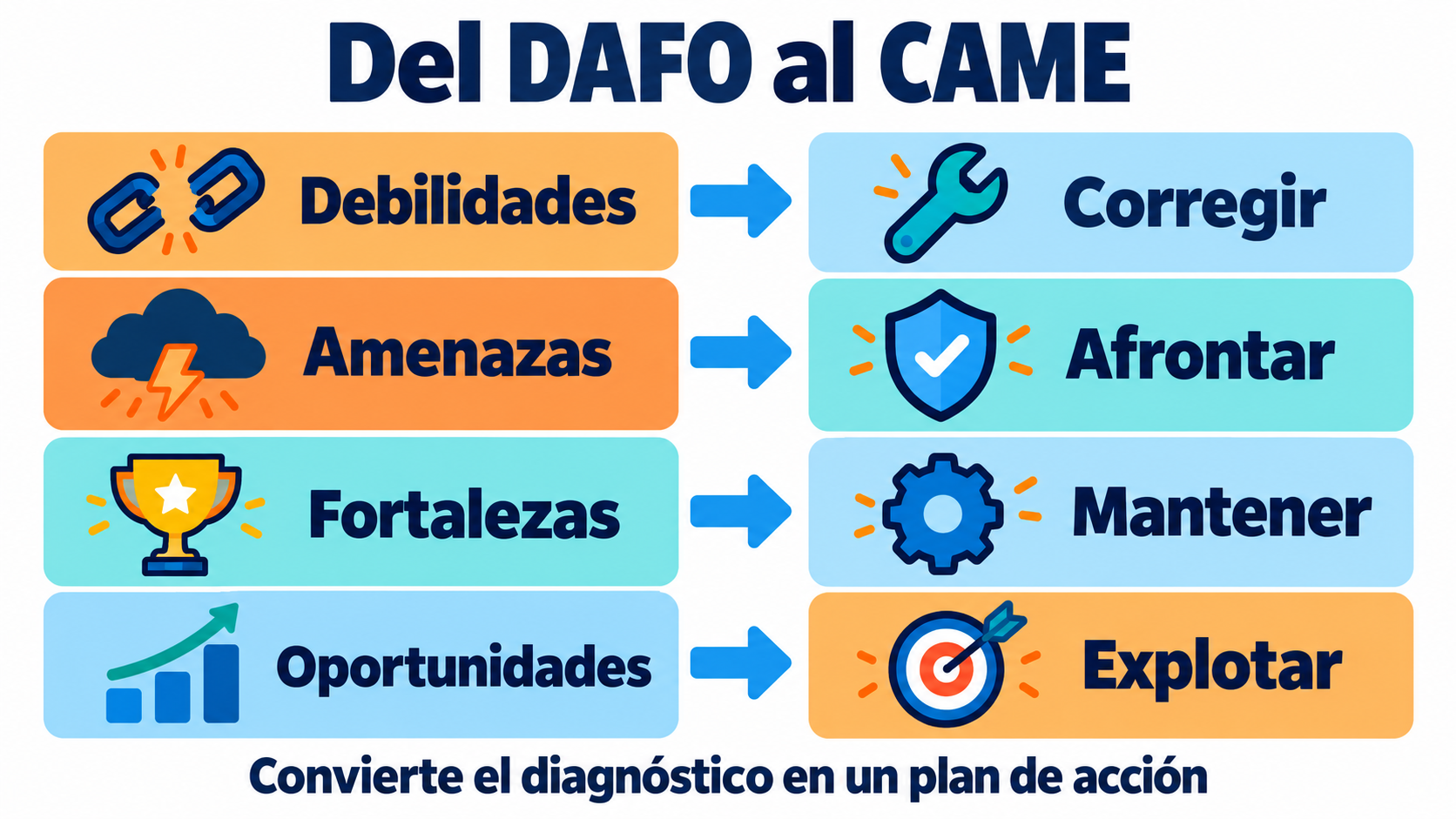
The matrix describes the situation. The CAME analysis tells you what to do about it. The acronym stands for Correct, Adapt, Maintain and Exploit:
| Action | Factor it addresses | What you do |
|---|---|---|
| Correct | Weaknesses | Fix what you do badly |
| Adapt | Threats | Prepare for what comes from outside |
| Maintain | Strengths | Look after what already works |
| Exploit | Opportunities | Take advantage of what the market offers |
You can also combine factors: use a strength to take advantage of an opportunity, or a strength to hold off a threat. That’s where the best strategies come from.
SWOT analysis example for a small business
An online specialty coffee shop that sells in Spain:
| Positive | Negative | |
|---|---|---|
| Internal | Strengths: in-house roasting, 4,000 newsletter subscribers, good reviews | Weaknesses: small advertising budget, slow shipping outside mainland Spain |
| External | Opportunities: growing interest in quality coffee, corporate Christmas gifts | Threats: rising green coffee prices, big capsule brands |
Combining them produces concrete actions:
Exploit: an email campaign in November for corporate gift packs.
Correct: a deal with another shipping company for the Canary and Balearic Islands.
Adapt: explain in the newsletter where the coffee comes from and why it costs what it does.
Maintain: ask every customer for a review after their second purchase.
SWOT analysis applied to email marketing
You can also analyze your email strategy this way. Some questions for each box:
Strengths: is your list your own and permission-based? Is your click rate above the industry average?
Weaknesses: do you always send the same thing to everyone? Do you have a lot of inactive contacts?
Opportunities: could you automate your welcome or abandoned cart emails? Are there times of the year you’re not taking advantage of?
Threats: stricter Gmail and Yahoo requirements, increasingly crowded inboxes, changes in how opens are measured.
With the answers, you can organize your email marketing strategy and set KPIs to measure progress.
Common mistakes
Mixing internal and external. “There’s a lot of competition” is a threat, not a weakness.
Endless lists. Twenty points per box won’t help you decide.
Opinions without data. Every point should be backed up by evidence.
Stopping at the matrix. A matrix without actions is useless. Always finish it with a CAME analysis.
Not updating it. The market changes. Review it at least once a year.
How Mailrelay helps you
With Mailrelay, you can send surveys to your customers to spot strengths and weaknesses, and use click statistics to measure which messages work. That way, your analysis is based on real data, not just gut feeling.
The free account includes up to 80,000 emails a month and 20,000 contacts, with human support by chat, ticket and phone.
Send your newsletters with Mailrelay
Up to 80,000 emails a month and 20,000 contacts for free, with human support on every plan.
Frequently Asked Questions
These are the most common questions about the SWOT matrix.
What is a SWOT in a nutshell?
A four-box table with the strengths, weaknesses, opportunities and threats of a company or project.
What’s the difference between DAFO, FODA and SWOT?
None. They’re the same tool: DAFO is used in Spain, FODA and DOFA in Latin America, and SWOT in English.
What is the SWOT matrix?
The two-by-two table where the four factors go: internal ones at the top and external ones at the bottom.
How often should you do a SWOT analysis?
At least once a year, and always before an important decision, such as launching a product or entering a new market.
Can you do a personal SWOT?
Yes. It works the same way for a person: your strengths and weaknesses, and the opportunities and threats in your industry or career.