KPI (key performance indicator): what it is, types and examples
What a KPI is, how it differs from a metric and which ones to track in your email campaigns
A KPI, short for key performance indicator, is a metric that shows how effectively and how well different actions are being carried out within a business. KPIs provide information that lets you make decisions objectively and so meet the goals set for a specific process or project.
KPI is usually translated into Spanish as “indicador clave de rendimiento” or “medidor de rendimiento”. They are metrics that can be applied in any business area and sector, although they are most commonly used in digital marketing.
Above all, a KPI must be able to help us make the best decisions about the current state of a project, strategy or campaign, so that we can define a future course of action on a firm footing.
KPI vs. metric: what’s the difference
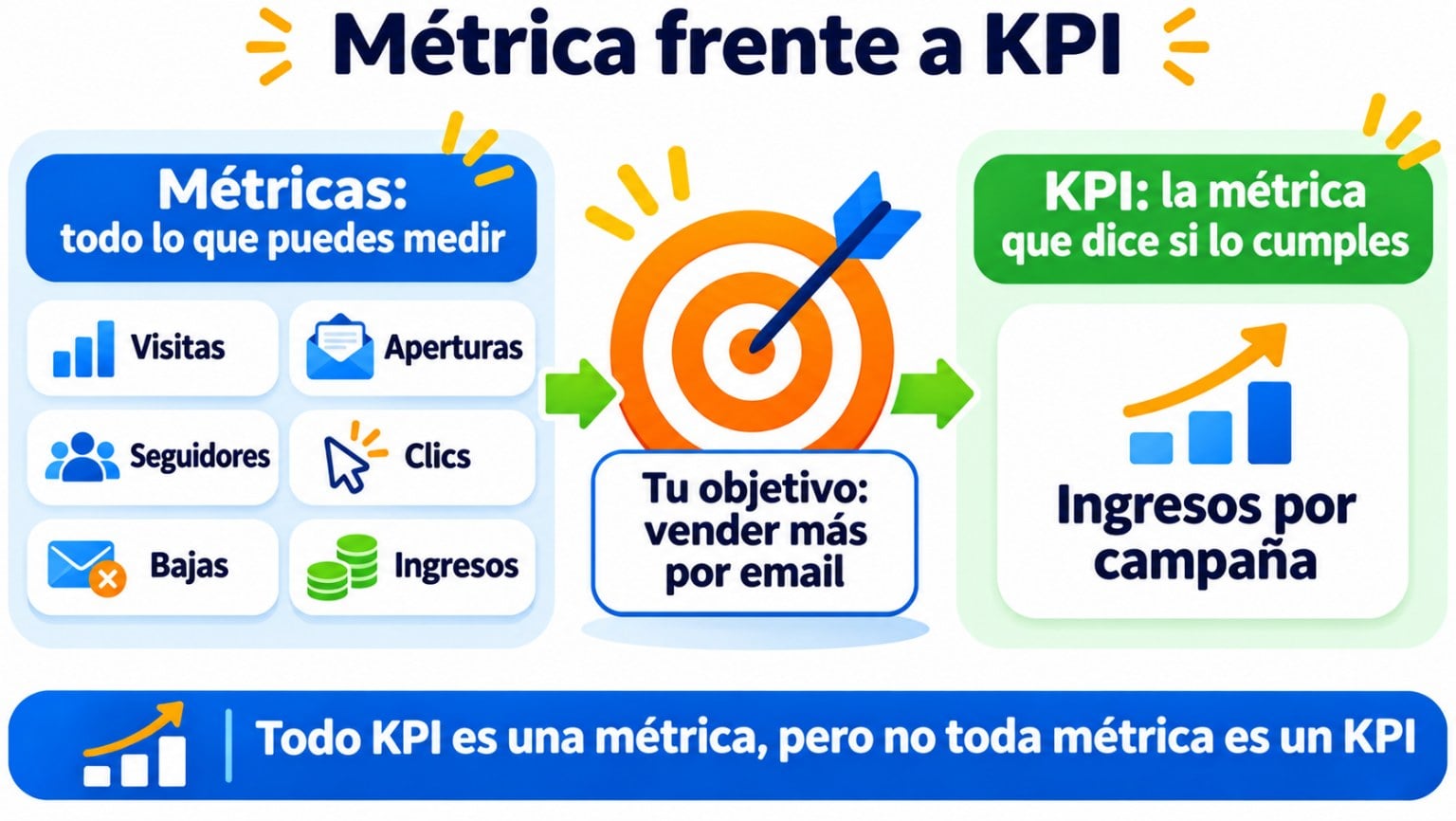
Every KPI is a metric, but not every metric is a KPI. A metric is any data point you measure, such as visits or opens. A KPI is the metric you choose because it tells you whether you’re meeting a specific goal. If your goal is to sell more through email, the KPI is revenue per campaign, not opens.
Some companies go a step further and choose a single metric that guides the whole business: the North Star Metric. The KPIs of each area should help move it.
Measure what matters in every campaign
Sends, bounces, unsubscribes and, on the free account, opens and clicks for every email. Get started for free with Mailrelay.
Characteristics of a good KPI
Any KPI you want to evaluate must have the following characteristics in order to work properly:
- Attainable. The objectives set must be realistic and feasible.
- Measurable. It may seem obvious, but you must be able to quantify them.
- Relevant. It must be important and necessary.
- Periodic. It must be possible to analyze it periodically (on specific dates).
- Practical. It must allow decisions to be made.
- Accurate. It must provide precise and detailed information.
- Aligned. It must be aligned with the company’s general objectives.
Most widely used KPIs in marketing
KPIs are determined by the nature of the business and its current situation. However, some are very widely used in digital marketing to measure the performance of campaigns. These KPIs include:
- Increased sales. It is used to measure whether the campaign, as planned, is increasing the number of sales.
- CTR. Find out the percentage of clicks out of the total number of impressions of our campaign.
- Sales funnel. To find better ways to turn users into customers.
- Traffic sources. The aim is to find out which channels bring users to the campaign, which you can tag with UTM parameters.
- Measuring the success rate. To keep track of the effectiveness of the actions taken.
- Number of followers. To monitor the number of followers and how your social media profiles are growing.
- Keywords. Measures the ranking of our keywords to optimize the SEO strategy.
- Return on investment (ROI). To find out the revenue generated by the campaigns carried out.
- Open rate. Find out the percentage of customers who open the emails sent in email marketing campaigns.
There are many KPIs that can be used, as many as there are measurement needs, but these give you a very clear idea of the great value of having KPIs in your business or digital projects.
Types of KPI
KPIs can be classified in several ways. These are the most common ones:
| Type | What it measures | Example |
|---|---|---|
| Strategic | Business results | Quarterly revenue |
| Operational | The day-to-day work of a team or channel | Emails sent per week |
| Lagging | What has already happened | Monthly sales |
| Leading | What anticipates a result | New list signups |
| Quantitative | A number | Conversion rate |
| Qualitative | An opinion turned into a scale | NPS |
Email marketing KPI examples with formulas
| KPI | Formula |
|---|---|
| Open rate | Opens ÷ delivered emails × 100 |
| CTR | Clicks ÷ delivered emails × 100 |
| Conversion rate | Purchases ÷ clicks × 100 |
| Unsubscribe rate | Unsubscribes ÷ delivered emails × 100 |
| Bounce rate | Bounces ÷ sent emails × 100 |
| Revenue per email | Campaign revenue ÷ delivered emails |
Open rate is no longer reliable as a main KPI, because Apple Mail Privacy Protection records opens that aren’t real. Use it to compare your own campaigns with each other. You’ll find more detail in email marketing metrics.
How to define a KPI step by step
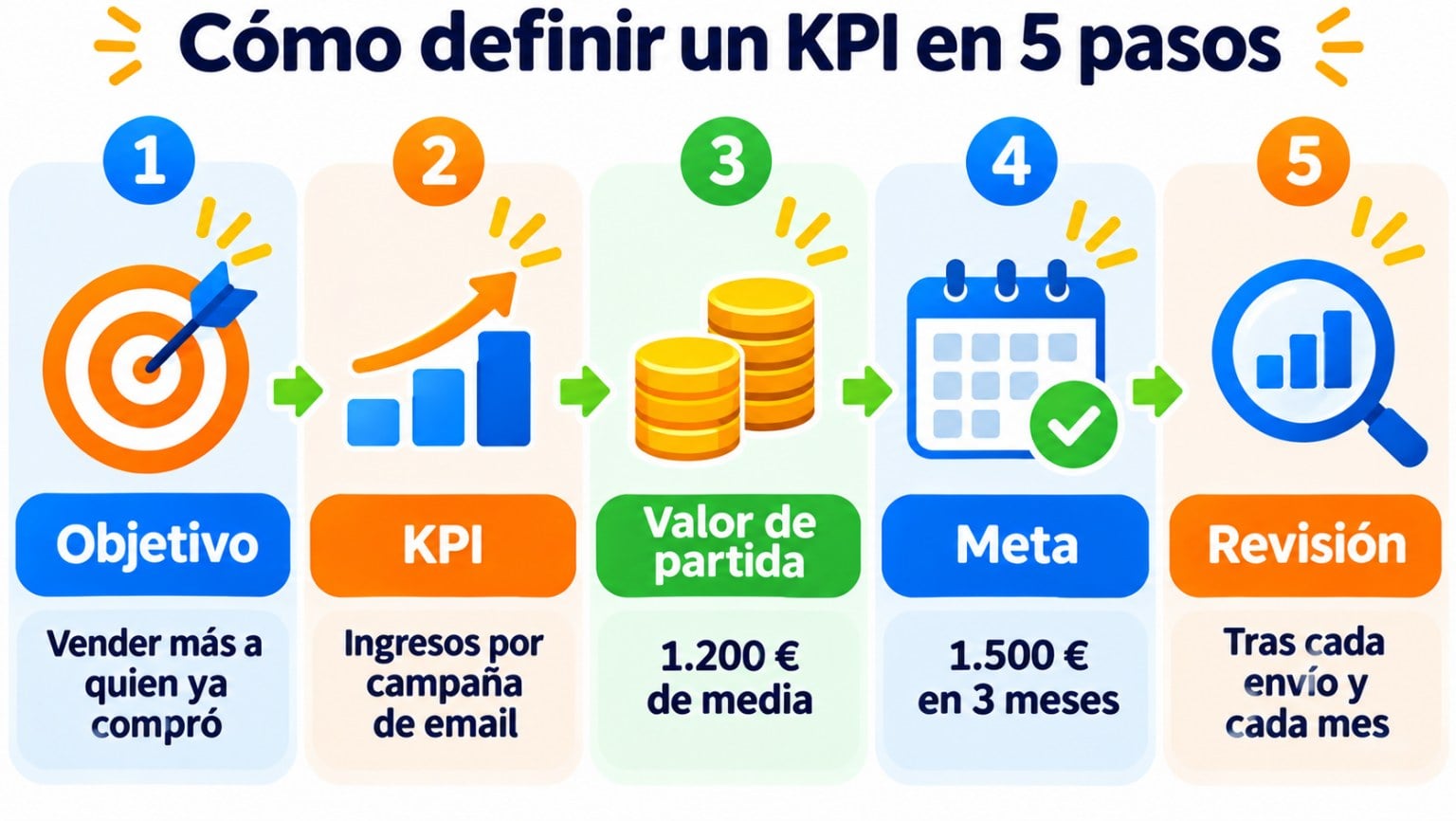
Imagine an online coffee shop that wants to get more out of its newsletter. This is how it would define its KPI:
1. The goal. Sell more to customers who have bought from you before.
2. The KPI. Revenue per email campaign, because it’s the number that tells you whether the goal is being met.
3. The starting value. An average of €1,200 over the last 6 campaigns.
4. The target. €1,500 per campaign within 3 months.
5. The review. After each send and, once a month, in a dashboard alongside the other channels.
How Mailrelay helps you
Mailrelay gives you the statistics for each campaign: sends, bounces and unsubscribes, and on the free account and Enterprise, opens and clicks too. You can also see where opens come from and heat maps showing the best times of day.
If you connect Google Analytics, the UTMs on each send tell you which sales each email brings in. And you can start with the free account, with up to 80,000 emails a month.
Your email KPIs, from the very first send
Send your next campaign and compare its results with the previous one. Up to 80,000 emails a month for free with Mailrelay.
Frequently asked questions
How do you say KPI in Spanish?
Indicador clave de rendimiento, or indicador clave de desempeño. In practice, the English acronym is almost always used, in the plural too: los KPI.
What’s the difference between a goal and a KPI?
The goal is what you want to achieve, for example selling 20% more through email this quarter. The KPI is the number that tells you whether you’re achieving it, in this case revenue per campaign. Without a clear goal, no KPI makes sense.