1. Home
  2. Marketing Glossary

Business letter

What is a business letter and what is it used for?

A business letter is a formal written document used in the corporate world to communicate important information, whether between companies (B2B communications) or between a company and a customer (B2C communications).

Traditionally, these letters were sent on paper via postal mail; however, today they are primarily sent by email, thus integrating into organizations’ email marketing strategies.

Everything indicates that digital media is replacing offline formats in this field.

In terms of content, a business letter can vary greatly depending on the purpose and the recipient.

Likewise, it serves multiple purposes, for example:

  • Requesting information about a product or service from a supplier or company.
  • Presenting a commercial offer to a potential client or partner.
  • Confirming a business transaction or the receipt of a payment.
  • Claiming a pending payment for an invoice or raising a complaint about a defective product or service.
  • Announcing changes in a company’s policies, prices, or sales conditions.

Ultimately, the business letter is a key tool for business because it allows establishing and maintaining formal and effective communication among companies, clients, and suppliers.

Through it, professionalism is conveyed, agreements or requests are documented, and trust is reinforced in business relationships.

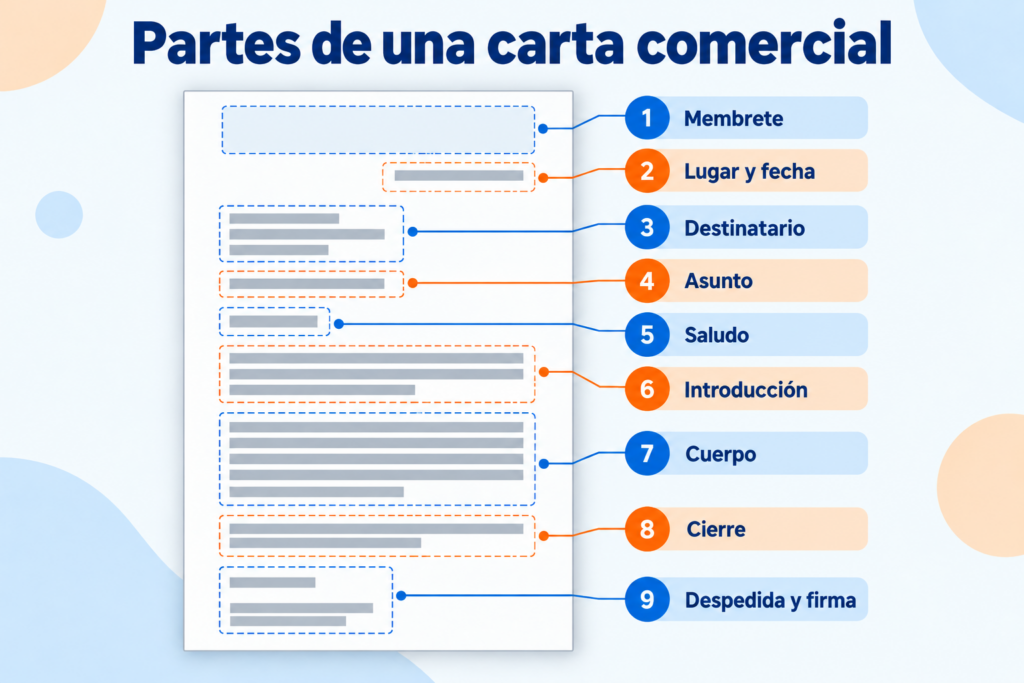
Key elements of a business letter

Although each business letter can be adapted depending on the context, they all share a basic structure.

A good business letter should include certain key elements:

Sender and recipient:

At the top of the letter, the sender’s details (your name or your company’s name, along with address and contact info) and the recipient’s details (name of the company or person it is addressed to, address, etc.) must be clearly indicated, in addition to the date of issue.

This data identifies the parties involved and places the letter in a specific timeframe.

Formal greeting:

After the heading, a polite and professional greeting should be included.

For example, “Dear Mr. Perez:” or “Dear Ms. Garcia:” followed by a colon is often used.

Whenever possible, it is preferable to address the letter to a specific person by name, which demonstrates personalized attention from the very beginning.

Introduction:

In the first paragraph of the letter, it is advisable to briefly explain its purpose.

This introduction should be clear and concise, stating why the letter is being written.

For example: “I am writing to introduce our new product line…” or “We are writing regarding order No. 12345 placed last month.”

A direct introduction helps capture the reader’s attention quickly.

Body of the message:

This is the main section of the business letter, where the matter at hand is developed in detail.

In the body, you must provide all the relevant information in an organized and easy-to-understand manner.

It is important to maintain a professional tone, use clear language (avoiding unnecessary jargon), and, if the text is lengthy, divide it into one or more paragraphs to make reading easier.

This is where you explain the details of the offer, answer queries, explain incidents, or address any central theme of the message.

Conclusion:

After presenting the main topic, the business letter usually includes a closing paragraph as a conclusion.

In this section, the main idea is summarized or the request made is reinforced, and often the recipient is invited to take action or respond.

For example, “We look forward to your response to schedule a meeting next week.” or “We thank you in advance for your attention and remain at your disposal to clarify any doubts.”.

Sign-off and signature:

Finally, a formal sign-off must be added, followed by the sender’s signature.

Common closing expressions are “Sincerely,” or “Best regards,”, after which a space is left for the handwritten signature (in the case of a postal letter), and the sender’s full name and job title or position are indicated.

It is also advisable to include additional contact information at the bottom of the letter (such as a phone number, email, or company website) so the recipient can easily reach out if needed.

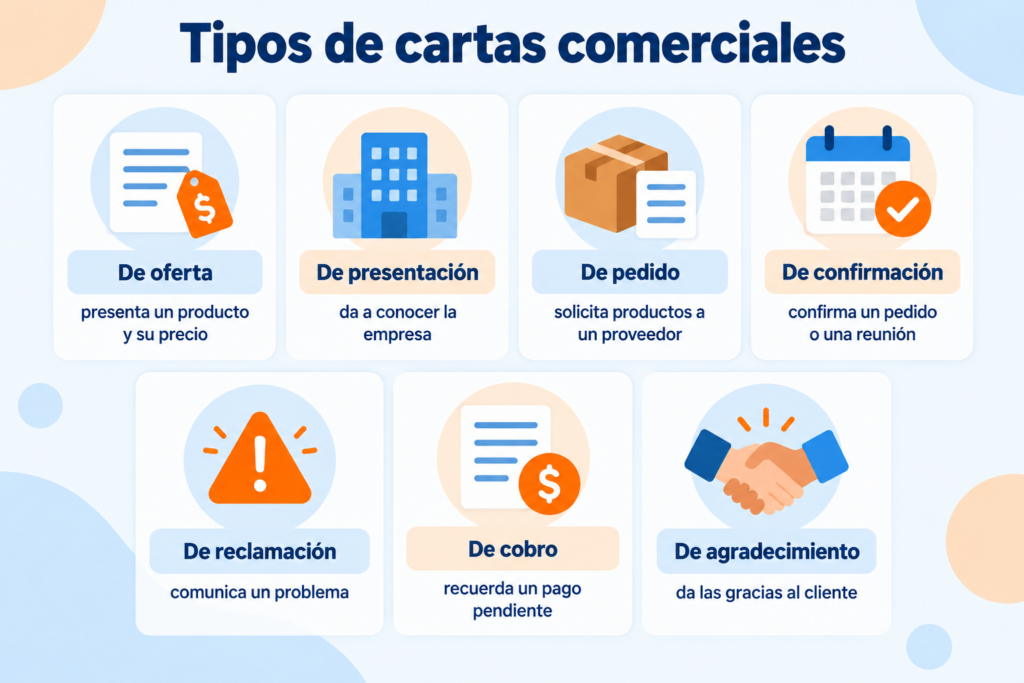
Types of business letters

Depending on the recipient and the communication goal, there are several types of business letters.

Each type pursues a specific purpose and presents nuances in its content.

Below, we will see the main business letter models:

Business introduction letter:

This type of letter is used to introduce your company, product, or service to someone who might not know them.

Its goal is to establish an initial business relationship and spark the recipient’s interest in what you offer.

For example, a business introduction letter can be addressed to a potential client to enter the market or to offer collaboration to another company.

In it, you will summarize who you are, what you offer, and what benefits the recipient can gain, striving to make a good first impression.

Commercial offer letter:

An offer letter is used to propose a specific offer to a client or supplier.

Sometimes it is also called a “business cover letter” because it presents a specific proposal.

Its purpose is to persuade the recipient to accept the offer, thereby closing a business deal.

In this type of letter, you will detail the terms of the offer (for example, a special discount, a promotional price, or favorable conditions for a limited time), emphasizing how the offer is beneficial to the recipient.

Confirmation letter:

This letter is sent to confirm a business transaction or agreement that has already taken place.

For example, it can confirm that an order has been received and will be shipped, or that payment for an invoice has been received.

The confirmation letter provides written assurance that both parties understand and accept the terms of the agreement, serving as documentary support to prevent future misunderstandings.

It is, essentially, an informational letter that records an agreed-upon fact.

Order or claim letter:

A commercial order letter (also called a claim letter when it comes to complaints) is used to request something or express dissatisfaction within a business context.

This could involve claiming payment for an overdue invoice, requesting compensation, or demanding the repair or replacement of a defective product or service.

The goal of this type of letter is to formally resolve a business issue.

It must clearly state the issue or request, provide the necessary details (such as invoice references, dates, etc.), and propose or request a specific solution.

Business thank you letter:

The goal of this letter is to express gratitude to a client, supplier, or collaborator.

It is sent, for example, after the successful completion of a business deal, to thank a client for a major purchase or their loyalty, or to acknowledge a business partner’s collaboration.

Thank you letters help maintain good business relationships and foster loyalty, demonstrating appreciation and personalized attention toward the other party.

Resignation letter:

Although it deviates slightly from business communications with clients, an employee’s resignation letter is also common in the corporate environment.

It is the formal document through which an employee notifies the company of their resignation.

The goal is to provide a written record of the decision to terminate the employment relationship.

In this missive, the employee officially communicates their departure, thanks the company for the opportunity provided (in many cases), and sets the effective termination date, fulfilling the corresponding notice period.

While it doesn’t seek a commercial outcome, it is an important formal letter within corporate communication.

As we can see, business letters cover a wide variety of situations, but in all cases, they fulfill the function of establishing and maintaining effective communication in the professional sphere.

Each type pursues a specific objective and must be written with the appropriate tone and content to achieve its purpose.

Tips for writing an effective business letter

Regardless of the type of business letter you need to write, there are some general best practices you should follow to ensure your message is clear and achieves the desired impact:

Define your purpose before you begin:

Be very clear about why you are writing the letter.

This will help you stay focused and structure your content effectively from the start.

Know your recipient:

Adapt the tone and style of the letter to the person who will read it.

Addressing a top executive is not the same as addressing an individual customer; understanding their expectations will allow you to choose the appropriate level of formality and approach.

Use clear and concise language:

Avoid overly complex expressions or technical jargon that the recipient might not understand.

Ideally, anyone should be able to understand the message without difficulty.

Short, direct sentences will make it easier to read.

Maintain a professional and polite tone:

Even if the letter is to raise a complaint or claim, maintaining courtesy and respect is essential.

An appropriate tone reinforces your professional image and facilitates a positive response.

Highlight benefits or solutions:

If you are presenting an offer or proposing something, emphasize how the other party will benefit.

Be transparent with the terms and conditions, but try to highlight the value you bring (for example, cost savings, process improvements, competitive advantages, etc.).

Proofread before sending:

It is essential to reread the letter several times.

Check for any spelling or grammatical errors and ensure the writing flows smoothly.

An error-free text demonstrates professionalism and attention to detail.

Include your contact information:

Make sure to provide the necessary information in the letter (usually at the bottom or next to the signature) so the recipient can reply easily.

A phone number, email address, and other relevant details will make subsequent communication much simpler.

By applying these tips, you will increase the chances of your business letter making a good impression and achieving its goal, whether that is getting a favorable response, closing a deal, or strengthening a professional relationship.

Common mistakes when writing a business letter

Despite following best practices, there are some frequent mistakes you should avoid when writing a business letter:

Sending a generic, unpersonalized template:

A serious mistake is using the exact same letter for all recipients without tailoring it.

This is usually obvious to the reader and conveys a lack of interest.

Take the time to personalize each letter with names, specific details, and references relevant to the recipient.

Excessive length:

Even if you want to provide a lot of information, an overly long business letter can overwhelm the reader.

Beating around the bush or including unnecessary details distracts from the main message.

It is better to be concise and keep the letter to one or two pages maximum, focusing on the essentials.

Spelling mistakes or sloppy formatting:

Spelling and grammatical errors or a messy format (for example, inconsistent fonts, uneven alignments) give an unprofessional image.

These flaws can lead the recipient to not take your message seriously.

Thoroughly proofread the writing and pay attention to the visual presentation of the letter.

Inappropriate tone:

Another common mistake is using an inappropriate tone for the situation, whether it is too informal or overly cold.

You need to strike a balance: communication should be approachable yet respectful.

The wrong tone can lead to misunderstandings or annoy the recipient, undermining the letter’s objective.

By avoiding these mistakes, your business letters will be much more effective and reflect the professional image you wish to project.

Examples of business letters

To better illustrate everything mentioned above, here are two examples of well-written and structured business letters.

These templates can serve as inspiration when creating your own letters:

Example of a business introduction letter

Dear Mr. Lopez: I am pleased to write to you on behalf of TechSolutions Inc., a company specializing in custom enterprise software development.

We have over 10 years of experience helping companies like yours optimize their processes with innovative and tailored technological solutions.

During this time, we have built a solid reputation for our quality of service, close support, and competitive pricing.

We strive to provide our clients with the best possible experience, from the first point of contact to the final product implementation.

We firmly believe that our attention to detail and commitment to customer satisfaction set us apart in the industry.

We would be delighted to have the opportunity to collaborate with Lopez Enterprises LLC and provide you with our tools to improve your operational efficiency.

We would like to schedule a meeting to better understand your needs and explore how TechSolutions can add value to your business.

Please do not hesitate to contact us with any questions or to schedule a meeting at your earliest convenience. Sincerely,

Carlos Marquez
Commercial Director, TechSolutions Inc.

Example of a business claim letter

Dear Ms. Gomez: I am writing regarding order No. 4785 that we received from your store on July 10th.

Unfortunately, two of the products arrived in subpar condition.

Specifically, the ZX-300 model is faulty, and the AB-200 model does not match the description in your online catalog.

We understand that these issues may be isolated mistakes, but they represent a setback for our company.

We have attempted to contact your customer service department twice this week without receiving a satisfactory solution yet.

Therefore, we kindly request instructions on how to proceed with replacing or refunding the aforementioned items as soon as possible.

We trust that this matter will be resolved promptly and favorably, as we have had a pleasant experience with your products up to this point.

We thank you in advance for your attention and look forward to your reply.

Please feel free to contact me directly if you require further details about the incident. Sincerely,
Laura Perez
Purchasing Manager, Innovar Retail LLC

Conclusion

In conclusion, the business letter remains a cornerstone of business correspondence and corporate communication, even in the digital age.

Knowing how to write this type of document with a clear, professional, and personalized style can make all the difference in day-to-day business operations.

Whether you send your letter on paper or transmit it via email as part of an email marketing campaign, a well-crafted business letter conveys trust, reinforces your company’s image, and can drive valuable conversions (new sales, agreements, or increased customer loyalty).

Remember that every detail counts: from an appropriate greeting to a cordial sign-off, as well as a well-structured and error-free central message.

Taking the time to perfect your business letters is an investment that will reflect in stronger business relationships and positive results for your company.