Let me be very clear from the start: for me, all marketing is emotional marketing.
What I mean by that is that this post isn’t about a fleeting theory or just another marketing trend, but about the only possible way to connect with your audience: on an emotional level.
“Imagine that marketing is like a tree. And that its roots stretch into a soil of dreams and desires.”
Those are the words of a superhero of emotional marketing: Seth Godin.
And following his analogy, your marketing can’t be a simple response to market demand, because then its roots will never grow deep. Your tree won’t grow or, if it does, it will be hidden among so many other trees just like it.
For your tree to take root, you need to feed it emotional fertilizer.
Because your message has to actually reach your audience, and for that you need to understand their dreams and desires, and the way they see the world. And that view of the world rests on a small number of shared patterns and emotions.
That’s why this is an introductory guide to the world of emotional marketing, but also a fundamental guide for everyone who is trying to sell and build a community.
I’ll tell you exactly what we mean when we talk about emotional marketing and which basic emotions guide our decisions, and we’ll look at some great examples of emotional marketing and emotional email marketing.
And that’s because…
a mailing campaign is more discreet than an advertising one, but email is one of the few channels that lets you talk to your audience one-to-one, which makes it a perfect way to tell stories and connect on an emotional level.
· What Is Emotional Marketing [With Examples]
Emotional marketing is about using emotions to win the attention, memory and trust of your potential customers.
In other words, it seeks to create a deep personal connection by appealing to the audience’s emotions, usually through a story.
Almost all the big brands, like Coca-Cola or Nike, know perfectly well the potential of emotional marketing to influence their audience, emotion by emotion.
But if I had to choose a single example that perfectly illustrates what emotional marketing is, it would be Google’s Parisian Love campaign.
This video tells a love story that stands out for its originality and simplicity: through the Google searches of a guy who moves to Paris to study, we witness the birth and development of a relationship.
A simple but epic campaign, built on Google queries, music and background sounds, which in fact became a true example of viral marketing.
I’ve watched this video more times than I can remember and yet I still get emotional every time the end approaches (that’s the power of emotional marketing).
Within emotional marketing in Spain, some of the best examples are the Christmas Lottery ads, which year after year manage to bring a little tear to our eyes with campaigns like “The biggest prize is sharing it”.
What Science Says About Emotional Marketing
Studies show that campaigns with purely emotional content perform almost twice as well as those based on rational content (31% vs. 16%).
But emotions guide all of our behavior, which is why emotional marketing goes much further. It isn’t about the results of a single advertising action.
Stop and think for a moment: do you remember what the last thing you bought was?
If you’re human — I assume you are, although the opposite would be fantastic — chances are you didn’t buy a product or a service, but how that product or service made you feel.
Yes, we like to think we’re much more rational than we really are. Even though science has shown us time and again that most decisions are made with the heart and not with reason.
In fact, up to 95% of purchasing decisions are made emotionally.
But how does all this happen? Which emotions come into play? How do they affect the final decision?
The Role of Emotions in Emotional Marketing
Although it would take an entire book to explain them in detail, there are only a few emotions and they are shared by all human beings: happiness, fear, surprise, anger, awe, serenity…
Depending on the moment we’re in, we may long to experience one emotion or another more, although the capacity to feel that whole emotional range is always there.
And perhaps most importantly, we are predisposed to being moved.
That is, we like to laugh, to cry, to be amazed, to feel safe, to feel understood, to feel that we belong to the group and, at the same time, that we are unique beings in the whole universe.
Those same emotions are the ones that guide our actions and create the connection. Because when we share emotions, we get the illusion that we share a way of seeing life and that we have other things in common.
That’s where emotional marketing comes into play, when a brand uses emotions to create that connection with its audience and move it toward the desired action, which is almost always… to buy.
There Are 8 Basic Emotions
Although there are many more, people usually talk about 8 basic emotions:
- Joy
- Trust
- Fear
- Surprise
- Sadness
- Disgust
- Anger
- Anticipation
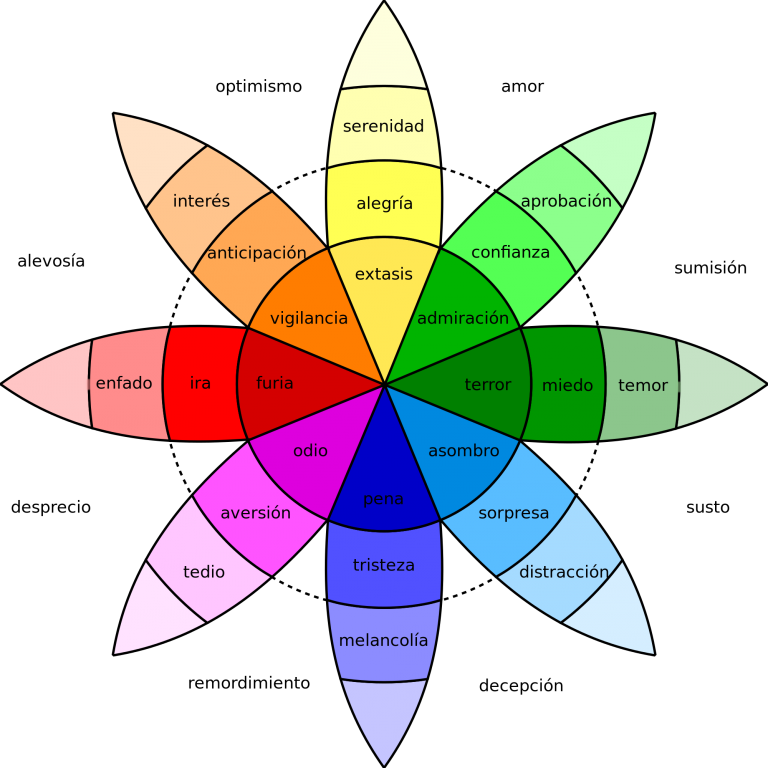
But these emotions don’t appear in an absolute way; they exist on a spectrum, that is, with greater or lesser intensity. And they also don’t usually show up in isolation; there is almost always some mix of emotions.
This idea is very easy to understand with the wheel of emotions by Robert Plutchik, who created a diagram to visualize how emotions overlap with one another, giving rise to an emotional spectrum full of nuances.
Well, These Emotions Are Decisive
And they influence everything you decide throughout the day: from the color of the T-shirt you put on this morning to what you’ll have for dinner tonight or the time you’ll go to bed.
One study that helped us better understand the role of emotions was Jonah Berger’s research on viral content, because when he analyzed 7,000 New York Times articles looking for the most shared ones, he found… you guessed it: emotions.
At first, they concluded that one of the main reasons we share content is that the simple act of doing so makes us look good, which is known as Social Currency.
But a huge number of articles that had gone viral didn’t seem to fit that explanation. And that’s when 4 critical emotions for emotional marketing appeared: awe, happiness, anxiety and fear.
Awe
It turned out that scientific articles were always among the most shared and didn’t have that social-value characteristic.
But why? Because articles about scientific innovations trigger a very specific emotion in us: awe (a mix of fascination, surprise, mystery and admiration).
The study showed that articles that produced awe were 30% more likely to end up on the most-shared list, precisely because of the type of emotion they evoked.
Happiness
The more positive an article is, the more likely it is to be shared. It seems we like to share good news and stories that evoke happiness much more than negative ones and those that evoke sadness.
Anxiety and Fear
On the other hand, there are negative emotions that also move us to act, such as anxiety, fear or anger.
For example, one of the most exploited negative emotions in emotional marketing is loss aversion, also known as FOMO (Fear of Missing Out).
But be very careful, because with emotions that leave us in a more passive state, such as sadness, the effect is the opposite; it turns out these don’t move us to take any kind of action.
The negative emotions that move us to share and act have to be emotions that provoke some degree of arousal, as happens with fear, rage or anxiety.
How to Apply Emotional Email Marketing [With Examples]
By this point it should be clear that your audience is made up of people who think, dream, experience problems, look for solutions and act — in short, live — guided by emotions.
But the question is, what are you supposed to do with all this? How can you apply emotional marketing to your email campaigns?
Well, just as you would in any other channel: by using your emails to awaken that emotional response in your potential customers.
By making them feel loved, safe, valued, recognized, inspired and countless other states that can turn any email action into an emotional email marketing action.
And the most effective way to achieve that is with copywriting, that is, by applying persuasive writing to your email campaigns.
2 Emotional Email Marketing Techniques and Examples
Let’s look at a couple of mailing examples that put two powerful emotional marketing techniques into action:
1. Presenting ideas that foster universal feelings of love and connection
2. Evocative descriptions that create mental images and trigger an emotional response
Emotional Email Marketing Example #1
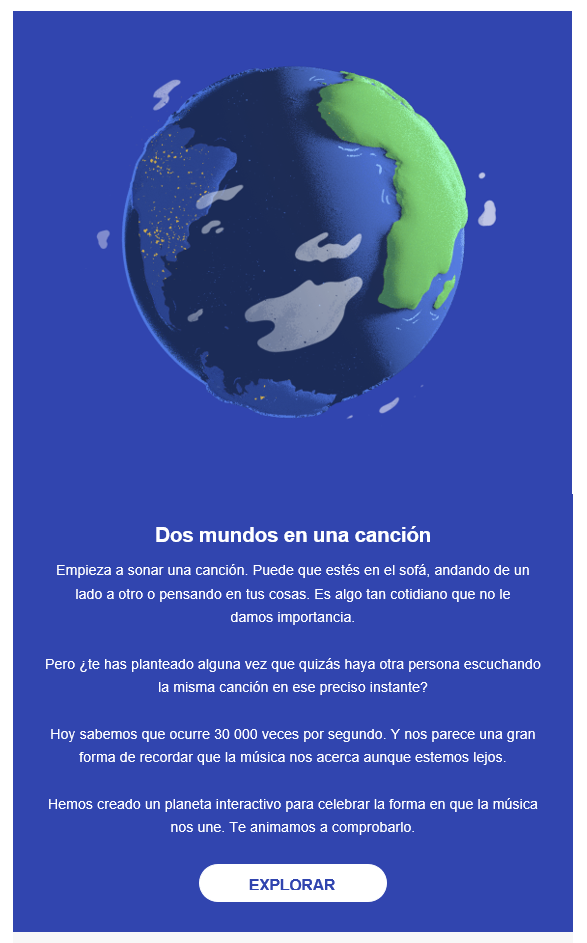
The goal of this email is to promote their microsite “Two Worlds in One Song”, in which, inside an interactive globe, songs are played that are being listened to at the same time by two people at opposite points of the planet.
The idea behind this marketing action already has a clear emotional component, because they are trying to convey a powerful message: music brings us together.
But let’s get practical and see how they manage to inject into their copy those basic emotions associated with togetherness, a universal idea. To do that, we’re going to split the text of this email into three paragraphs or ideas:
“A song starts playing. You might be on the couch, pacing from one side of the room to the other, or lost in your own thoughts. It’s so everyday that we don’t give it a second thought.”
In this sentence, what they do is put you in the scene. They set up a scene in which you can quickly identify with the situation. And they also ask you not to skip past it: even if it’s “an everyday thing”, give it the importance it deserves.
“But have you ever considered that maybe someone else is listening to the same song at that very moment? Today we know it happens 30,000 times per second. And we think it’s a great way to remember that music brings us closer even when we’re far apart.”
Notice how they open with a question, and that question very naturally sets the stage for the main thesis: music brings us closer, even when we’re far apart.
“We’ve created an interactive planet to celebrate the way music brings us together. We encourage you to try it out.”
Now the main idea has been planted in your head. Even if only subtly, you already feel emotions related to love, kindness, connection or togetherness.
Only now do they say it openly: music brings us together.
And they link this message directly to the call to action: we encourage you to try it out.
Emotional Email Marketing Example #2
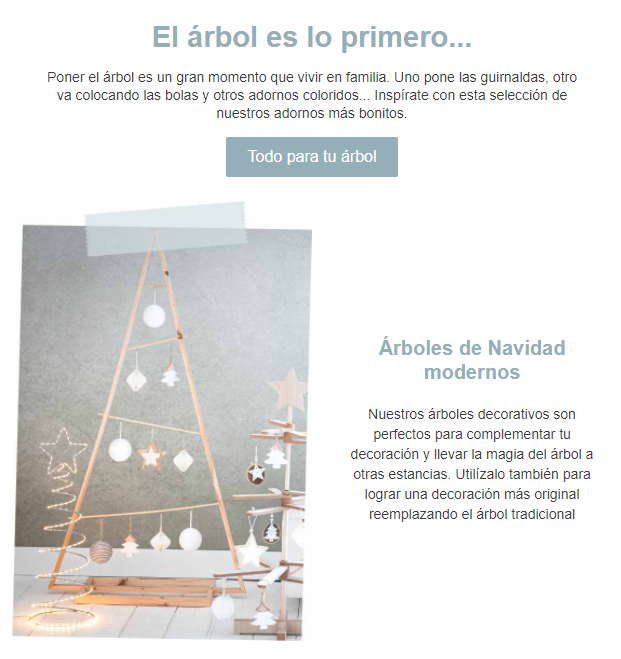
Almost all the email marketing actions of Maisons du Monde — the online furniture and home décor store — include touches of emotional marketing, usually in the form of detailed descriptions that evoke cozy home scenes.
Again, to see exactly how they do it, let’s go through it part by part.
“Putting up the tree is a great moment to share with family.”
The goal of this email is to close more sales of decorations during the holiday season.
But of course, they don’t know whether the people opening this email plan to put up a tree or are even interested in Christmas. So they start out strong: straight to the point with an emotional argument.
Were you thinking about putting up the tree? They fan that feeling that was probably already present in you. Here’s an extra helping of homey warmth and family love!
You hadn’t considered it? Or maybe you had, but you’d dismissed the idea? You might just reconsider if their emotional argument wins you over (it’s a great moment to share with family — are you really going to miss it?).
“One person hangs the garlands, another puts up the baubles and other colorful ornaments… Get inspired with this selection of our prettiest decorations.”
Here, just like in the Shopify example, they use the technique of describing a scene in detail so you can picture it in your mind.
In fact, make a note of it: mental images are one of the most powerful tools for creating emotions quickly and directly.
“Get inspired with this selection of our prettiest decorations.”
And they finish with a call to action that is less salesy and more evocative.
Perfectly aligned with the approach of the email and perfect for removing barriers: they aren’t selling you anything, they’re giving you ideas to get inspired!
A Few Final Words on Emotional Marketing
The people who make up your audience are unique and unrepeatable, each with their own dreams, problems and needs. But each and every one of them wants to feel loved, safe, recognized, cared for or valued.
And emotional marketing is a very powerful tool for connecting with that emotional side: emotions are the key to getting your audience to feel connected to your brand and trust it.
But as Uncle Ben from Spider-Man said — paraphrasing Roosevelt — with great power comes great responsibility.
That’s why, if you’re interested in emotional marketing, I recommend reading three outstanding books:
- This Is Marketing, by Seth Godin
- Predictably Irrational: The Hidden Forces That Shape Our Decisions, by Dan Ariely
- Thinking, Fast and Slow, by Daniel Kahneman
Because they not only pave the way to consumers’ emotions, but will also give you the perspective you need to use them ethically and responsibly.
And what better way to end this article than with a quote from the master Godin, a real guru of emotional marketing.
“Marketers change things. We make people move from one emotional state to another. We take them on a journey and, little by little, help them become the person they dream of being.”
These emotions are also very present in hyper-personalization in marketing and in techniques like storydoing, which seek to create memorable experiences to build loyalty among your subscribers.