CPM (cost per thousand impressions)
What it is, how it's calculated and how to optimize it
When you launch a digital advertising campaign, one of the first decisions is how you’re going to pay. For each click? For each sale? Or for every time someone sees your ad? That last option has a name of its own: CPM.
What is CPM?
CPM, or cost per thousand impressions, is the price you pay every time your ad is shown a thousand times. It’s known as cost per mille or cost per thousand; the “M” comes from the Latin mille, meaning thousand.
An impression is counted every time the ad appears on screen. It doesn’t matter whether the user clicks it, ignores it, or doesn’t even notice it. That’s why this model measures visibility, not interest.
It’s the most common payment model in branding, display advertising and video campaigns. It’s also used on social media, in Google Ads and in programmatic advertising, where impressions are bought through automatic auctions.
How to calculate CPM
The basic formula is simple:
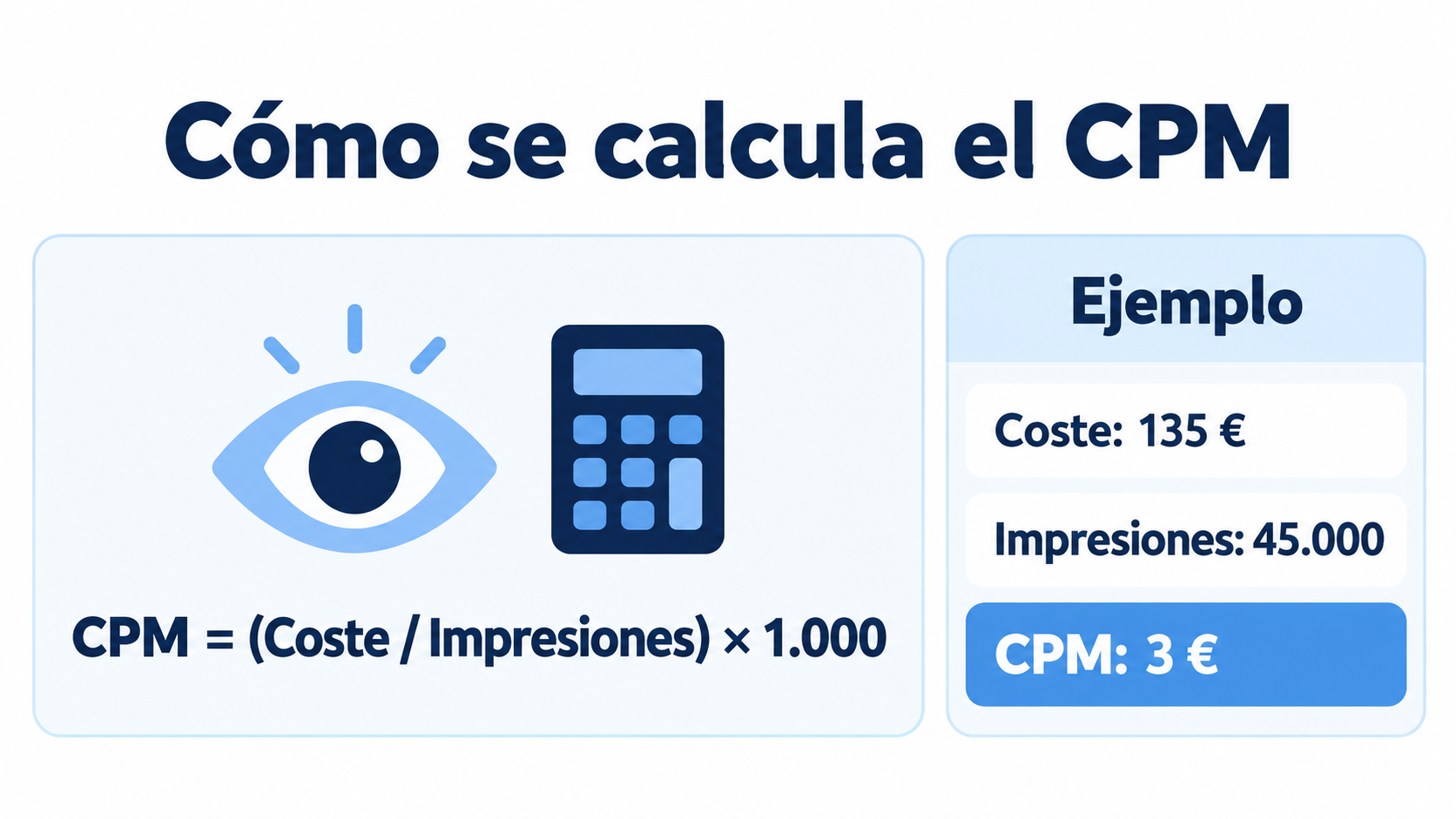
CPM = (total campaign cost / number of impressions) × 1,000
Imagine you invest 135 euros in a campaign and your ad is shown 45,000 times. You divide 135 by 45,000 and multiply by a thousand. The result is a CPM of 3 euros: every thousand impressions cost you 3 euros.
You can also do the calculation the other way around. If a platform offers you that same price and you want 45,000 impressions, the cost will be 135 euros.
There’s a second formula that’s useful when you know the CTR and the cost per click:
CPM = CTR × CPC × 1,000
Here, CTR is expressed as a decimal. With a CTR of 1% (0.01) and a CPC of 0.30 euros, the equivalent CPM would be 3 euros. This formula is useful for comparing campaigns that are paid for using different models.
CPM, CPC and CPA: what’s the difference
All three measure the cost of a campaign, but each one focuses on a different moment in the user’s journey:
- CPM (cost per thousand impressions): you pay for visibility. It fits well with brand awareness and reach goals.
- CPC (cost per click): you only pay when someone clicks. It’s the typical model for search campaigns and traffic acquisition.
- CPA (cost per acquisition): you pay for each conversion, whether that’s a sale, a sign-up or a download.
The closer the model is to conversion, the more expensive each event tends to be. But the risk of paying for results that never arrive is also lower.
When it makes sense to pay by CPM
This model works best when your goal is to get known. A brand launch, a new product presentation or a seasonal campaign are good examples.
It’s also worth considering when your ad has a high CTR. If a lot of people click, paying by impressions can work out cheaper than paying per click. However, if you’re looking for immediate sales and your CTR is low, CPC or CPA tend to be safer options.
What factors influence the cost per thousand impressions
The price of a thousand impressions isn’t fixed. It varies depending on the platform, the country and the competition for the same audience.
The time of year matters a lot. During periods like Black Friday or Christmas, many brands bid for the same users and prices skyrocket. Targeting also plays a role: a very specific, sought-after audience, like executives in a particular industry, costs more than a general audience.
The format and placement also make a difference. A video at the top of a popular website doesn’t cost the same as a banner in a side column.
How to optimize your impression-based campaigns
Paying by impressions doesn’t mean giving up on results. These guidelines will help you get more out of every euro:
- Control the frequency: showing the same ad too many times to the same person drives up campaign costs and causes rejection.
- Target with criteria: reaching fewer but more relevant people usually improves overall performance.
- Take care with your creatives: eye-catching images and videos grab attention in the first few seconds.
- Include a clear call to action: even if the goal is brand awareness, a good call to action turns part of that visibility into traffic.
- Measure beyond impressions: keep an eye on CTR, conversions and ROI to know whether the investment is paying off.
CPM in email marketing
This model also shows up in email. Many newsletters with large audiences sell sponsored spots at a CPM price. The calculation is based on the number of subscribers or opens.
And there’s another interesting way to look at it. With paid advertising, every new impact costs you money again. But when you convert that audience into subscribers on your own list, the situation changes. You can reach out to them again as many times as you want without paying for each impression.
That’s why many brands combine both strategies. They use impression-based paid campaigns to get known and capture contacts. Then they build the relationship through email, where the cost per message is much lower.
That’s the logic behind it.
How we can help at Mailrelay
At Mailrelay, we make it easy to turn the visibility you gain from your ads into a lasting relationship. You can create subscription forms for your landing pages and segment contacts based on the campaign they came from.
Our real-time reports show you the opens, clicks and conversions of every send. That way you can compare what each contact you capture costs against what it brings you afterward.
All of this is available on the free plan, with up to 80,000 emails a month and 20,000 contacts. If you want to try it, you can create your Mailrelay account today.
Frequently asked questions about CPM
What’s a good CPM? There’s no universal figure. It depends on the platform, the industry, the country and the time of year. The most useful approach is to compare it with your previous campaigns and the results you get afterward.
Does CPM include clicks? No. It only measures the cost of impressions; any clicks that happen are an extra you don’t pay for separately.
Why is it called CPM and not CPT? Because of the Latin mille. Although the phrase cost per thousand is also used in English, the abbreviation that’s stuck is CPM.
In conclusion
CPM is the go-to metric when what you’re after is visibility. Calculating it is simple, but interpreting it correctly means looking at it alongside CTR, conversions and final returns.
And if you manage to turn some of those impressions into subscribers, every euro invested keeps working for you long after the campaign ends.