GIF
What is a GIF?
GIF is an acronym for “Graphics Interchange Format”.
It was created in 1987 by CompuServe and has become one of the most popular image formats on the web.
Unlike static images, GIFs can display animations, which means they can show a short series of images in sequence.
A GIF, or Graphics Interchange Format, is a file format widely used for graphic images on the Internet. You will usually find lots of GIFs on social media platforms, instant messaging apps and promotional emails. This way, GIFs can add quality and personality to your professional emails. You can create your own GIFs or find them online.
This is useful for creating the illusion of movement.
The popularity of GIFs in digital marketing
So why has it become such a popular tool in the marketing world?
The answer is simple: movement grabs attention.
In a digital landscape where content is consumed quickly and there is fierce competition for the user’s attention, GIFs stand out as a dynamic visual tool.
In addition, GIFs are versatile.
They can be humorous, informative or simply aesthetic.
This versatility allows brands to connect with their audiences in many ways, whether by making them laugh, teaching them something new or simply grabbing their attention with an attractive design.
How can you make the most of animated GIFs in your strategies?
“Animated GIFs (Graphics Interchange Format) are image files with one or more frames that play in a constant, endless loop.”
As I mentioned, their first use in online marketing was in web banners. Banners have evolved enormously and now favor rich formats that expand to reveal an image gallery or a video.
As banners evolved, the use of GIFs declined, and the format fell out of demand. However, social media users’ love of memes has given it new value, and now the platforms themselves make it easy to include GIFs in content.
Users increasingly use animated GIFs in their conversations, sometimes even communicating exclusively through them. After all, it is a format that lets you tell a short story in seconds.
“Animated GIFs are a great ally for online communication strategies precisely because they let you say a lot in a short time.”
In addition, their technical features make them ideal for use on all digital channels:
- Loading speed: Unlike other content, these files load very quickly, since they are static images joined together rather than a video file.
- File size: Thanks to their compression algorithm, animated GIFs are very lightweight and easy to distribute on the Internet.
- Activation: There is no need to activate them manually, since they start playing their sequence of images as soon as they load. Users don’t need to interact with them to see the story you want to tell.
- Movement: Because they are a sequence of images, they attract more attention than static content.
- Viewing: They can be viewed on any device and browser.
Thanks to these features, animated GIFs have a very high potential to go viral; they are easy to share and are more popular than ever on social media.
That is why more and more brands are including them in their strategies and using them not only on social media, but also in blogging and email marketing.
► Using animated GIFs in blogging
In general, audiovisual content plays a very important role in any blog’s content strategy. Supporting text with audio, videos, infographics or images helps answer questions and reinforce the message in the reader’s mind.
Today, the blogging trend focuses on long-form content that explores topics in depth. To lighten the read and make it more enjoyable, it is a good idea to use graphic content that lets users take a break and see the information from another perspective.
“Animated GIFs are the ideal option for summarizing and explaining long content in just a few images.”
They also bring other benefits to your blogging strategy, such as:
- They grab users’ attention by standing out within the text.
- They help you connect with users in a close and direct way.
- They reinforce the message.
- They are easy to share on social media.
- They can strengthen your corporate image.
These files can be used not only to explain content (as infographics do), but they also have other uses on blogs. For example:
- Call to action: Designed as a button, they can be the indicators that tell users what to do on the website. Since they move, they are more likely to catch the user’s attention and get them to interact.
- Banner: Both for advertising (the traditional use) and for promoting sections of the blog, newsletter services or other aspects of your strategy you want to highlight.
- Slide: If you don’t want to keep changing the images in your blog’s or website’s header slider, you can replace it with a GIF of whatever size you need. This will make the image lighter and the page load faster.
- Lead capture pop-up: Pop-ups that appear when a user is about to leave a website, telling them why they should stay (or vice versa), are very common today. An animated pop-up will catch their attention more and let you include more content.
In short, animated GIFs are such versatile files that they can have almost as many uses in blogging as you can think of.
Most social channels already support GIFs: Facebook lets you include them in the timeline and in Messenger conversations, X (formerly Twitter) lets you attach them to your posts, and Instagram even lets you post them directly from your phone, just like photos or videos.
“For brands, they are a very useful resource for standing out in their followers’ timelines.”
They can be used in two ways: as branded content or in social ad campaigns. Although you can’t create an ad with GIFs directly, you can promote already published content that contains this type of file.
Social media is the main channel where users post this type of content and make it go viral, and it is especially well received when it is humorous. So, if you include them in your social media strategy, you will be speaking to your followers in their own language.
► Using animated GIFs in email marketing
Email is another online channel that supports animated GIFs. Although it doesn’t happen as often as on blogs, the text of a newsletter campaign can get too long, so graphic content is often a necessary resource too.
“Brands use images to visually lighten their newsletters and grab users’ attention. GIFs help you achieve this goal while also standing out from your competitors.”
Used well, this format can be truly versatile. For example, it can help you:
- Show different features of a product or service.
- Highlight promotions and offers.
- Explain conceptually complex information.
Take a look, for example, at this email from Foodinthebox:
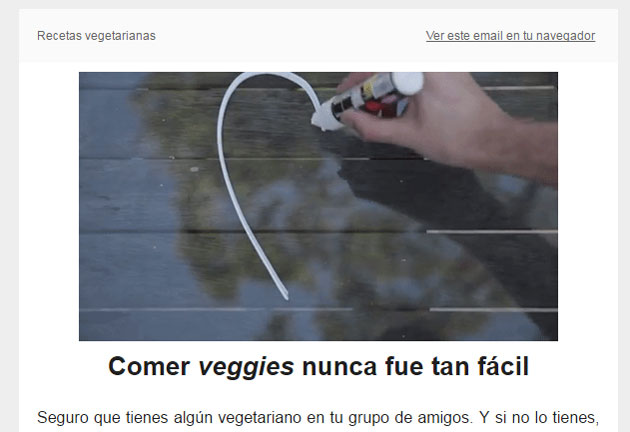
See that image? It is actually this GIF:
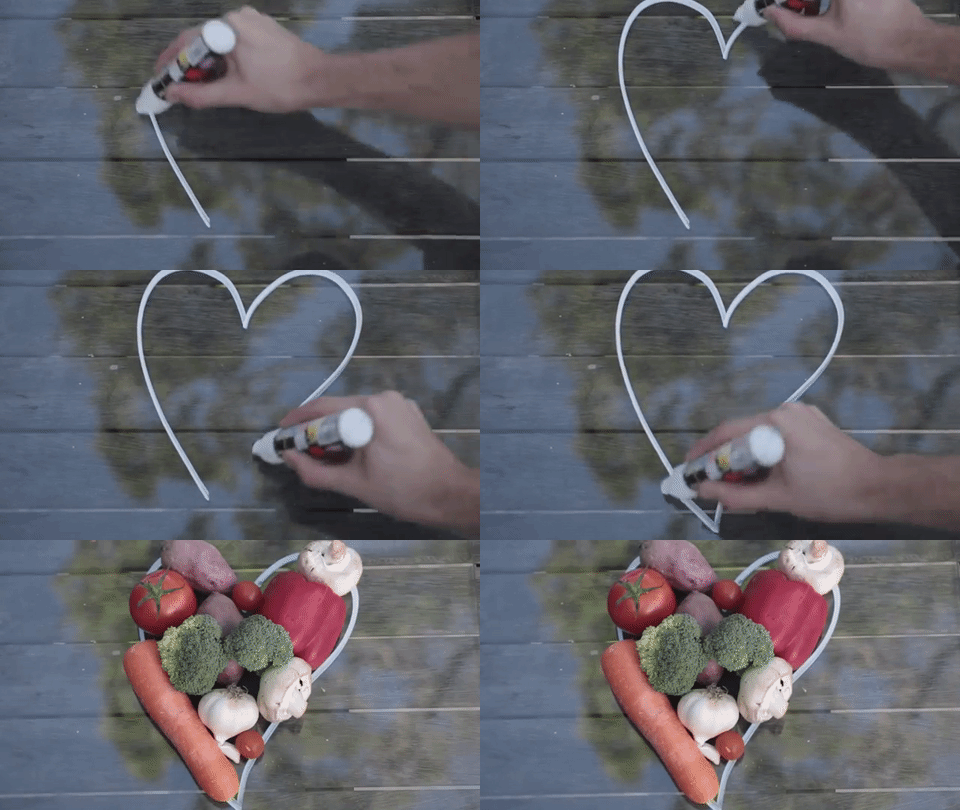
Pretty eye-catching once you open the email, don’t you think?
However, there is one thing to keep in mind if you want your GIF strategy to work in email marketing: many users have automatic image blocking enabled in their email so that messages are lighter and don’t slow them down on mobile devices (and this blocking also affects GIFs).
The best option is to include a message in the text explaining the reason for that visual content, so that it encourages them to unblock it. This way, you will also get them to see the static images you include in the email.
Below, I explain other email marketing tips for succeeding with your animated GIFs.
► Using animated GIFs on websites and in e-commerce
In today’s digital world, using animated GIFs on websites and e-commerce platforms has become a powerful strategy for capturing users’ attention.
And, in doing so, improving the customer experience.
They also let you present information in a more enjoyable and visual way.
Some examples would be:
Capture visitors’ attention
Animated GIFs can work like a visual magnet that catches visitors’ eyes the moment they land on the site.
By using them in banners, ads or sliders, you can highlight special offers, new products or key features in a vibrant, dynamic way.
Dynamic explanation of products or services
Use GIFs to show how your products or services work.
Through an animated sequence, you can break complex processes down into a series of easy-to-understand steps, making the information more digestible and appealing to users.
Enrich blog posts and content
Add GIFs to your blog posts or product descriptions to break up the monotony of the text and give readers a visual break.
GIFs can illustrate key points or simply add a touch of fun and personality to your content.
Customer testimonials and reviews
Add GIFs to your testimonials or reviews sections to bring your customers’ words to life.
For example, a GIF of someone smiling or celebrating can add an emotional, authentic touch to positive comments.
Interactive guides and tutorials
GIFs can be great allies when creating interactive guides and tutorials.
With simple animations, you could show how to assemble a product or how to use a special feature of your service, making it easier for users to understand.
In conclusion, animated GIFs don’t just add an attractive visual element to your website or e-commerce platform.
They can also help communicate complex information in a more accessible and entertaining way.
By integrating them strategically into your platform, you can create a richer, more engaging user experience, which can ultimately translate into higher conversions and customer loyalty.
Specific tips for using animated GIFs
In the fast-paced world of digital marketing, animated GIFs have become powerful tools for adding a touch of creativity and dynamism to online communication strategies.
To use them effectively, it is important to keep a few practical tips in mind.
In this section, we will dive into the art of creating custom GIFs, important technical considerations and best practices for integrating them into different platforms.
Let’s dive in!
► Creating custom GIFs
Creating custom GIFs not only allows for greater originality and authenticity, but also gives you the opportunity to design content that resonates specifically with your audience.
By creating your own GIFs, you can:
- Represent your brand: design GIFs that reflect your brand’s identity and values.
- Exclusive content: build anticipation and engagement by offering unique GIFs that can only be found on your platforms.
- Creative storytelling: use GIFs to tell stories in a visual, captivating way.
► Technical considerations (size, speed, color)
To make sure your GIFs maintain optimal quality and a professional look, it is crucial to keep in mind technical aspects such as:
- The right size: adjust the size of your GIFs so they are light enough to load quickly without compromising visual quality.
- Animation speed: adjust the animation speed to convey the intended message without overwhelming viewers.
- Color palette: choose a consistent color palette that aligns with your brand’s look and is pleasing to the eye.
► Best practices for integrating GIFs into different platforms
Integrating GIFs into your online strategies can really pay off if you follow a few best practices:
- Adaptability: make sure GIFs display correctly on all platforms and devices.
- The right context: use GIFs in contexts that complement and enrich your content, rather than distracting or diverting attention.
- Alternating with other content: alternate GIFs with other types of visual content to keep the user experience balanced and engaging.
► Use GIFs to show an action
Who says you have to talk about something in your emails when you can show it? When used effectively, GIFs can help you demonstrate how your product or service works.
This can increase customer trust, and they will be more motivated to respond to your message.
► Create an animated GIF yourself
Believe it or not, you can also create GIFs and animate them yourself, instead of having to rely on ready-made online resources. You will also be in a better position to give your GIF a personal touch by creating or editing your own images, so people will be more engaged with your message.
Here is a quick introduction to creating a GIF with presentation software such as Visme:
· First, start with a blank image or an animated GIF template.
· Use brand elements for the font, colors, icons, etc.
· Choose from illustrations, characters, etc. that can be customized to your brand.
· Animate those illustrations, characters, etc. to create the action you want (e.g. boomerang, zoom rotation, etc.).
· Choose the start and end of the animations.
· Finally, preview your GIF before downloading it to your desktop.
► Animate just one part of a GIF
Animating just one part of a GIF can be effective in two ways: it makes your GIF look “light” once it is loaded in an email, and it keeps the GIF from being so overdone that it overwhelms the message.
► Use occasion-based GIFs
People like receiving something on special occasions: birthdays, Christmas, etc. So why not show a GIF that reminds them of that special day? This kind of personalization adds a personal touch to your newsletters.
► Use GIFs with a CTA
It is important for your CTA to stand out in the email, so don’t leave it bare. Use a GIF to help illustrate your CTA so that recipients take action when they see your call to action.
With these tips, you will be ready to explore the world of animated GIFs with a well-thought-out, technically sound strategy under your belt.
Don’t hesitate to let your creativity run wild and explore the many possibilities GIFs can offer your digital marketing strategy!

Tools and resources for creating and finding animated GIFs
In today’s digital world, animated GIFs have established themselves as an excellent way to add a touch of joy and dynamism to online communication strategies.
But how can we create these fun GIFs, and where can we find them?
Below are some essential tools and valuable resources for creating and finding animated GIFs to boost your digital strategies:
► Tools for creating custom GIFs
Creating unique, custom GIFs is easier than ever with the help of specialized tools.
Some of the most popular are:
- GIMP: free, open-source software that offers a wide range of tools for creating GIFs from scratch.
- Canva: with its user-friendly interface, Canva lets you design custom GIFs using a wide variety of templates and graphic elements.
- Adobe Photoshop: although it is a paid tool, it offers advanced features for creating professional GIFs with a polished finish.
- EZGIF: a website that offers a quick and easy way to create GIFs from images and videos.
► Where to download animated GIFs
Sometimes you need to find ready-made GIFs that suit your content. Here are some places where you can download them:
- Giphy: It is one of the most popular and extensive platforms for searching and downloading GIFs. Its library contains a huge variety of GIFs organized by categories and tags, making it easy to find the perfect GIF for every occasion.
- Google Images: Google Images is another reliable source for finding animated GIFs. Simply set “Type” to “Animated” in the search tools to filter and show only GIFs.
- Reddit: Reddit is home to an active community of GIF creators, where you can find unique and often humorous GIFs. Subreddits such as r/gifs or r/reactiongifs are good places to start.
- Wikimedia Commons: On Wikimedia Commons you can find a collection of GIFs that are in the public domain or available under open licenses, which means you can use them freely in your projects.
With these tools and resources at your fingertips, you are fully equipped to add animated GIFs to your online communication strategy.
And enrich your content with dynamic, fun visual elements.
GIFs in email marketing
In email marketing, GIFs can play a crucial role.
Imagine opening an email and being greeted by an animated GIF showing a new product in action or presenting a special offer in an eye-catching way.
This not only improves user interaction with the email, but can also increase click-through and conversion rates.
By incorporating GIFs into your email marketing campaigns, you are adding an interactive element that can be much more attractive than a simple static image.
However, you need to strike a balance: an email full of GIFs can be too heavy.
And, as a result, may not load properly on all devices.
They can also divert the reader’s attention from the message you want to send.
Therefore, it is essential to use them in moderation.
Why do GIFs work?
“People are naturally drawn to light and movement,” said Geoffrey Radcliffe, a blogger at Writinity and Research papers in the UK. “GIFs combine both attractions to naturally catch users’ attention. That is why flashing lights are used so much in Japanese culture, because they understand this phenomenon.”
GIFs can draw people in. However, where you place the GIF matters, because placing GIFs appropriately and in moderation in your emails can:
- Increase click-through rates (CTR)
- Increase engagement with your emails
- Tell your story in a single animated image
- Send a fun and informative message
► 1) They are short and sweet
Short and sweet is the way to go, especially with a GIF. Look at social media platforms such as Snapchat and TikTok, which let their users post GIFs just a few seconds long.
It is no surprise that GIFs tend to perform better than videos, because they get straight to the point. Besides, people want your content to be clear, even when they follow your company on social media. GIFs are more successful than videos because people are likely to watch the whole GIF through to the end. That is not the case with videos: most users watch the first few seconds, and if it isn’t very entertaining, eye-catching or relevant, they will probably stop watching.
People are increasingly impatient and, to be honest, lazy. This means they want information that is quick and easy to understand.
► 2) They are engaging
Besides being short and sweet, GIFs can also capture people’s attention.
When someone opens an email, what is the first thing you want them to see? It is something to think about when adding a GIF to your email. Adding a visually appealing feature can help you hold readers’ attention from the beginning to the end of the message.
► 3) They offer a competitive edge
Every business faces some kind of competition when it comes to email marketing. However, when you use GIFs effectively, you can gain a significant edge over your competitors. You can take particular advantage of this if your competitors haven’t yet joined this digital trend.
► 4) They help you illustrate your company culture
Company culture is essential for any business. So why not illustrate it with a GIF? If you use too much text on a plain background, you risk making your emails boring and uninteresting. Using GIFs in your emails shows recipients who you are and what you are offering.
► 5) They make effective calls to action
Whatever happens, you will need a call to action (CTA), usually at the end of the email. For example, a call to action is ideal when you send, say, a monthly newsletter, because the button creates a visual incentive that can persuade your customers to act: sign up, buy something, take advantage of a promotion, etc. So, with GIFs acting as CTAs, you can add subtlety to your emails.
GIF and SMS Marketing
Just as the GIF has found its place in email marketing, it has also started to appear in SMS marketing.
Although space in text messages is limited, and GIFs may not always be the most practical option.
Mainly due to restrictions on size and compatibility.
Even so, some modern messaging platforms are beginning to allow GIF integration.
This can add a touch of creativity and dynamism to promotional text messages.
Conclusion
To conclude, the GIF, an animated image format that has been around for decades, has found a special place at the heart of digital marketing.
Thanks to its ability to capture attention and convey information concisely and visually, it has proven to be a valuable tool for brands looking to stand out in a saturated digital world.
Whether you are exploring email marketing or SMS marketing strategies.
Or simply looking for ways to make your social media or website content more interactive, the GIF is a resource you shouldn’t overlook.
But, like everything in marketing, the key is moderation.
And making sure that any tool or technique you use aligns with your brand’s voice, values and goals.
With strategic and creative use, the GIF can be the perfect ally in your digital campaigns.
So don’t be afraid to test and see how this animated format can bring your content to life!