Google Fonts: what it is and how to use it on your website and in your emails
Google's free font library, how to install it and what to keep in mind in your newsletters
Google Fonts is a free service offered by Google that provides a wide range of easily accessible fonts for use in web design and graphic design projects.
This library includes a variety of styles, from classic to the most modern.
It is a practical and versatile way to improve the look and readability of websites and marketing materials.
Today it offers 1,942 font families (August 2026), 553 of them variable, and it has been around since 2010. It is used by everyone from personal blogs to big brands, on WordPress and in almost any website builder.
Is Google Fonts free and can it be used in commercial projects?
Yes. Almost all of its fonts are under the SIL Open Font License, and a few under the Apache License. Both are free licenses: you pay nothing, you don’t have to sign up, and you can use them on your website, in a logo, in print and in your emails, even for a business.
Ways to use Google Fonts on your website
There are three ways to add a Google font to your website. Each one has its upside and its drawback:
| Method | How | Advantage | Watch out |
|---|---|---|---|
| Link to Google | A line in the HTML or @import in the CSS | The quickest to set up | The visitor’s IP is sent to Google |
| Hosted on your server | You download the font and load it with @font-face | No data sent to third parties and more control | You have to update it by hand |
| WordPress plugin | A plugin downloads and hosts the fonts | No code needed | One more plugin to maintain |
Design emails that read well in any inbox
Mobile-friendly templates and a visual editor so your newsletters look the way you want. Get started for free with Mailrelay.
The importance of choosing the right font
Typography is not just about aesthetics.
It deeply affects how users perceive and interact with the content.
The right font can improve readability, convey brand personality and boost user engagement.
In this sense, Google Fonts offers a solution that balances design and functionality.
Integration into web design and UX
A website’s design has a big influence on the user experience (UX).
Google Fonts makes it easy to add fonts that are not only visually appealing but also optimized for the web.
This ensures fast loading and a consistent user experience across different devices and browsers.
How to add and use Google Fonts
The first step is to choose the font you want to use. To do this:
Go to Google Fonts
Go to the Google Fonts website (fonts.google.com) and explore the font collection.
You can filter fonts by category, language, properties and popularity to find the one that best suits your project.
Preview and select
Use the preview feature to see how the font will be displayed with your specific text.
Once you find a font you like, click on it to open its dedicated page.
Add the font to your website
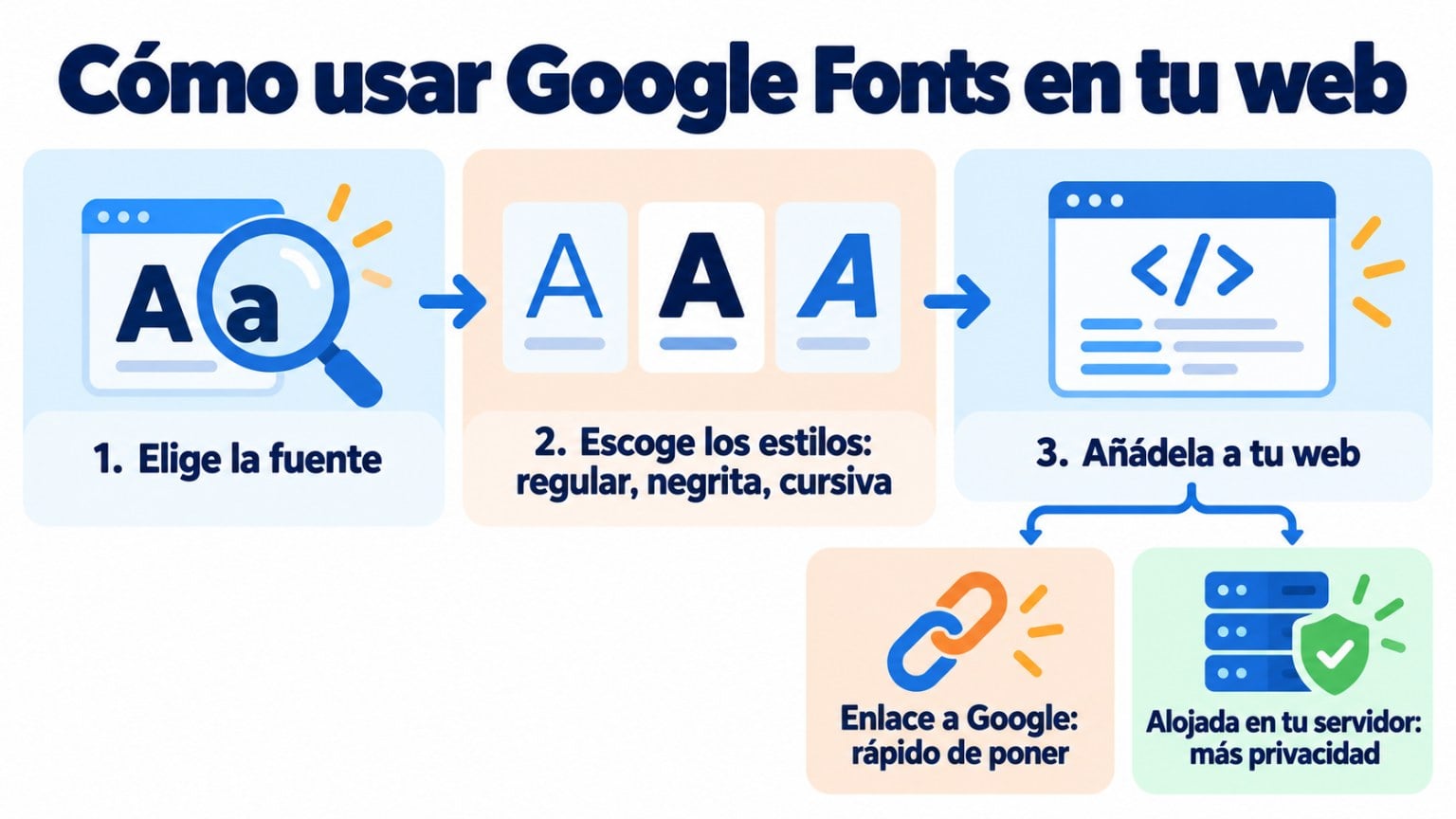
- Select the font styles: On the font’s page, select the styles and weights (for example, regular, bold, italic) you need for your project.
- Generate the embed code: click “Get font” and then “Get embed code”. Google Fonts gives you a code snippet with two parts:
- HTML link: A line you need to place in the <head> section of your HTML. This link imports the font from Google Fonts.
- CSS: A CSS rule you need to add to your stylesheet to apply the font to the desired elements on your page.
- Or download it: with “Download all” you get the font in a ZIP file and host it on your server with the
@font-facerule. It is the option that best protects privacy.
Google Fonts and SEO
In addition to improving aesthetics and UX, Google Fonts also plays a role in SEO.
When set up properly, they barely affect page load time, a factor Google takes into account (we explain it in WPO). But every external font is one more request, and since 2020 browsers no longer share their cache between websites, so it no longer helps that the visitor “already has it downloaded”. Load only the variants you use, add font-display: swap so the text is visible while the font loads and, if you can, host it on your server.
In addition, implementing fonts correctly can improve the site’s accessibility, another aspect that search engines value.
Google Fonts and the GDPR
If you load the fonts from Google’s servers, each visitor’s browser connects to Google and sends it their IP address. Google Fonts doesn’t use cookies, but an IP address is personal data under the GDPR.
On January 20, 2022, the Munich Regional Court ordered a website to pay a visitor €100 for sending their IP to Google without their consent when loading Google Fonts. Thousands of similar claims followed in Germany.
The simplest solution is to host the fonts on your server: the license allows it and the website looks the same. If you prefer the link to Google, mention it in your privacy policy along with cookies and other external services.
Can you use Google Fonts in an email?
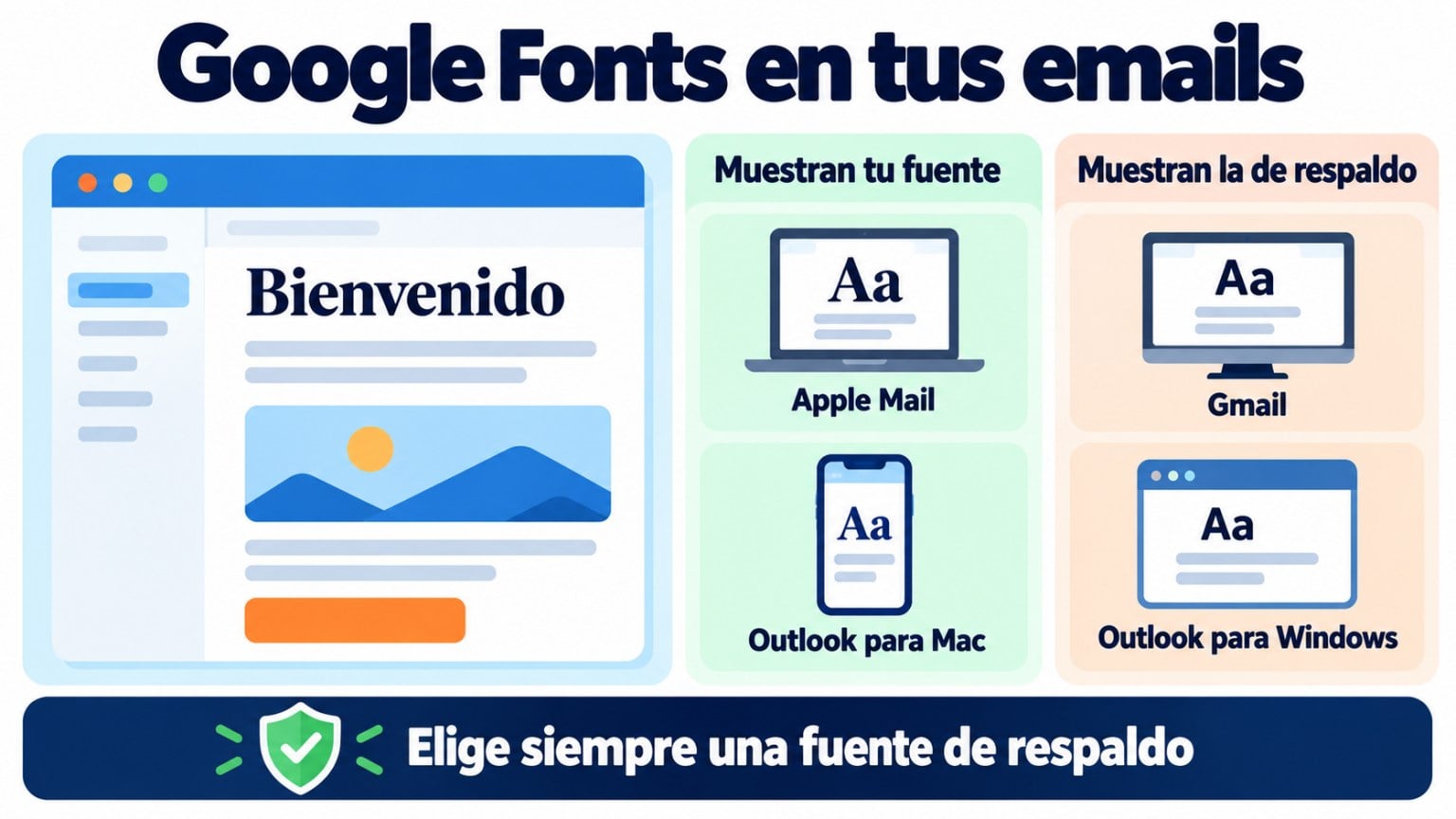
Yes, but not every email client displays them. When a client doesn’t support it, it shows the fallback font you specified:
| Email client | Does it display Google Fonts? |
|---|---|
| Apple Mail (Mac, iPhone, iPad) | Yes |
| Outlook for Mac | Yes |
| Thunderbird | Yes |
| Gmail | No (only Roboto and Google Sans) |
| Outlook for Windows | No, or only partly (sometimes it switches to Times New Roman) |
| Outlook.com and Yahoo | No |
That’s why you should always add a fallback font after the main one in your newsletters, for example 'Montserrat', Arial, sans-serif. That way, people reading in Gmail will see Arial instead of some random font.
Don’t put important text in images just to use a nice font. It hurts accessibility, it can’t be read if images are blocked and it can affect deliverability. And before sending, check how it looks in different email clients (email rendering).
Challenges and best practices
Despite its many advantages, using Google Fonts also comes with challenges.
Choosing the right font can be overwhelming given the wide variety available.
It is also worth checking that the fonts you choose fit the brand’s identity and values.
A good practice is to test different fonts on various devices, consider readability and accessibility, and maintain consistency across all marketing materials.
How Mailrelay helps you
Google Fonts gives you plenty of options so your website and materials have typography that matches your brand. In your emails, the key is to pair a font with personality with a fallback font so they read well in any email client. With Mailrelay you get:
- Visual editor and templates that adapt to mobile so your emails read well on any screen.
- A/B tests to see which design works best with your subscribers.
- Free account with 80,000 emails a month and 20,000 contacts.
Your newsletters, in your style and readable everywhere
Create emails with a visual editor and mobile-ready templates. Up to 80,000 emails a month for free with Mailrelay.
Frequently asked questions
Is Google Fonts free?
Yes. All of its fonts are free and can also be used in commercial projects, because they have free licenses.
Is Google Fonts available in Spanish?
The Google Fonts website is in English, but its fonts can be used to write in Spanish. You can filter by language to see the ones that include accented letters and the ñ.
Is using Google Fonts legal under the GDPR?
Yes, if you host them on your server. If you load them from Google’s servers, you send the visitor’s IP to Google, and a German court already ruled against a website for this in 2022.
How do I download a font from Google Fonts?
Go to fonts.google.com, open the font, click “Get font” and then “Download all”. A ZIP file with the font is downloaded.
Can I use Google Fonts in my emails?
Yes, but Gmail and Outlook for Windows don’t display them. Always add a fallback font such as Arial or Georgia.