Growth hacking: what it is, how it works and examples to grow with few resources
How to grow fast with few resources through experiments, data and a bit of ingenuity
Growth hacking is a way of doing marketing focused on a single goal: growing fast while spending little. Instead of big campaigns, it relies on many small, cheap experiments: each one is measured and only the ones that work are kept.
It was born in tech startups, which had to win users with no budget. But its ideas work for any business that wants to grow smartly.
What is growth hacking?
The term was coined by Sean Ellis in 2010, on his blog. Ellis had helped startups such as Dropbox grow. He wanted to describe the profile they needed: not a classic marketing manager, but a growth hacker: someone whose only goal was growth.
In 2012, Andrew Chen popularized it with an article that became very well known.
Growth can be measured in users, customers, revenue or subscribers. What matters is choosing a single metric and working to move it.
It shouldn’t be confused with related concepts:
| Concept | What it focuses on | How it works |
|---|---|---|
| Growth hacking | Growing fast with few resources | Fast, cheap experiments and lots of measurement |
| Traditional marketing | Building brand awareness and selling | Planned campaigns with a bigger budget |
| Agile marketing | Organizing the marketing team’s work | Short cycles, changing priorities, small teams |
| Lean startup | Validating a new business or product | Building, measuring and learning with a minimum viable product |
They are often used together. A growth team usually works with agile methods and draws on lean startup ideas.
How growth hacking works
Growth hacking isn’t a trick, it’s a method. This cycle is repeated over and over:
- Analyze your situation. How your customers find you, where they drop off and what your competitors are doing.
- Choose a goal. A single metric, with a deadline and a number. For example, going from 50 to 80 sign-ups a week in two months.
- Come up with ideas. The more, the better. Small changes to your website, forms, emails or pricing.
- Prioritize. Start with the ones with the highest potential impact and the lowest cost.
- Test. Run the experiment for a set period and with a specific group.
- Analyze and decide. If it works, it stays. If not, drop it without regret and try the next one.
The key is in the last step. Copying what your competitors do is useless if you don’t measure it. An idea is only worth something if the data says it moves your metric.

The AARRR funnel
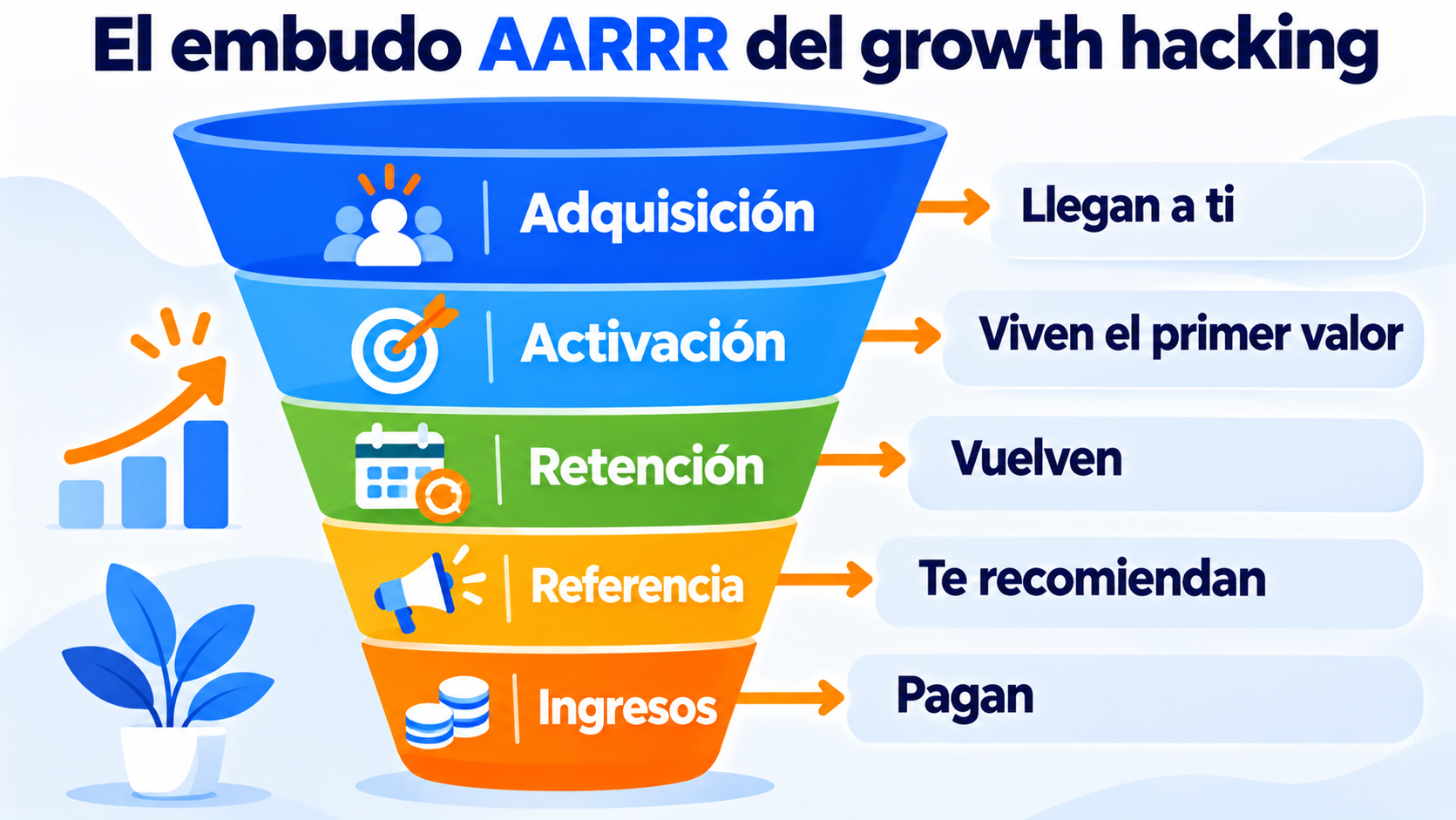
To know where to experiment, many growth hackers use the AARRR funnel. It was proposed by investor Dave McClure in 2007 and is known as “pirate metrics”, because of how its acronym sounds:
| Stage | What it measures | Example of an email experiment |
|---|---|---|
| Acquisition | How new users arrive | A lead magnet in exchange for subscribing |
| Activation | Whether they have a good first experience | A welcome email with a clear first step |
| Retention | Whether they come back | A newsletter with useful content every week |
| Referral | Whether they recommend you | An email asking them to invite a friend in exchange for a perk |
| Revenue | Whether they pay | An upselling email to those already using the basics |
The funnel helps you avoid spending energy on the wrong part. If you get lots of sign-ups but hardly anyone comes back, the problem is retention, not acquisition.
Grow your list without overspending
Forms, landing pages and automations to capture, activate and retain, on the free account too.
Growth hacking examples
Three examples appear in almost every growth hacking story:
- Hotmail. In 1996 it added a line at the end of every email its users sent: “PS: I love you. Get your free email at Hotmail”. Every message became an ad and an invitation to create an account.
- Dropbox. It gave extra storage space to anyone who invited a friend, and to the invited friend too. Both sides gained something, and referrals became its main growth engine.
- Airbnb. In its early days it let hosts also publish their listings on Craigslist, a very popular classified ads website in the United States. That way it reached a huge audience without paying for it.
None of the three needed a big campaign. They found a way for the product itself, or its users, to bring in the next ones. Two of them also relied on something as simple as an email or an invitation.
Growth hacking techniques you can apply with email
Email is one of the cheapest levers for experimenting. Some ideas:
- Capture with value. A subscription form or a pop-up that offers something useful in return, such as a guide or a discount.
- Onboarding. A series of emails that takes new customers to the moment they understand the value of your product. We explain it in customer onboarding.
- Referrals. An email that rewards those who recommend you, as Dropbox did. You’ll find more ideas in the post on referral marketing.
- Subject line and sending tests. An A/B test on every important campaign is a cheap, fast experiment.
- Reactivation. A winback campaign to win back those who stopped buying.
They all have something in common: they can be measured. You’ll know within a few days whether they worked.
Email marketing is one of the tools that can do the most to help your business grow exponentially. Working on your subscriber list lets you keep contacting your potential customers without new investment in advertising. As a result, you’ll be able to keep in touch with them often enough to help them move through the conversion funnel, at minimal cost. Growth hacking needs visibility, and email marketing gives you that.
Jose Argudo, CMO at Mailrelay
The growth hacker
The growth hacker is the professional who runs these experiments. They’re not just a marketing expert: they combine data analysis, some technology and lots of creativity.
They usually share three qualities. They’re agile, because they test ideas quickly and drop the ones that don’t work without getting attached.
They’re analytical, because they decide with data, not gut feelings. And they’re creative, because they look for paths the competition hasn’t tried.
A small business doesn’t need a job with that title. It’s enough for someone to adopt the way of working: a clear metric, small tests and constant measurement.
How Mailrelay helps you
Mailrelay gives you the tools to run growth experiments with email without spending money. You can capture subscribers with forms and landing pages, and welcome them with an automation that sends itself.
With A/B testing you try two subject lines or two senders and pick the winner by opens or clicks.
With segments and each subscriber’s reputation you can see who responds and whom you should reactivate. And if you connect Google Analytics, you’ll know what each contact does on your website after the click.
All of this is included in the free account, with up to 80,000 emails a month and 20,000 contacts.
Your next experiment, in an email
Test subject lines, segments and automations and keep what works, with up to 80,000 emails a month for free.
Frequently asked questions
These are the most common questions about growth hacking.
Does growth hacking work for a small business?
Yes. It was born in startups, but its core idea works for any business: choose a goal, test small changes and keep what works. You don’t need a big budget, just consistency and good measurement.
What tools are used in growth hacking?
The ones that let you test and measure: a web analytics tool, an email marketing tool with A/B testing and automations, and a spreadsheet to log each experiment and its result.
What’s the difference between growth hacking and growth marketing?
They are used almost as synonyms. Growth hacking is more associated with fast experiments to grow in a short time. Growth marketing is used more for ongoing growth work across every stage of the funnel, with more weight on retention.