CPL
Cost Per Lead
The term CPL, which stands for Cost Per Lead, is an essential digital marketing metric that refers to the cost incurred to acquire a lead.
A lead is a person or entity that has shown interest in a company’s products or services.
Generally by providing their contact information through an online form.
CPL is crucial for measuring the effectiveness and efficiency of marketing campaigns, allowing companies to assess how much it costs them to generate a potential customer and optimize their strategies to maximize return on investment (ROI).
Relevant historical data
The concept of CPL is not new in the field of marketing, but its relevance has grown exponentially with the rise of digital marketing and email marketing.
In the past, companies invested in traditional advertising, such as newspaper ads and TV commercials, where it was difficult to measure the direct impact of these campaigns in terms of lead generation.
With the arrival of the internet and digital marketing platforms, the door opened to more accurate measurement and data-driven optimization.
In the early days of digital marketing, metrics focused on website traffic and ad impressions.
However, over time, marketers realized that true success wasn’t just about attracting visitors, but about converting them into qualified potential customers.
This led to the development and adoption of metrics like CPL.
Email marketing, in particular, has benefited enormously from this metric, as it allows companies to measure the cost of acquiring subscribers for their mailing list.
Who in turn can be nurtured and converted into customers through well-designed campaigns.
Key considerations
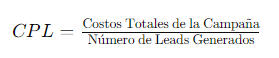
To calculate CPL, it is important to take into account several factors:
- Total campaign costs: these include all expenses associated with the marketing campaign, such as content creation, media buying, marketing automation software and other operating expenses.
- Number of leads generated: this is the total number of leads obtained as a result of the specific campaign.
The basic formula to calculate CPL is:
It is essential to consider the quality of the leads obtained.
Not all leads are equal.
Some may be more qualified than others to become paying customers.
This is where segmentation and personalization in email marketing come into play.
Using advanced automation tools, companies can segment their audiences and send more personalized messages, thereby increasing the likelihood of conversion and, consequently, improving CPL.
Why it is important and its benefits
CPL is a key metric for several reasons:
- Accurate performance measurement: it allows companies to accurately measure the performance of their marketing campaigns. Knowing the cost of acquiring a lead helps companies identify which strategies and channels work best and which ones need improvement.
- Budget optimization: knowing the CPL helps companies allocate their budgets more efficiently. They can invest more in campaigns that generate leads at a lower cost and adjust or eliminate those that are not profitable.
- Improved lead quality: by focusing on CPL, companies can improve the quality of the leads they obtain. This is especially relevant in email marketing, where lead quality can have a significant impact on the final conversion rate.
- Higher ROI: a lower CPL generally indicates greater efficiency in marketing campaigns, leading to a better return on investment. This is crucial for companies looking to make the most of their resources and get the highest possible return from their marketing efforts.
Moreover, in the context of email marketing, CPL gains particular relevance.
Well-executed email marketing campaigns can generate high-quality leads at a relatively low cost.
By segmenting and personalizing emails, companies can capture their audience’s attention more effectively, which translates into a more favorable CPL and a higher likelihood of conversion.
Conclusion
In summary, CPL is an essential metric in every digital marketer’s toolkit.
It gives a clear picture of how efficient marketing campaigns are and helps companies make smart decisions about resource allocation and strategy.
In the world of email marketing, CPL is even more crucial, as it lets you measure the cost of acquiring qualified subscribers who can be nurtured over time.
Understanding and optimizing CPL not only helps reduce costs but also improves lead quality, increases return on investment, and ultimately contributes to the overall success of a company’s marketing strategies.
In an increasingly competitive digital environment, companies that master the art of calculating and optimizing CPL are better positioned to attract, convert, and retain customers effectively.
Therefore, investing time and resources in understanding and improving CPL is not just a good practice, but a necessity for any business that wants to thrive in the competitive world of digital marketing and email marketing.