
Keeping a business afloat in times of crisis can be a real challenge. Economic uncertainty, declining sales, and increased competition are just some of the difficulties businesses face in times of crisis.
That’s why it’s essential to have a solid online marketing strategy to help keep your business running.
In this article, we’ll explore the 5 essential steps that any business should follow to stay afloat in times of crisis.
From building a solid online presence to implementing an effective email marketing strategy, these steps will help you reach new customers, retain existing ones, and keep your business running in times of uncertainty.
Keep reading to discover how you can keep your business afloat in times of crisis with online marketing!
In times of crisis, keeping a business afloat can be a real challenge
Businesses face a variety of obstacles, from declining sales and increased competition to economic uncertainty.
In these circumstances, having a solid marketing strategy online is essential to help keep your business running.
Online marketing can help you reach new customers and retain existing ones, which is especially important in times of uncertainty.
By building a solid online presence, identifying target customers and adapting the marketing strategy accordingly, and offering promotions and discounts to encourage customer loyalty, businesses can improve their ability to survive and thrive in times of crisis.
In addition, implementing an effective email marketing strategy can be a cost-effective and efficient way to keep customers engaged and increase sales.
Using analytics tools to monitor and adjust your online marketing strategy as needed is also essential to adapt to changes in the market and the economy.

Why you should act and not shut down your business in times of crisis
The solution to a crisis is not to completely shut down your business activity. That may be the quickest path, but not the one that will benefit you most once it’s all over.
Even if you slow down, never lose presence or positioning with your audience. Otherwise, you run the risk of fading into the background.
That’s why I recommend adopting marketing actions that help you maintain your users’ loyalty, as well as add value in times that are difficult for everyone.
If you were thinking about disappearing from the scene, think twice. It’s likely that if you don’t act in time, by the time you react someone else will have taken your place.
My advice is to focus on helping your audience. If you’re willing to help, your brand will be remembered for it.
It’s in these moments that the most human values of businesses come through, and this will bring you benefits such as:
- Positioning yourself as a socially responsible brand.
- Improving your image and reputation.
- Getting closer to your ideal customer.
- Activating the principle of reciprocity in your audience.
- Showing commitment to your purpose.
Idea 1: Build a solid online presence
A solid online presence is essential for any business these days, and it’s especially important in times of crisis.
Having a professional website optimized for search engines, maintaining an active presence on social media, and offering valuable content for customers are some of the key steps to building a solid online presence.
1.- Have a professional website optimized for search engines:
A website is one of the most important tools for any online business.
It’s essential that the website be professional, easy to use, and optimized for search engines.
A professional, optimized website can help attract new customers and retain existing ones.
In addition, making sure the website loads quickly and is mobile-friendly can improve the user experience and increase the likelihood that customers will make a purchase.
Social media can be a powerful tool for attracting new customers and keeping existing ones engaged.
Maintaining an active presence on the social media platforms most relevant to your business can help increase brand visibility and encourage interaction with customers.
Regularly posting relevant content, interacting with customers, and responding to questions and comments are some of the ways to maintain an active presence on social media.
If you need to know which are the best social media platforms for companies and businesses, we’ve left it in the link.
3.- Offer valuable content for customers:
Valuable content for customers can help attract and retain them.
Providing useful, educational, or entertaining information on the website and on social media can increase customer trust in the brand and encourage loyalty.
In addition, quality content can improve search engine rankings and attract new customers to the website.
La clave:
With so many consumers making purchases online and searching for information on the web, not having an online presence can mean missing the opportunity to attract new customers and retain existing ones.

Idea 2: Identify target customers and adapt the marketing strategy accordingly
It’s important to understand customer needs and adjust the marketing strategy accordingly to achieve success in times of crisis.
Below are some key steps that can help identify target customers and adapt the marketing strategy accordingly:
1.- Understand customer needs:
The first step in adapting the marketing strategy accordingly is understanding customer needs.
Listening to customer feedback, monitoring social media trends, and conducting surveys or market research can be some ways to gain valuable information about what customers need and want.
By better understanding customer needs, you can create more relevant and effective offers and messages.
2.- Adjust messages and offers to meet those needs:
Once customer needs are understood, it’s important to adjust marketing messages and offers accordingly.
For example, if customers are looking for solutions to a specific problem, you can create offers that address that problem effectively.
Or if customers are looking for lower prices due to the current economic situation, you can create promotions or discounts that meet that need.
3.- Use analytics tools to measure and adjust the marketing strategy:
Finally, it’s important to use analytics tools to measure and adjust the marketing strategy as needed.
Tracking the results of the marketing strategy can help identify which tactics are working and which aren’t, which can help you make informed decisions about how to adjust the strategy accordingly.
Some useful tools include Google Analytics, which can provide information about website traffic, user behavior, and conversions, and social media platforms, which can provide information about engagement and post reach.
La clave:
By focusing on customers who are more likely to buy, businesses can maximize their return on investment and increase their chances of success in difficult times.
Idea 3: Implement an effective email marketing strategy
In times of crisis, businesses may not have the resources to implement a wide variety of marketing tactics.
An email marketing strategy can be a cost-effective and efficient way to keep customers engaged and increase sales.
Below are some key steps to implement an effective email marketing strategy:
1.- Collect email addresses from customers and potential customers:
The first thing to do to implement an effective email marketing strategy is to collect email addresses from customers and potential customers.
This can be done through the website, social media, in-person events, and other marketing tactics.
It’s important to make sure customers understand why their information is being collected and how it will be used.
2.- Send personalized and relevant emails:
Once you have a list of customer emails, it’s important to send personalized and relevant emails.
Emails should be designed to meet customers’ needs and wants, not simply to promote products or services.
Including useful content, special offers, and relevant news in emails can help keep customers engaged and encourage sales.
3.- Use marketing automation to maximize efficiency:
Marketing automation can be an efficient way to send personalized emails to customers.
Marketing automation tools can schedule emails based on certain triggers, such as customer action on the website or purchasing behavior.
This can help keep customers engaged without having to send emails manually.
La clave:
Implementing an effective email marketing strategy is a cost-effective and efficient way to keep customers engaged and increase sales in times of crisis.

Idea 4: Offer promotions and discounts to encourage customer loyalty
Offering promotions and discounts can be an effective way to encourage customer loyalty and increase sales in times of crisis. They can be carried out, for example, through promotional emails.
Below are some key steps to offer effective promotions and discounts:
1.- Create attractive promotions and discounts:
The first thing to do when offering promotions and discounts is to create attractive offers for customers.
Offers should be attractive enough to motivate customers to make a purchase, but not so generous that the company loses money.
Some options can include percentage discounts on products, free shipping, and gifts with purchase.
2.- Offer incentives for loyal customers:
Offering incentives to loyal customers, such as exclusive discounts or early access to new products, can help encourage customer loyalty.
Customers who feel valued are more likely to buy again in the future and to recommend the company to their friends and family.
3.- Clearly communicate the benefits of promotions and discounts:
It’s important to clearly communicate the benefits of promotions and discounts to customers.
Making sure customers understand what they’re getting and why can help increase the likelihood that they’ll make a purchase.
In addition, making sure promotions and discounts are communicated through multiple channels, such as email and social media, can help increase reach.
La clave:
To implement an effective promotions and discounts strategy, it’s essential to create attractive offers for customers, offer incentives to loyal customers, and clearly communicate the benefits of promotions and discounts.

Idea 5: Use analytics tools to monitor and adjust the online marketing strategy as needed
Monitoring and adjusting the online marketing strategy as needed is essential to adapt to changes in the market and the economy.
Analytics tools can provide valuable information about user behavior, website performance, and the effectiveness of the online marketing strategy.
Below are some key steps to use analytics tools effectively:
1.- Set up analytics tools to track user behavior and website performance:
The first thing to do is set up analytics tools, such as Google Analytics, to track user behavior and website performance.
These tools can provide valuable information about how users interact with the website, which pages are the most popular, and how users are converting into customers.
2.- Evaluate the performance of the online marketing strategy:
Once you have information about user behavior and website performance, it’s important to evaluate the performance of the online marketing strategy.
You can analyze the marketing tactics used, the channels used, and the results obtained to determine what’s working and what isn’t.
This can help you make informed decisions about how to adjust the marketing strategy accordingly.
3.- Adjust the online marketing strategy as needed:
Finally, it’s important to adjust the online marketing strategy as needed.
Based on the information gathered through analytics tools, you can make changes to the marketing strategy, such as adjusting the tactics used, changing the channels used, and adjusting messages and offers.
By adjusting the marketing strategy as needed, businesses can improve their ability to adapt to changes in the market and the economy.
Importante:
Using analytics tools to monitor and adjust the online marketing strategy as needed is essential to adapt to changes in the market and the economy.

10 Marketing and Email Actions for Tough Times
Let’s now discuss some specific marketing actions that are highly recommended to ease difficult times and even come out stronger.
Here the goal will be to maintain the visibility of your brand or business. For example, in the case of the crisis caused by the global COVID-19 pandemic, offering your help based on your own business capabilities is essential.
Put yourself in someone else’s shoes for a moment, step into your ideal customer’s shoes, and analyze what they need, what they want, how they think and feel. Only then will you be able to help them.
Below you’ll find my proposal, but first I want to advise you that, whatever measures you take, always take them from a place of empathy.
1) Free access and other perks
One of the best ways to offer value to your audience, and make things easier for them for as long as the crisis lasts, is through free access to content or services. For instance:
- You can offer free training, daily live webinars, downloadable resources, videos, audio… It could even be the time to launch a podcast!
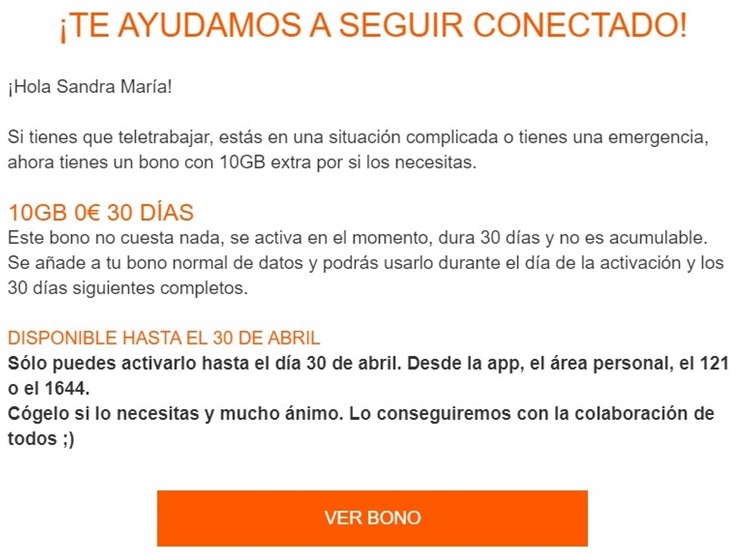
- Another option is to provide free services such as consultations, or even, as phone companies do when they give more data, offer some extra value during those days.
In moments like these, any help is welcome, and it’s something users will greatly appreciate. That said, I recommend you pace out these kinds of actions, because too much content or information can end up overwhelming people.
Here’s an example:
2) Assertive communication
Whether it’s an email, a social media post, a blog post… or any other message you’re going to send, don’t forget to be assertive. Always convey consistency and confidence in your messages.
You need a certain amount of tact to talk about sensitive topics, and always think about reassuring your customers and offering your help so they know you’re there.
Keep them informed about your activity, availability, and whether the service they’ve contracted will continue. Here, the important thing isn’t to sell, but to maintain user loyalty.
Follow these tips to communicate assertively:
- Be clear, concise, and specific.
- Pay attention to the words you use in each email.
- Use a friendly, approachable tone.
- If you’re going to provide relevant data, include the official source.
- Speak from a place of positive emotion.
- Express gratitude toward your reader.
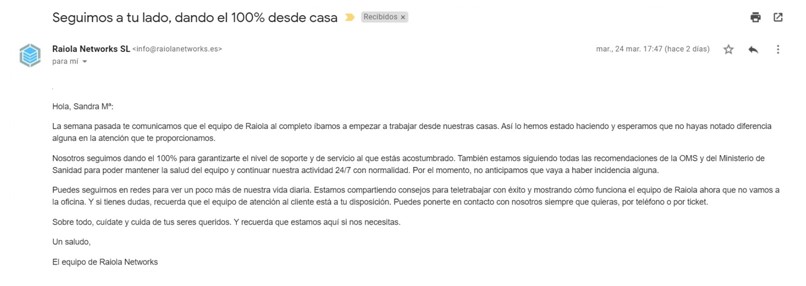
In this email from Raiola you can see how they do it:
3) Follow-up (or welcome) mailings
Just because there’s a crisis or a delicate situation in much of the industry doesn’t mean you should turn your back on email marketing.
Any unforeseen circumstance can be a good time to send emails applying the tips on assertiveness and empathy.
Earlier you already saw several examples of these mailings. As I said at the beginning, disappearing is not the best option. Keep sending emails to your audience, adapt your strategy to the new circumstances, and work on the more human side of your brand.
With Mailrelay you have a free account that lets you send up to 80,000 emails and manage up to 20,000 contacts, for free.
At no cost.
There’s no possible excuse not to at least try it, especially now.
There’s no better alternative for your marketing right now.
4) Engagement analysis
In addition to creating follow-up or informational emails, I encourage you to add actions that move your audience to interact with your brand. For example, propose a challenge whose results they have to share on social media.
If you’re a trainer or own a gym, one idea could be to show daily the number of steps your clients have managed to take at home each day. You could even create a ranking to encourage interaction.
Other ideas could be sharing recipes with the community, or posting stories working out in your living room. In this image you can see this idea put into practice:

5) Positive language
If using positive language is important in normal situations, in times of crisis it’s even more so.
Words generate emotions, so we must be very careful about the ones we choose when addressing other people.
Avoid talking about the harshest side of the situation, since the news already does that. Use your email marketing to encourage your subscribers, show hope, add value, give ideas, promote taking action, amuse, entertain…
All of this is done through positive language. So words like “impossible,” “no,” “never,” or “problem” should be left out of your vocabulary, both personally and professionally.
6) Interest surveys
If you can’t think of ideas to take action, you can send a questionnaire through stories or email. You can also do this to optimize the actions you’ve put in place.
By asking the right questions, you’ll get very relevant information. You’ll be able to know how they’re doing and offer exactly what they need to get through times of crisis. From there, ideas will emerge for content, materials, webinars, services, extra bonuses…
7) Market analysis
Another option is to analyze what other companies are doing, both inside and outside your industry. But don’t stop there, also study the audience’s response.
If you discover an action that could yield good results for your brand, implement it. Though this isn’t about copying, but about finding inspiration to develop your own emergency strategy.
8) Activate creativity
Your creativity and that of your team will be the lifeline that makes your brand stand out from the rest. Put it to work and develop creative actions for your emails, which you can accompany with fun images, memes, or videos.
The same goes for your ads. Use your wit and especially aim for originality. Here’s an example of this last point:

9) Hashtag tracking
If there’s a hashtag that went viral during the Covid-19 crisis, it’s #yomequedoencasa (I’m staying home).
I encourage you to follow it and get your brand involved. It’s a way to promote the initiative from your own brand or business, show your commitment to the cause, and at the same time reach more people.
10) Include the surprise factor
Lastly, I’d say play with the surprise factor.
Don’t bore your subscribers by sending them the same type of emails every day. Reach out to brighten their day and, at the end of each mailing, add something they don’t expect. For instance:
- A video message from your team showing how each person is handling remote work at home.
- A statement of intent about what you’d like to do once it’s all over.
- A collection of valuable materials…
General tips for keeping your business going during a crisis
The marketing actions you ultimately carry out should be accompanied by other, more general ones that allow your business to survive in times of crisis. We’ll talk about these now.
Keep in mind these are measures that, although difficult to adopt, will help your business overcome almost any setback:
Positive mindset and proactivity
As you know, this should be the common denominator of all actions for as long as the emergency situation lasts.
Without a positive mindset, it’s not possible to make good decisions or objectively analyze what’s happening in order to ease its effects.
Proactivity, in turn, will help you keep your business from freezing up out of fear, and will give you the push you need to take action.
Cutting unnecessary expenses
This isn’t about shutting everything down, but if you had unproductive resources, now is the time to clean house.
For example, those subscriptions to tools you’re not getting any benefit from — drop them and keep everything that truly supports the productivity of your company or business.
Temporarily pausing major investments
It’s not about stopping investing overnight, or no longer hiring outside services, but about pausing those larger investments aimed at specific acquisition goals that, given the moment, have fallen outside the business’s objectives (there will be time to pick them back up later).
Centralizing efforts
The combined efforts of your colleagues or team members will keep everything flowing in the right direction (especially when it comes to changing course).
Prioritizing intelligently and collectively leads us to focus on what’s really important.
Betting on flexibility
Whoever adapts best to the new circumstances will win.
So if you need to change processes, work procedures, priorities, or anything else, do it. Some changes will be temporary, others are here to stay.
Retaining and building customer loyalty in times of crisis
In times of crisis, it’s crucial to keep customers satisfied and happy.
This is achieved by making sure all their questions, concerns, and issues are addressed quickly and effectively.
Exceptional customer service can become a key differentiator that keeps customers loyal to your business.
- Stay in touch with your customers and show them you care about their well-being.
- Personalize your communications so they’re relevant and meaningful, and use different channels to reach them, such as email, social media, and text messages.
- Listening to your customers and taking their opinions and suggestions into account is essential to keep them satisfied and engaged with your business.
- Ask for feedback regularly and make sure to implement changes based on their comments to constantly improve your products or services.
- Implement loyalty and rewards programs to encourage customers to keep buying from your business. These programs can include discounts, exclusive promotions, accumulable points, and gifts for customers who make frequent purchases or referrals.
- In times of crisis, it’s essential to be transparent with your customers about how the situation is affecting your business and what steps you’re taking to address it. Show empathy and let them know you understand their concerns and that you’re working hard to give them the best possible experience.
Conclusion
Keeping a business afloat in times of crisis can be a challenge, but there are many online marketing strategies that can help.
The five essential steps to keep your business afloat in times of crisis through online marketing include building a solid online presence, identifying target customers and adapting the marketing strategy accordingly, implementing an effective email marketing strategy, offering promotions and discounts to encourage customer loyalty, and using analytics tools to monitor and adjust the online marketing strategy as needed.
Ultimately, the key to keeping a business afloat in times of crisis is to be flexible, adapt to changes in the market and the economy, and focus on customers’ needs and wants.
By implementing these online marketing strategies, businesses can improve their ability to attract and retain customers, increase sales, and keep a successful business running in difficult times.