The 8 best social media platforms for businesses and how to choose the right ones for yours
Which social network suits each type of business, which ones to use if you sell to other companies and how to turn followers into customers

Which social network suits each type of business, which ones to use if you sell to other companies and how to turn followers into customers
If you have a business, chances are you’ve wondered more than once which social network could be the best fit for your sector.
The truth is there’s no absolute answer, but by getting to know each one a little better, at Mailrelay we can get an idea of which are, today, the best social media platforms for businesses.
If you feel that your social media just isn’t taking off, maybe it’s because you’re not in the right place.
A good strategy, among many other things, helps define which online marketing tools are most relevant to the business in question.
In today’s post, we give you the keys to understanding and choosing the most profitable social networks, the ones that can really help your business. Let’s dive in!
To find out which social network is best for your business, it helps to know which ones are the most widely used. There’s little point in being on a social network that suits our sector perfectly if there aren’t actually any users interacting on it.
We must remember that the purpose of being on this type of platform is to get our name out there and attract potential customers. That’s why we should choose tools that are actually being used by our target audience. This way, we’ll make sure our strategy is effective and successful.
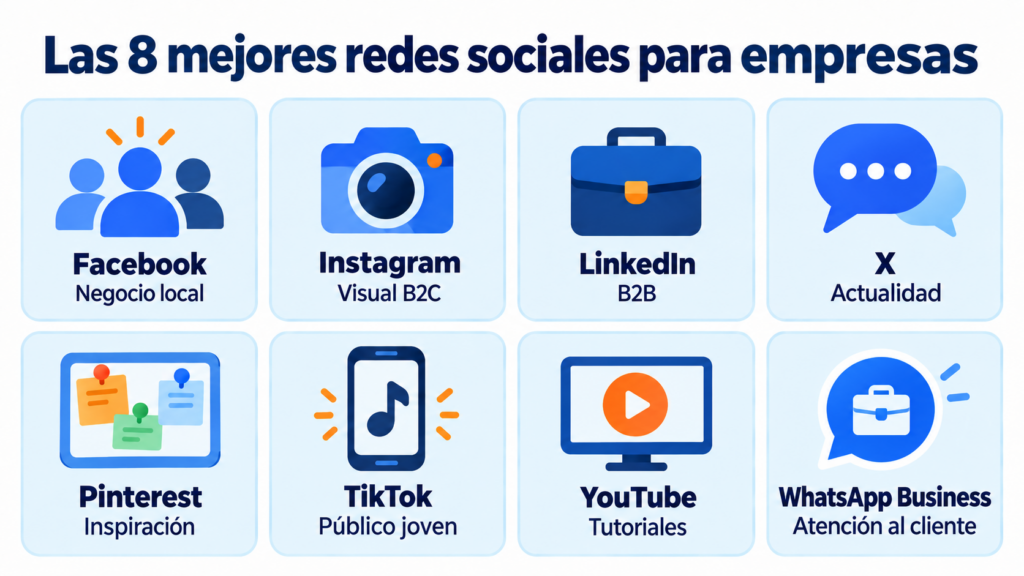
Among the most widely used social networks, we can find the following platforms:
This table sums up what each one is for. Here are the details:
| Social network | Main format | Best fit for | B2C or B2B |
|---|---|---|---|
| Posts, groups and ads | Local businesses and adult audiences | B2C | |
| Photos, reels and stories | Fashion, beauty, food, travel | B2C | |
| Articles and professional posts | Business services, technology, recruitment | B2B | |
| X (formerly Twitter) | Short real-time messages | News, technology, events | Both |
| Inspiration images | Home decor, weddings, recipes, fashion | B2C | |
| TikTok | Short vertical video | Young audiences, leisure, food | B2C |
| YouTube | Long and short video | Tutorials, training, demos | Both |
| WhatsApp Business | Direct messages | Customer service and local retail | Both |
A classic. Nowadays, the platform has a huge number of active users, which tells us it’s still a widely used network where we could find our target audience.

At this point, you’re probably wondering: Is it worth having my business present on Facebook?
Not every business succeeds on Facebook, and this is due, among other things, to the very nature of the platform. We usually use Facebook to stay in touch with friends and/or acquaintances, which gives it a social, leisure-oriented character.
If my business sells to other companies, is it worth being on Facebook? The answer is a bit complex. It depends on the type of business. As we mentioned earlier, Facebook’s leisure and entertainment nature means it isn’t always useful for selling to other businesses.
Think of it this way: when someone opens Facebook, they do it to connect with people they know and switch off from work.
In general, all businesses that sell to an end customer rather than to other companies. In addition, businesses related to leisure and free time tend to have a higher success rate.
Some examples are: businesses related to travel, outdoor activities, sports (gyms), restaurants, bars and online stores.
Those aimed at other businesses, especially very specific or industrial businesses. These will find it harder to get results out of the tool.
For example, a company that sells industrial machinery to other companies will find it very hard to succeed on Facebook. This is mainly because its audience is a large organization, not an individual person.
No list of the most widely used social networks today would be complete without Instagram. Due to its unstoppable growth, this tool is, today, one of the most important social networks.
As in the previous case, Instagram is one of the best platforms for selling if you have a business aimed directly at the end consumer (B2C). Nowadays, it has a number of active users that keeps growing, which makes it one of the favorites among businesses.
But is it worth having my business on Instagram?

You might also be interested in these Mailrelay articles:
1) Email Marketing Tools
2) The Benefits of Email Marketing
Just as with Facebook, Instagram tends to be more effective for certain types of businesses. That’s why it’s important to keep this in mind and assess whether our business should be present there or not.
All businesses that sell to an end customer rather than to other companies. In addition, businesses related to health, beauty/aesthetics, fashion, food, travel, wellness and sports have a higher chance of success.
If your business matches any of the above, it’s important that you know how to navigate the platform. That’s why some expert tips on Instagram for businesses will come in handy.
For example, a company dedicated to maritime freight transport wouldn’t have much room on this social network, because its audience (executives at large companies involved in importing and exporting products) isn’t on Instagram or, at least, doesn’t use the app for that purpose.
This doesn’t mean that no business selling to other companies has a place on the social network. Today, there are many businesses aimed at entrepreneurs that have taken their first steps with Instagram and succeeded with their strategy on this social network. What matters is assessing whether our audience is really there or not.
With LinkedIn, we’re looking at the opposite case to the previous two. Being a professionally oriented social network, it’s ideal for businesses whose target audience is other businesses or companies (B2B).

LinkedIn users are on the social network for work-related reasons, whether to make new contacts or find a job, not to plan their vacation or buy clothes.
That’s why, if you know your end audience well and work on your content properly, you’ll see how you manage to connect with businesses and companies that are part of your potential audience.
Companies whose purpose is to sell to other companies. In addition, those related to marketing, technology, science, textile groups and banking activities tend to have a higher success rate on the platform.
Companies whose purpose is to sell to the end customer or user. Taking the previous examples, on LinkedIn a company dedicated to maritime freight transport is likely to be more successful than a travel agency.
Through this social network, a business can position itself within its sector, network with other companies and gain visibility within its field.
To understand this tool’s potential, it’s important to keep its particularities in mind. Today, X is a social network based mainly on sharing real-time information. This makes it a great source of news and opinion.
In fact, it can be used by businesses that target end consumers (mainly) or sell to other companies. However, it’s important to keep in mind that this social network isn’t suitable for every type of business. Here are some examples:

Companies whose purpose is to sell to the end customer (mainly) and to other businesses.
On X (Twitter), businesses related to news, sports, politics, telecommunications and technology have a high chance of success.
Very local businesses, for example, wouldn’t succeed on this platform. A small store selling phones in a small town, therefore, shouldn’t consider being present on X.
We’ve all heard of Pinterest, but the current lack of knowledge about this platform means most businesses don’t take it into account in their online marketing strategy. Curious, isn’t it?

Pinterest works very well for businesses that aim to sell to the end customer, especially when it comes to a female audience. In fact, this social network is used mostly by women. As a result, it can be very useful if your business’s audience matches the one described above.
People usually turn to Pinterest looking for inspiration or information, but don’t underestimate it: it’s a great social network for getting your name out there among the public (thanks to its strong ability to be indexed by Google). This makes it another one of the best social media platforms for businesses.
Companies whose purpose is to sell to the end customer.
On Pinterest, businesses related to events (especially weddings), decor, fashion and crafts have a high chance of success. If these businesses also operate online, they’ll have an extra point in their favor.
Businesses aimed at selling products or services to other companies, especially highly specialized businesses. A lawyer, for example, would most likely not succeed on Pinterest.
TikTok is a social media platform focused on creating and consuming short, creative videos. Its ability to make content go viral has attracted a wide variety of users, especially young people. The platform allows businesses to connect with audiences through dynamic, engaging content.
TikTok is predominantly used by people between 16 and 24 years old, which makes it a key platform for brands looking to attract a young audience.
Businesses in areas such as music, entertainment and food can benefit from TikTok’s visual, highly shareable nature. Challenges and viral trends offer opportunities to produce creative content that resonates with users.
Success Examples: Restaurants and cafés that create recipe videos or show off the fun atmosphere of their venues can attract customers through TikTok.
B2B Companies: Companies that sell products or services to other businesses (B2B) may find TikTok less effective. The platform is geared more toward the end consumer and may not be the best place for B2B strategies.
Limitation Examples: Industrial machinery companies or specialized consultancies may not see a significant return on investment on TikTok, since content aimed at a corporate or professional audience may not resonate well on this network.
Highly Specialized Businesses: Businesses that target very specific or highly specialized niches may face challenges connecting with their audience on TikTok, since the platform has a more general, entertainment-focused approach.
Limitation Examples: Specialized financial advisory services or highly technical products may find that TikTok isn’t the most effective channel for reaching their potential customers.
TikTok is a powerful platform for brands that want to create viral content and connect with a young audience through creative, entertaining videos. It’s particularly effective for businesses in fashion, beauty, entertainment and food. However, it may not be the best option for B2B or highly specialized businesses, since its focus is more on mass consumption and entertainment.
YouTube is the leading video platform, and it also works as a search engine: lots of people go there to find out how to do something. That’s why useful videos keep getting views years after they’re published.
It supports long videos, which explain things at a relaxed pace, and short videos (Shorts), similar to TikTok’s.
Those that can teach something: academies and training, software, DIY, cooking, sports and any product that’s easier to understand when you see it in action. Also B2B companies that publish demos, webinars or customer case studies.
Those that don’t have the time or resources to produce video regularly, or whose product doesn’t lend itself to being explained visually. In that case, it’s better to start with networks that require less production.
WhatsApp Business is the version of WhatsApp for businesses. It lets you have a profile with your opening hours and address, a product catalog and quick replies. Rather than a network for getting your name out there, it’s a channel for serving customers and closing sales.
Local shops, restaurants, clinics, academies and online stores that get lots of inquiries. Also any business that handles appointments, bookings or orders.
Those that want to reach new people: WhatsApp only works with people who already know you and message you. What’s more, it can’t be used to send bulk messages to contacts who haven’t asked for them.
Turn your followers into subscribers
Create your form with Mailrelay, link to it from your social media and write to your audience without depending on the algorithm.
To determine which social network to use, it’s important to consider your target audience and where they’re most active.
Here’s a general guide based on the type of audience:
If you sell to other businesses, your customer isn’t someone switching off from work, but a professional looking for solutions. That’s why different networks work best:
LinkedIn, first. It’s where the purchasing decision-makers are. Post customer case studies, data about your sector and your team’s opinions. This is where social selling comes in: your sales reps share useful content and talk to potential customers.
YouTube, to explain. Product demos, tutorials and recorded webinars.
X, for current affairs. Useful in sectors such as technology, media or finance, where the latest news gets discussed.
In B2B, the sales cycle is longer. Social media grabs attention, but the follow-up usually happens by email, with content that helps people decide.
A small business doesn’t need to be on every social network. Two that are well looked after are enough:
Instagram or Facebook, depending on your audience’s age, to show your product, your premises and your day-to-day.
WhatsApp Business to handle inquiries, bookings and orders.
It’s better to post consistently on one or two networks than to abandon five profiles after a few months.
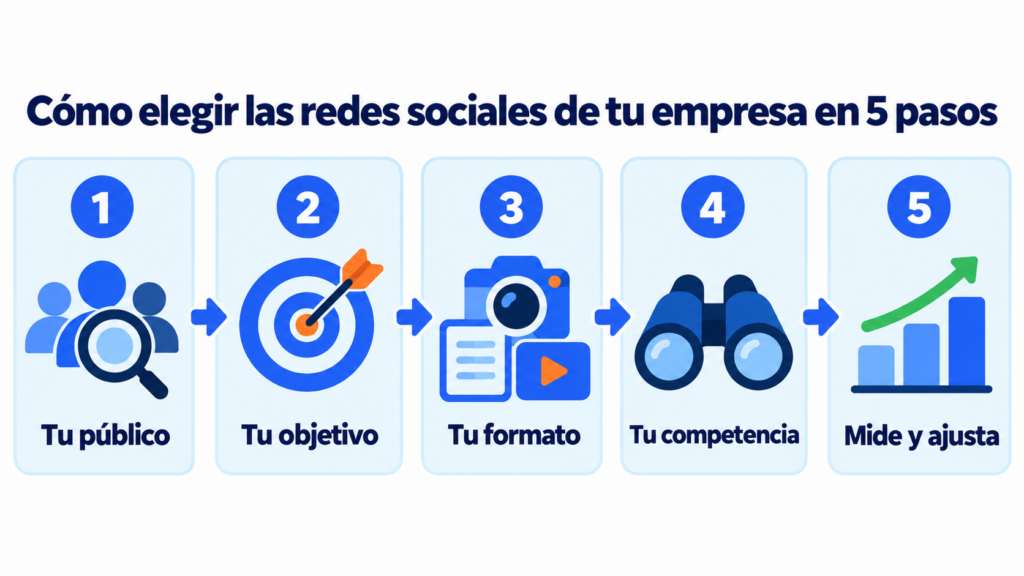
1. Define your audience. Age, interests and where they spend their time. Your buyer persona gives you the answer.
2. Set your goal. Getting your name out there, selling, serving customers or getting subscribers.
3. Choose based on the format you can produce. If you can’t shoot video, start with image or text-based networks.
4. Look at your competitors. Where they are, what they post and what works.
5. Measure and adjust. Check your reach, engagement and website visits every month, and stick with what works.
If you want to reach beyond your followers, you can combine it with ads. We explain how in social ads.
Here’s a starting point for a small business that works on two networks:
| Day | LinkedIn or Facebook | |
|---|---|---|
| Monday | Product or service of the week | Useful tip from your sector |
| Wednesday | Behind the scenes | Customer case study |
| Friday | Question or poll in stories | Invitation to your newsletter |
Your followers aren’t entirely yours. Each network decides how many of them see your posts, and that reach can drop overnight.
Your email list, on the other hand, is yours. That’s why it pays to use social media to get subscribers too: a link to your subscription form in your bio, a lead magnet or a giveaway that requires signing up.
These two templates will help you take the step:
Every Friday we send our subscribers [what they get: tips, news, offers]. No spam, and you can unsubscribe whenever you like.
Want to join? The link is in our bio 👉
Subject: Welcome, [Name]: here’s what you’ll get
Hi [Name],
Thanks for subscribing from our [social network] profile. From now on you’ll get [what and how often].
To get started, here’s [welcome gift or content].
If you feel like it, reply to this email and tell us what you’d like to receive.
That way, people who discover you on social media start getting your newsletters without depending on the algorithm.
Your list, your channel
Send your newsletters to the people who follow you on social media and measure which content works best.
With Mailrelay you can create the form you link to from your social media, send the welcome email automatically and send your newsletters to your whole list. You can also measure which content works best with the statistics for each send.
The free account includes up to 80,000 emails a month and 20,000 contacts, with human support on every plan.
Send your newsletters with Mailrelay
Up to 80,000 emails a month and 20,000 contacts for free, with human support on every plan.
These are the most common questions about social media for businesses.
It depends on your audience: Instagram and Facebook for most B2C businesses, LinkedIn for B2B and TikTok if your customers are young.
LinkedIn, followed by YouTube to explain your product and X in sectors where current affairs are discussed.
As many as you can keep up with consistently. For a small business, two is usually enough.
Instagram or Facebook to showcase the business, and WhatsApp Business to serve customers.
No. Social media helps you get your name out there, and email helps you stay in touch with people who already know you, without depending on the algorithm.
As we’ve seen throughout this article, there are a huge number of social networks today. Each one has its own characteristics and particularities. That’s why it’s important to get to know them thoroughly when choosing the best one for our business.
Are some social networks more profitable than others? Yes, of course — depending on your sector and business field, some social networks will bring you more profit than others.
We hope this post has helped you learn something new and, above all, helped you find out which are currently the best social media platforms for businesses. And you, do you think you’re getting the most out of your business’s social media?
On the other hand, if you’re looking for an email marketing service to sell more, Mailrelay offers you a free account to send up to 80,000 emails to 20,000 subscribers. Sign up now and take advantage of this offer to sell more, for free!
The right social network will always depend on your buyer persona and where they really spend their time.