Buyer persona: what it is, how to create one and free PDF template
How to portray your ideal customer so you can speak to them better, with an example and a fillable template
A buyer persona is a semi-fictional representation of your ideal customer, built from real data. It has a name, an age, goals, problems and a way of making decisions, so your whole team knows who they’re talking to.
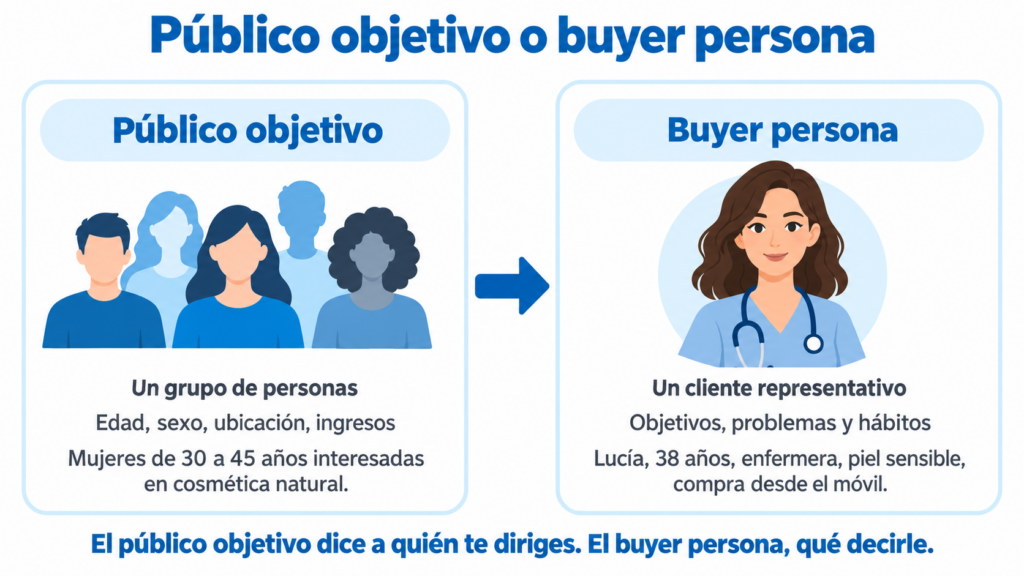
Instead of thinking about “women aged 30 to 45”, you think about Lucía, a nurse with little time and sensitive skin. That makes it easier to write an email, choose a channel or decide what content to publish.
What is a buyer persona?
The term comes from software design. Alan Cooper popularized personas in the late nineties as a way to design with specific users in mind, and marketing adopted the idea to describe the people who buy.
A buyer persona brings together four kinds of information. Who they are: demographics and, in B2B, their job title and company. What they want and what worries them: goals, problems and objections. How they research and decide: channels, influences and buying process. And how you talk to them: the message, channels and content that suit them.
You can have several. The usual approach is to start with two or three and add more when you see a group of customers that doesn’t fit any of them.
What’s the difference between a buyer persona and a target audience?
The two concepts are often confused, but they aren’t the same. The target audience is a broad segment of the population. A buyer persona is a specific person who represents part of that segment.
| Target audience | Buyer persona | |
|---|---|---|
| What it describes | A group of people | A representative customer |
| Type of data | Demographic: age, gender, location, income | Demographic, plus goals, problems, habits and motivations |
| Example | Women aged 30 to 45 in Spain interested in natural cosmetics | Lucía, 38, shift nurse, sensitive skin, shops from her phone |
| What it’s for | Deciding who you’re targeting | Deciding what to say, where and how |
If you want to learn more about the group, see also marketing audiences.
Speak to each buyer persona with its own message
Create a segment for each profile and personalize your emails for free.
What is a buyer persona for?
Having well-defined buyer personas helps you:
- Create content that answers your customers’ real questions.
- Choose the tone and style of your messages.
- Be present on the channels where they look for information.
- Personalize your emails and segment your list.
- Guide them through every stage of the sales funnel.
- Anticipate objections before they hold up the purchase.
It’s the foundation of any inbound marketing and content marketing strategy, and one of the first steps in a marketing plan.
What types of buyer persona are there?
Primary buyer persona. The one who makes the purchase decision. They should be your priority.
Secondary buyer persona. Influences the decision, but doesn’t buy. For example, the technician who recommends a tool to their boss.
B2C buyer persona. Represents an end consumer who buys for themselves. If you sell to individuals (B2C), this is yours.
B2B buyer persona. Represents a professional who buys for their company (B2B). What matters is their job title, their industry, the size of the company and who else is involved in the decision.
Negative buyer persona. The customer you don’t want to target, because your product isn’t a good fit for them or they aren’t profitable. Knowing who they are helps you avoid wasting effort in the wrong place.
How do you create a buyer persona step by step?
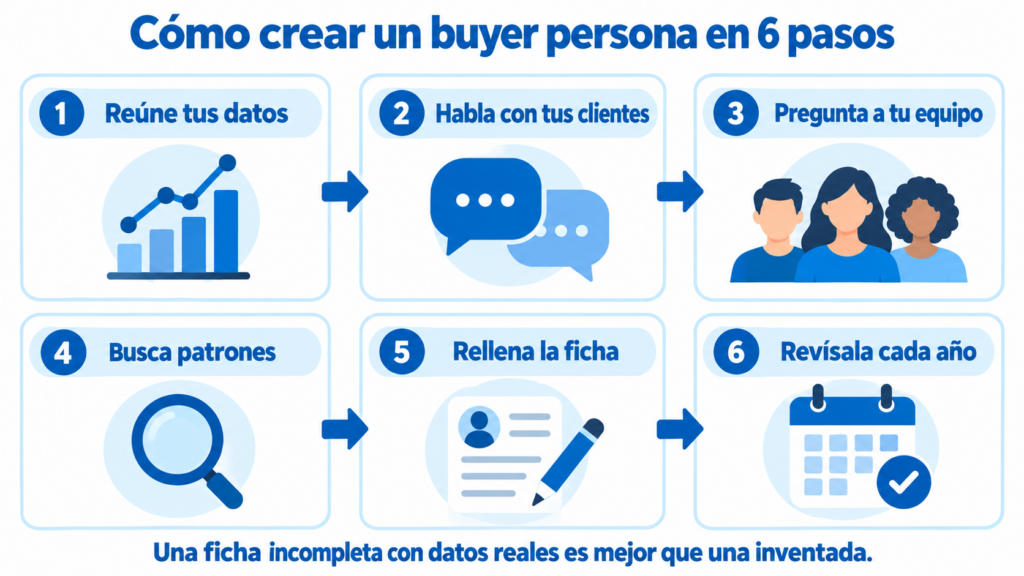
- Gather the data you already have. Stats from your website, your emails, your social media and your store or CRM.
- Talk to your customers. Run short surveys and, if you can, 5 to 10 interviews. Ask why they chose you and what almost stopped them.
- Ask your team. Sales and customer support know the most common questions.
- Look for patterns. Group together customers with similar goals and problems. Each group will be a buyer persona.
- Fill in the profile. Give it a name, an age and a sentence that sums it up. Use the template below.
- Share it and review it. Make sure the whole team uses it, and update it at least once a year or whenever your product changes.
Free buyer persona template (PDF)
We’ve prepared a PDF template you can fill in on your computer or print out. It has two pages: the fillable profile, with four sections (who they are, what they want and what worries them, how they research and decide, and how we talk to them), and a complete example, so you can see what a finished profile looks like.
Download the buyer persona template
2-page fillable PDF: the profile and a complete example. Free, no sign-up required.
Fill in one profile for each buyer persona. If you’re unsure about a field, leave it blank and complete it when you have data: an incomplete profile is better than a made-up one.
Buyer persona examples
B2C example: Lucía, a customer of an online natural cosmetics store
| Field | Lucía |
|---|---|
| Who he is | 38, shift nurse in Valencia, two children. Shops from her phone |
| What he wants | Natural products that work for her the first time |
| What problems he has | Sensitive skin; expensive creams that have irritated her skin |
| What holds him back | The price of a new brand and shipping costs |
| Where he gets information | Instagram, reviews with photos and two newsletters |
| How we talk to him | Weekly email at 9 p.m. with simple routines and one offer a month |
B2B example: Jorge, marketing director at a software company
| Field | Jorge |
|---|---|
| Who he is | 45, marketing director at a 50-employee company in Madrid |
| What he wants | Generate more demos without increasing the budget |
| What problems he has | A small team and tools that don’t talk to each other |
| What holds him back | Setup time and getting approval from the CFO |
| Where he gets information | LinkedIn, comparisons, webinars and case studies |
| How we talk to him | Emails with data and real cases, once a week, and a 20-minute demo |
How do you use buyer personas in email marketing?
Each buyer persona can be a group or a segment of your list. That way you send each one what interests them:
- In the subscription form, ask just enough to know which buyer persona each contact belongs to (for example, “What do you use it for?”).
- Save that data in a custom field and create a segment for each buyer persona.
- Tailor the subject line, content and offer to their goals and objections.
- Set up a welcome sequence for each one, with content that answers their questions. It’s the foundation of lead nurturing.
- Check the stats by segment to see whether your buyer persona matches reality.
If one segment opens a lot and another hardly at all, that buyer persona may need a different message, a different frequency or a review.
How Mailrelay helps you
With Mailrelay you can turn your buyer personas into groups and segments. Subscription forms save custom fields, which you can use to personalize the subject line and content of every email you send. Automations let you create a different welcome for each profile.
After sending, the stats show you opens and clicks per link (on the free account and on Enterprise), so you know what works with each buyer persona.
The free account lets you send up to 80,000 emails a month to 20,000 contacts, with human support on every plan.
Put your buyer personas to work
Forms, custom fields and automations on the free account.
Frequently asked questions about buyer personas
These are the most common questions about buyer personas.
What does buyer persona mean?
It literally means “buyer person”. It’s the semi-fictional profile of your ideal customer, built from real data about your customers.
How many buyer personas should a company have?
It depends on what you sell. To start with, two or three are enough. More than five is usually hard to maintain.
What should a buyer persona profile include?
Basic details, goals, problems, objections, where they get information, who influences their decision and how you talk to them. Our PDF template already includes those fields.
What is a negative buyer persona?
It’s the profile of the customer you’re not interested in, because your product isn’t a good fit for them or they aren’t profitable. It helps you avoid aiming your campaigns at people who aren’t going to buy.
How often should you update a buyer persona?
At least once a year, and whenever your product, your pricing or the type of customers you attract changes.