
If you’re a 21st-century business owner or entrepreneur, your company will have an online presence in every way possible.
So you’ll already know how important it is to rank your website well in search results; you’ll be familiar (at the very least) with the term “keywords.”
But you may be less familiar with the terms “long tail” and “short tail.”
Helping you understand what these terms mean, and learn how to use them to optimize your online presence, is what I aim to do with this article.
Ranking your website with a “short tail” derived from a “long tail” is much easier than tackling rankings by competing with a keyword that everyone else is using for the same purpose of ranking in search engines.
But before we dive in, let’s cover a bit of theory to make sure these strange terms I’m using are perfectly clear. First, I want to explain what the English terms “long tail” and “short tail” mean.
· What Is a “Long Tail” Keyword
The term “long tail” literally means something like a “long tail,” and refers to a short phrase, rather than to keywords used to rank a website or a piece of text in search engines.
Long tail keywords are short phrases that users use to find your services or products.
A keyword could be: social media, lawyers, hair salons, repair shops…
A “long tail” could be: managing social media in Alcalá de Henares, social media to meet people with shared hobbies, cheap lawyers for my divorce in Murcia, modern dog grooming salons, skateboard repair shops in Valencia…
As you can see from these examples, a keyword is one (or two) very generic words that may or may not generate traffic for you.
If you run a motorcycle repair shop in Ciudad Real and rank your website with the generic keyword “repair shop,” a user searching for a shop to fix their skateboard in Valencia might land on your website, but they won’t become a customer because they’re not looking for your services.
What’s more, they’ll leave your website as quickly as they arrived, increasing your bounce rate, which hurts your rankings.

· What Is a “Short Tail” Keyword
Now that you know what “long tail” means, it won’t be hard for you to guess what “short tail” might mean.
Indeed, “short tail” means “short tail” and refers to shorter keywords than those in the “long tail.” In other words, these are the words users type into search engines to find what they’re looking for. They’re usually two-word terms: divorce lawyers, skateboard repair shops, hair salons in Puertollano.
If we use the keyword “lawyers,” we’d get thousands and thousands of results, and most of them would be useless to us because they’re not what we’re looking for.
We’d get law firms hundreds or thousands of kilometers away from us; we’d get lawyers specializing in other areas of law that we don’t need.
But if we rank our website with the “short tail” “divorce lawyers,” we narrow the search terms down to attorneys who specialize in family law and are therefore better equipped to handle our divorce.
The same would happen with the other examples. “Short tails” narrow the search down a bit more and show less generic results, more closely matched to what the user is looking for.

· “Seed” Keyword to Find “Short Tails” to Develop “Long Tails”
This statement might sound a bit confusing, but I’ll explain it clearly.
► “Seed” Keyword
A “seed” keyword (lawyers, repair shops, hair salons…) is a very generic search term. Trying to rank your website or pages (or content) with such generic terms has the advantage of the large number of monthly searches they may have.
But it has the huge disadvantage of being a highly competitive word, meaning a huge number of websites are trying to do the same thing you are, so competition is very high and it’s very hard for your website to rank above the others.
So I believe that unless you’re a highly reputable and prestigious hair salon, a well-known media-savvy lawyer, or a repair shop with its own TV show, you’re better off not wasting time trying to rank for such a generic keyword.
► “Short Tail” Keyword
What we should do is use that keyword to find various “short tails.”
This has several obvious advantages. The first is that you narrow down the search results a bit, so the users who visit you will be higher quality — they’re more likely to land on your website because they’re actually looking for your services or products.
On the other hand, a “short tail” generally doesn’t have the same number of monthly searches as a generic keyword. So they have less competition. And we all know that the less competition there is, the more opportunities there are to rank in better positions.
In a piece of text or in the description of a website or one of its pages, you can use several “short tails” to tell search engines what your website is about.
Let’s go back to the example of the hair salon in Puertollano. It’s obvious that no one from New York would book an appointment at this hair salon just because it showed up in the search results for “hair salons” on Google.
By using “short tails” on the website, we’ll be telling search engines that our hair salon has a number of characteristics: “women’s hair salon,” “hair salon in Puertollano,” “cheap hair salon,” “modern hair salon”…
This way, search engines will know it’s a women’s hair salon in Puertollano that’s affordable and offers modern haircuts.
Each of these “short tails” has far fewer monthly searches than the generic “seed” term “hair salons.” But together, they can match the “seed” term.
► “Long Tail” Keyword
“Long tails” will narrow the search terms down even further. And this has both advantages and disadvantages.
The disadvantages? Since it’s a much more specific term, the monthly searches can end up being almost laughably low. What do 100 monthly searches for a “long tail” mean compared to 500,000 for a “seed”? Comparisons are certainly odious.
At first glance, it seems more reasonable to try to attract those 500,000 people to our website and not make any effort to catch the attention of just 100.
And that’s the mistake. Because when you use a “long tail,” you’re only competing to attract 100 people a month.
But those are 100 people who are, or could be, highly interested in your articles or products.
A million people a month might search for the term “lawyers.” Every law firm website will be competing for that keyword. Not to mention universities, academies, official bodies…
And a guy from Cuenca who writes articles on his free blog and frequently uses the word “lawyers.”
But “cheap divorce lawyers in Murcia,” for example, is only searched by 50 people a month. These are 50 people who live in Murcia, need a divorce, and don’t have much money. They’re 50 potential clients for that family law firm based in Murcia.
Now tell me, as a business owner: which would you prefer, 1,000,000 curious visitors or 50 potential clients?
For a large multinational, 50 new customers placing small orders for soft drinks, clothing, perfume… might not even show up on the bottom line.
But for the vast majority of Spanish businesses (made up of small companies and freelancers), 50 new customers a month can mean a massive increase in workload and profits.

· How to Find Hundreds (or Thousands) of Long Tail Keywords From a Short Tail
By this point in the article, you’ll already understand the importance of ranking your website with a “long tail” strategy instead of fighting the rest of the competition with “seed” keywords or the somewhat less generic “short tail” ones.
Now the problem is knowing which “long tails” users type into search engines to find your business online, right?
You might be wondering: how did I get from “lawyers” to “cheap divorce lawyers in Murcia”?
When it comes to the internet, with just a little searching you’ll find a tool that solves your problem or answers your question.
The same goes for finding “long tail” keywords. There are quite a few paid tools that show you thousands of “long tails” for you to use on your website.
But this time, I’d like to save you some money and show you a more hands-on, but free, way to find the right “long tails” for your business yourself.
And for that, we’re going to use the almighty Google and some of its free tools.
Actually, I’m going to show you two ways to find your best long tail keywords. The first will simply be using Google’s search engine. The second will be using the Google Ads tool.

· Finding “Long Tails” Using Google Search
To show you how to do this, I’m going to focus on the example of divorce lawyers in Murcia.
As I mentioned above, the “seed” keyword (highly competitive) would be “lawyers.” And trying to rank a law firm in Murcia with such a generic word would be foolish.
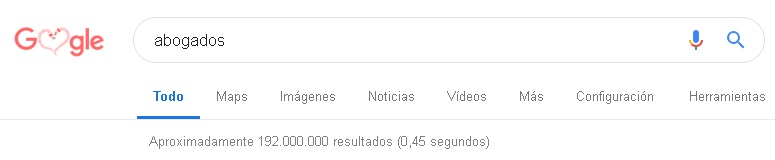
As you can see, that law firm’s website would have to compete against 192 million results — what real chance is there of appearing in the top positions?
Since we already know a few things about searches, keywords, and short and long tails, we should think like a client in Murcia who needs a lawyer to handle their divorce.
Let’s see what happens if I add “in Murcia” to the seed word for one search, and “divorce” for a second search.
By typing “lawyers in Murcia” into the search engine, we’re using our first “short tail,” and Google itself starts suggesting results:
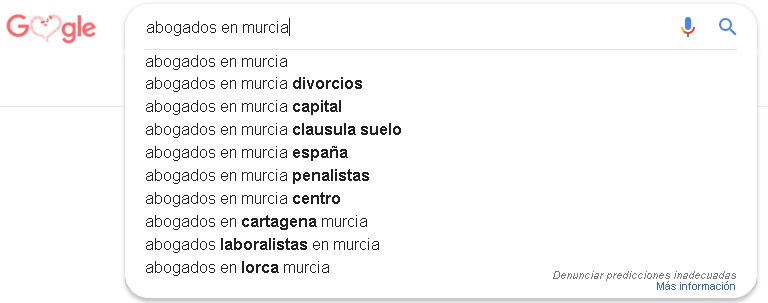
Google itself is already showing us “long tails” that could help us rank our own website. It’s showing us the terms users have used to search for lawyers in Murcia.
But even so, we still have to face competition from 20 million results:

Now let’s try seeing what happens if we type “divorce lawyers” into the search engine:
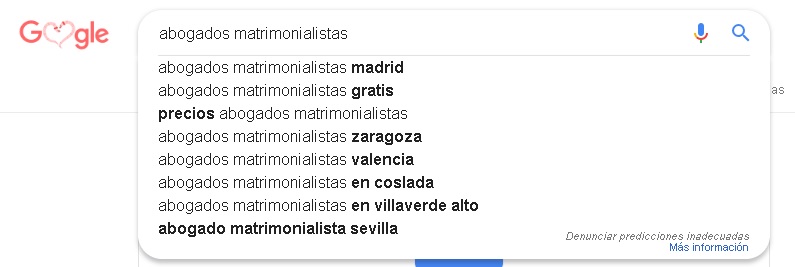
As you can see, people search for divorce lawyers… in their own city. So it seems to make sense for us to use “divorce lawyers in Murcia” as our “long tail.”
Also, the “short tail” “divorce lawyers” already has a much narrower search — we no longer have to compete with millions of websites, just with a good few thousand:
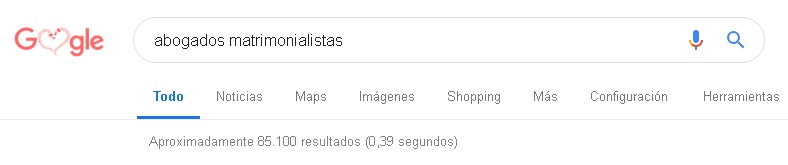
Well then, let’s see what the almighty search engine tells us about our first “long tail”:

Almost 10,000 results. And what’s 10,000 compared to the 192 million for the “seed” word?
But we can still get even more out of Google’s search engine. If we scroll all the way down the page, Google helps us out again:
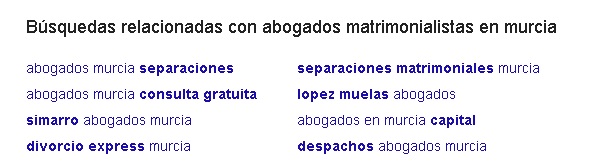
Without spending a single euro and without wasting much time, we now have another 8 “long tails” to use for ranking our website.
I used the term “lawyers” as my “seed,” but here Google is showing me that I could do this same search process for my “long tails” using different main words: divorce and separation.
If I was able to get 9 “long tails” from a single word, “lawyers,” it’s not far-fetched to think I could get another 9 using “divorce,” and 9 more using “separation.”
In just a moment, I already have 27 “long tails” that Google users use to find my services as a divorce lawyer. I also have some words I could use in my content that could work as “short tails,” like “quick divorce,” “free consultation,” “marital separation”
In other words, from one “seed” I get 27 “long tails” and 3 “short tails”
And all by just using Google’s search engine!

· Finding “Long Tails” Using the Google Ads Keyword Planner
The only thing you need to use the Google Ads tool is to sign up with a Gmail address. Completely free.
As soon as you log in, Google gives you two options. We want to find new keywords.
And let’s see what happens when I start searching:
- Lawyers
- Divorce lawyers
- Divorce lawyers in Murcia
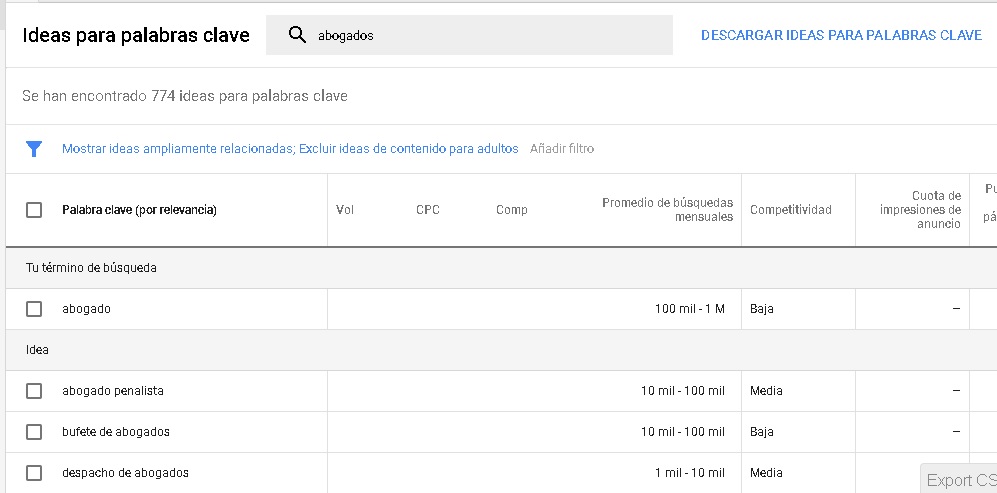
The first thing we see is that the seed term “lawyers” has between 100,000 and 1,000,000 monthly searches.
The more people search for that keyword, the more websites will try to rank for it, the more competition there is, and the harder it is to get a good position in the search results.
But below, we see the ideas Google offers us — 774 “short tails” we can use to find our “long tails.”
But let’s see what happens if we give the tool our own “short tail”:
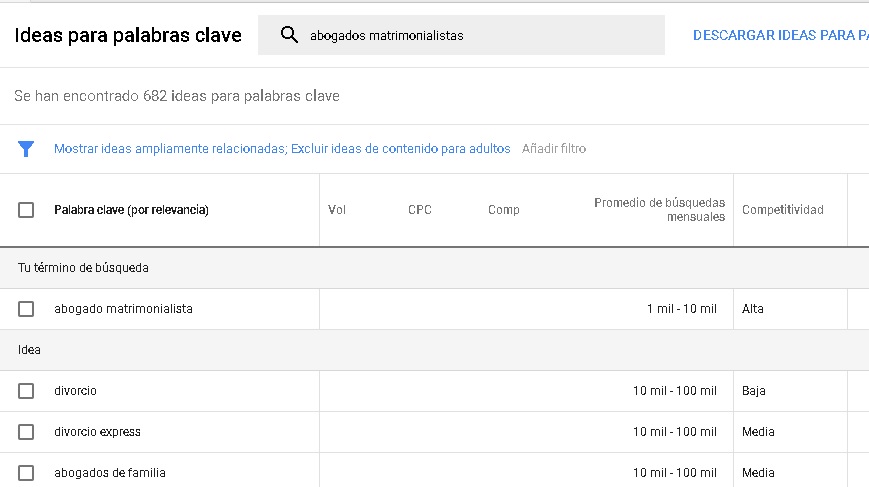
It’s Google itself telling you that this “short tail” has high competition. So it’s better for us not to use it as the pillar of our rankings.
But since it gives us 682 more “short tail” ideas, we now have over 1,400 “short tails” we can look into to see which ones fit our website and its content.
And now let’s see what happens when we type our “long tail” “divorce lawyers in Murcia” into the search engine:
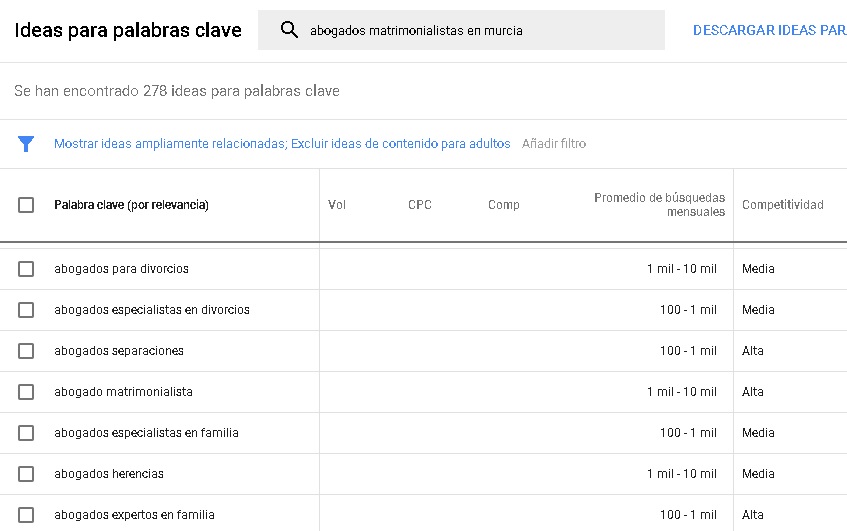
The results give us another 278 ideas for long and short tail keywords.
But here we can already see that the monthly searches have dropped considerably. In these search results, we see many “long tails” with between 100 and 1,000 monthly searches.
Those are the “long tails” we’re interested in using — they’re short phrases used by people who are genuinely interested in hiring a lawyer in Murcia to handle their divorce.
So we’re talking about catching the attention of between 100 and 1,000 potential clients a month. What do you think about that for a small provincial law firm? That could be a huge increase in profits, right?

· Find Your Best “Long Tails” and Rank Your Business in Search Engines
As you’ve seen, without spending a single euro, I’ve managed to gather more than 1,700 terms — “seed,” “short tail,” and “long tail” words — that can help me rank a divorce law firm in Murcia.
Applying this to your own business and industry, you can find an equal or even greater number yourself.
What matters here is finding those “long tails” with few monthly searches, but which represent potential customers who are highly interested in your business, in buying your products, or hiring your services.
So for a small business or a freelancer, fighting for 100 new customers a month is definitely worth the effort. It’s definitely worth trying to rank our website with those “long tails”
Also, you shouldn’t try to rank for just one “long tail.” You can try to do it with several.
The only thing is that they need to be natural and closely related to your business activity. This is because the user who lands on your page needs to find what they’re looking for.
If our lawyer friends don’t practice commercial paper law, for example, even if they find a “long tail” with lots of searches but little competition, they shouldn’t use it — they’d be misleading the user, who would leave their website immediately.
This would cause an increase in their bounce rate, and the almighty Google really doesn’t like that at all.
If you want to keep optimizing your rankings, we recommend reviewing these SEO basics, and to understand the bigger picture, what SEO is.