Long tail SEO: what it is, examples and how to find long tail keywords
Why more specific searches bring fewer visitors, but customers who are more eager to buy
In SEO, the term long tail (in Spanish it is usually translated as “búsqueda de cola larga”) refers to a search that is longer and more specific than usual, made in any search engine, such as Google. Long tail is usually associated with a set of words, but it is really more of a phrase that gives context and shows a very precise intent when searching the internet.
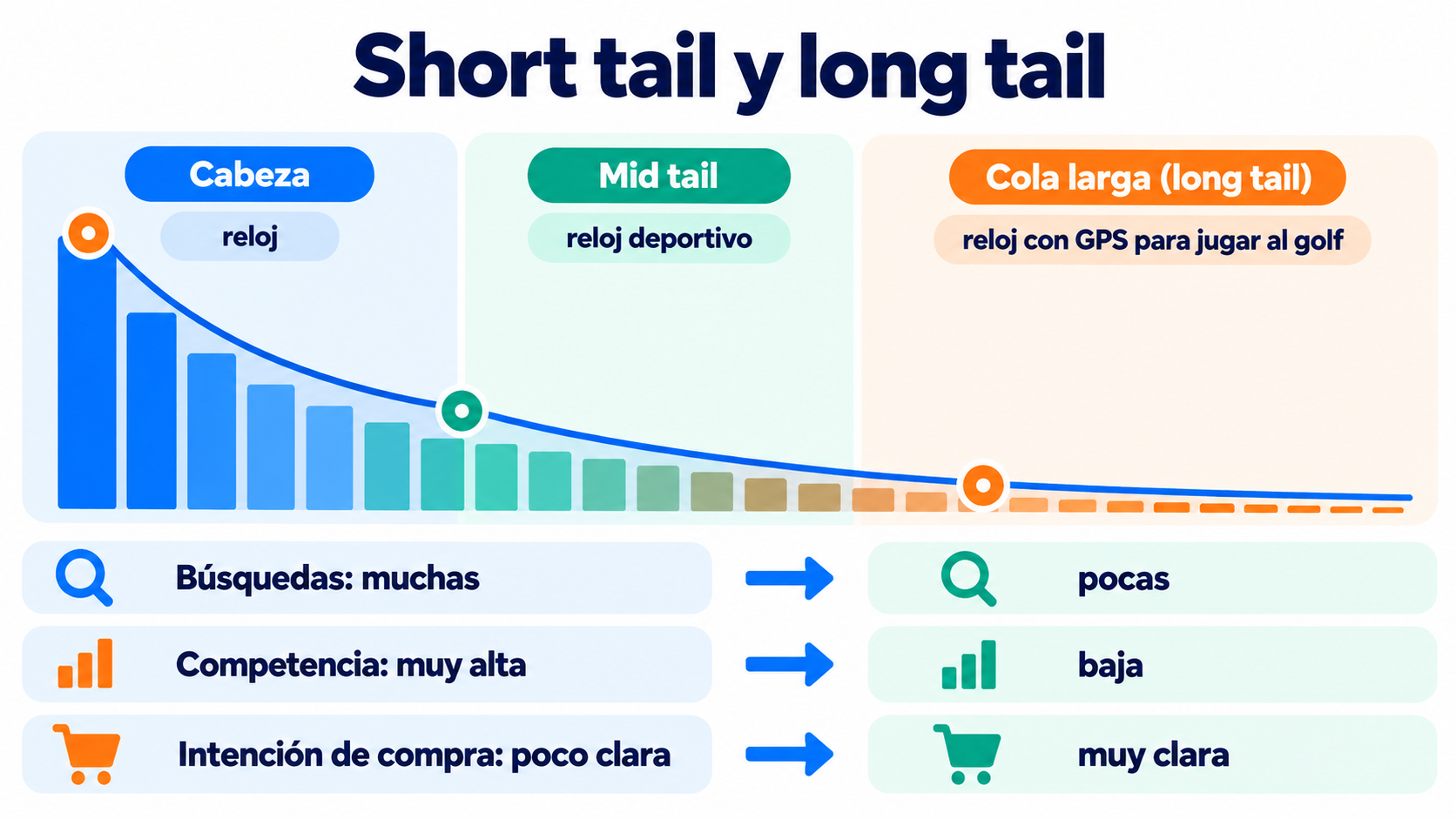
For example, if you only use watch, that is a very generic keyword, since a search returns lots of results matching watch and nothing narrows it down; but if you search for watch for playing golf, that is a long tail keyword or phrase.
Long tail terms or phrases receive fewer searches, but offer users very relevant results. This means that if a website ranks well for several long tail phrases, it will get a very significant volume of qualified traffic that wants to learn more about its services or products.
Examples of long tail keywords
The term was popularized by Chris Anderson in his article “The Long Tail”, published in Wired magazine in October 2004, and later in a book with the same title. Anderson explained that many products with few sales each can, added together, match or exceed the few bestsellers. The same happens with searches in SEO.
According to Ahrefs, almost 93% of the keywords in its US database get fewer than 10 searches a month. Most of what people search for on Google is long tail.
What defines a long tail keyword is not the number of words. What matters is that it is specific and has few searches and little competition. This is how they differ:
| Type | Example | Searches | Competition | Intent |
|---|---|---|---|---|
| Short tail (head terms) | watch | A huge number | Very high | Unclear |
| Mid tail | sports watch | Quite a few | High | Somewhat clearer |
| Long tail | GPS watch for playing golf | Few | Low | Very clear, close to buying |
| Long tail in email marketing | free email marketing tool for an online store | Few | Medium | Looking for a specific tool |
Turn your content’s visitors into subscribers
Add a subscription form to your articles and send each reader what they are looking for. Get started for free with Mailrelay.
Benefits of long tail in SEO
Let others fight over short tail words (the generic ones, where competition is fierce) and take advantage of the benefits that good long tail SEO gives you to win customers.
- Long tail words have much less competition than generic ones (short tail), which makes it easier for us to appear in Google’s top results.
- They increase conversion, since the user is not in the first stage of the sales funnel: they show a very specific interest and their need is very clear. If you know how to help the user at the right moment, they are very close to becoming a customer.
- They reduce the cost of SEM campaigns, since bidding on long tail words costs much less because there is less competition.
- They let you target a very specific market niche at a very reasonable cost or easily improve your ROI.
- Long tail words are a great ally for small and medium-sized businesses that lack the resources to compete with companies that have bigger SEO budgets.
How to find long tail words
Finding long tail words is not a very complex task, all it takes is a little perseverance and experience. However, since experience only comes with practice, here are several ways to find long tail words and start your keyword research:
- Better together. If you can brainstorm with other people in your company, go for it. In this way, you will enrich and locate, at first, many words that are likely to become your next long tail targets.
- Add a geographical location. Create phrases that include locations to capture searches that take into account where the service or product is offered, such as “unfair dismissal lawyer in Madrid”. It’s the foundation of local SEO.
- Put yourself in your clients’ shoes. Think about how they might reach you when they are in front of their computer or mobile phone. The search terms they would use, the words or phrases they would most commonly use and even the most common location you think they search from.
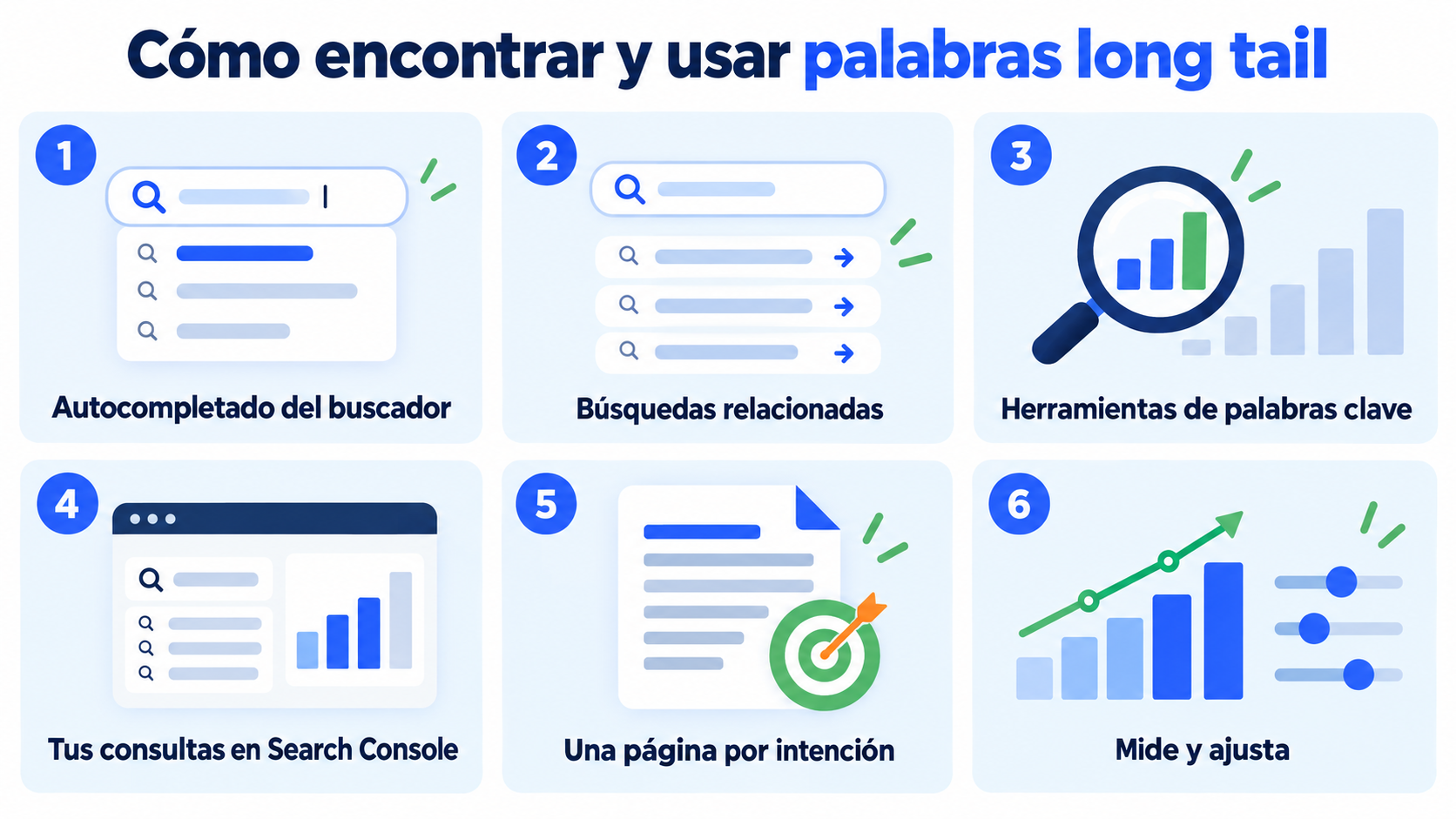
- Related searches. At the bottom of Google’s results there is a section with related searches. It shows terms similar to the one you searched for that also have a notable search volume. The “People also ask” box also gives lots of ideas in the form of questions.
- Google autocomplete, a source of ideas. When you start searching on Google, the search engine itself suggests phrases to complete your search after you type just a few characters. There you will find many long tail keywords.
- Use specialized keyword tools. They can simplify your work and are a great starting point. The standout is the Google Ads Keyword Planner, which requires a Google Ads account, but there are others that can help you too, such as Ubersuggest, AnswerThePublic or the very popular Keyword Tool. They all have a free version with limits.
- Check your own queries in Search Console. The long searches for which you already appear on Google’s second page are the easiest to improve.
How to use long tail words in your content
Finding the words is half the job. The other half is using them well:
- One page per intent, not per variant. “Long tail words” and “long tail keywords” go on the same page. If you make a page for each variant, they compete with each other.
- Use the phrase in the title, in the H1 and at the start of the text, always naturally.
- Answer the question in the first few lines and expand on it afterwards.
- Add frequently asked questions with the variants you find.
- Measure in Search Console which searches bring you visitors and adjust your texts.
Long tail and AI search
With AI assistants, searches are getting longer and more conversational. When it introduced its AI Mode in March 2025, Google said that in testing people asked questions about twice as long as a regular search.
For these answers, AI relies on pages that answer specific questions clearly. Working on long tail prepares you for AEO and for position zero.
Long tail and email marketing
Someone who reaches your website through a very specific search knows what they want. But if they leave without giving you their email, they will most likely not come back.
To avoid losing them, offer a lead magnet or a form related to the page’s topic. Then, split your subscribers by the topic that brought them in and send them content on that topic. That way, each specific search becomes a lasting relationship.
How Mailrelay helps you
With Mailrelay you can create subscription forms with double opt-in and add them to your articles. Then, split your subscribers into groups and segments by topic and welcome them with an automation, also included in the free account.
With the Google Analytics integration you add UTMs to your campaigns and see which visits come from your emails. And the free account includes 80,000 emails a month and 20,000 contacts.
Take your readers from search to your newsletter
Collect emails with double opt-in, split them by topic and send up to 80,000 emails a month for free with Mailrelay.
Frequently asked questions
What is long tail in SEO?
It refers to long, specific searches, each searched only a few times but with a very clear intent. Together they can bring in a lot of qualified traffic.
What is long tail called in Spanish?
It is translated as “cola larga”. People talk about “palabras clave de cola larga” (long tail keywords) or “búsquedas de cola larga” (long tail searches).
How many words does a long tail keyword have?
They usually have three or more, but that is not what defines them. What matters is that the search is specific and has low volume and little competition.
What is the difference between short tail and long tail?
A short tail keyword is generic, with lots of searches and a lot of competition. A long tail keyword is specific, with few searches, less competition and a clearer intent.
Is it worth working on keywords with few searches?
Yes, if they fit what you offer. They are easier to rank for, convert better and, added together, can bring more visitors than a single generic keyword.