Sales funnel
The path your customer takes from discovering your brand to making a purchase
Out of every hundred people who visit your website, only a few end up buying. The rest drop off somewhere along the way. Knowing exactly where they leave, and why, is the key to selling more. That is what a sales funnel is for.
What is a sales funnel?
A sales funnel, also called a conversion funnel or marketing funnel, is a marketing model. It represents the stages a person goes through from the moment they discover your brand until they become a customer.
It is called a funnel because of its shape. Many contacts enter at the top. As they move forward, the number shrinks, and only some of them reach the end: the purchase.
The sales funnel helps you understand that journey and measure how many people move from one stage to the next. That way you can spot where you need to improve. It is a basic tool for both marketing and sales teams.
The stages of a sales funnel
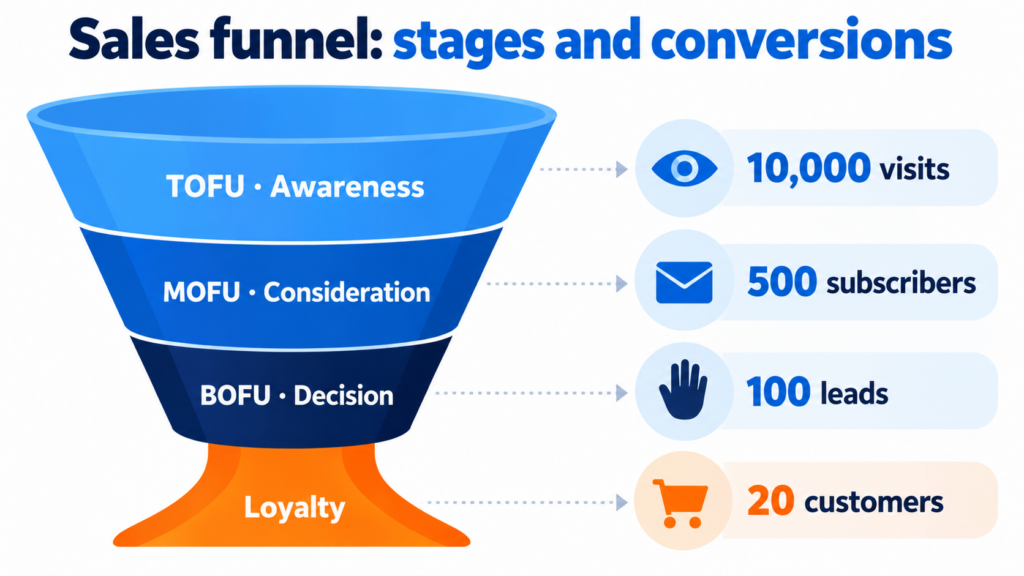
There are many versions of the model, but the most common one splits the funnel into three stages, known by their acronyms: TOFU, MOFU and BOFU.
Top of the funnel (TOFU). This is the awareness stage. The person has a need or a problem and starts looking for information. They don’t know your brand yet, or have barely heard of it. SEO, social media and content marketing work well here.
Middle of the funnel (MOFU). This is the consideration stage. The contact already knows you and is comparing options. They look for guides, comparisons and case studies. It is the right moment to capture their email address in exchange for a lead magnet and turn them into a lead.
Bottom of the funnel (BOFU). This is the decision stage. The potential customer is ready to choose. They need concrete reasons: a demo, a free trial, reviews from other customers or an offer.
If you want examples of content for each stage, take a look at our guide to TOFU, MOFU and BOFU.
After the purchase: loyalty
Many models end with the sale. But the work doesn’t stop there.
A satisfied customer can buy again, purchase complementary products and recommend you. That’s why many companies add a final stage focused on customer loyalty. It increases customer lifetime value and turns buyers into brand advocates.
How to measure a sales funnel
The main metric of a sales funnel is the conversion rate between stages. It tells you what percentage of contacts move on to the next step.
Let’s look at an example. Your website gets 10,000 visits a month. Of those, 500 subscribe to your newsletter, a conversion rate of 5%. Of those subscribers, 100 ask for information or a demo (20%). And 20 of them end up buying (20%).
The overall conversion rate of the funnel is 0.2%. But the interesting part is comparing each step. If the first conversion is very low, the problem is lead capture. If the last one fails, your offer or your checkout process may need some work.
Other useful metrics are customer acquisition cost and average order value. It’s also worth measuring how long it takes a contact to move through the funnel.
How to build your own funnel
These are the basic steps to design one:
- Define your ideal customer: create your buyer persona so you know what they need at each moment.
- Map their journey: identify how they discover you, where they compare options and what makes them decide.
- Create content for each stage: articles to attract, guides to capture and case studies to convince.
- Set up a capture point: a landing page with a form and a clear value proposition.
- Automate your follow-up: a lead nurturing sequence supports each contact until they are ready to buy.
- Measure and optimize: review the conversions at each stage and test improvements with A/B testing.
The role of email marketing in the funnel
Email marketing is present in almost every stage of the funnel. And it is especially useful in the middle, where most contacts are not ready to buy yet.
A welcome email opens the relationship. Then a newsletter with useful content keeps their interest alive. At the decision stage, emails with testimonials, comparisons or offers help close the sale. And after the purchase, follow-up emails encourage repeat business.
In addition, segmentation in email marketing lets you send each contact the message that matches their stage.
Common mistakes
The most common one is focusing only on attracting traffic. If the middle and bottom of the funnel don’t work, more visits won’t turn into more sales.
Another mistake is treating every contact the same way. Sending an aggressive offer to someone who has just discovered you usually scares them away.
And many companies simply forget to measure. Without data for each stage, it’s impossible to know what to improve.
How Mailrelay can help
At Mailrelay we make it easy to guide your contacts through the whole funnel. You can create signup forms, segment your list according to each person’s interests and automate email sequences. You can also see which campaigns generate the most clicks and conversions.
All of this with a free plan that includes up to 80,000 emails per month and 20,000 contacts. If you’d like to try it, you can create your Mailrelay account today.
Frequently asked questions about the sales funnel
Is a sales funnel the same as a marketing funnel? They are often used as synonyms. Some teams use “marketing funnel” for the top and middle stages and “sales funnel” for the final decision, but the model is the same.
What is the difference between a funnel and a customer journey? The funnel focuses on the stages that lead to a sale and on how many contacts move forward. The customer journey describes the customer’s whole experience with your brand, including touchpoints and emotions.
Does every business need a sales funnel? Yes, even if they haven’t defined it. Every customer goes through a process of discovery, consideration and decision. Understanding it helps you improve it.
In conclusion
A sales funnel gives you a clear view of your sales process. You know how many people come in, where they drop off and what makes them buy.
Define its stages, measure each conversion and support your contacts with the right message at every moment. With that foundation, every improvement you make will have a direct impact on your sales.