Although marketing strategies and techniques are constantly evolving, there are always unexpected sources to learn from.
Historical speeches, for example.
In this article, we’ll analyze some examples of world oratory from great orators who have left their mark on the world.
Why?
To uncover the principles and tactics used by some of the most outstanding speakers in history.
And to use them as a source of inspiration for today’s marketing strategies.
Through a detailed analysis of iconic speeches, from the passionate eloquence of Martin Luther King Jr. to the persuasive rhetoric of Winston Churchill.
Martin Luther King Jr.: “I Have a Dream”
On August 28, 1963, in front of a crowd of more than 250,000 people at the Lincoln Memorial in Washington D.C.
Martin Luther King Jr. delivered one of the most iconic and transformative speeches in history: “I Have a Dream”.
This speech became a turning point in the struggle for civil rights in the United States, symbolizing hope and determination in the fight against racial segregation and injustice.
At a time of deep social division, King’s words offered a vision of a fairer, more equitable future, resonating not only in the United States but around the world.
Apply persuasion to your emails
The techniques of great orators also work in email marketing. Find out how with Mailrelay.
A standout example from the “I Have a Dream” speech:
A particularly memorable passage from Martin Luther King Jr.’s speech is where he expresses his vision of a future without segregation and discrimination:
· “I have a dream that my four little children will one day live in a nation where they will not be judged by the color of their skin but by the content of their character. I have a dream today.”
This moment in the speech captures his ability to connect with the audience on a deep emotional level.
King not only presents a vision of hope and change, but does so in a way that is both personal and universal.
He invokes the image of his children and a better future for them.
This way of communicating doesn’t just appeal to logic; it touches the hearts of the audience, something marketing campaigns can aspire to replicate when delivering their messages.
Key elements: emotional power and a call to action:
“I Have a Dream” is an outstanding example of how emotional power and a call to action can capture an audience’s attention and hearts.
King used a mix of personal narrative, biblical references and allusions to historical American documents to create a speech that didn’t just inform.
It also inspired and mobilized.
His ability to weave hope, passion and urgency into his oratory makes him a masterclass in effective communication.
Marketing application: using emotional narratives:
King’s technique of appealing to shared emotions and aspirations can be extremely effective in marketing.
Brands can learn from his approach by building narratives that don’t just promote a product or service, but also resonate emotionally with their audience.
This means telling stories that reflect shared values, aspirations and experiences, creating a deeper, more meaningful connection with consumers.
An example of a marketing campaign inspired by this approach:
A contemporary example of a marketing campaign inspired by this approach could be an advertising initiative from a company committed to equality and social justice.
The campaign could feature real people’s stories.
People who have overcome barriers of discrimination, highlighting how the company’s product or service supports or symbolizes these values of equality and unity.
Like King’s speech, the campaign could use emotional elements and a call to action, encouraging viewers to be part of the change and support the cause.
This application of King’s approach shows something important:
The principles of effective, emotional communication are as relevant in marketing today as they were in the context of the civil rights movement in the 1960s.

Winston Churchill: “We Shall Fight on the Beaches”
On June 4, 1940, in the middle of World War II and after the evacuation of Allied troops from Dunkirk, Winston Churchill delivered one of his most famous speeches:
“We Shall Fight on the Beaches”
This speech, delivered to the House of Commons of the British Parliament, stood out for its resolute tone and its call for unwavering resistance.
Churchill didn’t just inform the British people about the grave military situation; he also instilled a sense of courage, determination and national unity.
This proved vital to the British war effort.
A standout example from the “We Shall Fight on the Beaches” speech:
One of the most iconic and representative passages of Churchill’s speech is the following:
· “We shall fight on the beaches, we shall fight on the landing grounds, we shall fight in the fields and in the streets, we shall fight in the hills; we shall never surrender.”
This excerpt exemplifies Churchill’s ability to instill courage and determination.
He uses repetition and evokes multiple settings to reinforce his message of unwavering resistance.
Key elements. Resilience and determination:
Churchill used powerful, direct rhetoric, mixed with unvarnished realism, to convey both the seriousness of the situation and his unshakable confidence in final victory.
The key phrase, “We shall fight on the beaches”, and his repetition of “we shall fight” across different settings, didn’t just show unwavering determination.
It also served to unite the nation in a common front.
Marketing application. Building resilient, motivating messages:
Churchill’s techniques can be very useful in marketing, especially in situations that require conveying confidence and strength.
Brands can apply this approach when facing a crisis or when positioning themselves in highly competitive markets.
By communicating determination and strength, companies can inspire confidence in their customers and stand out from their competitors.
An example of a marketing campaign inspired by this approach:
One example could be a campaign by an insurance company that emphasizes its strength and reliability in uncertain times.
Using a firm, confident tone, the campaign could highlight how the company has weathered and overcome various crises, reaffirming its commitment to its customers.
This would reflect the spirit of Churchill’s speech, conveying a message of stability and confidence in the future.

Abraham Lincoln: the Gettysburg Address
The Gettysburg Address, delivered by Abraham Lincoln on November 19, 1863, is one of the shortest yet most powerful speeches in the history of the United States.
It was delivered at the dedication of the Soldiers’ National Cemetery in Gettysburg, after one of the bloodiest battles of the American Civil War.
This speech not only honored the fallen, but also redefined the purpose of the war and the nation’s vision.
In just 272 words, Lincoln reaffirmed the ideals of equality and liberty and called for a renewed dedication to the unity of the nation.
A standout example from the Gettysburg Address:
A key passage of Lincoln’s speech is the following:
“…that this nation, under God, shall have a new birth of freedom—and that government of the people, by the people, for the people, shall not perish from the earth.”
This passage captures Lincoln’s ability to condense meaningful, emotional ideas into a few powerful words.
A principle that can be extremely valuable in marketing.
Key elements. Concise, clear messaging:
What makes the Gettysburg Address so remarkable is its incredible concision and clarity.
Lincoln was able to express deep, complex ideas in a simple, direct way, making his message not only understandable but also memorable.
This speech shows how brevity, combined with meaningful content, can have a lasting impact.
Marketing application. The importance of brevity:
In marketing, the ability to communicate a message clearly and concisely is valuable.
Don’t forget that we live in a world where consumers are constantly flooded with information.
Capturing attention and getting a message across quickly and directly is essential.
Brands can learn from Lincoln the importance of distilling their message down to its purest essence, making sure every word counts and the core message is immediately clear.
An example of effective, direct brand communication:
A practical example could be an advertising campaign from a tech company highlighting its flagship product.
Instead of overwhelming people with technical specifications, the campaign could focus on a simple core message: “Technology that makes life simpler”.
This approach, inspired by Lincoln’s concision, ensures that the main message is clear and direct, resonating effectively with the audience.

Turn your words into results
Write persuasive email marketing campaigns and measure their impact with Mailrelay’s tools.
John F. Kennedy: “We Choose to Go to the Moon”
The “We choose to go to the Moon” speech was delivered by John F. Kennedy on September 12, 1962.
This speech not only marked a milestone in the history of space exploration, but also became a symbol of ambition and progress.
In this speech, delivered at Rice Stadium at Rice University in Houston, Texas, Kennedy set out the United States’ bold goal of sending a man to the Moon before the end of the decade.
This speech not only symbolized a nation’s commitment to innovation and exploration, but also inspired future generations to dream big and pursue the impossible.
A standout example from the “We Choose to Go to the Moon” speech:
In his speech, Kennedy said:
“We choose to go to the Moon in this decade and do the other things, not because they are easy, but because they are hard…”
This passage perfectly illustrates how Kennedy used rhetoric to turn a technical challenge into a symbol of humanity’s capacity for great achievements.
His emphasis on the difficulty and ambition of the lunar project resonates with the idea that brands should aim high and communicate that ambition in a way that inspires and motivates.
Key elements. Inspiring vision and ambition:
Kennedy stood out for his ability to communicate a stimulating, bold vision.
His speech went beyond the technical features of the space mission to focus on the broader meaning of this feat:
The human desire to explore and reach new horizons.
His inspiring approach and his call to action captured the public’s imagination, injecting a sense of urgency and possibility into the space race.
Marketing application. How to convey a vision of the future:
In marketing, the ability to project and communicate a vision of the future is crucial to inspiring and motivating consumers.
Brands can learn from Kennedy the importance of looking beyond the present, dreaming big and setting bold goals.
By sharing a vision of the future that is both inspiring and achievable, companies can motivate their audience to embark on a journey with them, creating a deep and lasting connection.
An example of marketing strategies that aim high and motivate:
An example of this could be a campaign by a renewable energy company that focuses on its vision of a future that is sustainable and carbon-free.
Like Kennedy’s speech, the campaign could highlight not only the technical aspects of its products, but also how they contribute to a brighter, healthier future.
This approach doesn’t just inform; it also inspires and mobilizes the audience toward a common goal.

Sojourner Truth: “Ain’t I a Woman?”
Sojourner Truth, a prominent abolitionist and women’s rights advocate, delivered her powerful speech “Ain’t I a Woman?” at the Women’s Rights Convention in 1851.
At a time when the struggle for civil rights and gender equality was in full swing, Truth boldly addressed the intersections of race and gender in her speech.
She challenged contemporary notions of what it meant to be a woman in American society.
A standout example from the “Ain’t I a Woman?” speech:
Note: the best-known version of the speech was published by Frances Dana Gage in 1863; the first record, from 1851, is worded somewhat differently.
A standout part of Truth’s speech is when she says:
“That man over there says that women need to be helped into carriages, and lifted over ditches, and to have the best place everywhere. Nobody ever helps me into carriages, or over mud-puddles, or gives me any best place! And ain’t I a woman?”
This passage not only demonstrates her ability to connect with her audience on an emotional level.
It also serves as a call to recognize the strength and capability of all women, a message that remains relevant and moving today.
Key elements. Emotional force and a call for equality:
In her speech, Truth used her personal experience as a Black woman to challenge the perceptions of weakness and submissiveness traditionally associated with women.
Her direct, passionate approach, along with rhetorical questions such as “Ain’t I a woman?”, made a powerful case for equality.
And for recognizing the contributions of all women, regardless of their race.
This speech highlights the importance of incorporating meaningful social messages that are authentic into brand communication.
Companies can draw inspiration from Truth to address issues of equality and social justice, showing a genuine commitment to these values.
This strategy not only raises awareness of crucial issues, but also can strengthen the brand’s relationship with audiences who value authenticity and social responsibility.
An example of a marketing campaign inspired by this approach
One example could be a campaign by a beauty company that celebrates and promotes diversity and inclusion.
The campaign could feature women of different backgrounds, ages and body types, highlighting their unique stories and achievements.
And connecting this with the brand’s message of inclusive, empowering beauty.
Like Truth’s speech, this campaign could focus on empowerment and equality, resonating with an audience that values representation and equity.
Nelson Mandela: “Inaugural Address”
Nelson Mandela’s “Inaugural Address”, delivered on May 10, 1994, marked a momentous point in the history of South Africa and the world.
This speech was given in the context of the abolition of apartheid and Mandela’s election as South Africa’s first Black president.
His message not only celebrated a new beginning for his nation, but also symbolized the victory of justice, equality and reconciliation over decades of segregation and oppression.
A standout example from the Inaugural Address:
An iconic part of Mandela’s speech is when he says:
“Let freedom reign. The sun shall never set on so glorious a human achievement!”
This excerpt captures Mandela’s vision of a future based on freedom and equality for all.
A concept that can inspire brands to create messages that don’t just sell, but also celebrate and promote these universal values.
Key elements. A message of unity and reconciliation:
Mandela’s speech stood out for its powerful vision of unity and hope.
Instead of focusing on the painful past, he chose to look toward a shared future, emphasizing the importance of reconciliation and cooperation among all South Africans, regardless of race.
His ability to instill hope and promote unity at a time of great change is an outstanding example of leadership and effective communication.
Marketing application. Promoting universal values and unity:
This approach of Mandela’s is hugely relevant in today’s marketing, especially in campaigns that seek to highlight universal values such as unity, diversity and inclusion.
Brands can draw inspiration from his example to create messages that don’t just promote products or services.
They also reflect a commitment to broader social values, creating a deeper resonance with their audience.
An example of a marketing campaign inspired by this approach:
A marketing campaign that could reflect this approach would be one from a global organization that promotes cultural diversity and inclusion in its operations.
The campaign could highlight stories of collaboration and success among people of different cultures and backgrounds, underlining the importance of working together toward common goals.
Inspired by Mandela, the campaign could convey a message of optimism and unity, showing how diversity enriches and strengthens society.
Conclusion
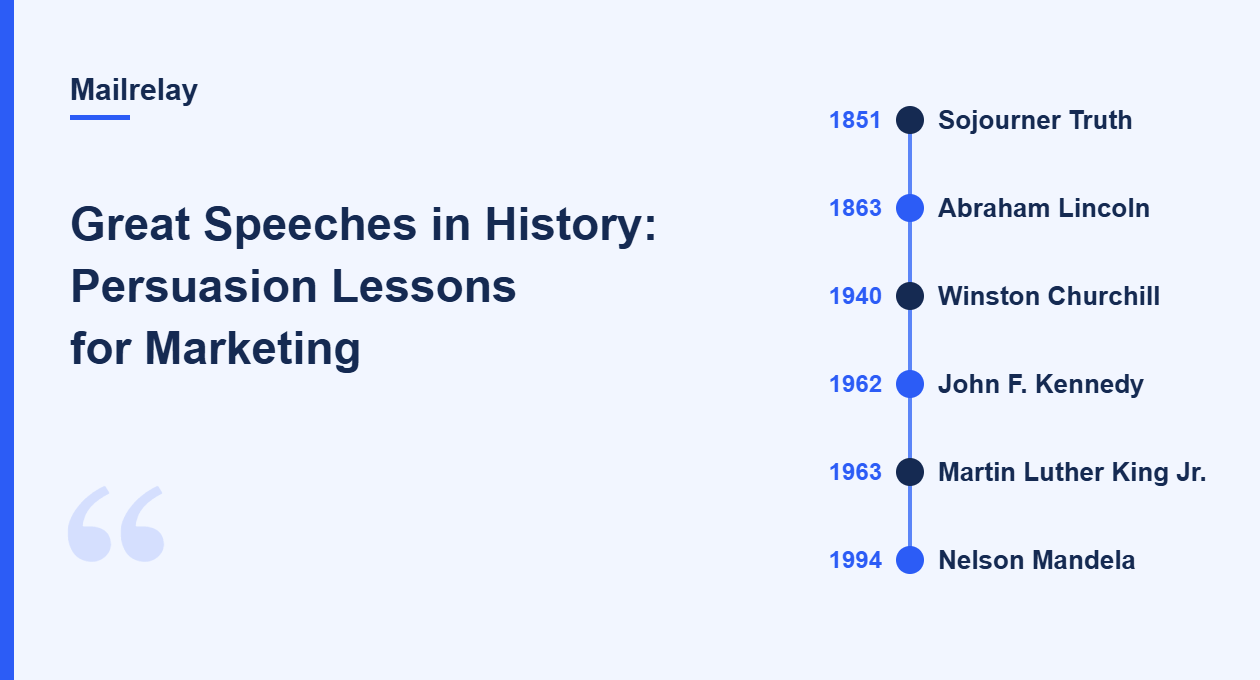
This analysis of historical speeches shows that the effective communication techniques of leaders such as Martin Luther King Jr., Winston Churchill, Abraham Lincoln, John F. Kennedy, Sojourner Truth and Nelson Mandela are timeless and applicable to modern marketing.
The ability of these speeches to inspire, connect emotionally and convey clear, powerful messages offers key lessons for today’s brands.
By integrating these principles into their marketing strategies, companies can create more resonant, meaningful campaigns that don’t just promote their products
But also reflect universal values and build authentic connections with their audience.
Bring persuasion to the inbox
Design, send and analyze memorable email marketing campaigns with Mailrelay.
Behind these speeches lies carefully crafted storytelling, backed by a very careful use of loaded words in written persuasion.

Jose Argudo
CMO at Mailrelay. Writes about email marketing, copywriting, and conversion for small businesses and entrepreneurs.