Advertising campaigns: what they are, types and how to create one step by step
From the goal to the last ad: how to plan a campaign people remember
An advertising campaign is a set of coordinated ads that share a goal, a message and an audience, and that run in one or more media over a specific period.
It can be used to build brand awareness, launch a product, boost sales in a particular season or generate leads. What sets it apart from a one-off ad is planning: every piece pushes in the same direction.
What is an advertising campaign?
A campaign brings together several pieces, such as search ads, social media posts, radio spots or posters, under a single creative idea.
For example, an online store that wants to sell more at Christmas can combine Google ads, short videos on social media and a series of emails to its customers. All with the same slogan, the same offer and the same dates.
If you are only interested in the online side, check out our post on digital advertising.
Elements of an advertising campaign
Every campaign is built on these elements:
| Element | What it defines | Example |
|---|---|---|
| Goal | What you want to achieve and how you will measure it | Sell 500 units in a month |
| Target audience | Who you are addressing | Women aged 25 to 40 who exercise |
| Message | The main idea you want to get across | “Train wherever you want, whenever you want” |
| Creative concept | How it is told: tone, images and slogan | Real videos of customers working out at home |
| Media | Where it runs | Social media, search engines and email |
| Budget | How much you invest and how you split it | €3,000, 60% on social media |
| Schedule | When it starts and when it ends | From January 1 to 31 |
| Measurement | Which metrics you will track | Clicks, sales and cost per sale |
Types of advertising campaigns
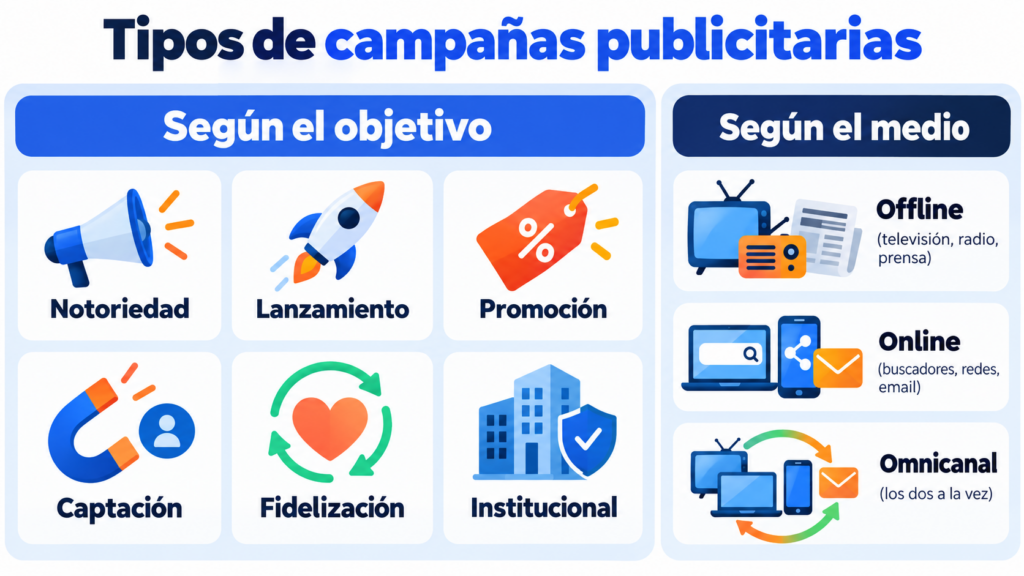
Campaigns can be classified by their goal and by the media they use.
By goal:
| Type | What it’s for |
|---|---|
| Awareness or branding | Getting people to know and remember the brand |
| Launch | Introducing a new product or service |
| Promotional | Selling more for a limited time, with an offer |
| Lead generation | Getting leads or subscribers |
| Loyalty | Getting customers to buy again |
| Institutional or social | Conveying the brand’s values or raising awareness of a cause |
By channel: offline campaigns use TV, radio, print or outdoor advertising. Online campaigns use search engines, social media, websites, video or email. Many combine both and are called 360 or omnichannel campaigns.
How to create an advertising campaign step by step
- Set a measurable goal. “Get 300 subscribers in a month” can be measured. “Get our name out there” can’t.
- Define your audience. Describe your ideal customer or buyer persona: age, interests, problems and where they spend their time.
- Write the briefing. Sum up the goal, audience, message, budget and dates in one document. You’ll find a template in our post on briefing.
- Create the message and the pieces. Look for a simple idea and adapt it to each format.
- Choose the media and split the budget. Prioritize the channels where your audience is.
- Launch and measure. Review the results every few days and adjust what isn’t working. If you can, test two versions with an A/B test.
- Analyze when it’s over. Compare the results with the goal and note what you would repeat and what you wouldn’t.
Add email to your next campaign
Send the offer to your subscribers with Mailrelay and track opens, clicks and sales in real time.
Examples of advertising campaigns
These three campaigns are often studied. All three turned a simple idea into a brand story:
| Campaign | Brand and year | Idea |
|---|---|---|
| “Just Do It” | Nike, 1988 | A short slogan that encourages anyone to exercise, whatever their level |
| “Real Beauty” | Dove, 2004 | Real women instead of models to challenge beauty standards |
| “Share a Coke” | Coca-Cola, 2011 | Cans and bottles printed with first names, to give as gifts and share on social media. It started in Australia |
What they have in common is a clear message, consistent across all media and designed to get the audience involved.
Advertising campaigns and email marketing
Email is one of the most cost-effective channels in a campaign. Unlike ads, you don’t pay for each impression, because you are writing to people who already know you.
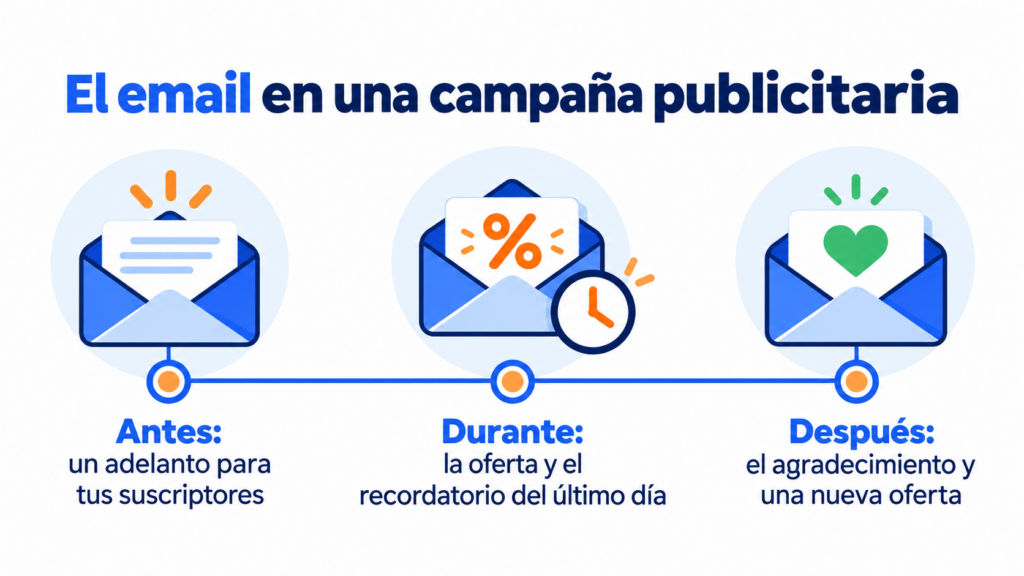
Here’s how it fits into each stage:
- Before: announce the campaign to your subscribers with a sneak peek or early access.
- During: send the offer to each segment with its own message and remind them of the end date.
- After: thank those who bought and offer something else to those who didn’t.
Ads can also capture subscribers through a landing page, and email turns them into customers over time. You’ll find more ideas in our post on email marketing campaigns.
How Mailrelay helps you
With Mailrelay, you create your campaign emails with the drag-and-drop editor and send them to each group of subscribers. Then you see opens and clicks in real time.
You can run A/B tests to choose the best subject line and send yourself a test email before each send.
The free account lets you send up to 80,000 emails a month to 20,000 contacts, with chat, ticket and phone support.
Launch your campaign with Mailrelay
Up to 80,000 emails a month to 20,000 contacts with the free account, with chat, ticket and phone support.
Frequently asked questions about advertising campaigns
What is an advertising campaign? It is a set of coordinated ads, with the same goal, message and audience, that run in one or more media over a specific period.
What types of advertising campaigns are there? By goal: awareness, launch, promotional, lead generation, loyalty and institutional. By channel: offline, online or combined.
What are the steps to create an advertising campaign? Set a goal, define the audience, write the briefing, create the message, choose the media, launch and measure, and analyze the results.
What is the difference between an ad and an advertising campaign? An ad is a single piece. A campaign is the set of ads and actions that share a goal, a message and a schedule.
How long does an advertising campaign last? It depends on the goal. A promotion can last a few days, and an awareness campaign several months.