AOV
How much each customer spends on average in your store
Imagine two online stores that receive 1,000 orders a month. The first one brings in 30,000 euros and the second one, 60,000. They have the same customers and put the same effort into acquisition, but one earns twice as much. The difference lies in how much each customer spends per purchase. That is what AOV measures.
What is AOV?
AOV stands for Average Order Value. It is a metric that shows how much a customer spends on average each time they buy from your store over a given period.
It is one of the basic indicators of any ecommerce business. Together with the number of visits and the conversion rate, it explains where your revenue comes from.
In brick-and-mortar retail, the term “average ticket” is more common. In practice, they mean the same thing.
How to calculate average order value
The formula is simple:
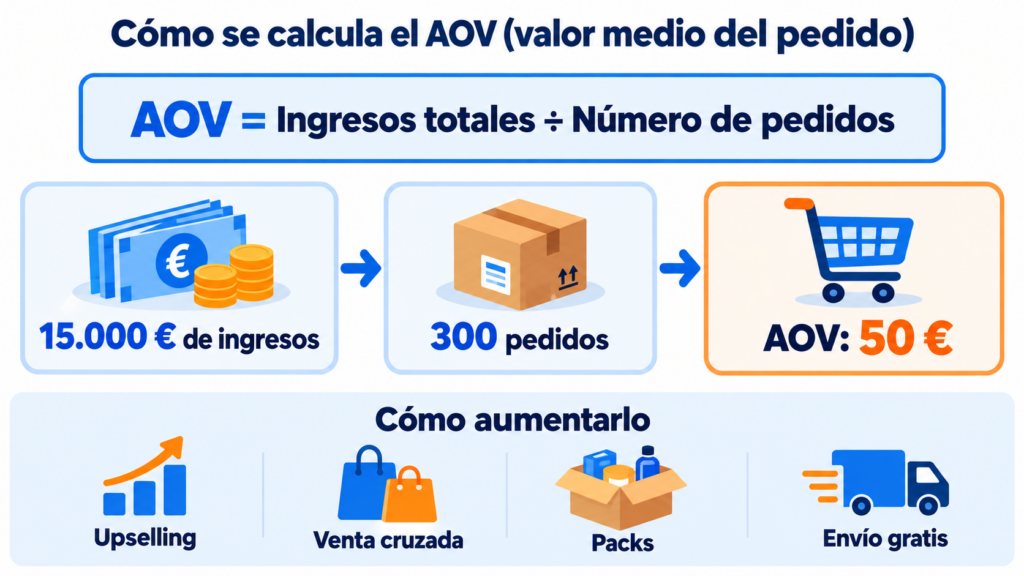
AOV = total revenue ÷ number of orders
For example, if you bring in 15,000 euros from 300 orders in a month, your average order value is 50 euros.
But before calculating it, you should decide what to include. Do you count shipping costs? What about taxes? Do you subtract returns? There is no single answer. What matters is always applying the same criteria so that month-to-month comparisons are reliable.
If you use Google Analytics, you will find this figure in the ecommerce reports. Most online store platforms also show it in their dashboard.
Why AOV matters
Your revenue depends on three levers: how many people visit your store, how many of them buy and how much they spend on each order. AOV is the third one, and often the easiest to move.
Acquiring a new customer costs money in advertising, content or discounts. Getting someone who is already buying to add one more product to their cart costs much less. That is why raising your average order value directly improves the profitability of each sale and the ROI of your campaigns.
It also helps you make decisions. If you know how much a customer spends on average, you can work out how much you can afford to invest to win each order. And set realistic revenue targets.
AOV, average ticket and CLV: the differences
These three concepts are often confused, although they measure different things:
- AOV: what a customer spends on average in a single order.
- Average ticket: the same concept, under a name more common in physical stores and restaurants.
- CLV: the total value a customer generates throughout their entire relationship with your brand, adding up all their purchases.
AOV is a snapshot of each transaction. CLV, on the other hand, is the whole movie. Ideally, you should work on both: bigger orders and repeat customers.
How to increase AOV
These are the most widely used techniques, and almost all of them can be combined:
- Upselling: offer a premium version of the product the customer is looking at. Upselling works well when the upgrade is clear and the price jump is reasonable.
- Cross-sell: cross-selling suggests complementary products. Cases with a phone, or a protective spray with leather sneakers.
- Packs and bundles: group several products together with a small discount. The customer perceives a saving and you sell more units per order.
- Free shipping threshold: set it slightly above your current AOV. If your average order is 45 euros, offering free shipping from 50 euros encourages customers to add one more item.
- Volume discounts: “10% off orders over 80 euros” or “3 for 2” are classic formulas that still work.
- Personalized recommendations: show products based on each customer’s history, on the product page or in the cart.
- Loyalty programs: reward those who spend more with perks they can redeem on their next purchase.
A word of warning: don’t force the sale. If the suggestions have nothing to do with what the customer is looking for, they are annoying and can lead them to abandon their cart.
How email marketing helps increase AOV
Email marketing is one of the most effective channels for increasing average order value. Because it lets you reach each customer with the right offer at the right time.
Post-purchase emails are a clear example. After an order, you can send suggestions for complementary products with a small incentive for the next purchase. You can also use your confirmation transactional emails to include recommendations.
Segmentation is another key tool. An RFM analysis helps you identify your highest-spending customers. You can offer them premium products. To those who buy less, bundles or volume promotions.
And on dates such as Black Friday, combining email with an SMS campaign reinforces offers with a minimum purchase threshold.
How we help you at Mailrelay
At Mailrelay, we make it easy for you to turn your campaigns into bigger orders. You can segment your contacts based on their purchase history and create post-purchase automations. You can also measure which links and products get the most clicks.
All of this on a free plan of up to 80,000 emails a month and 20,000 contacts. If you want to try it, you can create your Mailrelay account today.
Frequently asked questions about AOV
What is a good AOV? It depends on the industry and the type of product. An electronics store will have a much higher average order than an accessories store. The most useful thing is to compare yourself with your own progress.
Does AOV include shipping costs? It may or may not include them. What matters is always using the same criteria when calculating it.
How often should I measure AOV? The usual practice is to review it every month. And also before and after each major campaign, to see its real impact.
In conclusion
AOV is one of the simplest metrics to calculate and one of the most useful for improving your online store’s profitability. It tells you how much each sale is worth and shows you a way to grow without relying solely on acquiring more customers.
With techniques such as upselling, cross-selling or a well-set free shipping threshold, along with well-segmented email campaigns, each order can be worth a little more.