Copywriting: what it is, types, formulas and examples
Formulas and examples for writing copy that drives action
Copywriting is the art and science of writing persuasive texts that will convince readers to act.
Although it sounds simple, it is a much more complex discipline than it seems.
Copywriting professionals must create content that connects with the audience, makes an emotional impact and motivates readers to take a specific action, such as buying a product, subscribing to a newsletter or downloading a free resource.
Why is copywriting so important in marketing?
Copywriting is key because everything in marketing is based on communication.
Whether we are talking about a Google ad, an email or a landing page, the copy is what conveys the message.
Without a solid copywriting strategy, your marketing efforts are not likely to have the impact you are looking for.
The goal of copywriting is ultimately to sell.
But it’s not just about selling products, it’s also about selling ideas, persuading people to trust your brand or convincing them to keep reading your content.
In addition, copywriting has a direct impact on conversion.
Think about the last time you bought something online.
What was it that convinced you to click the buy button?
The text probably had a lot to do with it.
Good copy doesn’t just inform, it also stirs emotions, solves problems and guides users toward the action you want them to take.
Key principles of copywriting
When it comes to copywriting, there are several principles we should always keep in mind.
It is not simply a matter of writing paragraph after paragraph.
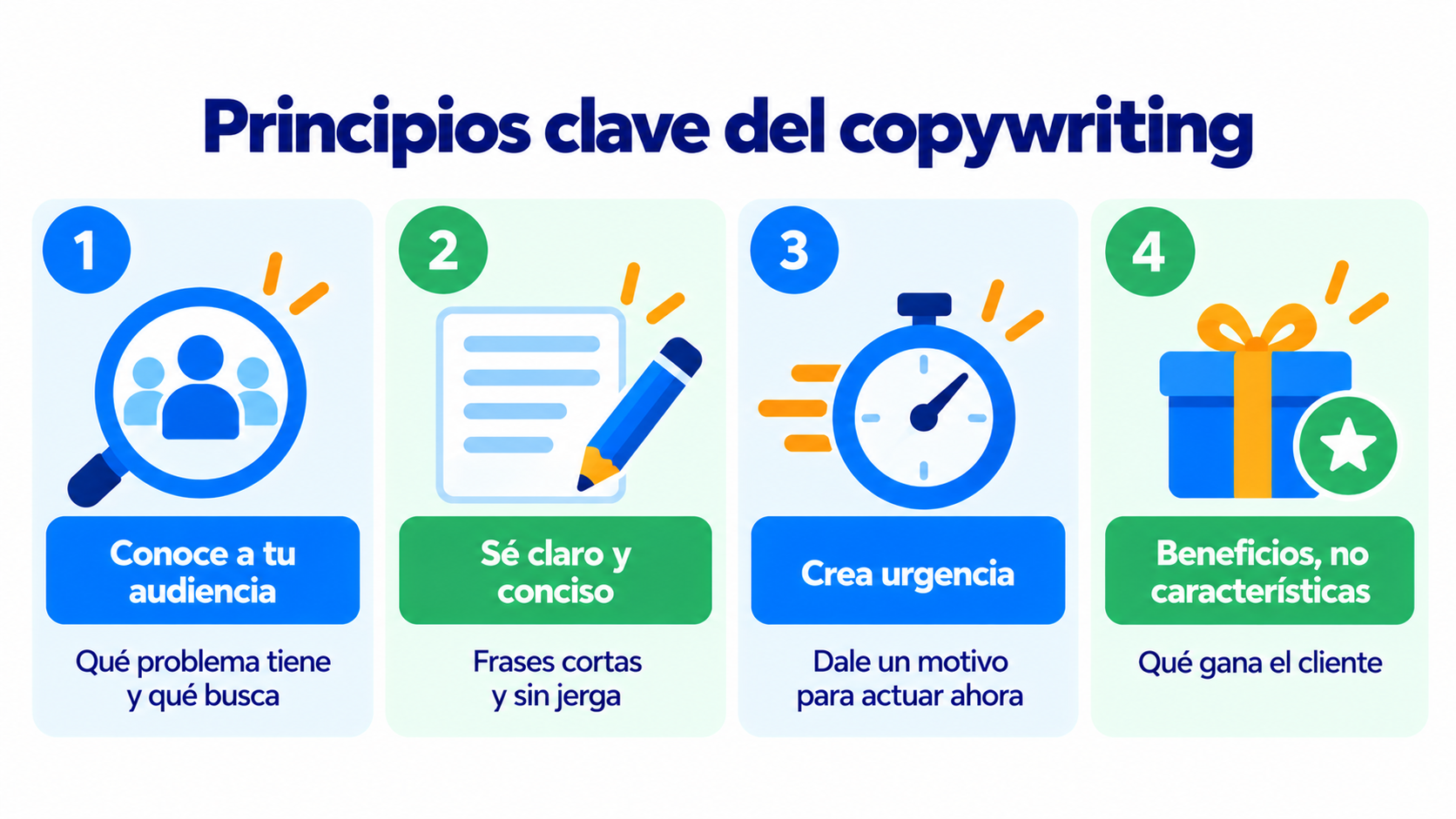
Copywriters follow certain rules to ensure that their message is effective:
Write emails that convince
Create your campaigns with the Mailrelay editor and its AI assistant to improve your copy. Start for free.
Know your audience
The first step in any copywriting strategy is to understand who you are talking to.
What is their problem? What solutions are they looking for? How do you speak to them so that they really care about what you have to say?
The better you understand your audience, the more effective your message will be.
Keep it clear and concise
No one has time to read endless paragraphs that don’t get to the point.
A good copywriter knows how to convey a clear message in a few words.
Avoid unnecessary jargon or complicated sentences. Remember, the goal is for your audience to immediately understand what you are offering.
Create urgency
The best advertising copy often plays on urgency.
“Limited offer”, “Last chance” and “Today only” are common phrases that prompt immediate action.
If the reader feels they can wait to make a decision, they probably will.
On the other hand, if they feel they must act now, they are more likely to do so.
Focus on benefits, not features
Brands often make the mistake of focusing on what their product does, rather than what it can do for the customer.
Users are not interested in technical specifications as much as they are interested in how the product or service will solve their problems or improve their lives.
Copywriting formulas
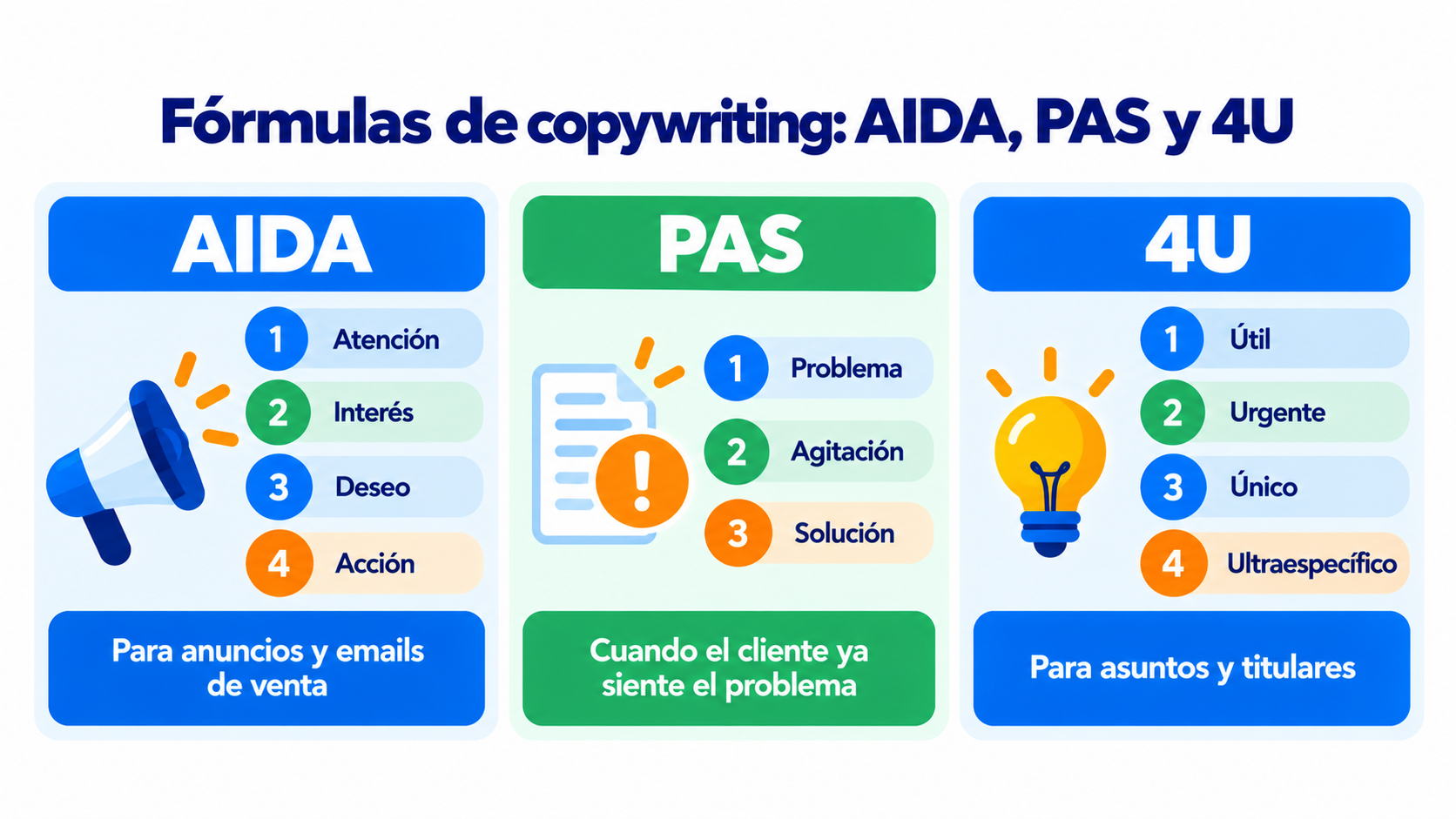
Formulas help you structure a text so that it leads the reader step by step to the action. These are the most widely used:
| Formula | Steps | When to use it |
|---|---|---|
| AIDA | Attention, Interest, Desire and Action | Ads, landing pages and sales emails |
| PAS | Problem, Agitation and Solution | When the customer already feels the problem |
| 4U | Useful, Urgent, Unique and Ultra-specific | Email subject lines and headlines |
| Before, after, bridge | How things are now, how they could be and how to get there | Success stories and welcome emails |
You’ll find more examples in the post on the 5 copywriting formulas.
Copywriting and its role in SEO
SEO (Search Engine Optimization) and copywriting are closely related.
Good copy is not only attractive to readers, but also to search engines.
This is what is known as SEO copywriting, which involves writing content optimized for specific keywords to help improve rankings on Google, Bing and other search engines.
However, it’s not about flooding the text with keywords.
Effective SEO copywriting will balance the needs of the reader with those of the search engines.
Content must be useful, relevant and of quality, but it must also be optimized for search engines so that it will be properly ranked.
This is where factors come into play, such as text structure, proper use of headings (H1, H2, H3), keyword density and content length.
Types of copywriting
Although the term copywriting covers a wide range of activities, we can divide it into several categories according to the objective and the medium in which it is used:
| Type | Where it’s used | What it’s after |
|---|---|---|
| Advertising | Search engine, social media, radio or TV ads | Getting the user to click or buy |
| Website | Home page, product pages, landing pages | Getting the visitor to understand the offer and take the next step |
| Subject lines, email body and buttons | Getting the subscriber to open, read and click | |
| SEO | Articles and pages designed for Google | Attracting traffic from search engines |
| Social media | Social media posts and ads | Getting engagement and followers |
| UX or microcopy | Buttons, forms and website messages | Making the website or app easy to use |
Advertising copywriting
This is probably the most traditional type and the one most associated with the term.
It refers to the texts used in advertisements for television, radio, Internet banners, among others.
Its objective is to directly persuade the viewer or reader to take an action, such as buying a product or service.
Web content copywriting
Here we talk about the texts written for web pages.
The main objective of this type of copywriting is to inform and guide the user within a website.
It includes everything from the home page to product descriptions and “About us” sections.
While they are not always overtly persuasive in tone, their function is to ensure that visitors understand what the company offers and what to do next.
Copywriting for email marketing
In the world of email marketing, copywriting carries a lot of weight.
Emails must be engaging, direct and persuasive to capture the recipient’s attention in a sea of emails.
Good copy in an email marketing campaign can make the difference between an email that gets ignored and one that generates clicks and conversions.
To achieve this, the subject line, the call to action and the body of the message must work together to motivate readers to take the desired action, such as subscribing, making a purchase or downloading content.
Copywriting and the importance of email marketing
When it comes to digital marketing, one of the most powerful channels remains email.
Although many people may think email marketing is a thing of the past, the reality is that it is still one of the most effective ways to reach your audience directly.
This is where copywriting becomes an indispensable ally.
Every word you include in your emails can make the difference between a potential customer opening your email or sending it directly to the trash.
Copywriting in email marketing must be strategic.
From the subject line to the email body, everything must be designed to capture the reader’s attention in a matter of seconds.
In addition, email copywriting can help build a closer relationship with your audience.
Using a warm, friendly tone, personalizing your messages and offering useful content are some of the keys to succeeding with copywriting in email marketing.
Here are three examples of subject lines and buttons depending on the goal of the email:
| Email goal | Subject line | Button text |
|---|---|---|
| Welcome | “You’re in: your getting-started guide is waiting” | “Get started” |
| Offer | “Until Sunday only: 20% off your first order” | “Use my discount” |
| Abandoned cart | “Forgot something? Your cart is still saved” | “Complete my purchase” |
To write the rest of the email, see how to work on the subject line, the preheader, the email body and the call to action. On the blog you’ll also find the elements of copywriting and the most influential copywriters.
What makes a good copywriter?
Being a good copywriter is not just about having writing skills.
It is also about having a deep understanding of consumer psychology and knowing how to adapt your message according to the context and audience.
The best copywriters know how to put themselves in their readers’ shoes, anticipate their objections and offer solutions in an engaging and persuasive way.
On the other hand, a good copywriter is also a good researcher.
Before writing a single word, they must research the product, the audience and the market to ensure that their message is relevant and effective.
And, of course, a good copywriter is always willing to keep learning and improving their skills, because the marketing world is constantly changing.
How Mailrelay helps you
Copywriting is much more than just writing pretty words.
It is a key strategic tool in any digital marketing campaign, as it allows you to connect with your audience and persuade them to take action.
Moreover, in an increasingly competitive environment, having an effective copywriting strategy can be the difference between success and failure for your business.
While mastering this skill takes time, it is well worth the effort for those looking to maximize the results of their marketing campaigns.
With Mailrelay you can put copywriting into practice in every send:
- AI assistant in the editor to improve the copy of your emails.
- A/B tests to check which subject line or copy gets more opens and clicks.
- Custom fields to include the subscriber’s name or details of their purchase.
- Click statistics per link (opens and clicks on the free account and on Enterprise) to see which button works best.
The free account includes 80,000 emails a month and up to 20,000 contacts.
Find out which copy works best
Compare two subject lines with an A/B test and send up to 80,000 emails a month for free with Mailrelay.
Frequently asked questions
What is copywriting?
It is the writing of persuasive texts that aim to get the reader to do something specific: buy, subscribe, click or request information.
What does a copywriter do?
They write the copy for ads, websites, emails and social media. Before writing, they study the customer, the product and the competition to know which message will convince them.
What is the difference between copywriting and content writing?
Copywriting seeks an immediate action, such as a purchase or a click. Content writing informs or teaches, and aims to attract visitors and build trust over the long term.
What is the AIDA formula?
It is a way of structuring a text in four steps: grab Attention, spark Interest, create Desire and ask for Action.
How is copywriting applied in email marketing?
In the subject line, so they open the email. In the body, so they keep reading. And in the button, so they click. A/B tests help you find out which copy works best.