CPA (cost per acquisition): what it is, how to calculate it and how to lower it
How much each sale, sign-up or subscriber costs you and how much you can afford to pay without losing money
**CPA (Cost Per Acquisition) is what it costs you, on average, to get a conversion: a sale, a sign-up, a subscriber or any other action you care about. In Spanish, it is called coste por adquisición**.
If you invest €500 in a campaign and get 25 sales, your cost per acquisition is €20 per sale.
What does CPA mean?
It stands for Cost Per Acquisition, although it is also read as Cost Per Action. The term is used in two ways:
As a metric. It shows how much each conversion in a campaign has cost you.
As a payment model. The advertiser only pays when the agreed action happens, not for each click or impression. It is the usual model in affiliate marketing.
The “acquisition” can be whatever you decide: a purchase, a quote request, a download or a sign-up to your newsletter.
CPA formula
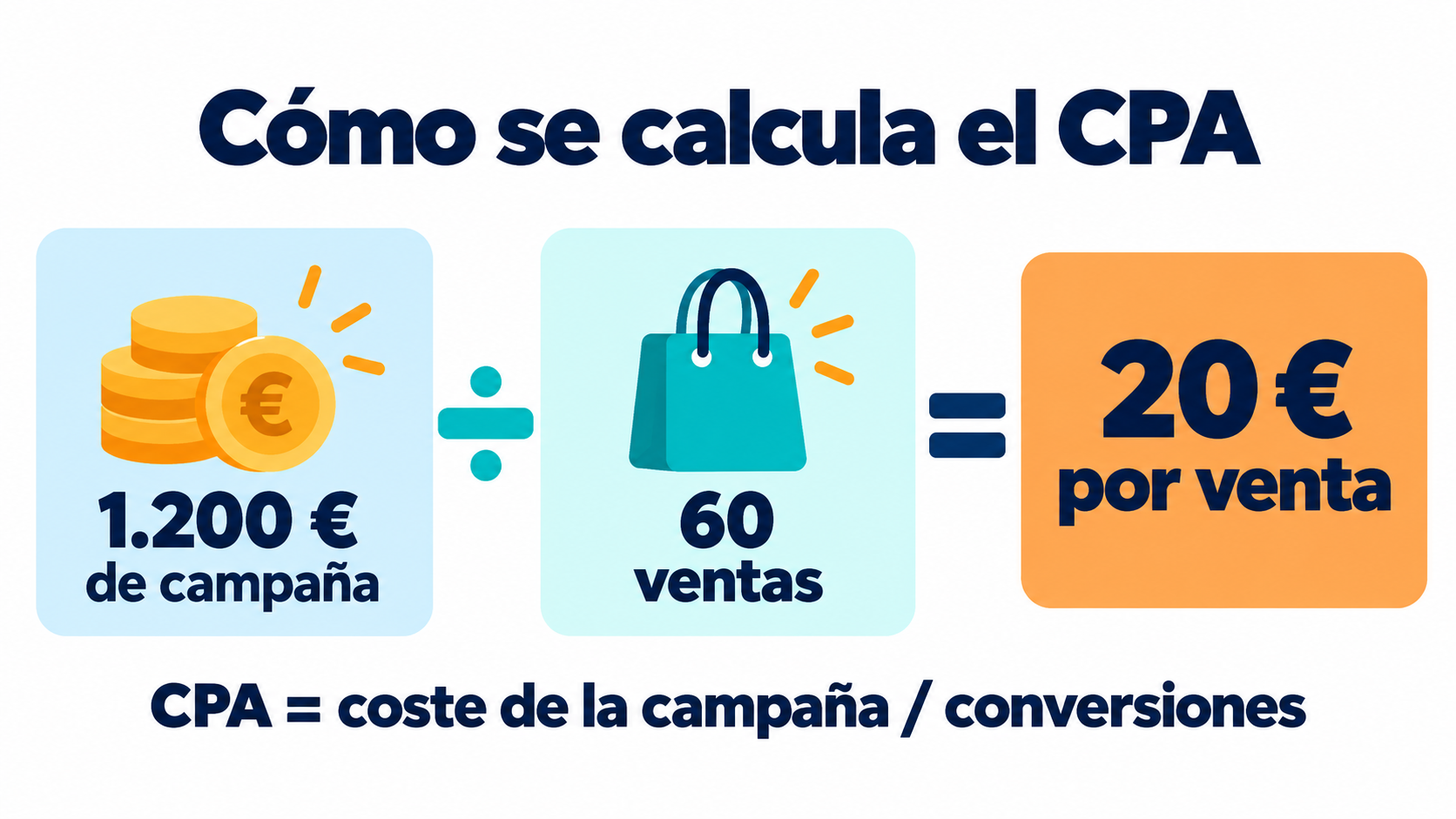
CPA = total campaign cost / number of conversions
The cost should include everything the campaign needed: ads, design, tools or commissions.
Calculation examples
An online store invests €1,200 in search ads and sells 60 orders. 1,200 / 60 = €20 per sale.
A training academy spends €300 on social media ads to promote a free guide and gets 150 downloads. 300 / 150 = €2 per contact.
A software company pays its affiliates €30 for each new customer. Its cost per acquisition in that channel is fixed: €30.
CPA, CPC, CPM, CPL and CAC: the differences
| Metric | What it measures | You pay or calculate per… |
|---|---|---|
| CPM | Cost per thousand impressions | Every 1,000 times the ad is shown |
| CPC | Cost per click | Each click on the ad |
| CPL | Cost per lead | Each contact you get |
| CPA | Cost per acquisition | Each conversion you define |
| CAC | Customer acquisition cost | Each new customer, adding up all marketing and sales |
The former is usually measured per campaign or per channel. CAC looks at the business as a whole: everything you spend to win customers, divided by the number of new customers.
Get sales without paying for every click
Capture subscribers with Mailrelay forms and turn them into customers with your emails.
What is a good CPA?
It depends on what you earn from each conversion. The limit is set by your maximum CPA: what you can spend without losing money.
Maximum CPA = sale price − product cost − other costs per order
If you sell a product for €80 and, after deducting the product, shipping and commissions, you have €30 left, your cost per acquisition should not exceed that €30.
| Profit per sale | Maximum CPA | €25 CPA |
|---|---|---|
| €20 | €20 | You lose €5 per sale |
| €30 | €30 | You earn €5 per sale |
| €60 | €60 | You earn €35 per sale |
If your customers buy again, you can afford to spend more on the first sale. What counts is the customer lifetime value.
How to lower your CPA
1. Refine your audience. The more the people who see the ad resemble your ideal customer, the cheaper each conversion becomes.
2. Improve the landing page. A clear, fast landing page with a single goal increases the conversion rate.
3. Simplify the form. Every extra field makes someone give up.
4. Test variants. Compare copy, images and offers with an A/B test.
5. Pause what doesn’t convert. Keywords, ads or audiences with a cost per conversion above your maximum.
6. Optimize conversion. CRO aims to turn more visits into sales without increasing spend.
7. Make the most of people who already know you. Converting a subscriber is much cheaper than converting a stranger.
CPA and email marketing
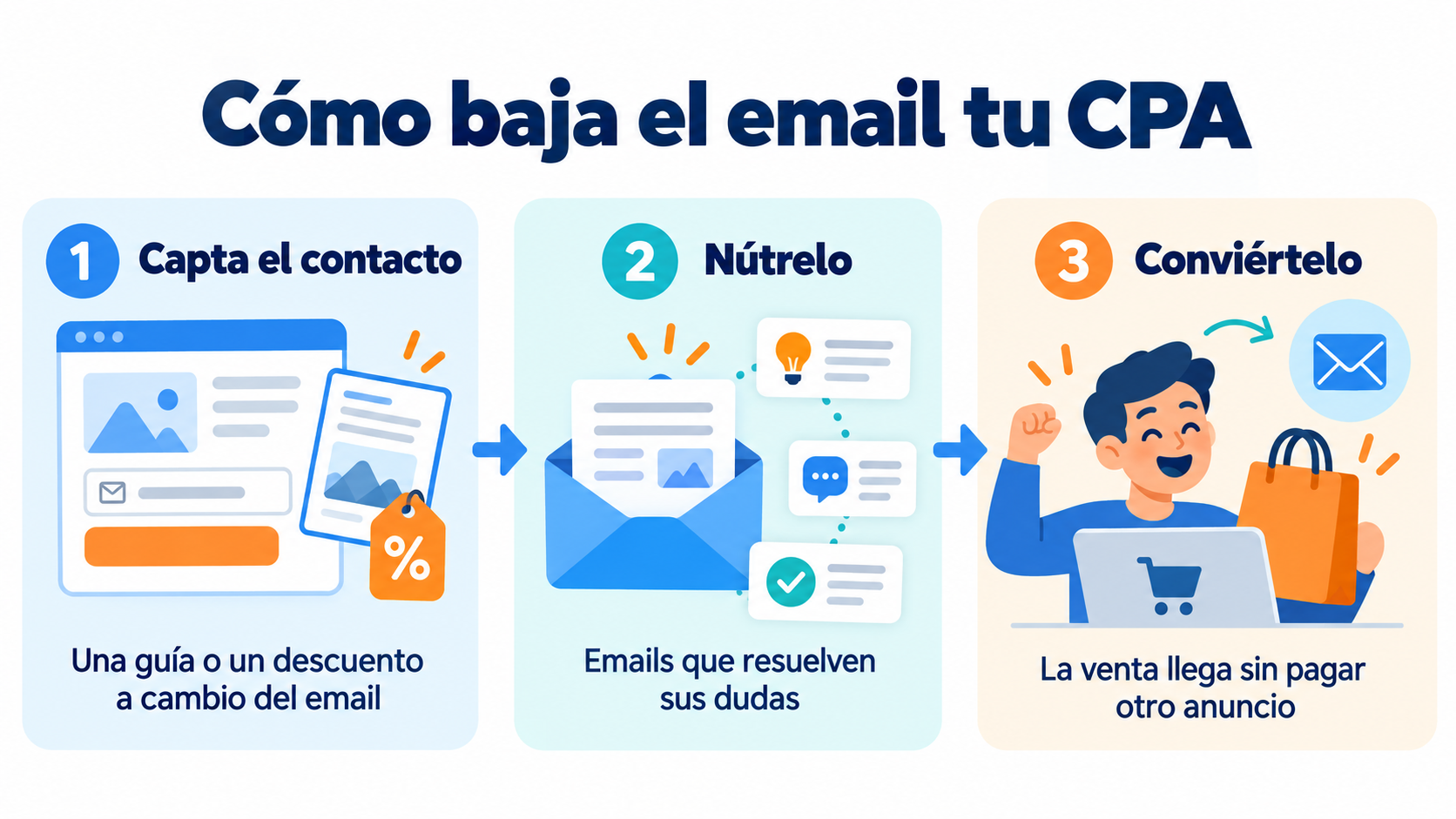
Email is one of the channels with the lowest cost per acquisition, because you are talking to people who have already given you their permission:
Capture before you sell. Many visitors don’t buy the first time. If you get their email address with a guide or a discount, you can convert them later without paying for another ad.
Calculate what each email sale costs you. Divide what the tool and creating your campaigns cost you by the sales they generate.
Recover lost sales. An abandoned cart email closes purchases you had already paid to attract.
Nurture your contacts. A lead nurturing sequence supports people who aren’t ready to buy yet.
Common mistakes
Counting only ad spend. If you forget design, tools or commissions, the real cost is higher than what you see.
Comparing different conversions. A sale doesn’t cost the same as a download. Measure each type separately.
Chasing the lowest cost at any price. A cheap contact who never buys ends up being expensive.
Ignoring repeat purchases. A returning customer justifies a higher initial cost.
Getting attribution wrong. If several channels claim the same sale, each one’s cost per conversion looks lower than it really is.
How Mailrelay helps you
With Mailrelay, you can capture subscribers with forms, send campaigns to your contacts and automate welcome and abandoned cart emails. Click statistics and UTM parameters help you see which sales come from each mailing.
The free account includes up to 80,000 emails a month and 20,000 contacts, with human support by chat, ticket and phone.
Send your newsletters with Mailrelay
Up to 80,000 emails a month and 20,000 contacts for free, with human support on every plan.
Frequently Asked Questions
These are the most common questions about this metric.
What is CPA in a nutshell?
What it costs you, on average, to get a sale, a sign-up or another action.
How is CPA calculated?
Divide the total campaign cost by the number of conversions you got.
What is the difference between CPA and CAC?
Cost per acquisition is measured per campaign and per type of conversion. CAC adds up all marketing and sales spend and divides it by the number of new customers.
What is the difference between CPA and CPC?
With CPC, you pay for every click, whether or not the person buys. With pay per acquisition, you only pay when there is a conversion.
What is target CPA?
A bidding strategy offered by some ad platforms. You set how much you want to pay per conversion and the platform adjusts its bids to get close to that figure.