Email subject line
The line that decides whether your email gets opened, with examples for every type of message
Before you open an email, the first thing you read is a single line. Based on it, you decide whether to open it now, leave it for later or delete it without a second look. That line is the email subject line.
In a personal email, it just needs to be clear. In an email marketing campaign, it also makes the difference. It separates a newsletter that gets read from one that gets lost in the inbox.
What is an email subject line?
The email subject line is the short phrase that sums up what the message is about. It’s also called the subject or the subject line. In email clients, it appears as a field of its own, right below the recipient.
Technically, it’s one of the message’s headers: the one that starts with “Subject:”. It’s not part of the email body, but it’s what the recipient sees before opening it.
It’s optional: you can send an email without a subject line. But it’s not a good idea. Many readers ignore those emails, and some filters treat them with suspicion.
What the subject line is for
The email subject line has three jobs. The first is to inform: it says what the message is about without having to open it. The second is to persuade, because it’s the main reason someone decides to open an email. And the third is to organize: it helps you find the message weeks later with the search bar.
In the inbox, the subject line never appears alone. It’s read together with the sender name and the preheader, the preview text that comes right after it. Together, the three make up a small ad for your message.
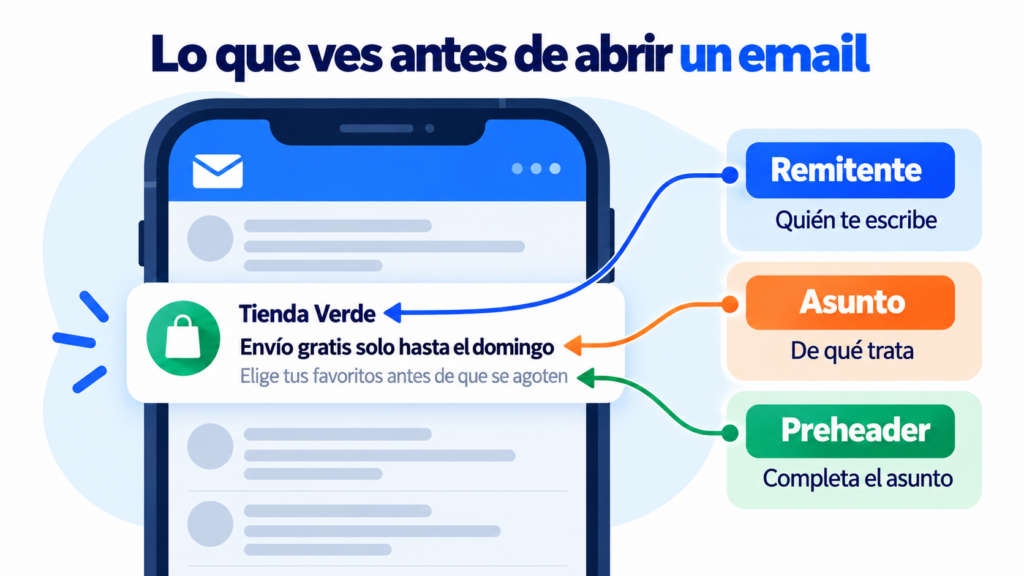
That’s why it’s best to write them together.
The preheader should complete the email subject line, not repeat it.
What to write in an email subject line
It depends on the type of message. A work email needs precision; a newsletter needs a hook. Here are some examples:
| Email type | What it should convey | Sample subject line |
|---|---|---|
| Professional | The topic and, if needed, the action you expect | Website quote: shall we review it on Thursday? |
| Job application | The position and your name | Application for UX Designer – Laura Gómez |
| Newsletter | The main content of the issue | 5 ideas to boost your Christmas sales |
| Promotion | The offer and its deadline | Free shipping only until Sunday |
| Transactional | What happened, straight to the point | Your order 4521 is on its way |
| Welcome | A greeting and the next step | Welcome to Tienda Verde: here’s your 10% off |
When you reply to an email, keep the original subject line with “RE:” in front. That way the conversation stays grouped and nobody loses track. The same goes for forwarding a message, which adds “FW:” or “Fwd:”.
How to write a good email subject line
There’s no magic formula. It’s copywriting in very little space. Even so, the subject lines that work best usually follow these guidelines:
- Short, with the important part first. On mobile, only about 30–40 characters are visible, depending on the app and the screen. Anything after that may get cut off.
- Clear rather than clever. Readers should know what they’re going to find. A cryptic subject line gets ignored.
- Consistent with the content. If you promise something the email doesn’t deliver, you lose trust. That’s the problem with clickbait.
- Personalized when it adds value. Including the subscriber’s name or city can help. See how to apply personalization in email marketing.
- One emoji, at most. It grabs attention, but not every email client displays them the same way. Here’s how to add emojis to the subject line.
- With real urgency, not made-up urgency. “Last 24 hours” works if it’s true.
If you’re looking for inspiration, our blog has 20 original subject line examples for your newsletters.
Subject lines that end up in spam
Some habits trigger antispam filters or simply make readers suspicious. The most common ones are writing the email subject line in ALL CAPS and overusing exclamation marks or currency symbols. Also typical spam words, such as “free!!!” or “make money”.
Today, however, your reputation carries more weight than specific words. If your subscribers open your emails and don’t mark them as spam, a subject line with “free” will get through without any problem. We explain it in deliverability.
There are also legal limits. In the United States, the CAN-SPAM Act prohibits misleading subject lines. In Spain, the LSSI requires commercial communications to be identified as such. That said, since 2007 it’s no longer mandatory to start an email subject line with “publi”.
Test which subject line gets your emails opened most
With Mailrelay, you can run A/B tests on subject lines and senders and send the winning version to the rest of your list.
How to tell if a subject line works
To evaluate an email subject line, the classic metric is the open rate. But since 2021, Apple Mail Privacy Protection has been marking many emails that nobody has read as opened. So look at clicks too: the CTR tells you whether the subject line attracted the right people.
The most reliable way to choose is an A/B test. You send two versions of the subject line to a small part of your list, and the rest receives the winner.
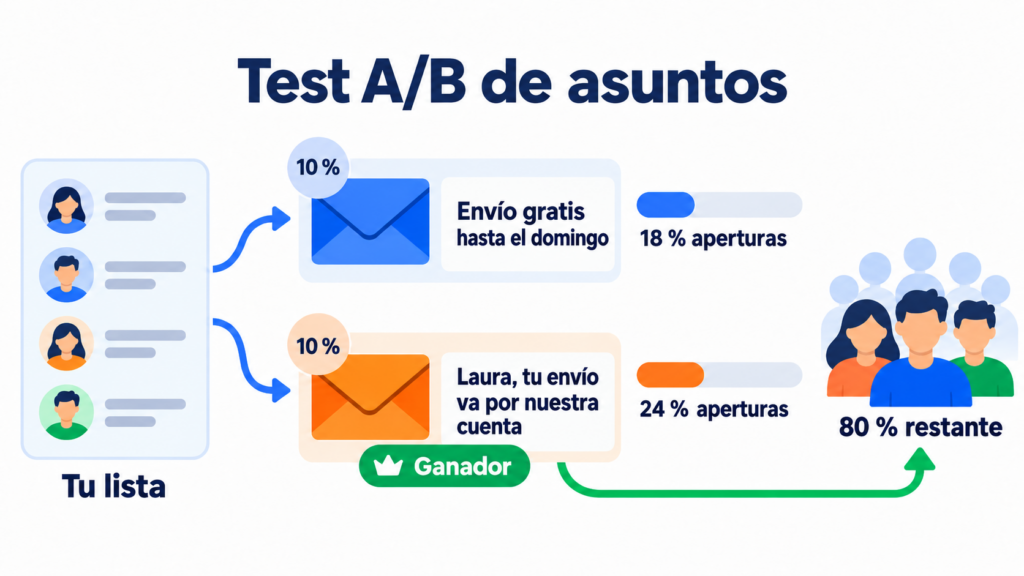
Change only one thing in each test: the length, the emoji or the personalization. If you change several at once, you won’t know what worked.
How Mailrelay helps you with your subject lines
In Mailrelay, you can run A/B tests on subject lines and senders before sending the campaign to your whole list. You can also personalize the email subject line with variables, such as each subscriber’s name. And you can see each send’s opens and clicks in real time, as well as segment your list.
The free account includes up to 80,000 emails a month and 20,000 contacts. Human support by chat, ticket or phone is included on every plan.
Write, test and send with Mailrelay
Up to 80,000 emails a month and 20,000 contacts, with human support on every plan.
Frequently asked questions about the email subject line
What does “subject” mean in an email? It’s the line that sums up the topic of the message. It appears in the inbox before you open it, next to the sender.
What should you put in an email subject line? A short phrase that says what the message is about. For example: “September invoice” or “Monday’s meeting: time change”.
How do you say “asunto” in English? Subject or subject line. In the message’s technical header, it appears as “Subject:”.
How many characters should an email subject line have? There’s no official limit. Ideally, the important part should fit within the first 30–40 characters. That’s what shows on mobile.
Can you send an email without a subject line? Yes, but it’s not recommended. It looks unprofessional, it’s easy to ignore and some filters treat it as suspicious.