Press release: what it is, structure and example
How to write company news that journalists want to publish
A press release is a brief and structured document that companies or entities use to send relevant information to journalists and the media.
Its main goal is to capture the attention of the media so that they publish the news and, in doing so, amplify the reach of the message.
This resource is especially useful for announcing product launches, events, relevant internal changes, corporate achievements or any content that may be of public interest.
Although it started out as a traditional printed format, digital press releases are now the standard, distributed through emails, specialized platforms or social networks.
Why are press releases important?
Press releases don’t just help the media cover your story, they also have important benefits for marketing, branding and SEO. They are one of the basic tools of public relations.
Increased visibility
When they are published on news websites, blogs or even in email marketing newsletters, they help position your brand in front of a wide audience.
When a recognized media outlet or platform shares your story, it builds trust with your target audience.
More web traffic
Many press releases include links to the brand’s official website, which bring in visits.
A complement to email marketing strategies
Press releases can be reused as content in email campaigns, especially if you announce something exclusive or relevant to your subscribers.
Basic structure of a press release
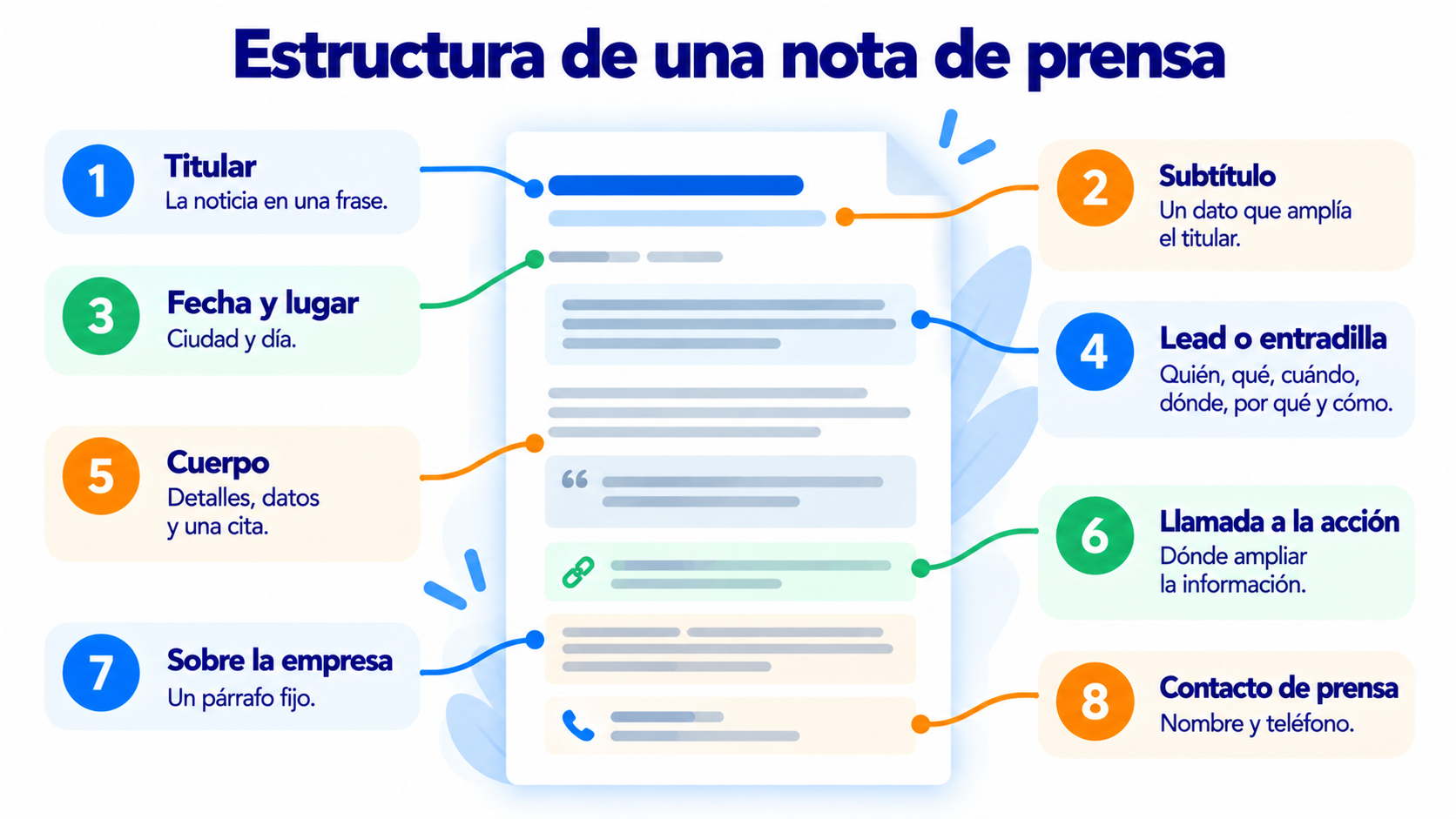
Although writing a press release seems simple, it has a specific structure that you must follow to capture the attention of journalists and editors:
| Part | What it includes |
|---|---|
| Headline | The news in one short sentence |
| Subheading | A fact or detail that expands on the headline |
| Date and place | City and date of the news, at the start of the first paragraph |
| Lead | Who, what, when, where, why and how |
| Body | Details, data and a quote from a spokesperson |
| Call to action | Where to find more information or sign up |
| About the company | A standard paragraph that introduces the company |
| Press contact | Name, phone number and email of the person in charge |
Build your press list
Add a form to your newsroom and send your releases only to the journalists who want to receive them. Get started for free with Mailrelay.
A striking headline
A good headline is key.
It should be short, direct and answer the “what” of your news.
Think of something that arouses curiosity or generates immediate interest.
Subheading
A brief summary that expands on the idea of the headline and provides a little more context.
Date and place
The first paragraph starts with the city and date of the news, for example, “Valencia, October 26, 2026”. That way the journalist knows from the start whether the information is current.
Lead or opening paragraph
This first paragraph is also known as the lede. In this section, you should include the answers to the basic questions:
- Who?
- What?
- When?
- Where?
- Why?
- and how?
It must be clear and concise.
Body
Here you expand on the main information, adding details, quotes from relevant people (such as the company’s CEO) or data that support your story.
Call to action (CTA)
Although not always necessary, including a CTA can direct the reader to a web page, event registration or content download.
About the company
It is a standard paragraph that is repeated at the end of all your press releases. In two or three sentences, explain what the company does, since when and where.
Contact information
At the end of the release, include the name, email and phone number of the person responsible so journalists can contact you.
How to use press releases in a digital strategy?
Although there are multiple ways, let’s take a look at some of the most popular ones.
SEO and press releases
When you distribute a press release online, you can optimize it with keywords related to your brand or product.
This will not only help make it more visible in search engines, but will also drive organic traffic to your website.
Example: If you are launching a new email marketing tool, make sure to include phrases like “advanced email marketing solutions”, “email campaign software” or “email automation”.
Be careful with links: Google considers press releases distributed on other websites with optimized anchor text to be a link scheme. What does help is a media outlet talking about you on its own initiative.
Distribution through email marketing
Email marketing is a perfect channel for distributing press releases to strategic contacts, such as journalists, business partners or even interested customers. Send it only to people who have asked to receive it or to journalists you already have a relationship with.
Create a segmented list and send the release with an attractive design, along with a “Read more” button that leads to the full document.
A press release can be adapted to more visual formats and shared on social media platforms.
For example, create a carousel on Instagram with the key points or a post on LinkedIn with the link to your release.
How to send a press release by email
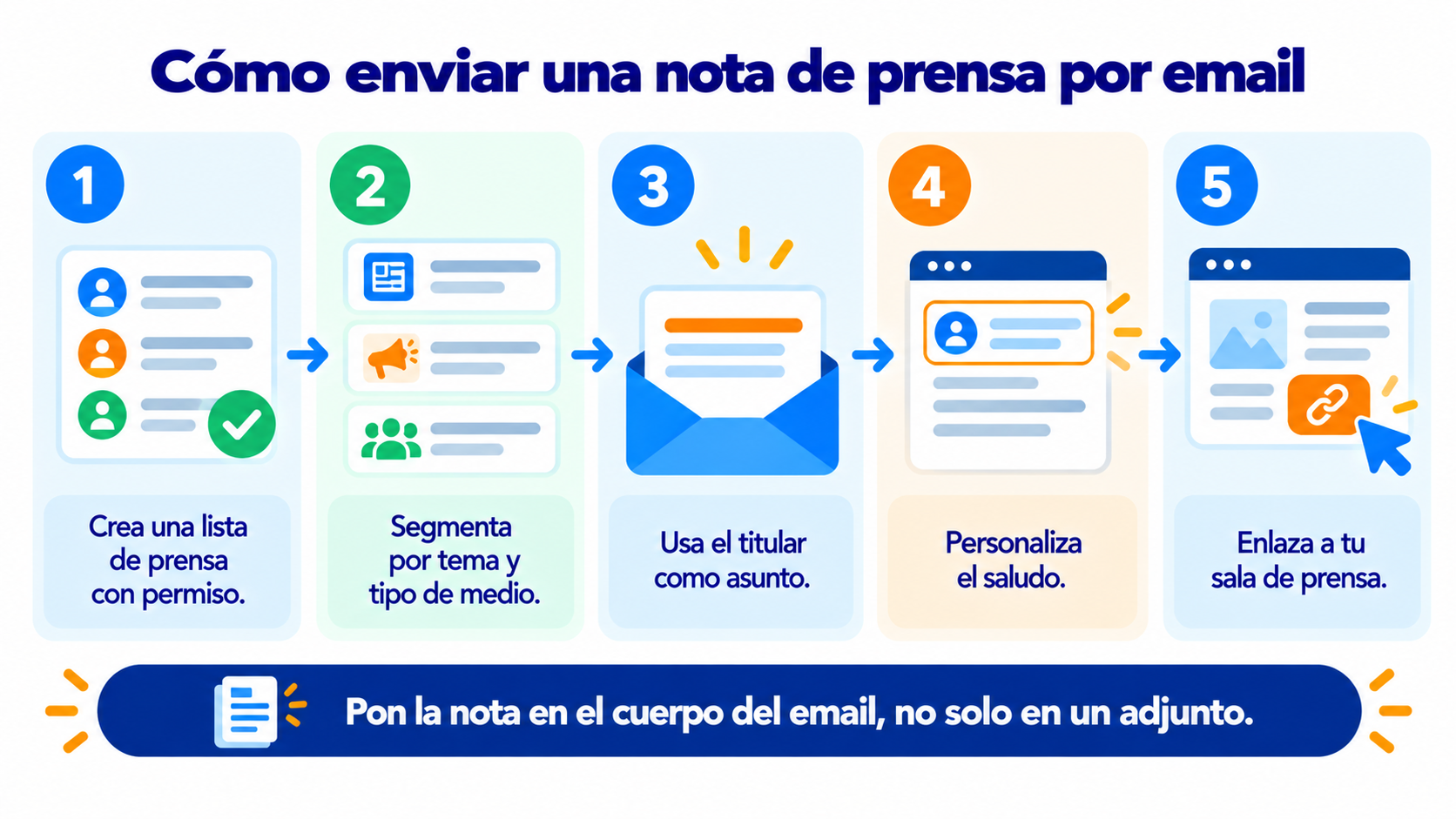
- Build a permission-based press list. A form in your newsroom or on your website so journalists can ask to receive your releases. Don’t buy lists: they end up in spam and damage your domain’s reputation.
- Segment by topic and type of media outlet. Don’t send a technology release to a sports journalist. We explain how in segmentation in email marketing.
- Use the headline as the subject line and put the release in the body of the email, not just in an attachment.
- Personalize the greeting with the journalist’s name and media outlet.
- Link to the newsroom with the photos and documents, instead of attaching heavy files.
Tips for creating effective press releases
Without going into too much detail, we can share the most important aspects:
Be brief and get to the point
Journalists receive dozens of press releases a day, so avoid redundancy. Keep the release clear and well-structured.
Use a professional but human tone
Although the information should be formal, try to make your writing attractive and easy to understand.
Include relevant data
Statistics, studies or quotes from experts always add credibility.
Don’t forget visual media
Images, graphics or videos related to your press release can make it much more interesting.
Personalize your distribution
Before sending your press release, research which journalists or media are more related to your topic.
A mass mailing is not always the best strategy.
Practical example of a press release
Let’s say you have a coffee shop that is opening its second location. All the details are made up:
Café Lumbre opens its second location in Valencia and hires 12 people
The coffee shop, founded in 2021 in Ruzafa, will open on November 15 in El Cabanyal
Valencia, October 26, 2026. Café Lumbre will open its second location on November 15, in the El Cabanyal neighborhood. The opening involves an investment of €180,000 and the hiring of 12 people.
The new location will have 60 seats, its own bakery and coffee workshops for neighbors on Saturdays. “We wanted to grow without losing our neighborhood feel,” explains Laura Gómez, founder of Café Lumbre.
More information and photos of the location in the newsroom on the website.
About Café Lumbre: specialty coffee shop founded in 2021 in Valencia. It roasts its own coffee and works with producers from Colombia and Ethiopia.
Press contact: name, phone number and email of the person in charge of communications.
How Mailrelay helps you
The press release is still a key piece of any communication strategy, even in the digital environment.
If you combine it with tools like email marketing, you can maximize its reach and effectiveness.
Remember that, although the format may seem simple, the key is to offer relevant information and do it in an attractive way.
With Mailrelay you can send your press releases to the people who want to receive them:
- Subscription forms for your newsroom, with double opt-in on every sign-up.
- Custom fields and segments to store each journalist’s media outlet and topic and send each one what interests them.
- Personalization of the greeting with each contact’s name.
- Click statistics on the free account and on Enterprise, so you know who has opened the link to the newsroom.
The free account includes 80,000 emails a month and up to 20,000 contacts.
Send your press releases by email
Personalize each send with each journalist’s name and media outlet, and see who clicks. Up to 80,000 emails a month for free with Mailrelay.
Frequently asked questions
What is a press release?
It is a short text that a company or organization uses to tell journalists a piece of news so they publish it in their media outlets.
Are a press release and a press statement the same thing?
In practice, yes. Some companies reserve “statement” for official positions, such as a response to a crisis, and “press release” for news.
How long should a press release be?
One page is the norm. If more information is needed, link to the newsroom or a press kit.
How do you send a press release?
By email, to journalists who have asked to receive it or with whom you already have a relationship, with the headline as the subject line and the release in the body of the message.
What is the difference between a press release and an advertorial?
A press release isn’t paid for: the media outlet decides whether to publish it. An advertorial is paid advertising in article format.