Prospect
How to recognize your potential customers and guide them all the way to a purchase
Your form captured 500 contacts this month. Some only wanted to download a free guide. Others have a real need, a budget and want to solve their problem soon. Treating them all the same wastes time and opportunities. Knowing who your prospects are makes all the difference.
What is a prospect?
In marketing and sales, a prospect is a potential customer who fits your business profile and has a real chance of buying from you. They have shown interest in your product or service, but haven’t made a purchase yet.
The word comes from the Latin prospectus, meaning “view” or “outlook”. In business, it refers to the people or companies you have on the horizon as future customers.
It shouldn’t be confused with another very common use of the word in Spanish. In Spanish, the «prospecto» of a medicine is the leaflet with its instructions. They are two different meanings that only share the name.
Prospect, lead and customer: how they differ
The three terms describe different stages of the relationship with your brand.
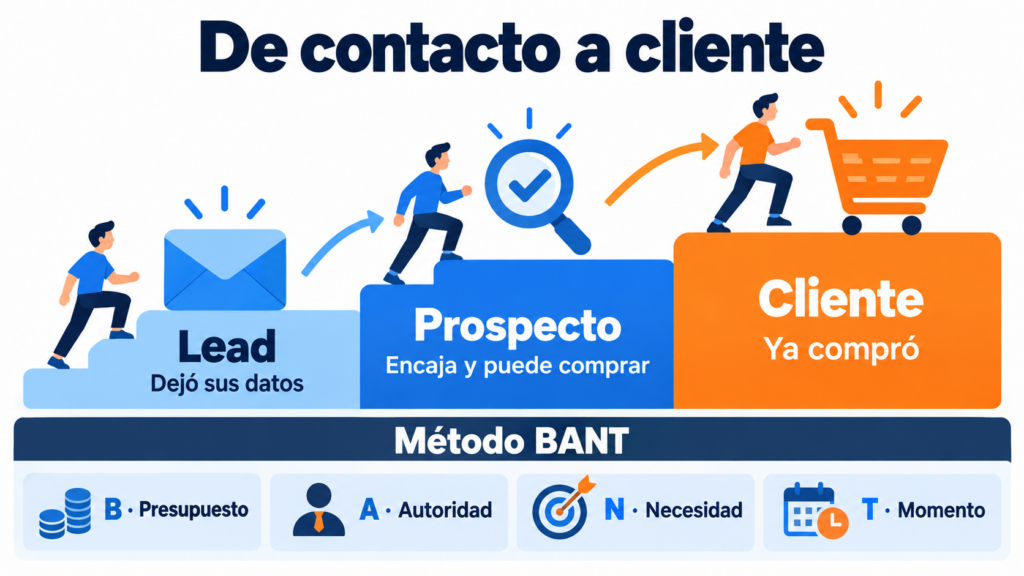
A lead is anyone who has given you their contact details, for example by subscribing to your newsletter. You don’t know yet whether they are a good fit for your business.
A prospect is a lead you have already analyzed and who meets certain requirements: they have the need you solve, can afford your product and are in a position to decide.
The customer is the one who has already bought.
In many companies these steps are measured with two labels: MQL, when marketing considers the contact ready, and SQL, when sales validates it as a real opportunity.
How to identify a good prospect
The first step is to be clear about who you are looking for. Your buyer persona describes your ideal customer: their profile, needs and objections.
Then you can apply a qualification method. One of the best known is BANT, developed at IBM, which evaluates four criteria:
- Budget: can they afford your product?
- Authority: are they the person who makes the decision or influences it?
- Need: do they have a problem that your product solves?
- Timing: are they planning to buy soon?
The more criteria they meet, the higher their priority. Lead scoring automates this work: it assigns points to each contact based on their data and behavior, such as opening your emails or visiting your pricing page.
Where to find prospects
There are two main approaches, and most companies combine both.
Inbound. You attract prospects with useful content and let them find you. A blog, a lead magnet or a landing page with a form are the typical tools. We go into this in more depth in our entry on lead generation.
Outbound. You are the one who takes the first step: calls, social media messages or cold outreach. In B2B, techniques such as social selling or account based marketing help you reach the right companies.
This whole process of searching and making contact is known as sales prospecting.
How to convert a prospect into a customer
Few people buy at the first contact. That’s why you need to guide them until they are ready.
Record each prospect in your CRM with their history of interactions. That way you’ll know where they are in the sales funnel and what they need.
Provide value before selling. Guides, success stories or comparisons help them resolve their doubts and trust you.
Follow up without overwhelming them. A well-timed message can revive a conversation. Ten in a row will end it.
And when you spot a buying signal, act fast. A demo, a free trial or a clear offer make closing the sale easier.
The role of email marketing
Email is one of the most effective channels for nurturing prospects. It lets you stay in touch regularly, personally and at a very low cost.
A lead nurturing sequence sends each prospect the right content based on their interest. Segmentation in email marketing helps you separate those who have just arrived from those who are close to buying.
In addition, your campaign metrics give you valuable clues. If a prospect opens all your emails and clicks the links to your prices, it’s probably time to call them.
How we help you at Mailrelay
At Mailrelay we make it easy for you to turn prospects into customers. You can capture contacts with forms, segment them by interest and create automations that guide them step by step. You can also see who opens and clicks in each campaign.
All of this with a free plan of up to 80,000 emails a month and 20,000 contacts. If you want to try it, you can create your email marketing account at Mailrelay today.
Frequently asked questions about prospects
Are a prospect and a lead the same thing? They are often used as synonyms, but they don’t mean exactly the same thing. A lead is any interested contact. A prospect is a lead who is a good fit for your business and has a real chance of buying.
Can I send commercial emails to a prospect? It depends on how you got their address and where they are located. In the European Union, the GDPR and the rules on commercial communications generally require their prior consent.
How many prospects do I need to get customers? It depends on your conversion rate. If you close one sale for every ten prospects, you’ll need a hundred to get ten customers.
In conclusion
Each prospect represents a sales opportunity with a name. That’s why they deserve specific attention within your database.
Define your ideal customer clearly, qualify your contacts and guide them with useful messages until they are ready to buy. That way your sales efforts will focus where they really pay off.