Wholesaler: what it is, what it does and types of wholesale trade
The link between the manufacturer and the store, and how it can sell more to its customers
A wholesaler is a company that buys products in large quantities from manufacturers and resells them, also in bulk, to other businesses, such as stores, restaurants or other distributors. It doesn’t usually sell to the end consumer.
It’s the link between the people who make products and the people who sell them to the public.
Without it, every store would have to negotiate with dozens of factories.
What does wholesaler mean?
A wholesaler is a business that buys or sells wholesale: in large quantities. The word works as a noun (“a fruit wholesaler”) and, in its form “wholesale”, as an adjective (“a wholesale price” or “wholesale trade”).
The activity is called wholesale, and the business that carries it out is a wholesaler. Its opposite is the retailer, or retail seller, who sells to consumers in small quantities. The term “wholesaling” is also sometimes used to refer to the wholesale trade as a whole.
Being a wholesaler, therefore, means buying in bulk and selling in bulk to other businesses, in a B2B model.
What does a wholesaler do?
It does much more than buy and sell. These are its main functions:
It buys in large volumes. By buying a lot, it gets better prices from the manufacturer.
It stores the goods. It has warehouses and manages stock so that the product is always available.
It breaks bulk. It buys by the truckload or pallet and sells by the box, in the quantities each store needs.
It distributes. It handles transport to the customer, often on fixed routes.
It provides financing. It usually gives its customers payment terms, which helps small businesses keep stock without paying for everything up front.
It provides market information. Because it works with many customers, it knows what sells and what doesn’t, and shares that information with manufacturers and stores.
What types of wholesalers are there?
Not all of them work the same way. These are the most common types:
| Type of wholesaler | How it works | Example |
|---|---|---|
| General-line | Sells many product categories | A food and household goods distributor for neighborhood stores |
| Specialized | Focuses on a single category | An electrical supplies or spare parts wholesaler |
| Cash and carry | The business customer goes to the warehouse, buys and takes the product away | Makro |
| Wholesale market | Many wholesalers in the same venue, mainly for fresh food | Mercamadrid, Mercabarna |
| Exclusive distributor | Represents a brand in an area | The official distributor of a beverage in a province |
| Online wholesaler (B2B) | Sells to businesses from a web platform | A B2B fashion portal or a marketplace such as Alibaba |
| Travel wholesaler | Creates travel packages and sells them to agencies | A tour operator |
What’s the difference between a wholesaler and a retailer?
The main difference is who they sell to and in what quantity:
| Wholesaler | Retailer | |
|---|---|---|
| Who it sells to | Other businesses | The end consumer |
| Quantity | Large volumes | Single units |
| Price per unit | Lower | Higher |
| Where it sells | Warehouse, sales reps or B2B portal | Physical or online store |
| Example | Beverage distributor | Bar, supermarket or online store |
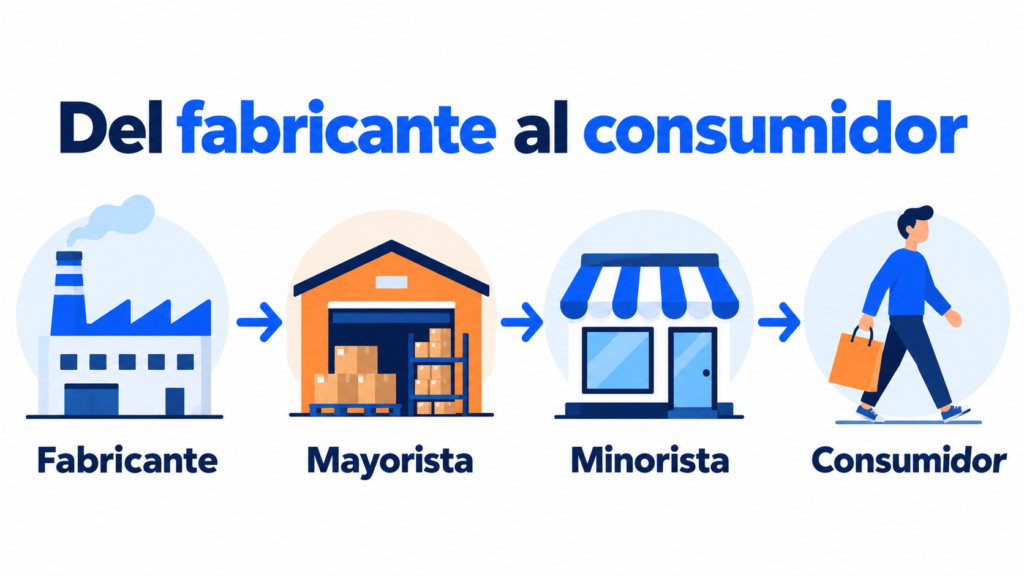
Both are part of the same distribution channel: manufacturer, wholesaler, retailer and consumer. The retailer’s business is known as retail.
Do you sell to stores and professionals?
With Mailrelay, you can send your catalog and stock alerts to each type of customer in minutes.
How does a wholesaler sell today?
The traditional wholesaler sold with a paper catalog and a sales rep who visited each store. Today, it combines that personal touch with digital channels.
Many have an online ordering portal, connect their ERP with their customers’ systems and use a CRM to manage the relationship with each account. And almost all of them use email to stay in touch with their customers.
Email marketing for wholesalers
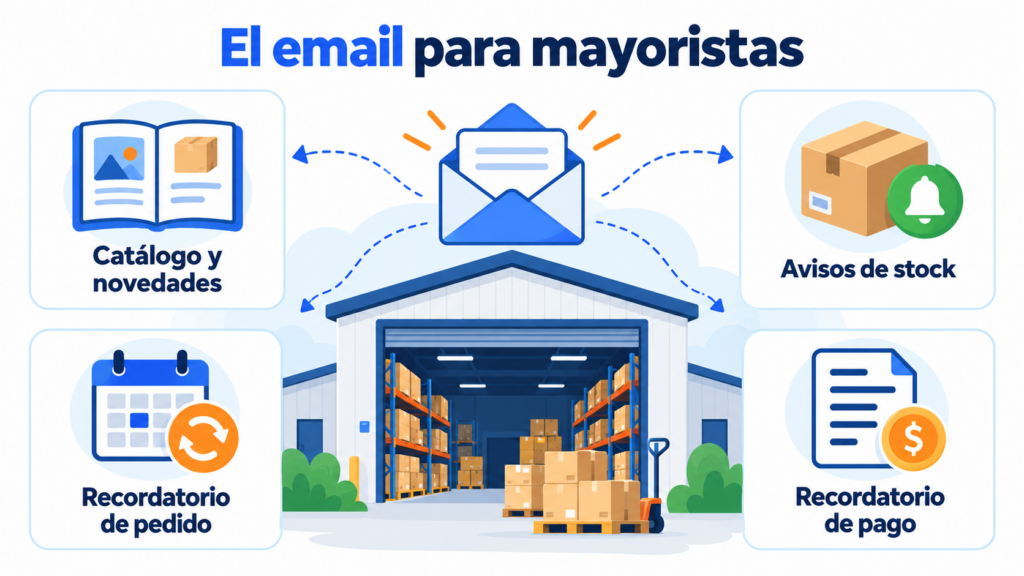
For this type of company, email is the fastest way to reach hundreds of business customers at once. These are its most profitable uses:
New products and catalog. A monthly newsletter with new products, volume deals and campaign dates.
Stock and price alerts. Let customers know when a product is back in stock or about a price increase before it takes effect.
Reorder reminders. Many customers buy every week or every month. An email at the right time keeps them from forgetting or buying from the competition.
Segmentation. A bar is not the same as a supermarket. With segmentation, you send each type of customer or area what interests them.
Collections. A payment reminder email reduces late payments without straining the relationship.
For urgent notices, such as a delayed delivery, SMS marketing is a good complement.
How Mailrelay helps you
With Mailrelay, you can import your customer base, store their data in custom fields and organize them into subscriber groups by area, industry or type of customer.
You send your catalog or alerts to each group and see in the statistics who opens and clicks. You can also send SMS from the same platform. The free account includes up to 80,000 emails a month and 20,000 contacts, with human support by chat, ticket and phone.
Send your newsletters with Mailrelay
Up to 80,000 emails a month and 20,000 contacts for free, with human support on every plan.
Frequently Asked Questions
These are the most common questions about wholesalers.
What is a wholesaler in a nutshell?
It’s a company that buys large amounts from manufacturers and resells them in large quantities to other businesses.
What does being a wholesaler mean?
Working in wholesale trade: buying in bulk and selling in bulk to stores, companies or professionals.
Can a wholesaler sell to the end consumer?
It can, but it’s not common. Many only sell to professionals and ask customers to prove they are a business or self-employed.
What’s the difference between a wholesaler and a distributor?
They are used almost as synonyms. A distributor usually works exclusively with certain brands or areas, while a wholesaler usually sells products from many manufacturers.
What is wholesale trade?
It’s the sector made up of companies that buy and sell wholesale, between manufacturing and sales to the public.