SWOT analysis: what it is, what it means and how to do it step by step
Strengths, opportunities, weaknesses and threats: what a SWOT matrix is, how to build one and a practical example
SWOT analysis is a methodology for identifying and organizing Strengths, Weaknesses, Opportunities and Threats within a project or strategy.
In Spanish-speaking countries, a SWOT analysis is also called a DOFA analysis, a DAFO analysis or a FODA matrix: only the order of the letters changes from country to country, but the four categories are the same.
Essentially, it gives you a panoramic view of your business’s internal and external environment.
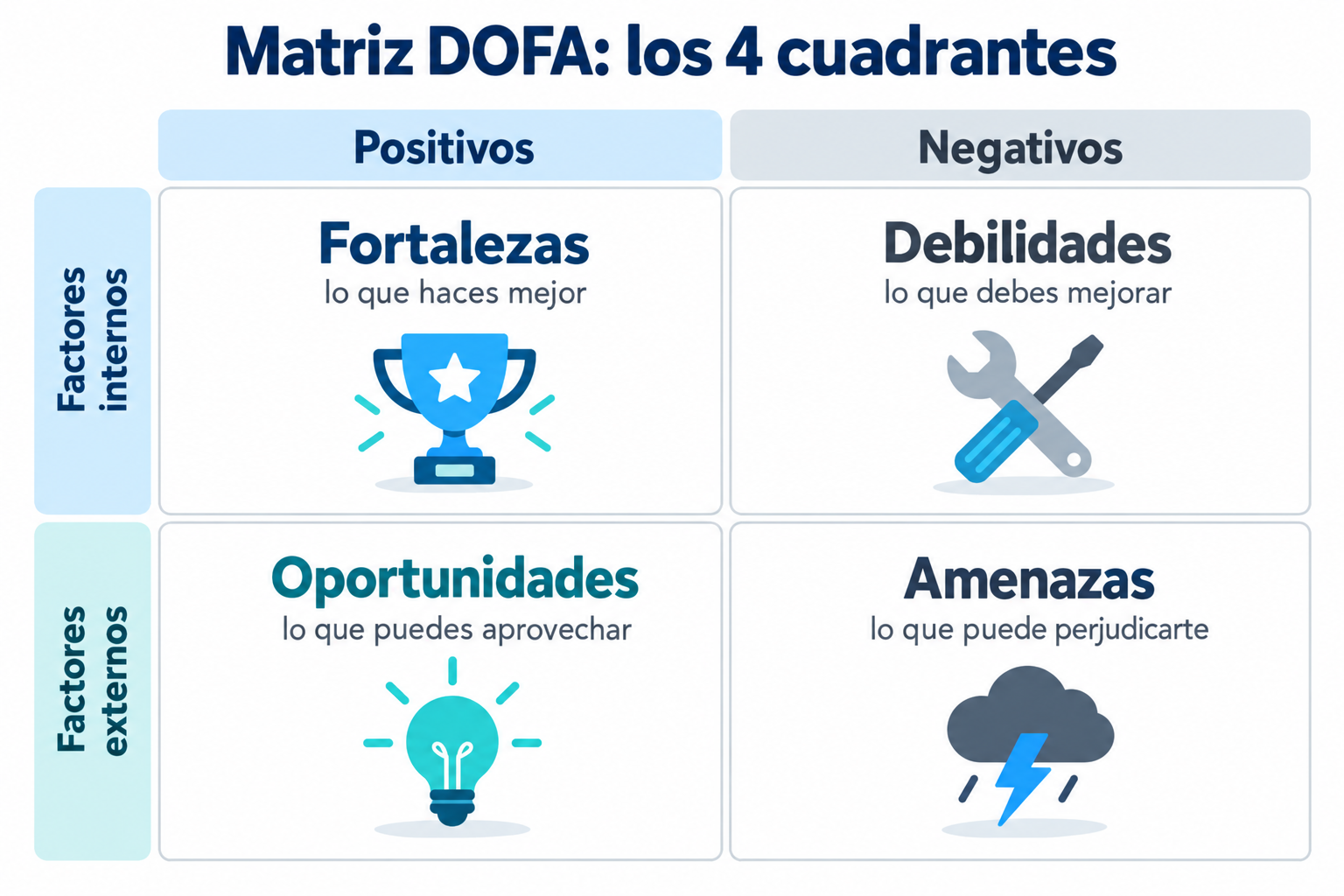
The main idea is to analyze which factors you can control (internal) and which are beyond your control (external) but still affect your strategy.
This type of analysis can be used in many areas, but it is especially useful in marketing.
It lets you adjust your tactics to make the most of your strengths and opportunities, while minimizing your weaknesses and threats.
Through this process, you can create a more robust and adaptable plan, capable of facing any market challenge.
How does a SWOT analysis work?
To carry out an effective SWOT analysis, you need to divide it into two main categories:
Internal factors (strengths and weaknesses)
These are aspects that you can control within your business or project.
This is where you should ask yourself questions like: What makes my company strong against the competition? Where can we improve?
External factors (opportunities and threats)
These are factors that, although you cannot control directly, influence your marketing strategy.
These can be changes in the market, technological advances or competitor movements.
Here, it is important to identify trends you can take advantage of and threats you should avoid.
Turn your strengths into campaigns that sell
Show what sets you apart with newsletters, automations and segmentation. Free for up to 80,000 emails a month.
Let’s take a closer look at each of these components.
Strengths
Strengths are the competitive advantages you have over other companies. These could be related to your products, your market knowledge, your team or even your brand.
For example, if your company has a team with experience in email marketing, that would be a strength.
You can use this knowledge to design more effective, better-segmented campaigns that increase open and conversion rates.
How do you identify your strengths?
Ask yourself these questions:
- What do customers value about my product or service?
- How are we better than our competitors?
- What resources do we have that others don’t?
It is essential to be realistic at this stage.
Sometimes, what we think is a strength may not be one in our customers’ eyes.
That’s why an objective analysis, based on data and feedback, is key.
Weaknesses
Weaknesses are those aspects that may be limiting the growth or success of your strategy.
You need to spot the areas where you might be falling short.
For example, if the conversion rate of your email marketing campaigns is low, that is a weakness you need to fix.
Perhaps your segmentation isn’t right, or the content of your emails isn’t engaging enough.
Identifying these weaknesses will let you work on specific solutions, such as improving your copywriting or running A/B tests on your emails.
How do you identify your weaknesses?
Ask yourself these questions:
- What frequent criticisms do we receive from our customers?
- What internal processes could be more efficient?
- In which areas do our competitors outperform us?
Spotting weaknesses doesn’t have to be a bad thing.
It’s a great opportunity to improve.
Once you recognize them, you can work on solutions that transform them into strengths.
Opportunities
Opportunities are those external factors that can be beneficial to your business.
These are elements beyond your control, but you can use them to your advantage.
This is where the analysis of the environment, the market and emerging trends comes into play.
A good example of an opportunity would be the growth of a technology trend that you can integrate into your marketing strategy.
For example, the rise of artificial intelligence in digital marketing is opening new doors to further personalize email marketing campaigns.
Modern platforms like Mailrelay are already starting to incorporate these technologies to help businesses offer their customers more personalized experiences.
How do you spot opportunities?
Ask yourself these questions:
- What trends are emerging in my industry?
- Are there new market segments that I haven’t tapped into?
- How can I take advantage of changes in regulation or technology?
Opportunities can arise from a variety of sources: changes in consumer preferences, technological innovations, shifts in the economy or even competitive moves.
The trick is to stay alert and be proactive.
Threats
Finally, there are threats.
These are external factors that can negatively affect your business.
Threats are more difficult to control, but being aware of them will allow you to be better prepared to deal with them.
An example of a threat in digital marketing could be a change in a social network’s algorithm or in the privacy policies of advertising platforms.
If your strategy relies heavily on paid ads on social media, a change in these policies could impact your results.
Another type of threat would be the entry of new competitors in your niche, which could reduce your market share.
How do you detect threats?
Ask yourself these questions:
- What changes in the economy could affect my sales?
- What is the competition doing that could hurt me?
- Are there regulatory changes that could impact my operations?
As with opportunities, detecting threats early can give you the advantage of getting ahead of potential problems and adjusting your strategy to minimize them.
How to do a SWOT analysis step by step
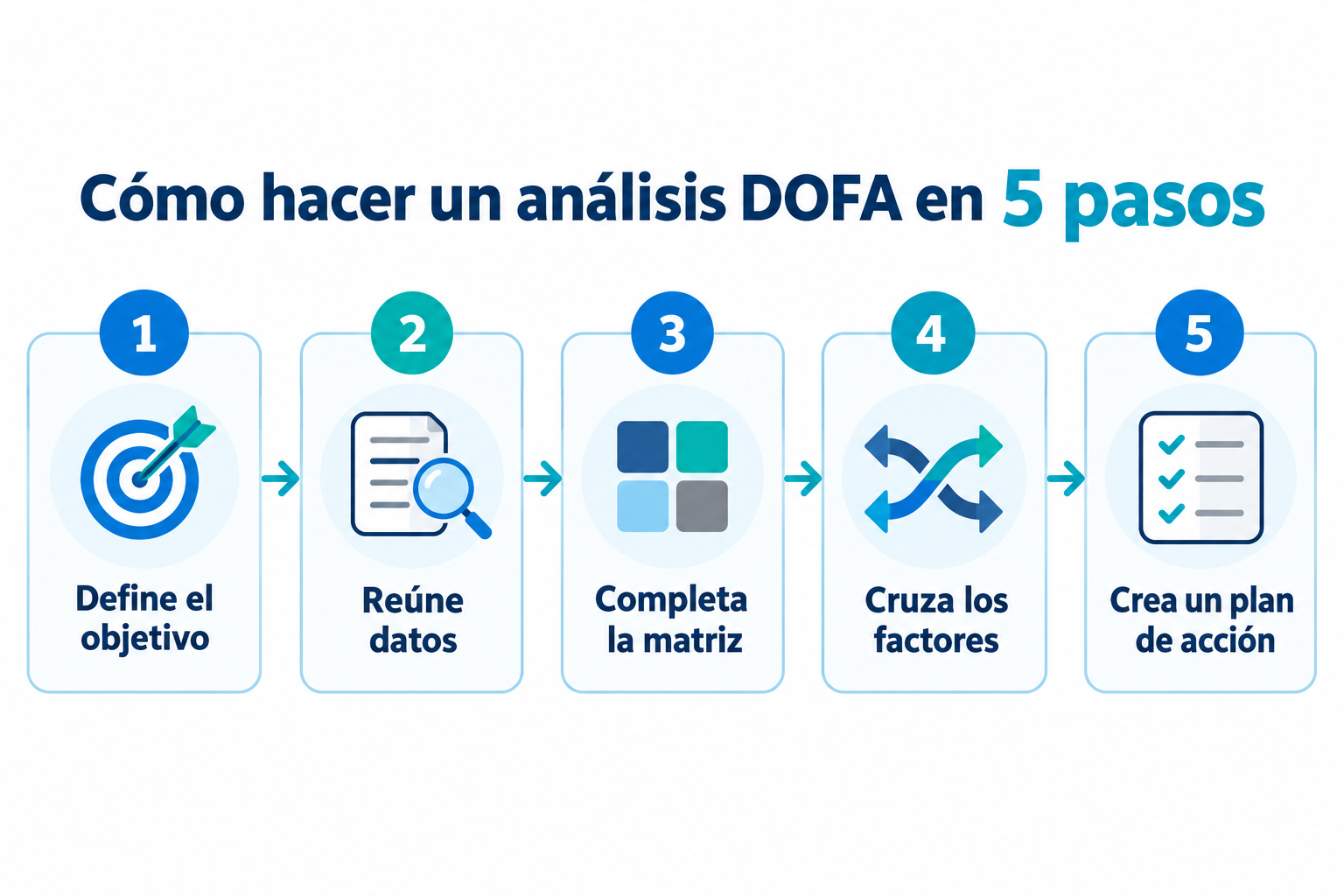
You can build your first SWOT matrix in an afternoon by following these steps:
- Define your objective. Decide what you’re going to analyze: the whole company, a product, a campaign or a channel, such as email marketing.
- Gather data. Review your sales, customer reviews, your campaign metrics and what your competitors are doing. The more data and the fewer assumptions, the better.
- Fill in the matrix. Write 3 to 5 points in each quadrant. Internal factors go under strengths and weaknesses; external ones under opportunities and threats.
- Cross-match the factors. Combine the quadrants to find strategies: use your strengths to take advantage of opportunities (SO), fix weaknesses with the help of opportunities (WO), rely on your strengths to face threats (ST) and reduce the weaknesses that leave you exposed (WT).
- Create an action plan. Turn each strategy into tasks with an owner, a deadline and a metric to measure the result.
SWOT analysis example: a small online store
Here’s what the SWOT matrix of a natural cosmetics online store that has been on the market for only a few years could look like:
| Quadrant | Example |
|---|---|
| Strengths | Its own products made with natural ingredients, good reviews and a loyal subscriber list |
| Weaknesses | Small advertising budget, few staff and slower shipping than the big marketplaces |
| Opportunities | Growing demand for sustainable cosmetics, key shopping dates like Black Friday and selling in other countries |
| Threats | Competitors with lower prices, rising shipping costs and changes to social media algorithms |
With this matrix, an SO strategy would be to launch a Black Friday email campaign featuring the best-rated products, and a WT strategy would be to automate abandoned cart emails so you don’t depend on advertising alone.
Applying SWOT analysis to email marketing
SWOT analysis can also be applied to specific strategies, such as email marketing.
In this case, you could analyze the following:
- Strengths: a high open rate on your emails, a well-segmented subscriber list and the use of advanced tools such as Mailrelay for automation.
- Weaknesses: little personalization in your emails or low subscriber engagement. These are aspects that could be improved by using more precise segmentation or automated campaigns.
- Opportunities: new features in email marketing platforms, such as AI integration to personalize content even further. In addition, the growth of eCommerce is an excellent opportunity to increase sales through email marketing.
- Threats: changes in the regulations on sending emails could affect the way you manage your email marketing campaigns.
How Mailrelay helps you
Many of the actions that come out of a SWOT analysis can be put into practice with email marketing: communicating your strengths, making the most of key dates and trends, building customer loyalty in the face of competition and reducing your reliance on advertising. With Mailrelay you can create newsletters, segment your list, automate your sends and run A/B tests, all from a single dashboard.
The free account includes up to 80,000 emails a month and 20,000 contacts, with human support on every plan.
Put your SWOT action plan into motion
Make the most of your opportunities with email campaigns, automations and human support.
Frequently asked questions about SWOT analysis
These are the most common questions.
What does DOFA stand for?
DOFA is the Spanish acronym for Debilidades, Oportunidades, Fortalezas and Amenazas (Weaknesses, Opportunities, Strengths and Threats), the four categories the information in the analysis is organized into.
Are DOFA, DAFO, FODA and SWOT the same thing?
Yes. They are different names for the same tool: DOFA is widely used in Colombia and Venezuela, DAFO in Spain, FODA in other Latin American countries, and SWOT is the English name.
What is a SWOT analysis used for?
To understand the situation of a company, product or project before making decisions, and to design strategies that make the most of the positives and reduce the negatives.
What is a cross SWOT matrix?
It is the step where the quadrants are combined to come up with strategies: SO (offensive), WO (reorientation), ST (defensive) and WT (survival).
How often should you update your SWOT analysis?
At least once a year, and whenever there is a major change, such as a new competitor, a launch or a shift in the market.