
Companies are no longer just brands that sell their products, have an environmental commitment and not much else; they’ve gone a step further by developing a corporate culture, which also influences how you see them as a consumer.
At Mailrelay, we know you’ve become more curious. Now you want to know where companies make their products, how they treat their employees, how they’ll treat you as a customer and where your money ends up.
It makes sense if you stop to think about it, and to see it more clearly, here’s a little test…
Imagine for a moment that you have to choose between two products of equal quality: would you choose the one from a brand that only cares about profit, or the one from a brand that’s also committed to its employees and customers?
You’d surely choose the second option.
Since you’re a more demanding shopper every day, you want a company’s values to be close to your own. And this is one of the main reasons corporate culture has been gaining prominence in recent years.
The days when companies were bunkers that wouldn’t let you see their true core are over. They’ve got down to work, whether out of conviction or to attract new customers, retain them and keep them from going to the competition.
If you’d like to get to know some companies that are handling corporate culture brilliantly and get some ideas, keep reading: we tell you all about it in detail at Mailrelay, the email marketing service par excellence.
But let’s start at the beginning.
What is corporate culture?
We could say it’s the code of ethics any company has, instills in its team and shares with its customers: its mission, vision and values.
In other words: what they want, how they’ll achieve it and how they engage with their users and employees.
Thanks to corporate culture, customers identify with the company and build relationships that go beyond the strictly commercial. At the same time, employees feel more comfortable because they know exactly what the corporate ethics are and what’s expected of them.
In short: everyone wins.
This kind of attachment means that companies with a strong, consistent culture usually make more profit, because they improve their team’s performance and their reputation.
Benefits of having a good corporate culture
There are many ways to measure a company’s success beyond its earnings.
Profit is no longer the only important value, and that’s where corporate culture comes in, although its results are somewhat harder to quantify and some goals have to be analyzed in the long term.
So is all the effort to build a solid corporate culture worth it?
Of course it is. And you also need to spread it among your team so it reaches your customers.
It’s complicated, we know, but what you can achieve far outweighs the time you’ll have to spend developing your company’s culture.
If you still have doubts, these are some of the most important benefits you can achieve; and note that all of them contribute to a (very) positive view of your brand.
Here they are:
- You establish yourself through employer branding: in other words, as a company where people want to work and stay because it offers a work environment full of perks and values. That way you retain your team’s talent and save on recruiting costs and the odd headache. All advantages.
- You create a good working environment: employees who are happy in their jobs tend to get better results. So if you manage to make your team like a family, your brand will surely perform more and better. Nothing like enjoying your work, right?
- You build trust: when customers see that you’re a respectful company that constantly seeks to improve, even if you have to take risks, they’ll trust your products and form a bond through these virtues.
- You achieve authenticity: a brand’s values are as unique as the brand itself. If you communicate the details of your corporate culture, you’ll stand out from others. Or do you want to be just another brand?
Key elements of a successful corporate culture
Creating and maintaining a successful corporate culture can be a decisive factor in an organization’s long-term success.
Below are some key strategies for implementing and maintaining a successful corporate culture.
Establish clear values and goals
An organization’s values and goals must be clear and understandable for all employees.
These values should be at the core of the corporate culture and guide the company’s decisions and actions. By establishing and communicating clear values and goals, you create a solid foundation for the corporate culture.
Open and effective communication
Open and effective communication is essential to maintain a successful corporate culture.
This includes communication between leaders and employees, as well as among employees themselves.
Fostering an environment where people feel comfortable sharing their ideas and opinions can improve collaboration, innovation and problem-solving.
Leadership development and employee engagement
Leadership plays a crucial role in creating and maintaining a successful corporate culture.
Leaders must be role models and demonstrate their commitment to the company’s values and goals.
They must also support their employees’ development and growth, fostering a work environment where everyone can thrive.
Foster an inclusive and diverse work environment
Diversity and inclusion are important aspects of maintaining a successful corporate culture.
An inclusive, diverse work environment enriches the company with different perspectives and experiences, which can improve decision-making and innovation.
Companies should promote policies and practices that foster diversity and inclusion at every level of the organization.
Adapt and evolve over time
Companies and their environments are constantly changing, and corporate culture must adapt and evolve to stay relevant and successful.
This may include adopting new technologies, updating policies and processes, or incorporating new values and goals.
Keeping a growth mindset and being willing to adapt to the business’s changing needs is key to maintaining a successful corporate culture in the long term.

8 good examples of corporate culture
And since there’s nothing better than seeing things in action to understand them, let’s look at eight inspiring examples of corporate culture.
#1 BrewDog
There are lots of beers, but not so many good ones. That’s why this brand’s main goal is, of course, to get you hooked on craft beer; but behind that goal there’s also a very strong corporate culture under the slogan “Equity for Punks”.
This idea lets you buy shares in the company and take part in it. By owning shares you’re doing good, because all the profits from this sale go to environmental projects.
And it gets even better: one of their latest achievements has been becoming carbon negative; that is, they remove more CO₂ than they produce. Not bad at all.
If you’d like to know more, their whole website covers this commitment to the planet, their proposals, what they’re looking for as a brand and how important people like you are in achieving their goals.
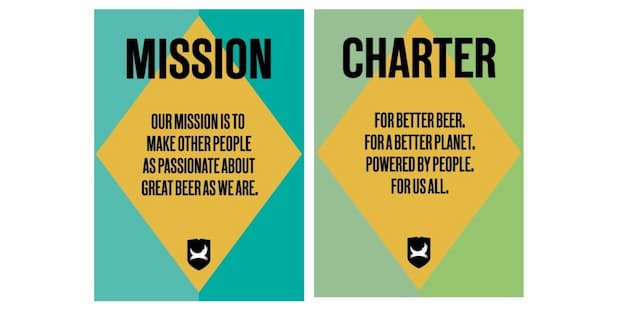
Other people they take very much into account are their own employees, since their way of working is based on meritocracy: they value personal effort and achievements, and they encourage employees to take certain risks to create new proposals that improve the brand.
In addition, their accounts and the results of their projects are completely transparent, and you can check them whenever you like.
One last detail that makes them unique, and that you’d surely have loved when your pet arrived home: they’re animal lovers, and if someone on the team adds a pet to their family, they get a week of paid leave so the animal can adapt to its new surroundings.
Now it won’t seem so strange that they have a dog on staff, even if only as an honorary member.
What we highlight about BrewDog’s corporate culture:
- They aim to spread their passion for craft beer over industrial beer and involve everyone in this change, so they connect quickly with their audience and get people to empathize with them.
- They accept that improving the company means taking certain risks, and they pass this idea on to their employees.
- They value their team as the only way to move forward and publish their financial and project results, which makes them a transparent company.
#2 Buffer
There are many apps like Buffer that let you schedule your social media posts and measure the results, but few that look after their users so well.
They see the happiness of their employees and customers, and their own growth, as success factors, and they seek to foster an environment of respect to “do things a little differently”.
And what do they mean by “differently”? For starters, they have a diverse work environment based on equality, respect and excellence, which serves as a foundation for everyone at Buffer to grow personally and professionally.
But it doesn’t end there, because as a brand they seek to create a sense of community among their employees and consumers where everyone feels comfortable.
To do this, they keep their programs’ code open, and anyone can see it, use it, improve it and give feedback.
And if you need inspiration to manage your projects, you can check their workflows in real time and see all the tasks they carry out, as well as who does them.
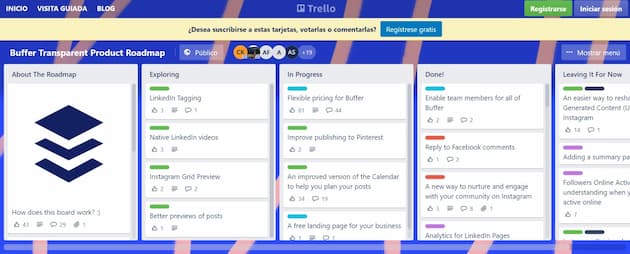
In line with this transparency, they publish their salaries and data on their team’s diversity on their website.
What we highlight about Buffer’s corporate culture:
- It saves time and recruiting costs because they retain talent thanks to a culture based on interpersonal relationships and their team’s well-being.
- They take transparency to a level where anyone can understand how the company works in a very natural way.
- At all times, they involve their customers, establishing themselves as a friendly, approachable brand.
#3 Salesforce
This CRM platform focuses on helping its customers satisfy their own customers with tailor-made products.
They call their community of employees, consumers and partners “Trailblazers”.
As with the American adventurers who came ashore from the Mayflower, their network is made up of innovative people willing to learn continuously and leaders who show the way.

But what matters most to Salesforce is fostering camaraderie among employees, and between employees and customers. That’s why it has created a large digital community where users can strike up a conversation with any employee of the company.
Its corporate culture also seeks to create a team that reflects today’s society, which is why they welcome anyone who wants to apply for one of their vacancies, regardless of their circumstances and beliefs.
Employees enjoy a range of benefits such as health insurance, financial advice or days off for volunteering for social causes.
But where Salesforce really stands out is work-life balance, since it includes paid parental leave, an extra meal allowance when your child is born and discounts on baby products or nannies.
If you have children, you know that any help like this is more than welcome.
They’re also partners of Milk Stork, and together they make it possible for mothers traveling on business to ship breast milk to their babies, providing a medical-grade cooler for transport, milk storage bags and the labels needed to send it with FedEx Priority Overnight.
No wonder they have several awards such as Best Place to Work!
What we highlight about Salesforce’s corporate culture:
- They value their human capital and make it easy for anyone to apply for their jobs.
- Their employer branding goes a step further, seeking real work-life balance with various benefits and programs for parents and their babies.
- They create an approachable community, open to dialogue and participation.
#4 Google
Its philosophy probably sounds familiar, partly because it’s one of the most widely publicized. However, there are surely elements of its corporate culture you’re not aware of because they’re less well known… and those are the ones we bring you.
As you can imagine, its users’ happiness matters to Google, which is why it keeps creating research and education products that improve the experience, under its motto “focus on the user and all else will follow”.
How many times have you wanted to learn digital marketing without spending hundreds of euros? Now, with just an internet connection, you can train without spending a cent thanks to some of their free education programs, such as Google Actívate.
You no longer have any excuse to put it off.
In addition, they know universal digital accessibility is far from a reality, and they want to do their bit by designing programs that make it easier for people with diverse needs to interact with technology.
Shall we continue with their transparency policy?
They know you care about your privacy; who doesn’t? That’s why they let you check their data transparency reports, in case you want to know how they handle data in each country and their commitments on the artificial intelligence they use.
They put this responsible development of technology at the service of users, and for years they’ve also been trying to make the internet a more accessible space for everyone.
And how do they achieve all this (and much more)? The answer is easy to give but not to carry out.
They achieve it with a great team, into which they also integrate at-risk groups, with programs designed to make room for employees from disadvantaged communities, retain their talent and lift them out of the risk of exclusion.

What we highlight about Google’s corporate culture:
- They promote sustainable equality for all communities within their teams and seek universal internet accessibility.
- They establish themselves as a transparent company, since you can check countless reports on data handling and the programs they’re involved in.
- They value their users’ experience and draw on their feedback to create new solutions increasingly tailored to what they really need.
#5 Zuora
An automation management platform that has created a new business model for the relationship between customers and brands couldn’t be left off this list.
They start from the idea that users have changed and are happier subscribing to a service that gives them ongoing solutions than buying a static product.
With this premise, they coined the concept of the “Subscription Economy”, and their corporate culture seeks customer satisfaction through the constant improvement of the services they provide to them as subscribers.
In pursuit of this continuous improvement, they strive to keep their team motivated and to make everyone capable of leading their own ideas and decisions.
Can you imagine becoming the company’s CEO on your first day at work? Well, at Zuora they want every employee to be the ZEO of their experience there. Yes, with a “Z”, because they play on the initial of the brand’s name.
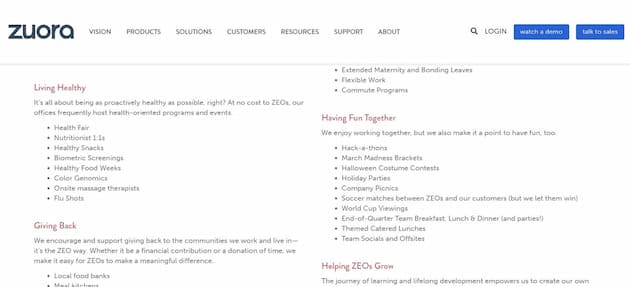
To give their employees this long-term well-being, besides the usual benefits, they offer programs aimed at improving health and encourage physical activity as a team.
But they don’t neglect fun either, with group activities such as Halloween costume contests, Christmas parties, themed lunches and even an annual soccer match between the company and its customers.
Do they let them win, as they say on their website?
What we highlight about Zuora’s corporate culture:
- They have revolutionized the way customers and companies relate to each other.
- You can freely browse their library of resources on the Subscription Economy, where you have access to books, inspiring case studies, training and working papers.
- They not only promote camaraderie with leisure activities among team members but also involve their customers in them.
#6 Piktochart
The standard of sales presentations and all kinds of reports has risen a lot lately thanks, in part, to tools like Piktochart; the results are excellent without having to be a graphic design pro.
Still, when you’ve had to put one together, you’ve surely felt you were wasting time learning to design. Piktochart knows this, which is why they focus their culture on making things easier for their users with simple, visual tools.
In their eagerness to constantly improve the user experience, they don’t strive for the excellence of their platform, but rather for each product to fit each customer perfectly.
And how do they do it? Very simply: by listening to them. They use customer feedback to work on their improvements, and it works wonders for them.
Besides looking after the end user, they also work hard to have a good working environment in-house, which is why optimism is the flag of their corporate culture.
Their thing is positivity, along with other values they express through the acronym “Hopeful”: humble, openness, passionate, excellence, fun and user-focused.
By championing these values, they manage to retain talent and keep an unbeatable atmosphere in their team.

Having values is great, but they don’t forget to offer conditions that let all employees balance their work and family lives, among other contractual improvements.
What we highlight about Piktochart’s corporate culture:
- They convey an optimistic business approach and use the letters of the word Hopeful to instill their values in employees.
- They do their utmost to adapt their products to users and make them easy to use.
- As a company that seeks to spark your creativity, they lead by example and apply it to themselves in things like their website; take a look at the section where they introduce their own team, where there’s a very fun surprise behind every photo.
#7 Typeform
If you’ve filled in lots of online forms, some of them were probably created with this platform.
But if you want to work there, you’ll need to be “the owner of an active brain, a good heart…”.

Wouldn’t you like to work at a company that values you like that?
Typeform’s corporate culture is aimed at attracting good employees and retaining them thanks to its workplace perks, which have a positive impact on their personal quality of life.
Health insurance, a gym discount, psychological support and language courses if you’ve moved abroad are some of the benefits you get if you join their team.
All this is sensational, yes, but the first value they show their people is empathy among colleagues.
If you’re part of a team where others put themselves in your shoes, you’ll surely feel more understood and lose your fear of being criticized, because that option simply doesn’t exist.
This company knows it and values mutual support, taking risks and owning up to mistakes without being judged.
And what’s all this for? Typeform is clear about it: a well-oiled team improves its product quickly, and its customers will be happier with the brand.
They also have a community where anyone can contribute their knowledge and suggestions, or ask questions for one of the tool’s creators to answer.
What we highlight about Typeform’s corporate culture:
- They create a comfortable work environment where learning is mutual and constant and schedules and workspaces are flexible.
- They look after the relationships among their employees, and at their Barcelona headquarters they’ve even opened “Barception”, a bar where employees can get to know each other, have a good time and come up with some of their best ideas, coffee or beer in hand. Who said you can’t be creative in a bar?
- They have a collaborative, accessible community where customers can take part, contribute ideas and have conversations with the creators. Proof of this are the almost 2,000 conversations and almost 7,800 comments on their website. We could say the Typeform community spends all day chatting.
#8 Minimalism
This Spanish clothing brand wants sustainable fashion not to be synonymous with more expensive clothes.
Getting you to ask yourself introspective questions and be part of the change to improve the environment is their calling card, but they also want you to feel empowered and be authentic, not represented by brands or logos.
That’s why they’ve made corporate social responsibility one of their pillars, and their clothes carry no logo at all.
If you were born in the 1980s, you may have played at being a designer with a famous game where you created dresses and outfits. Well, if you were one of those kids, with Minimalism you’ll be able to enjoy the feeling of taking part in a cool fashion project again.
Although designing the collections isn’t a game, they do it collaboratively with their customers through surveys where they hear their opinions directly.
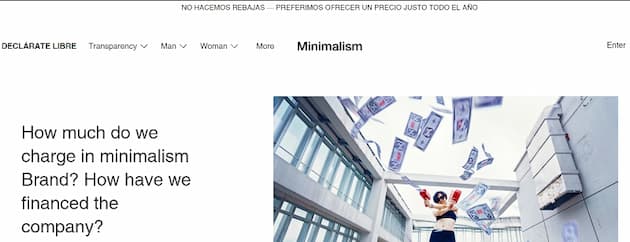
And another of the company’s hallmarks is aimed at its users: its complete transparency.
Not only can you see in detail how the company has been funded, but they also break down the price of each product so you know where every cent of your money goes.
What we highlight about Minimalism’s corporate culture:
- Their culture is customer-oriented, and they want customers to stand out through their essence, not thanks to a brand.
- They’re brutally honest and transparent about their salaries and all their processes.
- They seek to build a different, closer relationship with their community by inviting it to take part in some of the company’s decisions.

Corporate culture at a glance
Fortunately, more and more companies realize that having an attractive, well-defined corporate culture only brings benefits. But what about you? Are you clear about your brand’s corporate culture?
If you haven’t tied up all the loose ends yet, remember:
- A happy, motivated team is more effective than one where everyone does things without a shared roadmap.
- If you look after your team, you save on recruiting costs because you retain talent, and that makes you more competitive.
- To convey your brand’s values to customers so they identify with it, there’s nothing better than starting by instilling them in your own employees.
- People like workplace and social well-being, and that will position you as a benchmark many candidates will want to work for and customers will love buying from.
- A transparent corporate culture is a guaranteed success. At least when it comes to building trust.
With all the inspiring examples we’ve given you, you’ve surely found the motivation to look at whether there’s any aspect of your company’s culture you can improve, or even design from scratch… what are you waiting for?