
Using persuasion techniques isn’t optional; it’s a must if you want your online business to live up to expectations. In fact, if you don’t use them, you’ll never succeed online.
If you have some experience building online businesses, you’ve probably noticed that making money is anything but easy.
Having an online presence isn’t enough. Nor is it enough to have a steady flow of visitors to your website.
Users know you exist, that you provide value and that your content is good. In fact, they tell you so every day in blog comments, on social media and even by email.
What are persuasion techniques?
Broadly speaking, persuasion techniques are psychological and communication strategies designed to influence an audience’s perceptions, emotions, attitudes and behavior, guiding it toward a specific action (e.g., buying, subscribing, sharing, etc.).
They rely on mental heuristics and social principles well documented by psychology (Cialdini, Kahneman, Ariely, …). In digital marketing, their role is to reduce friction and increase the likelihood of conversion without resorting to manipulation or deception.
10 persuasion techniques that will help you sell more
Since you need to apply different persuasion techniques to get more sales online, I think it’s worth explaining the ones that usually work best.
That doesn’t mean these persuasion techniques will work 100% of the time, because nothing is set in stone in online marketing, but at least they can help you plan each of your strategies better.
With that said, do you want to learn the persuasion techniques I’d like to show you? Then let’s get started:
Put your messages to the test with an A/B test
Send two versions of the subject line and keep the one that persuades best.
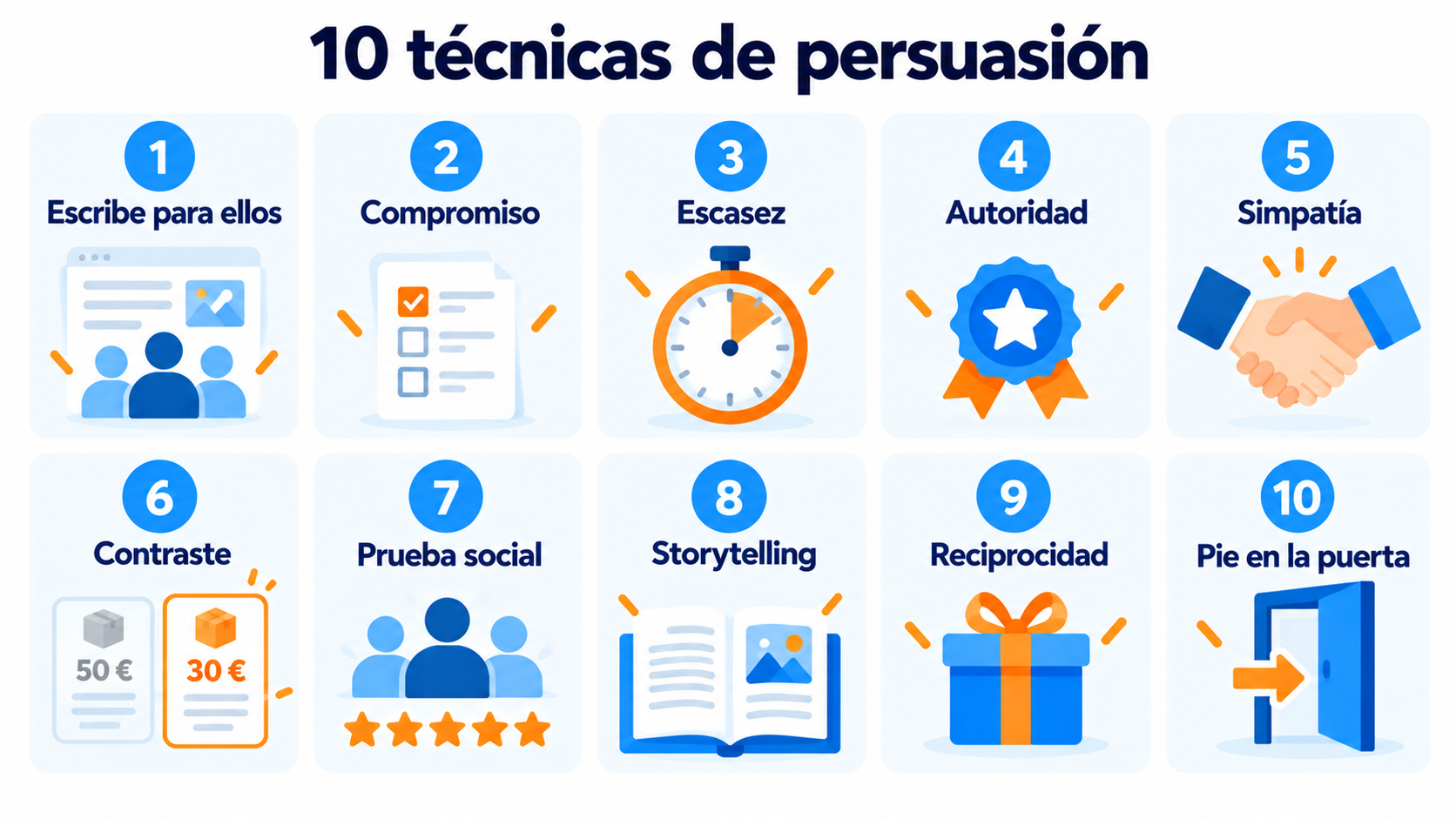
Persuasion technique 1: don’t write for yourself, write for them
This isn’t really a technique in itself, but it will help you apply persuasion techniques better from now on, whether in the copy on your website, your blog or your email marketing strategy.
One of the most common mistakes bloggers and webmasters make is that, surprisingly, they usually write their content for themselves.
It may not seem that way, since the intention is always to provide value, but is that really the case?
Let me give you an example to make it clearer.
Imagine your website is about jeans and one day, for a change, you write about shoes. Tell me, are you providing value? No.
The explanation is very simple: your audience wants information about jeans, not shoes.
Sure, it’s related to your topic, since it’s all part of the fashion industry, but is your audience looking for information about shoes or about jeans? The answer is pretty clear.
Now, if you wrote a post like “types of shoes that look great with your jeans“, then you would be providing value, because you’re still covering your website’s main topic.
Most bloggers and webmasters make this mistake. If you don’t believe me, take a look at a few websites and you’ll see.
So focus on your niche and make the most of it: your audience will thank you and, in all likelihood, you’ll be able to generate sales.
Persuasion technique 2: commitment
A very common mistake is promising something you won’t be able to deliver. This can definitely make your credibility plummet, and users may stop following you and even unsubscribe from your newsletter.
On top of that, your online reputation can suffer. And that, in short, can be fatal for your business.
If you promise something, deliver on it. If you aren’t committed to your own promises, why would your audience be committed to you? Makes sense, right?
Thanks to the commitment you show, you’ll be able to apply different techniques, most notably the well-known “foot-in-the-door technique“.
This technique is based on offering a product or service that users can access without having to spend a lot of money.
Once you’ve shown that everything you said is true, you can expand your offer with better features and higher prices without your strategy falling flat.
As you can see, commitment is everything. Don’t disappoint: build anticipation and improve other people’s lives.

Persuasion technique 3: scarcity
The scarcity technique is one of the most effective right now.
Everyone is short of something, without exception. In fact, everyone who looks for information online does so because they need something, and the sooner they can meet that need, the better.
This is something you should always keep in mind so you can offer your products or services more successfully.
With that in mind, you can apply several scarcity techniques, such as these:
The bold bet technique
This technique consists of showing your audience that the product or service they want is scarce at most companies, and that you’re able to offer it.
If users see that this is indeed the case, chances are high that they’ll at least want more information to make sure your option is the one they need.
Along the way, you’ll be able to edge out the competition and have a better chance of increasing your sales.
The deadline technique
This technique consists of explaining to users that your offer is limited and that, if they don’t get it now, one of two things can happen:
- The product is no longer for sale
- Once the promotion ends, the product will cost more
This encourages people to make quick decisions, because they know that if they don’t decide by the set date, they won’t be able to enjoy the product or the prices offered so far. It’s widely used in promotional mailings.
There’s nothing like being a leading figure in an industry to grow your sales exponentially.
Being a leading figure means authority. And authority brings credibility.
Admittedly, you can’t apply this technique when nobody knows you, because it makes no sense at all. First you need to prove that you’re an expert in the field.
Once you become an influencer, you can apply it. But how?
It’s very simple: you’ll be able to apply as many persuasion techniques as you like at the same time, because everything will be amplified.
Your word is definitely powerful and makes a difference. Everyone will take your suggestions into account, and that ultimately translates into sales.
A clear example is Dean Romero. He once wrote a post explaining how he had earned 4,000 euros from affiliate marketing using persuasive writing techniques.
Dean Romero has established himself as a leading figure in SEO and, thanks to that, every time he offers a product related to search engine optimization, sales skyrocket.
I don’t think there’s a better example to explain the authority technique. And if there is, leave a comment on the post.

Persuasion technique 5: likability or physical attractiveness
Being likable matters. And so does physical attractiveness. That said, the two don’t necessarily go together.
A person can be likable without being physically attractive and vice versa, although it’s true that someone with both qualities will have a much easier time.
Being likable helps others connect with you and follow you wherever you go. It gives you a special charisma that others can’t help falling for.
On the other hand, who doesn’t like good looks? Everyone does.
And for once, let’s set aside the idea that looks don’t matter. If that were true, do you think the leading online marketing bloggers would dress up for their photos to impress their audience?
Being physically attractive means a good presence, and both likability and looks can help you increase sales, because you appeal to your audience’s senses.
We have animal instincts, even if you think you don’t because you’re a human being. In fact, if likability or physical attractiveness weren’t part of the animal instinct inside us, our species would disappear, because there would be no offspring.
Persuasion technique 6: contrast
The contrast technique is a very powerful strategy in marketing and sales.
It consists of comparing two options, products or services, so that one clearly stands out over the other. When you show a superior option alongside one that isn’t as good, the first one looks even more attractive.
For example, if you’re offering a premium package of a product, you can contrast it with a competitor’s basic package.
By highlighting the product’s exclusive benefits and features, your potential customers will clearly see why it’s the best option.
You can use this technique in both your email and SMS marketing campaigns to increase sales and customer satisfaction.
The social proof technique is another very effective tool for persuading your customers.
It consists of using testimonials, reviews and experiences from other users to strengthen credibility and trust in your product or service.
In email marketing, you can build this technique into your newsletters by showing comments and ratings from satisfied customers who have already used your services.
You can also add third-party badges or certifications that back up the quality of your services.
People trust other people’s experience, and seeing that real people have achieved positive results can be a deciding factor for new customers to try your product.
Persuasion technique 8: storytelling
Storytelling is a powerful persuasion tool.
It consists of creating a narrative that connects emotionally with your audience, presenting your message in a more engaging and human way.
A good story can capture your readers’ attention, make your product or idea easier to understand and make it more memorable.
Well-told stories build empathy and can significantly influence a customer’s purchase decision.
Persuasion technique 9: reciprocity
The reciprocity technique is based on the principle of giving something in order to receive something in return.
In marketing, this can mean offering your customers something of value before asking them for a purchase or commitment.
It can be free content, a product sample or an exclusive discount.
The idea is that, after receiving something, customers feel more inclined to return the favor, increasing the chances of a purchase or of loyalty to a brand.
Persuasion technique 10: foot in the door
The foot-in-the-door technique is a psychological strategy that involves making a small request that most people will accept, followed by a bigger request (the real goal).
The theory behind this technique is that if someone agrees to a small request, they’re more likely to accept a related but more significant request in the future.
For example, if a customer subscribes to a free newsletter, they may be more willing to buy a product or service in the future.
10 persuasion examples for your emails
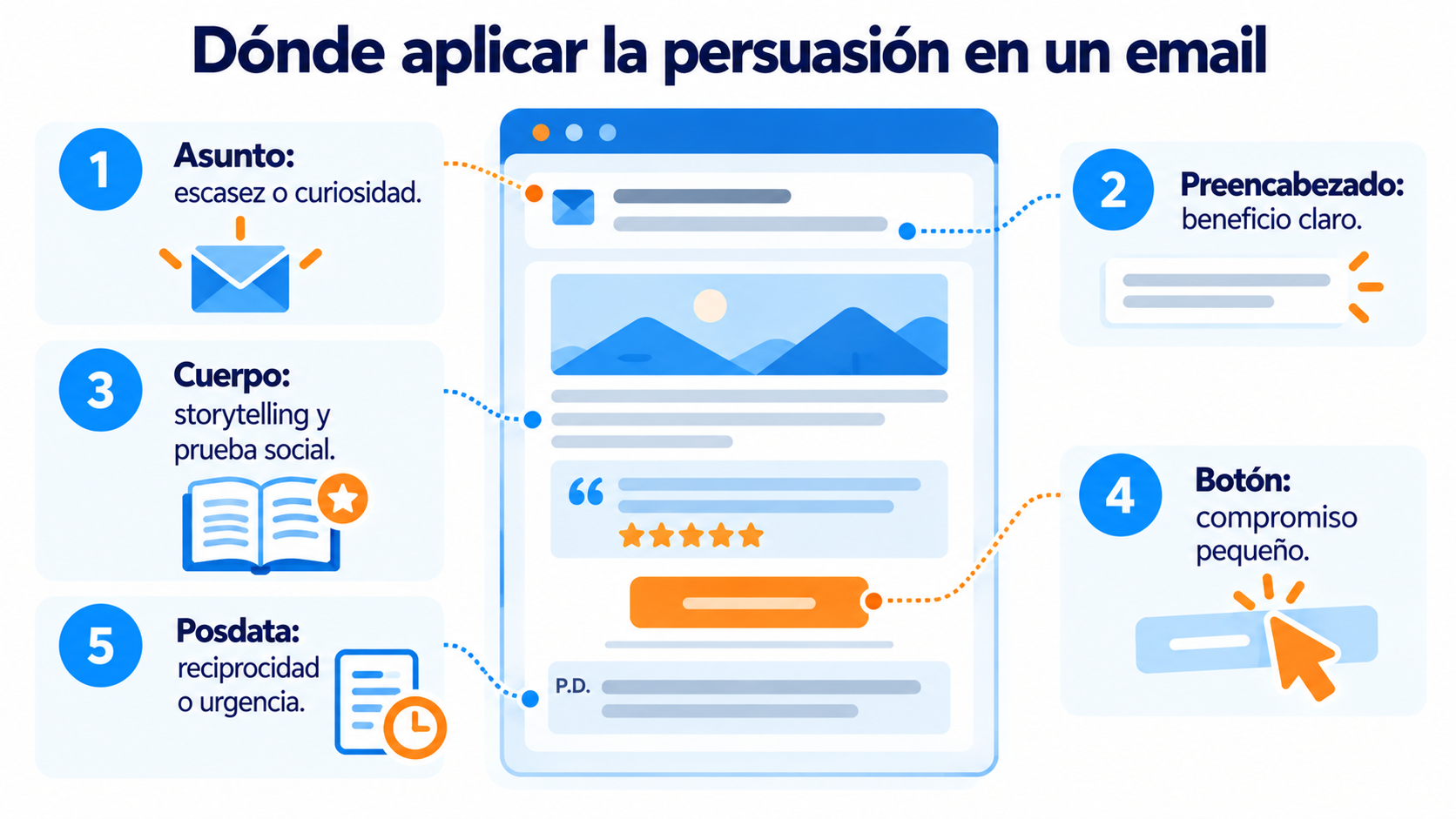
You can apply each technique in a single sentence in the subject line, the body or the button:
- Write for them: “Save 3 hours a week on your sends” instead of “Our new feature”.
- Commitment: “You’ve already completed 2 of the 3 steps. Finish your profile in a minute.”
- Scarcity: “Only 12 spots left for Thursday’s workshop.”
- Authority: “The method more than 10,000 teachers use in their classes.”
- Likability: a sender with a real name (“Laura from [your brand]”) instead of “no-reply”.
- Contrast: “Was €89, now €59”, with the old price crossed out.
- Social proof: “Rated 4.8 out of 5 in over 2,000 reviews.”
- Storytelling: “How a neighborhood bakery filled its waiting list in 2 weeks.”
- Reciprocity: “Here’s the template, free, no sign-up required.”
- Foot in the door: “Could you answer just one question?”, before asking for a full review.
The figures in these examples are illustrative: always use your own real data. Persuasion works when it tells the truth. If you want to know which one works best with your list, test two subject lines with an A/B test. And if you want to learn the psychology behind these techniques, check out Robert Cialdini’s 7 principles of persuasion.
Write emails that persuade
Templates, personalization with the contact’s name and statistics for every send.
Summary table of the 10 persuasion techniques in this article
| No. | Technique | Psychological principle it leverages | Key point in the text | Example of how to apply it |
|---|---|---|---|---|
| 1 | Write for them | Relevance / User focus | “Focus on your niche and make the most of it” | Publish only content that answers questions about jeans, not shoes. |
| 2 | Commitment | Consistency and follow-through | “If you promise something, deliver on it… commitment is everything” | Guarantee a delivery and keep that promise; then offer a premium plan. |
| 3 | Scarcity | Fear of missing out (FOMO) | “Limited offer… the product will cost more” | Units-left counter / price that goes up after the deadline. |
| 4 | Authority | Credibility through expertise | “Being a leading figure means authority… your word is powerful” | Show success stories like Dean Romero and certifications. |
| 5 | Likability / Attractiveness | Halo effect and affinity | “Likability connects… looks appeal to the senses” | Professional photos and a friendly, empathetic tone on social media. |
| 6 | Contrast | Relative evaluation | “Compare two options so that one stands out” | A Premium package next to a competitor’s Basic one to highlight value. |
| 7 | Social proof | Social validation | “Testimonials… experiences from other users” | Carousel of verified reviews on the landing page or in emails. |
| 8 | Storytelling | Emotional connection and memorability | “Create a narrative that connects emotionally” | The story of a customer who solved their problem thanks to your product. |
| 9 | Reciprocity | Returning favors received | “Offer something of value before asking” | Free ebook before the purchase offer. |
| 10 | Foot in the door | Escalating requests | “A small request first, then the big one” | Newsletter subscription → paid course offer. |
Conclusion
Clearly, persuasion is necessary to increase your business’s sales.
Life is about winning others over in every situation, whether you want to make friends, win over the person you like or sell.
Life is marketing and marketing is life itself: always keep that in mind.
So now you know: apply the techniques I’ve shown you and start changing your business’s direction.
What other persuasion techniques would you use in your content and your bulk email sends?
These persuasion principles are closely tied to the psychology of selling: also discover Robert Cialdini’s 7 principles of persuasion to dig deeper into the science behind these techniques.
Create your free account
Up to 80,000 free emails a month, with human support on every plan.

Jose Argudo
CMO at Mailrelay. Writes about email marketing, copywriting and conversion for small businesses and entrepreneurs.