Direct marketing: what it is, types, advantages and examples for small businesses
Email, SMS, WhatsApp or a leaflet in the letterbox: which channel to choose, how to set up the campaign and examples to copy
Email, SMS, WhatsApp or a leaflet in the letterbox: which channel to choose, how to set up the campaign and examples to copy
Direct marketing is communication a business sends to specific people, through a personal channel, to get a response that can be measured.
An email, an SMS, a WhatsApp message, a leaflet with your name on it or a phone call are all direct marketing.
A TV ad that everyone sees is not.
The difference comes down to three things: you know who you’re talking to, you ask them to do something and you can count how many did it.
Here you’ll find the types, the advantages, how to set up a campaign step by step and examples you can copy even if your business is small.
Philip Kotler and Gary Armstrong define it in their book “Principles of Marketing”.
For them, it is “engaging directly with carefully targeted individual consumers to obtain an immediate response and cultivate lasting customer relationships”.
The definition has two parts worth remembering. One is the immediate response: a purchase, a booking, a call or a sign-up.
The other is the lasting relationship. Direct marketing isn’t just about selling today. It’s also about staying in touch with people who already know you.
That’s why it works so well with a list of your own.
If your customers have given you permission to write to them, you can talk to them whenever you want without paying an intermediary for every impression.
Every direct marketing action shares four traits. If one is missing, you’re probably doing general advertising.
| Trait | What it means | Example |
|---|---|---|
| Segmented | You choose who each message goes to based on their data | Only customers who bought in the last 6 months |
| Personalized | The message talks about that person and what interests them | “Laura, your size is back in stock” |
| With a clear action | It asks for one thing only: buy, book, reply | A “Book your appointment” button |
| Measurable | You know how many responded and how much it cost you | 42 bookings from 1,000 sends |
Mass advertising speaks to a lot of people at once and aims to make you remember the brand.
Direct marketing speaks to each person and aims to get them to do something now.
| Direct marketing | Mass advertising | |
|---|---|---|
| Who receives it | People you choose one by one | A broad audience |
| Message | Personalized | The same for everyone |
| Goal | A specific response | Brand awareness |
| Measurement | Exact: responses, sales, cost per response | Approximate: reach, recall |
| Cost per contact | Low on digital channels | High, even though it reaches many people |
The two complement each other. An ad makes you known, and direct marketing turns that interest into sales and repeat customers.
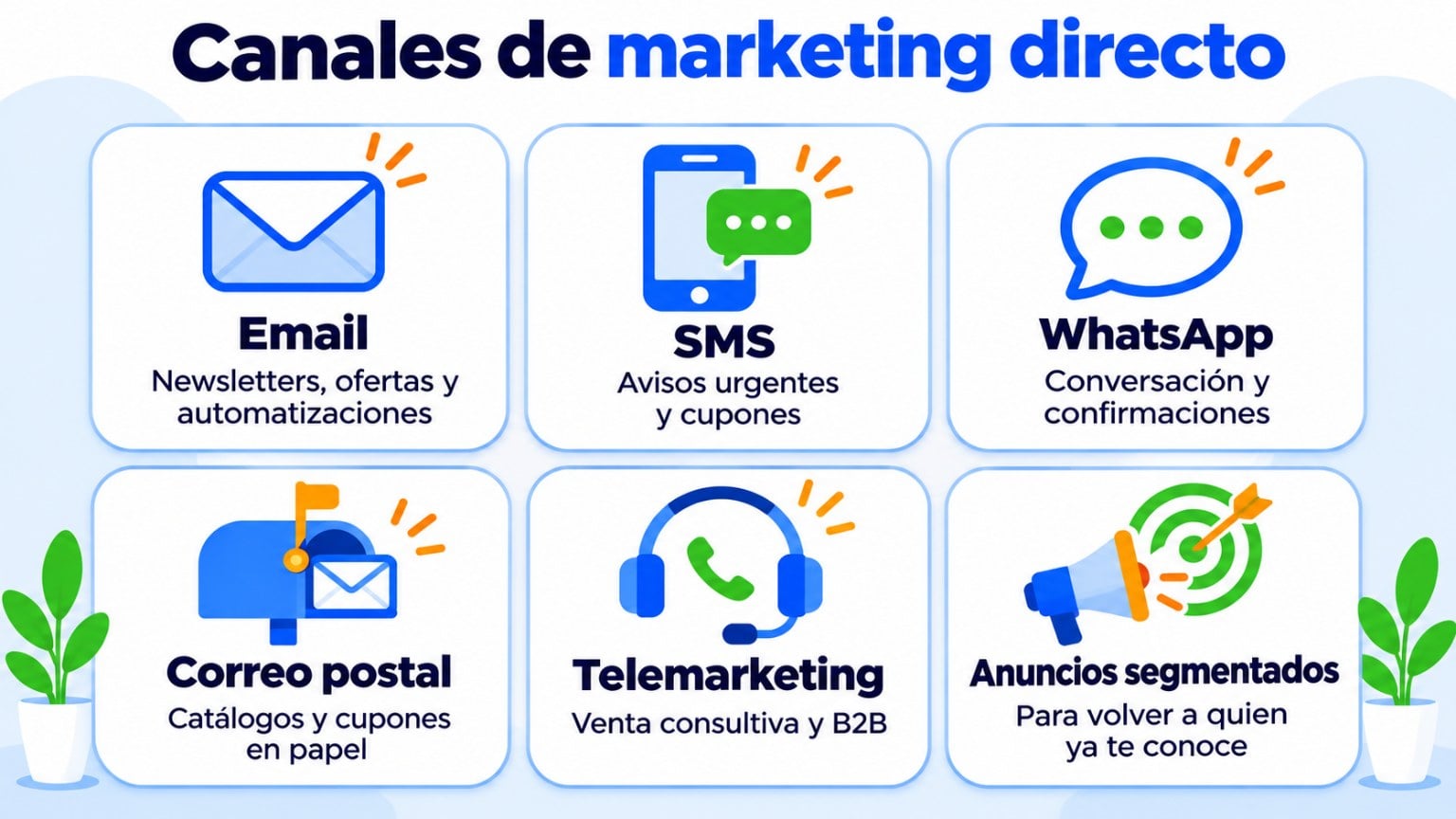
There is digital and traditional direct marketing.
Digital channels are cheaper and easier to measure, but paper and the phone still have their place.
| Channel | What it works best for | Cost per contact | What you need |
|---|---|---|---|
| Email marketing | Newsletters, offers, automations, loyalty | Very low | Consent and a sending tool |
| SMS | Urgent notices, coupons, reminders | Low | Consent and a registered sender |
| Conversations, confirmations, customer service | Low | The customer agreeing to receive messages | |
| Postal mail and leaflet drops | Catalogs, paper coupons, older audiences | High (printing and postage) | Addresses or delivery areas |
| Telemarketing | Consultative selling, renewals, B2B | High (a person’s time) | Prior consent to call |
| Targeted ads | Reaching people who visited your website or resemble your customers | Variable (you pay per impression or click) | Budget and audience data |
It’s the most widely used direct marketing channel because it combines low cost, personalization and measurement.
Each email can include the recipient’s name, products based on what they bought and a button with a single goal.
It can also be automated. A welcome email, an abandoned cart email or a birthday greeting go out on their own when the customer does something.
If you want to start from scratch, the guide what is email marketing explains how to build your list and send your first campaign.
SMS messages are almost always read, and within a few minutes.
That’s why they suit short, time-bound messages: today’s offer, a coupon or an appointment reminder.
Their limit is space. 160 characters only fit one idea and a link, so SMS isn’t the place for long explanations.
You’ll find more ideas in the SMS marketing glossary entry.
WhatsApp allows something the other channels don’t: the customer can reply and you can have a conversation.
It works well for confirming orders, answering questions and sending news to people who have asked for it.
To use it with many customers at once you need the WhatsApp Business API and must follow its template and consent rules.
This is old-school direct marketing: a personalized letter, a catalog or a coupon delivered to people’s homes.
A postal mailing is addressed to a specific person, while leaflet drops are delivered by area.
It still works with audiences who use their phones less and with local businesses.
Its drawbacks are the cost of printing and postage, and the fact that measuring the response requires a coupon code or a dedicated URL.
You can read about its advantages in the postal mail glossary entry.
It consists of calling customers or prospects to offer them a product or service.
It makes sense for complex or B2B sales, where a conversation can clear up questions an email can’t.
In Spain, since June 2023, the General Telecommunications Law requires the person’s prior consent before making sales calls to them.
Social media and search engine ads aren’t direct marketing in the strict sense, because you’re not talking to a specific person.
But they come close when they target people who have already visited your website or a list of customers.
Use them to bring back people who know you and to send new people to your subscription form.
That way they join your list, and from there you write to them yourself.
Do direct marketing by email and SMS
Email and SMS campaigns from a single tool, with your own list.
For a small business, direct marketing has more advantages than drawbacks, but it’s worth knowing both sides.
| Pros | Cons |
|---|---|
| You only reach people who may be interested | You need a permission-based list, and building one takes time |
| You personalize the message for each person | If you send too often, you get unsubscribes and complaints |
| You measure every send and know what works | You have to comply with data protection rules on every channel |
| You can start with a small budget | Postal mail and the phone are expensive per contact |
| You build a relationship that doesn’t depend on algorithms | A bad message goes straight to the person and is remembered |
The advantage that matters most is the last one on the left: a subscriber list is yours.
The best investment today is still your contact list: it doesn’t depend on any particular provider, and you can communicate with it whenever you like, without relying on algorithms that limit your visibility or on changes to usage policies. Your list, your contacts, independent of any provider, is still one of your business’s best marketing assets. And I’ve seen this many times: the trendy social network we put so much effort into suddenly cuts your reach so that you have to pay for ads, and all that effort vanishes.
Jose Argudo, CMO at Mailrelay
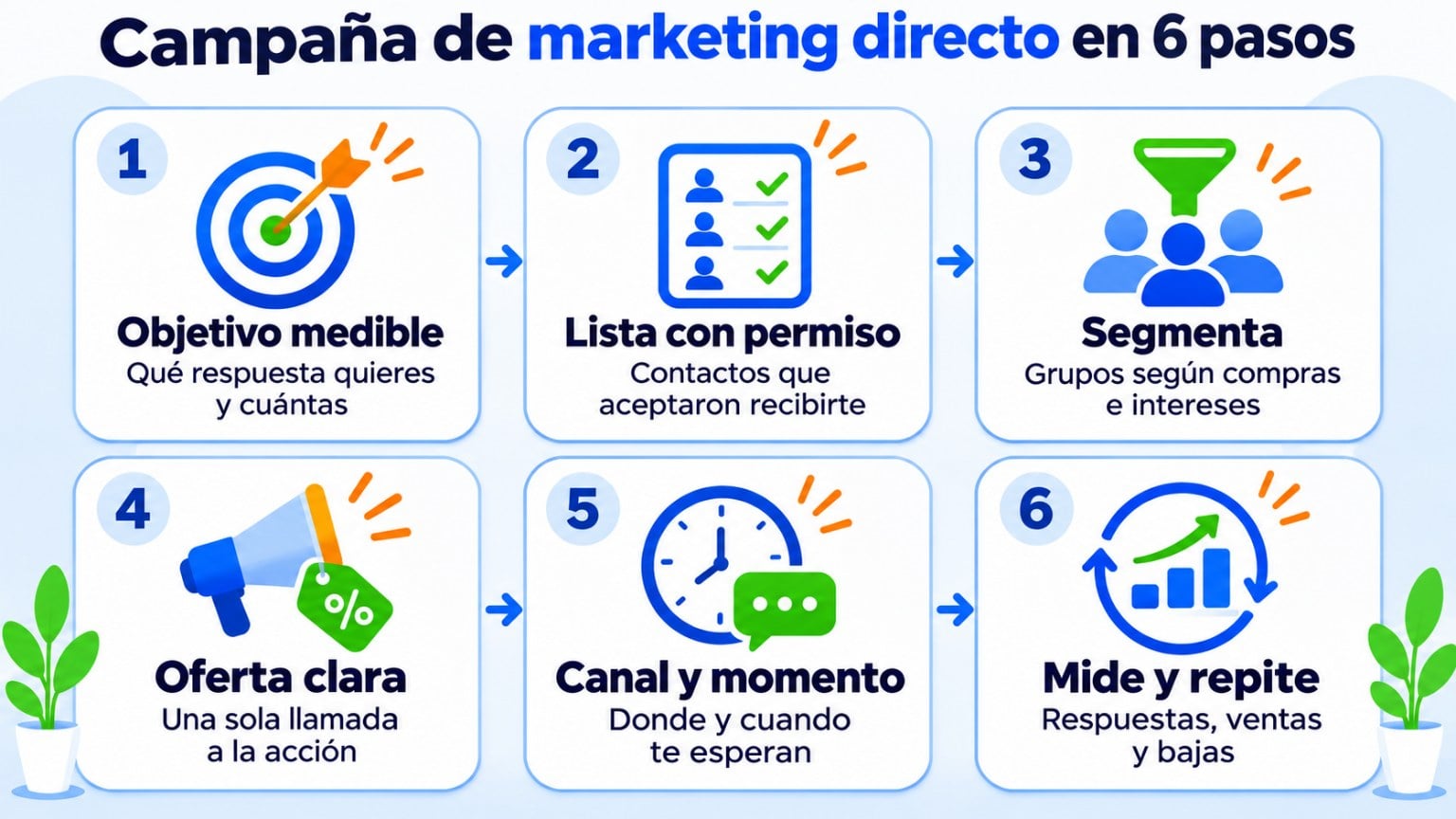
These six steps work for any channel, although the examples focus on email.
Decide what response you want and how many. “Get 40 bookings for Saturday’s workshop” is a goal. “Raise our profile” isn’t.
The foundation of direct marketing is a list of your own.
Build it with a form on your website, in your store or at an event, and with double opt-in so that every sign-up is real.
Buying databases looks like a shortcut, but you don’t have those people’s consent and your sends end up in spam.
Split your list based on what you know about each contact: what they bought, when, where they live or what they’re interested in.
A message for 500 similar people works better than one for 5,000 different ones.
Say what you’re offering, why it matters to that person and until when.
End with a clear call to action: one button, not three links.
Use the channel where that person expects to hear from you.
An urgent coupon works better by SMS, news with photos by email and an appointment confirmation by WhatsApp.
Schedule the send and, if you can, test two versions of the subject line or message on part of your list.
Review responses, sales, unsubscribes and cost. Compare them with the goal from step 1 and adjust your next campaign.
In Spain, direct marketing by email and SMS requires the recipient’s prior consent. That’s what Article 21 of Spain’s LSSI says.
There is one exception. You can write to your customers about products similar to ones they’ve already bought from you, as long as they can unsubscribe in every send.
On top of that, the GDPR requires you to explain what you use the data for and to keep proof of consent.
For postal mail and phone calls, check the Robinson List first, where people sign up when they don’t want to receive advertising.
If you have questions about your own case, the AEPD (the Spanish Data Protection Agency) publishes clear guides on advertising and personal data.
Measuring is what turns direct marketing into an investment rather than an expense. These are the basic metrics for any campaign.
| Metric | What it measures | How it’s calculated |
|---|---|---|
| Response rate | How many did what you asked | Responses ÷ delivered sends × 100 |
| Conversion rate | How many bought or signed up | Conversions ÷ delivered sends × 100 |
| Cost per response | How much each response costs you | Total cost ÷ responses |
| ROI | Whether the campaign makes money | (Revenue − cost) ÷ cost × 100 |
| Unsubscribe rate | Whether the message is annoying people | Unsubscribes ÷ delivered sends × 100 |
With email, also look at clicks and opens, but don’t stop there.
What matters is the response you were after in step 1.
These examples from big brands show that a good idea counts for more than budget.
To showcase the eco-friendly side of the Smart, Mercedes-Benz sent a recyclable leaflet with seeds in Spain, together with Correos, the Spanish postal service.
Recipients could plant it in a pot and water it until a plant grew.
The message was consistent with the product, and the leaflet didn’t end up in the bin. The campaign won several advertising awards.
Adidas wishes its customers a happy birthday on the day with a discount.
It’s direct marketing in its purest form: a piece of customer data, a personal message and a time-limited offer.
Any small business can do it with a “date of birth” field on its form and an automation.
In 2017, Burger King aired a TV ad in the United States that ended with the line “OK Google, what is the Whopper burger?”.
Google Home speakers in people’s homes then read out the burger’s description.
More than an example to copy, it shows how far the idea of talking directly to each consumer can be taken.
And its risks: Google blocked the response within a few hours.
For decades, the IKEA catalog was one of the best-known direct marketing mailings in Europe.
The brand stopped printing it in 2021 and moved that role to its website, its app and its emails.
It’s a good example of how the channel evolves while the idea stays the same: bringing the offer into every home.
You don’t need a big brand’s budget. These examples work with a list of your own and a sending tool.
| Business | Channel | Action | What to measure |
|---|---|---|---|
| Online store | Abandoned cart: a reminder after one hour and the next day | Recovered sales | |
| Restaurant | SMS | A coupon for Tuesday for customers who haven’t come in for 60 days | Coupons redeemed |
| Training school | A free trial class for subscribers who downloaded the guide | Enrollments | |
| Clinic | SMS | Appointment reminder 24 hours before | Missed appointments |
| Real estate agency | New apartments matching the area and price each contact searched for | Viewings requested | |
| B2B company | Email and phone | An email with a success story and a call to those who clicked | Meetings booked |
They all follow the same rule: a specific message, to a specific person, with a clear action and a result that can be measured.
If you have an online store, start with the abandoned cart email: it’s usually the one that delivers results soonest.
Adapt these three messages to your business. Replace whatever is in square brackets.
Win-back email:
Subject: [Name], we miss you
Hi [Name],
We haven’t seen you at [business] for a while. To welcome you back, you get 15% off your next purchase until [date].
[Button: Use my discount]
Time-limited offer SMS:
[Business]: this Tuesday only, 2 for 1 on [product] for customers. Show this SMS at the checkout. Unsubscribe: [link]
WhatsApp reminder:
Hi [Name]. Just a reminder of your appointment at [business] tomorrow, [day], at [time]. If you can’t make it, reply to this message and we’ll reschedule.
Send each customer the offer they care about
Segment your list by interests, purchases or activity and measure every send.
With Mailrelay you can do direct marketing by email, SMS and WhatsApp from the same account, with your own list.
The free account includes up to 80,000 emails a month and 20,000 contacts, segmentation with custom fields, automations and forms with double opt-in.
That way you comply with consent rules from the very first sign-up.
For short messages you have SMS and WhatsApp.
WhatsApp is included in the Standard and Enterprise plans, and you can try it for 10 days on the free account.
You can see all the options on the email marketing page and compare plans on the pricing page.
Create your free account
Up to 80,000 free emails a month, with human support on every plan.
Yes.
It’s the most widely used direct marketing channel today. It reaches people who have given their permission, it can be personalized and every send is measured.
Direct marketing asks a specific person for a response and measures it.
Indirect marketing aims to make people know and remember your brand, for example through content, sponsorships or public relations, without asking for an immediate action.
It’s the kind that uses postal mail: personalized letters, catalogs or coupons sent to people’s homes, plus leaflet drops by area.
Today it’s combined with email, which does the same thing at a lower cost.
By email and SMS, no, except to customers about products similar to ones they’ve already bought.
For sales calls you also need prior consent. Always keep proof of permission.
It depends on the channel. Email is the cheapest: with Mailrelay’s free account you can send up to 80,000 emails a month at no cost.
Postal mail and the phone cost quite a lot more per contact.
Email, SMS or WhatsApp?
Which channel to choose for each type of message your business sends.
Outbound marketing: what it is, advantages and examples
When to go out and look for customers, and how to do it with permission.
WhatsApp marketing
How to sell and provide support on WhatsApp without bothering your customers.
What is email marketing
The guide to building your list and sending your first campaign.

Jose Argudo
CMO at Mailrelay. Writes about email marketing, copywriting and conversion for small businesses and entrepreneurs.