Just so you know, a good B2B email marketing strategy isn’t only made of ingredients for a hard-sell campaign; it goes much further: it’s the key to building bridges with leads and customers.
Earning engagement and positioning ourselves as experts in front of other businesses is no easy task. But if there’s one way to do it, it’s with the help of email.
In this article we explain how to get the most out of the channel professionals use most to communicate, along with tips for writing the best B2B messages.
What is B2B Email Marketing?
B2B email marketing (Business-to-Business) is a digital marketing strategy that uses email as its main channel to communicate and build relationships with other businesses.
Unlike B2C (Business-to-Consumer) email marketing, which targets individual consumers, B2B is aimed at professionals, companies and organizations that make more complex purchasing decisions, with longer sales cycles and higher average order values. If you’re looking for an email marketing tool for businesses, Mailrelay lets you start with a free account of up to 80,000 emails a month.
Features of B2B Email Marketing
- Focus on building long-term relationships: The goal is to build trust, educate the customer and position the brand as an expert in its industry.
- Segmentation and personalization: Messages are tailored to the needs, interests and context of each audience segment. This includes company size, industry or the recipient’s job title.
- Longer sales cycles: Unlike B2C, where decisions tend to be impulsive, B2B decisions are more considered and rational, and involve several decision-makers.
- Educational and consultative approach: The priority is to add value through useful content, such as case studies, reports, webinars or guides that help recipients identify their needs and solutions.
Why is B2B email marketing important?
- Building trust: It lets you position your company as a leader in your industry.
- Lead nurturing: It helps keep potential customers interested throughout their decision-making process.
- Conversion: It’s an effective tool for guiding leads toward a desired action, such as booking a demo, downloading a resource or making a purchase.
- Cost-effectiveness: Compared to other channels, email marketing is affordable and highly measurable, which makes it easier to optimize.
B2B and B2C email marketing: Differences
Beyond the acronyms, the difference lies in the target audience we’re addressing. A B2C (business to customer) campaign is one a company runs to sell to an individual end user.
Whereas in B2B (business to business) we “target” another professional or company. A SaaS, such as invoicing software for small businesses, is a clear example of B2B sales.
That’s why we say they are two worlds in the same galaxy: they orbit around users who may be individuals or businesses, but who are, above all, people.
What happens in B2B email marketing when it comes to selling?
What we mean is that a B2B customer needs to be exposed to an offer (content/stimulus) more than once before making a purchase decision.
In B2B businesses it’s much harder to make an impulse sale. The reasons are clear and we’ve seen them already: the investments are larger, the decision is rarely made by a single person and the goals are rarely short-term.
All of this shapes the scenario we mentioned, where the sales cycle gets longer or, put more simply, the decision is made more calmly.
That means we have to work harder to nurture decision-makers and make a good impression on them.
Because, mind you, one thing about selling to businesses is that you have to win over the users and whoever pays for your product but, above all, the decision-maker.
Examples of B2B email marketing campaigns
There are several types of emails:
- Delivering a piece of content or a lead magnet
- Informational
- Follow-up (we keep the user interested in what we’re going to offer them)
- Nurturing (we add value so they become aware of their needs and of the solution they need)
- Sales (we talk about our product, payment options, etc.)
Email marketing campaign 1: Black Friday
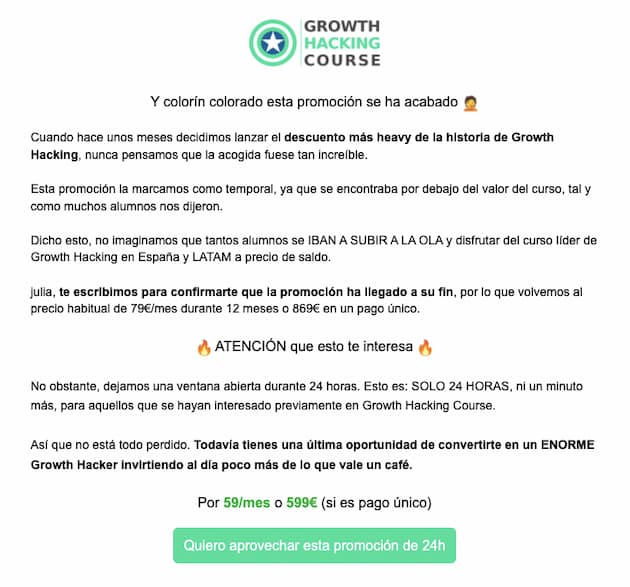
In the last week of November, GHC held its biggest promotion of the year: Black Friday.
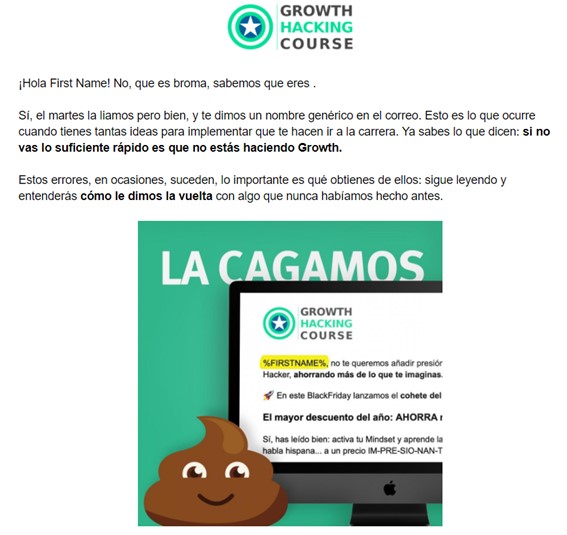
For the occasion, they put together a promotional email marketing campaign made up of an email sequence, and right in the first email they made a mistake: they sent 20,000 people in their database an email with %FIRSTNAME% instead of the name.
Oops.
What did they do?
They turned the situation around, owning up to the mistake and using it as proof that experimenting has its dangers (in other words, no risk, no success), and the best part is that this message is completely consistent with their philosophy.
They called it “the screw-up” and sent a new email to those same 20,000 people with a cheeky wink.
How about that?
They turned the mistake into an opportunity.
They made the most of the message, sparking recipients’ interest thanks to their honesty and the humorous tone of the subject line: 💩We bragged about Black Friday… and screwed it up.
And once they’ve caught your attention, they bring out their best copywriting weapons.
The keys to this B2B email campaign
- ✔ 2 CTAs (Calls to Action) throughout the email, without overdoing it. One in the middle of the message, built into the text, and another at the end as a button.
- ✔ They list the benefits and features of the course.
- ✔ They present the promotion and how it works in detail.
- ✔ They create a sense of urgency in the target audience through limited places and upcoming registration deadlines.
- ✔ They make readers feel part of something exclusive.
- ✔ They include an engagement CTA at the end of the message body and also in the signature, a house trademark.
The results? With this promotional email marketing campaign they generated so many leads interested in the course that the entire sales team was swamped during those days, achieving the biggest sales peak of the year.
🔗Related article: 4 newsletter templates for your next promotional campaign
Last October GHC launched a new viral campaign: the 48 Growth Hacking Tools guide, 2021 edition. It’s a free guide recommending a selection of tools for working with the Growth Hacking methodology.
With an email campaign they gained more than 8,000 leads in 48 hours without spending a single euro on advertising.
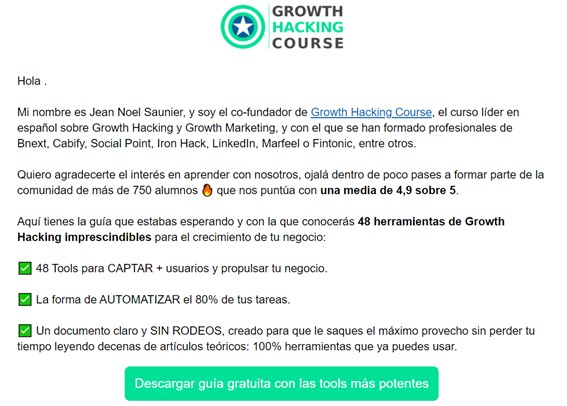
This was the follow-up email that people who wanted to download the guide received, which also contained a second CTA to drive sign-ups to a sales webinar.
The keys to this B2B email campaign
As you can see, the content of the email has it all:
- ✔ They start by demonstrating their authority by naming some of their distinguished clients: “professionals from Bnext, Cabify, Social Point, Iron Hack, LinkedIn, Marfeel and Fintonic, among others”.
- ✔ They show off their social proof: “a community of more than 750 students 🔥 who give us an average rating of 4.9 out of 5”, demonstrating that other people have used the product or service before and rate the course highly.
- ✔ They offer you value for free by giving you their lead magnet: the 48 Growth Hacking Tools guide.
- ✔ They pique your curiosity, finishing with a second CTA that invites you to a webinar.
- ✔ Notice that they always end their emails with a P.S., opening the door to questions.
- ✔ Notice that, to build trust, the signature is personal and includes a photo of the sender, and it once again encourages you to get in touch with questions.
With this B2B email campaign they managed to convert leads from a TOFU (Top of the Funnel) guide into MQLs (Marketing Qualified Leads) interested in their Growth Marketing course.
And metrics that are a joy to see: a 70% open rate, a 60% CTR (Click Through Rate: the number of clicks a link gets relative to its number of impressions), an 82% CTOR (Click To Open Rate, which only counts users who actually click) and a 40% webinar conversion rate.
🔗Related article: templates for sending mass follow-up emails
Email marketing campaign 3: Post-webinar email
One of Growth Hacking Course’s most powerful lead magnets is its one-hour sales webinar, in which they teach attendees the Growth Hacking methodology.
At the end of the webinar, those who stay until it finishes receive this email offering them the chance to join the Growth Hacking Course community with a special promotion, a gift only for those who stay until the end of the content.
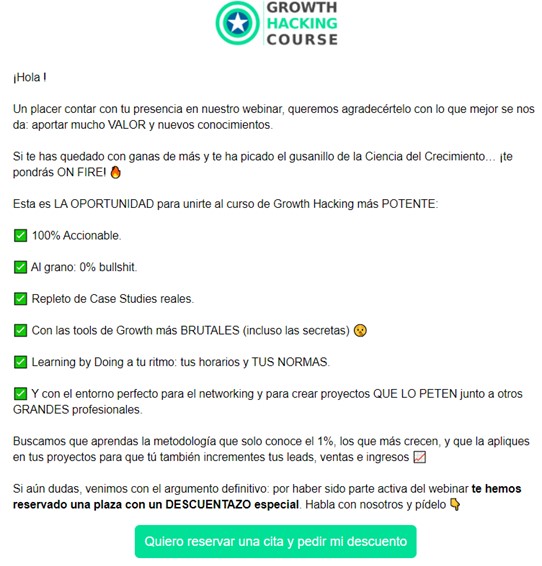
From the length of the email alone, we can see they’re addressing a well-warmed-up audience. It’s considerably shorter than the emails sent when the recipient hasn’t yet consumed any of their content.
There’s no need to distract the potential customer by repeating things they already know or to hide what they really want: for them to sign up for the course.
That doesn’t mean the message lacks substance, far from it. It simply means they get straight to the point.
The keys to this B2B email campaign
- ✔ They list the product’s benefits.
- ✔ They use bullet points with symbols to focus attention and remind readers why they’re there.
- ✔ They point out that it’s a methodology only winners know. Who wouldn’t want to be part of that select club?
- ✔ A prominent CTA with an exclusive discount that can only be accessed from that email.
- ✔ They don’t miss the chance to showcase their authority: “Growth Hacking Course has changed the lives of more than 450 students, boosting their careers and projects at companies such as Cabify, Telefónica, LinkedIn and Bnext”.
- ✔ A personal sign-off: “A hug from one Growth Hacker to another (future) Growth Hacker”. Remember that human beings always want to belong to a group or have a tribe, and with this they’re telling you that you already belong to their clan.
Check out the numbers for this email: a 54.71% open rate, a 5.75% CTR and a 35% conversion rate to SQL (Sales Qualified Lead).
Email marketing campaign 4: Sales email with a discount
Let’s look at the last promotional email marketing campaign from Growth Hacking Course, as good an example as any of how to run a B2B email campaign.
This time we’re looking at a campaign whose goal is to increase the sales department’s output. To boost sales, they decided that their sales reps could, with a single click, send this email to the SQLs (Sales Qualified Leads) who asked for an offer during sales calls.
It’s an email that doesn’t beat around the bush. It plays on 24-hour urgency and a €149 discount on the course price.
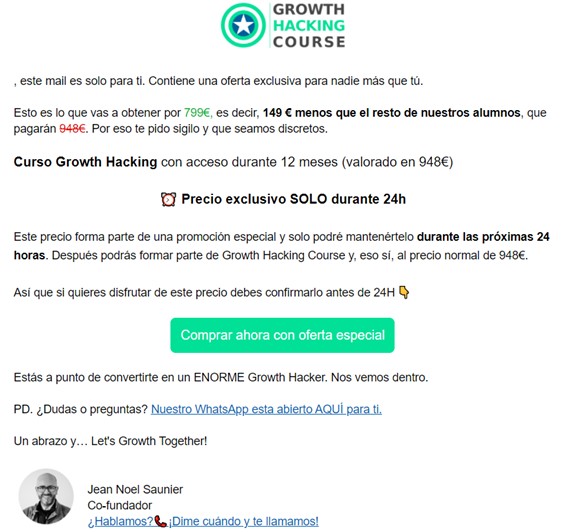
It’s pretty clear. It targets a warm audience that just needs a little nudge to make up their mind. And to encourage them, they aim straight below the waterline.
The keys to this B2B email campaign
- ✔ Exclusivity: “this email is just for you. It contains an exclusive offer for no one but you”.
- ✔ Price (and even more exclusivity): “This is what you’ll get for €799, that is, €149 less than the rest of our students, who will pay €948. So I’m asking you to keep it quiet and be discreet”.
- ✔ Different formats: they play with colors, bold, strikethrough… all to make the offer stand out.
- ✔ Urgency: “Exclusive price ONLY for the next 24 hours”. If the other blows haven’t convinced you, the fear of missing out (FOMO) will, making you stop looking at the offer and go ahead and buy it. Once again they emphasize it with bold and emojis so it stands out from the rest of the text.
- ✔ A CTA that’s appealing thanks to its color and its call-to-action message, which ties in with the email’s goal and clearly states what you’ll get if you click.
- ✔ A warm sign-off that keeps the line of communication open for doubts or questions. And on WhatsApp too; it couldn’t be more convenient.
- ✔ A personal signature encouraging you to get in touch if you haven’t already, of course.
Pay close attention to the results of this email, which is already at the end of the sales funnel: a 70% open rate, a 23% CTR and a 5% conversion rate.
Examples of successful B2B email marketing campaigns
Dropbox
Dropbox, a cloud file storage and sync service, has used B2B email marketing to promote its business solutions.
In one particular campaign, Dropbox sent personalized emails to its existing users highlighting the features and benefits of its business offering.
The campaign achieved a significant increase in conversions and sales of its business services.
Adobe
Adobe, a software and creative services company, ran a B2B email marketing campaign to promote its Adobe Sign product.
The campaign included personalized emails segmented by industry and company size, as well as a series of webinars and educational resources.
This email marketing strategy helped Adobe increase awareness and adoption of Adobe Sign in the B2B market.
Maersk
Maersk, a shipping and logistics company, implemented a B2B email marketing campaign to improve its customer relationships and increase retention.
The campaign included personalized emails focused on its customers’ specific needs, as well as regular updates on the status of their shipments.
As a result, Maersk saw an increase in customer satisfaction and long-term retention.
Slack
Slack, a team communication and collaboration platform, ran a B2B email marketing campaign to drive adoption of its product among businesses.
The campaign included emails with educational content, useful tips and testimonials from satisfied customers, as well as clear calls to action for subscribers to sign up and try Slack.
The campaign was successful in acquiring new customers and expanding Slack’s user base in the B2B market.
Lead temperature and stage: keys to getting your B2B email marketing right
One important thing about B2B email marketing is that the strategy must be aligned with the information the sales team passes on.
And that brings us, once again, to our great friend: context. Although this time it refers to the stage the lead is at in the sales process.
It’s very typical of B2B marketing to have an acquisition strategy based on lead magnets.
Those leads then go into a CRM, such as Salesforce or HubSpot, and then to the sales team, which takes care of scheduling demos and meetings.
That’s why it’s so important to understand the lead’s context. Knowing where they come from lets you understand what they need to hear and tailor the approach of your email campaigns accordingly.
What we mean is that if you understand the context, you’ll know what the user needs at every moment and you’ll be able to fine-tune your copy to relieve their pain points and feed their pleasure points.
CTA
We all know CTAs are important; whether the copy or the color of the CTA itself makes a difference… well, that’s something you should at least test.
What really matters here is defining exactly what happens after crossing the threshold of the CTA or call to action: where you’re going to take the user and what you need them to do there.
Either way, there must be consistency between the context of the email, the body text, the CTA and what happens on the other side: the landing page, the calendar to book the call, the form to enter a phone number and get a callback, or whatever it may be.
Be careful with offers and the risk of looking like a company on clearance
Urgency is a very important sales tool, but only if you know how to use it. You need to be natural and, going back to the previous point, understand the context the user is in.
In addition, B2B audiences are usually very familiar with marketing “tricks”. So an exaggerated or arbitrary use of urgency may not work or may even annoy them.
72-hour offer! Only until tomorrow! 50% off!
OK, but why? Justify it.
● If you’re offering a free consulting service as a step before the sale, you could perhaps explain that you (or your team) have limited availability.
● If you’re selling a course, you might want to offer it at a huge discount to the first customers who join the beta phase, because that will help you improve the content before launching a final course (which, of course, will have a different price).
Email list segmentation and personalization in B2B email marketing
Instead of sending the same message to your entire contact list, segmentation lets you divide that list into smaller groups based on criteria such as company size, industry, geographic location or online behavior.
This way, you can tailor the content of your emails to the specific needs of each segment and make your communications more relevant.
Here are some ideas for personalizing your B2B emails and improving open and conversion rates:
- Use the recipient’s name in the subject line and in the body of the email to create a more personal connection.
- Tailor the content of the email to the specific needs and interests of each segment of your mailing list.
- Offer recommendations based on the recipient’s previous behavior, such as the products or services they’ve viewed on your website.
- Include case studies or testimonials from customers in the same industry or with challenges similar to the recipient’s.
- Take advantage of events or news relevant to the recipient’s industry to put your message in context and show that you understand their concerns.

Creating valuable content to attract and retain B2B customers
In the world of B2B email marketing, content is king.
By providing valuable content to your customers and prospects, you not only give them reasons to open your emails, but also establish your company as a reliable source of information and solutions in your industry.
Here are some ideas and tips for creating valuable content in your B2B email marketing campaigns:
✅ Know your audience: To create content that resonates with your customers and prospects, it’s essential to understand their needs, challenges and goals.
✅ Address real problems and challenges: Content that addresses specific problems and challenges in your industry will be more valuable and relevant to your audience.
✅ Provide exclusive, up-to-date information: Keep your subscribers informed about the latest trends, news and innovations in your industry.
✅ Combine formats and media: Not all subscribers have the same content preferences.
✅ Tell inspiring and moving stories: Human, moving stories capture attention and create deeper connections with your audience.
✅ Include clear and effective calls to action: Make sure your B2B emails include clear and effective calls to action that guide your subscribers to the next step, whether that’s scheduling a demo, downloading an ebook or signing up for an event.
✅ Measure and optimize: Use analytics tools to measure the performance of your email marketing campaigns and optimize your content efforts based on the results.
By creating valuable content in your B2B email marketing campaigns, you’ll not only attract new customers, but also retain and strengthen your relationships with existing customers, driving your business’s long-term growth and success.
Analytics and optimization tools in B2B email marketing
Analytics and optimization tools let you collect data on your campaigns’ performance, identify areas for improvement and adjust your strategies accordingly.
Here are some key tools and techniques for analytics and optimization in B2B email marketing:
✅ Email marketing platforms: Most email marketing platforms, such as Mailrelay, Mailchimp or Brevo (formerly Sendinblue), offer built-in analytics that let you measure key metrics such as open rates, clicks, bounces and conversions.
✅ A/B testing: Running A/B tests on your emails lets you compare different versions of a message to determine which one is more effective.
✅ Google Analytics: Connecting your email marketing campaigns to Google Analytics lets you track subscribers’ behavior on your website after they click on your emails.
✅ Heatmaps and session recordings: Tools such as Hotjar or Crazy Egg let you see how subscribers interact with your emails and your website through heatmaps and session recordings.
✅ Customer surveys and feedback: Asking your subscribers and customers for feedback is an excellent way to gain valuable insight into the performance of your email marketing campaigns.
✅ Email marketing automation: Email marketing automation tools, such as HubSpot or Marketo, let you create automated workflows based on your subscribers’ behavior.
✅ Competitor analysis tools: Using tools such as SEMrush or Ahrefs lets you analyze your competitors’ email marketing campaigns and gain valuable insight into their strategies and results.
By using these analytics and optimization tools and techniques, you’ll be able to monitor your campaigns’ performance.
Maintaining a sending calendar and long-term planning
A well-structured calendar will help you maintain consistency in your communications, ensure your content is relevant and timely, and avoid content fatigue or overwhelming your subscribers.
Here are some tips for creating and maintaining an effective sending calendar and plan for your B2B email marketing campaigns:
✅ Set clear goals: Before you start planning your calendar, define the goals you want to achieve with your B2B email marketing campaigns.
✅ Identify key events and dates: Make a list of events relevant to your industry and audience, such as trade shows, product launches, special promotions and holidays.
✅ Plan ahead: To make sure your content is always fresh and relevant, it’s essential to plan your email marketing campaigns in advance.
✅ Set a sending frequency: Decide how often you’ll send emails to your subscribers.
✅ Create a workflow and assign responsibilities: To keep your sending calendar and plan on track, it’s essential to have an efficient workflow and assign responsibilities to your team members.
✅ Monitor and adjust: Regularly review the performance of your email marketing campaigns and adjust your calendar and planning based on the results.
✅ Stay flexible: While it’s essential to have a well-structured calendar and plan, it’s also important to be flexible and open to changes or adjustments.
By maintaining a sending calendar and long-term planning, you’ll make sure your B2B email marketing campaigns are consistent, relevant and effective, helping you achieve your goals and build strong, lasting relationships with your subscribers and customers.
The relationship between B2B email marketing and other digital marketing strategies
Content marketing:
Emails are an excellent way to share and promote your valuable content, such as blog posts, case studies, ebooks or webinars, with your target audience.
These pieces of content not only enrich your emails, but also help establish your company as a source of knowledge and resources in your industry.
Social media:
Integrating your email marketing campaigns with your social media efforts can increase the visibility and reach of your messages.
For example, you can include social sharing buttons in your emails, encourage your subscribers to follow you on your social channels and use your social media to promote your email campaigns and attract new subscribers.
SEO and search marketing:
B2B email marketing campaigns can complement your SEO and search marketing efforts by driving traffic to your website and increasing the visibility of your pages and content.
In addition, using relevant keywords in your emails can help improve the relevance and authority of your content in search engines.
Online advertising:
Online advertising, such as Google Ads or Facebook Ads, can be an excellent way to increase the visibility of your email marketing campaigns and attract new subscribers.
You can use targeted ads to promote your content, special offers or events and send visitors to specific landing pages where they can subscribe to your mailing list.
Public relations and influencer relations:
B2B email marketing can be an effective tool for building and maintaining relationships with influencers and media outlets in your industry.
You can use emails to stay in regular contact, share your content and news, and establish mutually beneficial partnerships.
By understanding and leveraging the relationship between B2B email marketing and other digital marketing strategies, you’ll be able to create integrated, effective campaigns that help you reach your goals and strengthen your online presence.
Examples and case studies of successful B2B email marketing campaigns
✅ Dropbox: Dropbox, a cloud file storage and sync service, has used B2B email marketing to promote its business solutions.
In one particular campaign, Dropbox sent personalized emails to its existing users highlighting the features and benefits of its business offering.
The campaign achieved a significant increase in conversions and sales of its business services.
✅ Adobe: Adobe, a software and creative services company, ran a B2B email marketing campaign to promote its Adobe Sign product.
The campaign included personalized emails segmented by industry and company size, as well as a series of webinars and educational resources.
This email marketing strategy helped Adobe increase awareness and adoption of Adobe Sign in the B2B market.
✅ Maersk: Maersk, a shipping and logistics company, implemented a B2B email marketing campaign to improve its customer relationships and increase retention.
The campaign included personalized emails focused on its customers’ specific needs, as well as regular updates on the status of their shipments.
As a result, Maersk saw an increase in customer satisfaction and long-term retention.
✅ Slack: Slack, a team communication and collaboration platform, ran a B2B email marketing campaign to drive adoption of its product among businesses.
The campaign included emails with educational content, useful tips and testimonials from satisfied customers, as well as clear calls to action for subscribers to sign up and try Slack.
The campaign was successful in acquiring new customers and expanding Slack’s user base in the B2B market.
These examples and case studies show how B2B companies can use email marketing effectively to achieve a range of goals, such as increasing sales, improving customer relationships and boosting retention.
By analyzing these successful campaigns, you can identify the tactics and strategies that work best in the B2B market and apply them to your own email marketing campaigns.
![What your B2B email marketing strategy should include [Checklist]](https://mailrelay.com/wp-content/uploads/2014/07/plantillas-newsletter-gratis.png)
What your B2B email marketing strategy should include [Checklist]
By now, you know how important email marketing is for attracting, nurturing and persuading other businesses to buy your product or service.
When you take the next step and put everything you’ve learned in this post into practice, you’ll build your own strategy.
In other words, you’ll spend time thinking about and organizing your email sends and complementary actions, such as creating sign-up landing pages, lead magnets or mailing lists.
It could take minutes, hours or days, depending on how complex the actions you want to carry out are.
So to make it easy for you, we’ve put together a checklist with practical tips that guarantee you an effective B2B email marketing spell 👇
✅ Group your leads into cohorts such as sign-up date, event, company size, job title, industry, etc.
✅ Identify your users’ entry sources.
✅ Don’t focus only on your products; think about the needs of your (potential) customers.
✅ Choose a powerful tool to schedule your bulk emails, such as Mailrelay.
✅ Design your autoresponder flows with context in mind.
✅ Be clear about the goal of each email you send (and try to make them SMART goals).
✅ Measure the results; once you’ve measured, measure again, and then measure once more.
✅ Optimize based on the results.
✅ Always test different subject lines to improve your open rate.
✅ Run A/B tests to find out which audiences, CTAs, design or copy work best for you.
If you’re already investing a good amount of money in online marketing, why not make that whole investment more effective?
👉 Add B2B email marketing and make your efforts more profitable. Are you up for it? Try our free account and see for yourself. At Mailrelay we have what you need.

Jose Argudo
CMO at Mailrelay. Writes about email marketing, copywriting and conversion for small businesses and entrepreneurs.