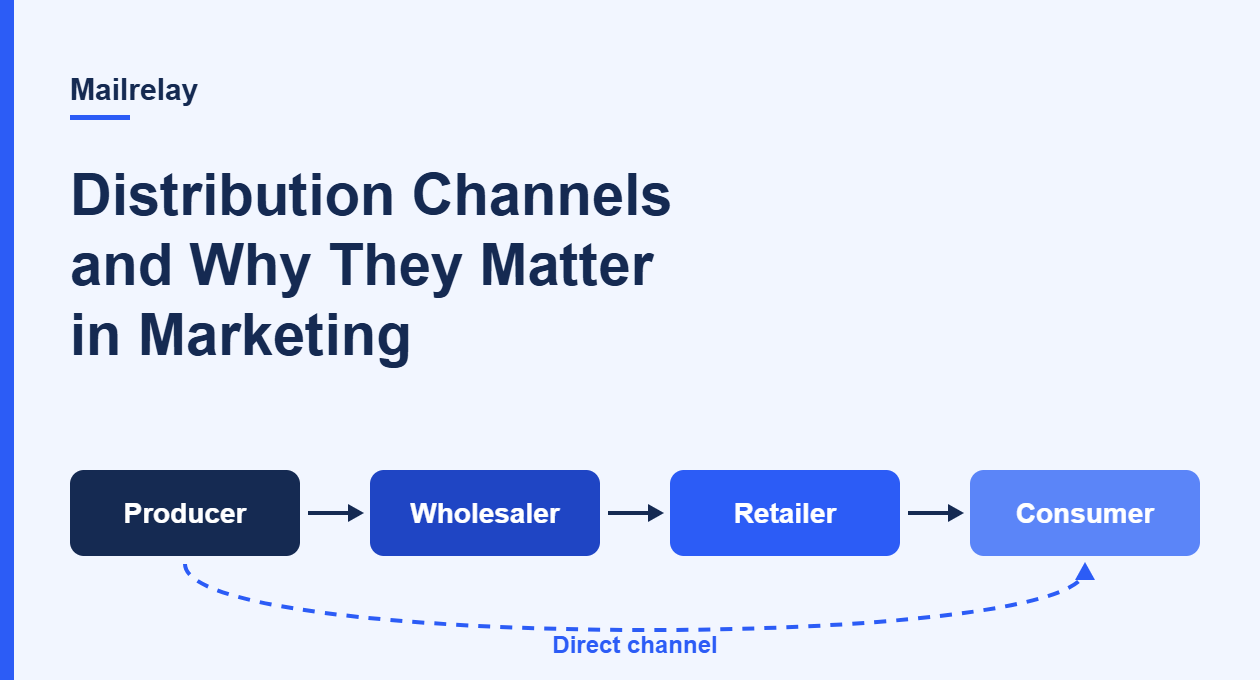
Although it may sound like a concept tied to traditional marketing, distribution channels are still highly relevant today. As we’ll see, the term refers to the way a company gets its products or services to consumers.
It can also be linked to everything that helps us provide better service to our customers. And in that sense, digital strategies play a major role.
But let’s not get ahead of ourselves. Let’s start with the definition: what a distribution channel is and what types exist today.
What is a distribution channel?
As the name suggests, a distribution channel is the route through which something is distributed. In this case, we’re talking about distributing products and services, although the concept is more commonly associated with products.
According to Stern and El-Ansary, distribution channels are all the functions and organizations that actively take part in making a product or service available to the end customer.
These channels move products from the manufacturer’s facilities to the end consumer. However, they shouldn’t be confused with transport companies that, for example, deliver online store orders. Distribution channels are made up of:
● Producers: the agents that make the product.
● Wholesalers: those who distribute to stores.
● Retailers: those who bring the product to the end consumer.
A company’s distribution channels have a positive impact on its sales, because they allow a product to reach more people.
An effective distribution channel allows a product or service to reach a larger number of customers.
Email, your most profitable distribution channel
Of all distribution channels, email marketing stands out for its high return. See for yourself with Mailrelay.
Discover MailrelayTypes of distribution channels in a company
As you can imagine, not all distribution channels are the same. There are several types and even several classifications. Let’s look at the following:
1. Direct and indirect distribution channels. A classification based on which agent is responsible for distribution.
2. Channels by business sector. A classification with different types of distribution channels depending on the industry.
3. Distribution channels in digital marketing. This one covers distribution channels applied specifically to digital marketing.
4. Channels by technology. The last one groups distribution channels according to the buying and selling technology they use.
1) Direct and indirect distribution channels
The first classification makes a clear distinction between a company’s own distribution channels and third-party ones:
Direct channels
A direct distribution channel belongs to the same company that makes the product. In other words, manufacturers deliver their products to consumers themselves.
To do this, they need warehouses and a suitable transport service. Its main advantages are:
● Lower costs.
● Higher profit margins.
● Greater control over the process.
● Easier problem solving.
● Direct contact with the consumer.
Indirect channels
In this case, different companies are involved: producers and distributors are not the same business. Depending on the number of agents involved (the length of the channel), there are:
● Short channel. The product goes from the producer to a retailer, who sells it to the end consumer. There is no wholesaler, so the channel is shorter and has fewer intermediaries.
● Long channel. It includes four agents: producer or manufacturer, wholesaler, retailer and end customer. The product is first sold to the wholesaler, then to the retailer and finally to the consumer. It’s the usual model for everyday consumer goods sold in small stores.
● Double channel. It adds one more link to the long channel: an exclusive agent or broker between the producer and the wholesaler. It’s common in franchises and in sectors such as travel.
We can say that indirect distribution channels offer:
● Wide coverage.
● Specialization.
● Good logistics support.
● Speed.
● Organized sales.
● The possibility to expand stock.
Both types of distribution channel have their pros and cons. Choosing one or the other will depend on the nature of the business and the resources available.

2) Distribution channels by business sector
If we look at the type of business activity, we can also find different distribution channels. Specifically, two: from the producer to the industrial customer, and from the producer to industrial distributors.
● Channel 1: from the producer to the industrial customer. It’s specific to this activity and connects the producer directly with the industrial buyer.
● Channel 2: from the producer to industrial distributors. These are what we called wholesalers earlier: they buy a product and then resell it.
3) Distribution channels in digital marketing
In digital marketing, distribution channels are the digital routes through which different services can be offered. They’re the ones we can use to provide better service to our customers.
By better service we mean giving consumers more information before they buy, making customer support easier, offering faster and more accessible interactive solutions, simplifying the buying process…
It’s worth noting that, for Philip Kotler, marketing strategies make it much easier to manage distribution channels.
Specifically, the following are considered digital marketing distribution channels:
● Articles and valuable content.
● Communication on social media and other apps.
● Digital advertising on different platforms.
● Search engine optimization (SEO) of web content.
As for this last channel, working on SEO makes it easier for people to find information and access certain products or services.
All distribution channels in digital marketing make it easier to access specific products or services, and they do so by creating valuable content.
Reach your customers through the right channel
Automate and personalize your sends so every distribution channel performs better with Mailrelay.
Get started with Mailrelay4) Distribution channels by technology
This last classification looks at the technology the different agents use to bring the product to the end consumer:
● Electronic channels. They rely mainly on the internet, but also use the phone and other digital tools.
● Audiovisual channels. Teleshopping, for example, uses this type of channel: information is shared on TV, the buyer places the order by phone and a transport company delivers the purchase.
● Automated channels. These are channels based on self-service technology, such as vending machines or self-checkout kiosks.
● Traditional channels. Finally, these are the channels that don’t rely on new technologies or communication networks.
How to choose the best distribution channel
From the previous sections, we can see that there are different types of distribution channels. They may be easy to understand, but choosing one is more complicated.
To make the right choice, keep the following criteria in mind.
Type of product
Not every channel we’ve described suits every product. The channel you choose should fit the company’s strategy, as well as its vision, mission and sales goals.
Added value
Ideally, you should choose a distribution channel that adds something positive for the consumer. To do this, analyze your customers’ expectations carefully.
Some will want to talk to the company, others will want to see the product up close, and others will want to order in one click without any hassle. All of this should be taken into account when choosing the right channel.
Speed
This is one of the factors companies value most. But which type of channel will respond best? Some products are clearly better offered through direct channels, while others benefit more from indirect ones.
Compatibility
Today it’s common to find companies with several distribution channels running at the same time. The most usual combination is an online sales channel alongside a retail one.
They can coexist, but conflicts between them must be avoided. Your strategy should respect the role of each channel.
Whatever distribution channel you choose, you need to monitor and track it to manage your supply chain properly.
Examples of distribution channels
As you can see, there are different types of distribution channels, but they all share the same goal. Let’s look at some examples to better understand the concept, focusing on direct and indirect channels.
Examples of direct distribution channels include:
● Banks. They create financial products and offer them directly to their customers, with no intermediaries.
● Farmers. Some sell what they produce directly at local markets, farmers’ markets or fairs. Again, these are businesses with a direct distribution channel.
● Fashion companies. Brands such as Zara both manufacture and sell their own products.
Examples of indirect distribution channels include:
● Car manufacturers. Hyundai, for example, has factories that send cars to dealerships, which sell them to the end consumer. This would be a short distribution channel.
● Ecommerce. Amazon is another well-known example of an indirect distribution channel: a marketplace that receives products from manufacturers and delivers them to the end customer.
● Small shops. Corner shops and convenience stores are examples of long indirect channels, because they need a wholesaler to receive their products.
● HORECA. The same happens in the hospitality sector. Restaurants and bars buy products such as drinks and snacks from wholesalers to offer them to the end consumer.
● Franchises. Food franchises usually use a double indirect distribution channel.
● Travel agencies. The same model applies here. In both cases, a special agent sits between the manufacturer and the wholesaler.
To sum up, one possible scenario is for the manufacturer to sell its products to consumers without intermediaries. For example, if a company makes clothes and sells them directly to customers through its online store, it’s using a direct distribution channel.
Another scenario is for the same company to use a network of wholesalers and retailers. In that case, it would be an indirect channel.
Wholesalers are usually the intermediaries that buy large volumes of a product to sell to retailers, who then sell it to the end user (although they sometimes sell directly to the end customer too).
In the end, the decision will depend on each company’s strategy. That’s why understanding distribution channels is so important for business marketing.
We hope these examples have helped you better understand what a distribution channel is. Now, could you identify the types of distribution channels used by the businesses around you?
If your distribution channel includes the digital environment, it’s worth learning more about digital marketing and the role email marketing plays as a direct channel with your customers.
Your choice of channel should also go hand in hand with a good pricing policy, since both are part of the same marketing mix.
Boost your distribution strategy
Add email marketing to your channel mix and multiply your results with Mailrelay.
Try Mailrelay for free