Lead nurturing: what it is, how it works and email sequence examples
How to guide contacts who aren't ready to buy yet with email
Lead nurturing is the process of staying in touch with a lead who isn’t ready to buy yet, sending them useful information until they are. It’s mainly done with email: a series of messages that answer their questions at each stage and bring them closer to a purchase.
In Spanish, it’s called nutrición de leads or maduración de leads. A lead is a person who has given you their details, for example by subscribing to your newsletter or downloading a guide.
What does lead nurturing mean?
A lead is a contact interested in your product, and nurturing means feeding or caring for something. The idea is to look after your relationship with that contact while they make up their mind.
Most people who give you their details don’t buy right away. Some are comparing options, others don’t have the budget, and others only wanted the resource you offered. Lead nurturing keeps them from forgetting about you in the meantime.
It’s often confused with two closely related terms:
| Term | What it does | Example |
|---|---|---|
| Lead generation | Gets new contacts | A form offering a free guide |
| Lead nurturing | Educates and guides those contacts | A sequence of 5 emails after the download |
| Lead scoring | Scores each contact based on their interest | Adding points for every click or visit to the pricing page |
How does lead nurturing work?
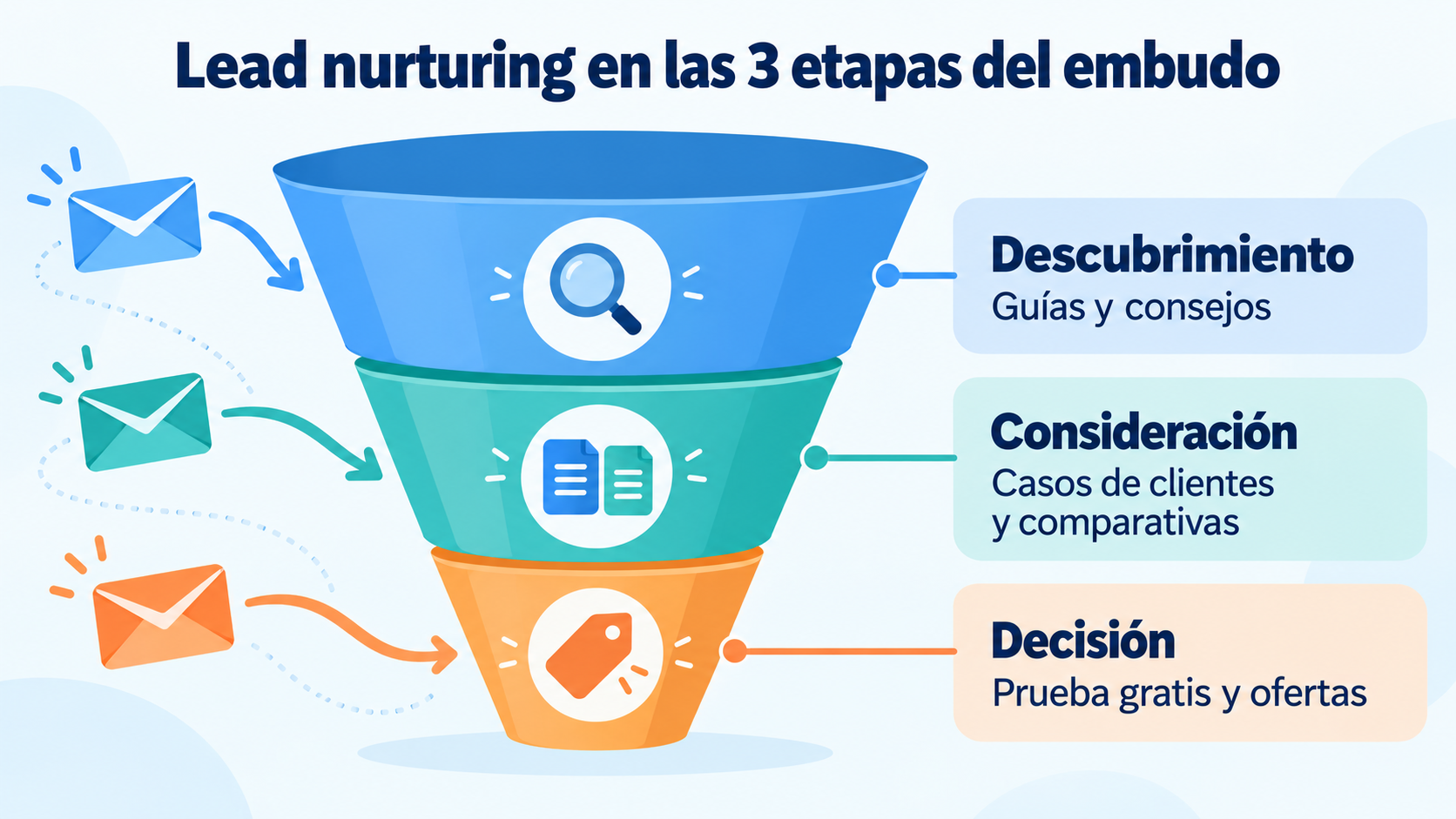
Each lead is at a different stage of the sales funnel. The content they receive should match that stage:
| Stage | What the lead needs | What to send them |
|---|---|---|
| Awareness | Understand their problem | Guides, tips and blog articles |
| Consideration | Compare solutions | Customer case studies, comparisons and webinars |
| Decision | Clear up any remaining questions | Demos, free trials and offers |
Emails are sent automatically based on what each person does. If they open an email about pricing, they get the next step. If they don’t open anything for weeks, they enter a different sequence to re-engage them. This is managed with marketing automation.
Types of lead nurturing campaigns
These are the most common flows:
Welcome. Starts right after someone subscribes. It introduces the brand and delivers what was promised. Learn more in welcome email.
Educational. A series of emails that teaches something useful over several days or weeks.
After a download or a webinar. Expands on the topic the lead was interested in and suggests the next step.
Abandoned cart. Reminds people of the products they left without buying. Learn more in abandoned cart email.
Re-engagement. Tries to win back people who haven’t opened your emails in a while. Learn more in winback campaign.
B2B. Longer cycles, with customer case studies and content for several people at the same company.
Automate your lead follow-up
Create forms, organize your contacts into groups and send automated sequences with Mailrelay.
How to create a lead nurturing strategy in 6 steps
1. Define who you’re targeting. Start with your buyer persona: what problem they have and what’s stopping them from buying.
2. Segment your list. Separate contacts by source, interest or stage. Segmentation means each contact gets what’s useful to them.
3. Prepare the content. Write one email for each major question, moving from general to specific.
4. Decide on the frequency. At first, one email every 2 or 3 days. After that, one a week.
5. Set up the triggers. A subscription, a click or a date starts each flow.
6. Measure and adjust. Check which emails get opened, which ones generate clicks and where you lose the most people.
Lead nurturing sequence example
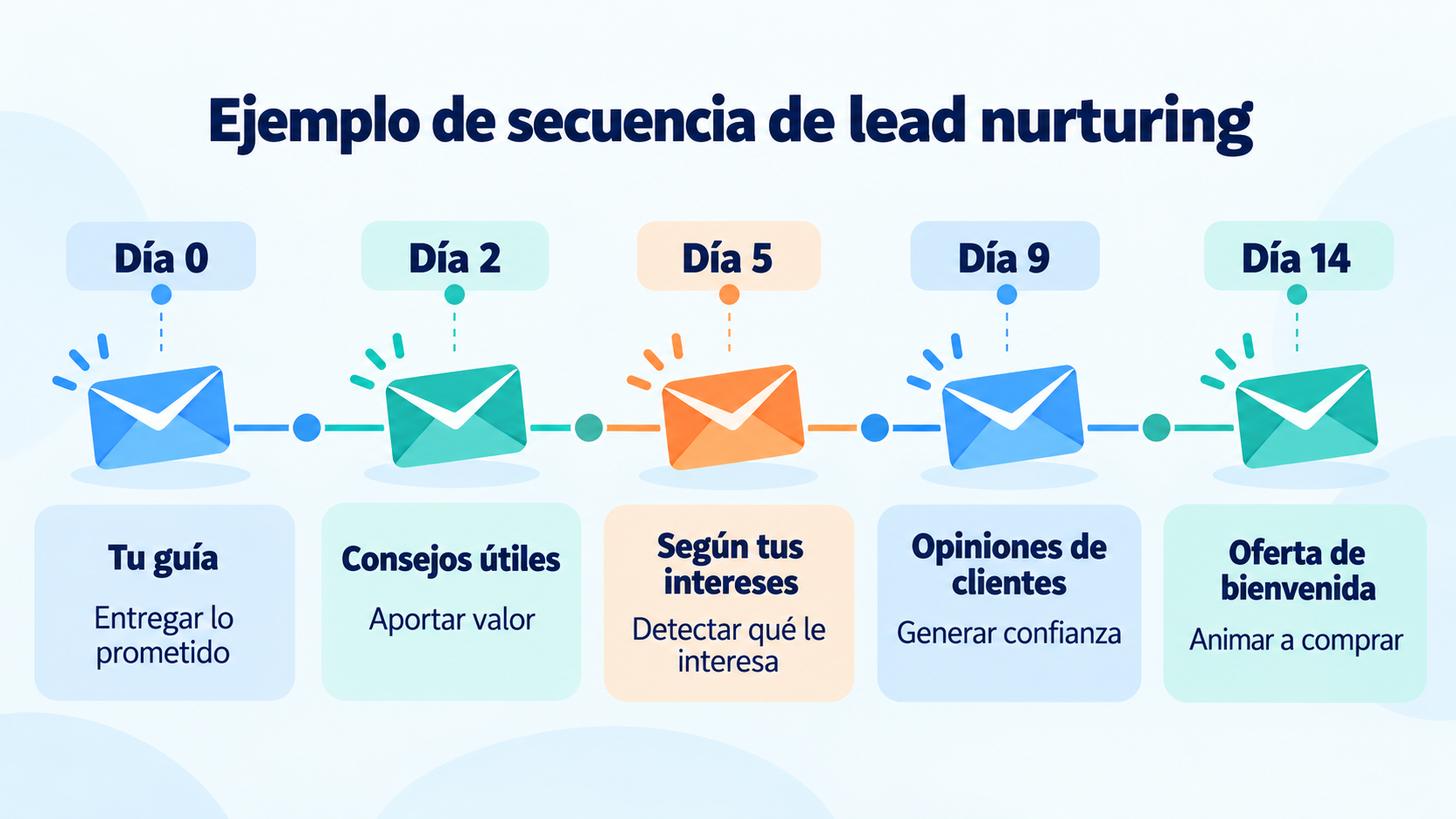
Here’s what the sequence could look like for an online store that gives away a plant care guide:
| Day | Goal | |
|---|---|---|
| 0 | Here’s your guide | Deliver what was promised and introduce the brand |
| 2 | The 3 most common watering mistakes | Provide value and build trust |
| 5 | Which plants handle shade best | Identify interests based on clicks |
| 9 | Customer reviews of indoor plants | Build confidence in the purchase |
| 14 | 10% off your first order | Encourage a purchase |
Anyone who clicks on the shade plants email can move to a different sequence with products of that type.
Which metrics to track
These figures tell you whether the sequence is working:
| Metric | What it indicates |
|---|---|
| Open rate | Whether the subject line and sender generate interest |
| CTR | Whether the content drives action |
| Conversion rate | How many leads buy or request information |
| Unsubscribes | Whether you’re sending too much or the content isn’t a good fit |
| Time to purchase | Whether the sequence shortens the sales cycle |
The most useful thing is to compare email by email. If one loses a lot of readers, change its subject line or content before touching the rest.
How Mailrelay helps you
With Mailrelay, you can capture leads with forms, store their source in custom fields and organize them into groups. Then you can send the welcome email and sequences automatically and see the statistics for each send.
The free account includes up to 80,000 emails a month and 20,000 contacts, with human support by chat, ticket and phone.
Start nurturing your leads for free
Up to 80,000 emails per month and 20,000 contacts, with human support on all plans.
Frequently Asked Questions
These are the most common questions about lead nurturing.
What is lead nurturing in a nutshell?
It’s guiding contacts who aren’t ready to buy yet with useful information, until they are.
What’s the difference between lead nurturing and lead scoring?
Lead nurturing sends content to move the lead forward. Lead scoring measures how far they’ve progressed, with a score.
How many emails should a lead nurturing sequence have?
Between 4 and 7 emails is a good starting point. It depends on how long your sales cycle is.
Is lead nurturing only useful for B2B?
No. In B2B the cycles are longer, but online stores also use it with welcome and abandoned cart emails.
What tool do I need for lead nurturing?
An email marketing platform with forms, segmentation and automated sends.