Machine translation
What is it, how does it work, and what are its benefits?
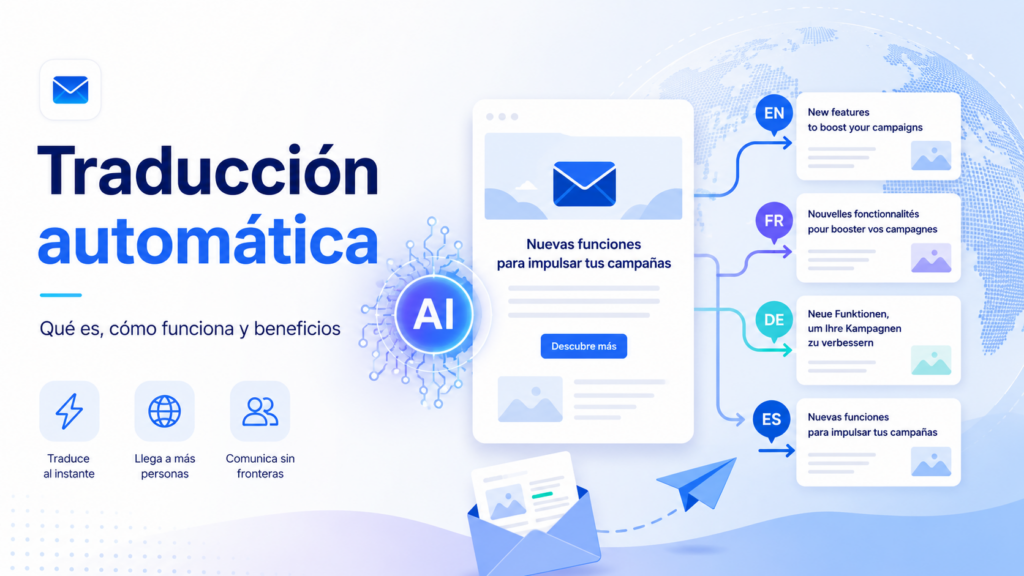
Machine translation is the process of converting text from one language to another fully automatically, without direct human involvement.
Thanks to artificial intelligence and machine learning, machine translation systems analyze large amounts of linguistic data to learn patterns and generate instant translations.
In the world of digital marketing and email marketing, this service lets businesses reach a global audience without language barriers.
Easily translating educational resources, blog articles, knowledge bases, and more.
How does machine translation work?
Machine translators rely on neural networks and advanced statistical models to understand and translate content.
First, the system is trained using a large corpus of parallel texts in two languages (for example, Spanish and English).
As the model processes these examples, it learns equivalent phrases and vocabulary.
Then, when a user inputs text in one language, the translation engine generates the target language version based on what it has learned.
This process uses advanced AI algorithms to continuously improve translation quality.
Advantages of machine translation
Machine translation offers some concrete benefits:
- Speed and efficiency: Translating content manually can be expensive. It can even be difficult for some businesses. Machine translation delivers results while saving time and money.
- Lower cost: Many tools (for example, Google Translate) are free or low-cost. You can even use AI tools to translate.
- Global reach: It lets your emails and content reach different markets without language barriers. For example, you can translate newsletters or transactional messages for international users, improving the customer experience (and conversion).
- Continuous improvement: Machine learning systems can be updated constantly. This means the quality of machine translations tends to improve over time, as the models learn from corrections and new data.
For all these reasons, machine translation is a powerful tool to expand the reach of your digital campaigns and optimize resources in a global strategy.
Disadvantages of machine translation
Despite its advantages, machine translation obviously has its limitations:
- Variable accuracy: Although it has improved a lot, it sometimes makes mistakes with idiomatic nuances or technical terms. That’s why it’s always a good idea to review translations.
- Loss of context: Sometimes the system doesn’t pick up on cultural context or local expressions, which can lead to inappropriate literal translations. This is critical in marketing messages, where tone and intent are key.
- Privacy and security: When you use cloud services, there’s a risk of sharing sensitive data with third parties. It’s important to check the privacy policies of the tool you choose and make sure it’s trustworthy.
Out of all these points, context is perhaps the most important.
If the message being translated loses or fails to detect the context, it might produce translations that seem valid but are completely incorrect due to being out of context.
Reviewing is essential.
Machine translation in marketing and email marketing
In digital marketing, machine translation makes adapting content for different markets much easier.
For example, businesses can use it to translate their websites, gaining access to a much broader audience.
It also makes it easier to create multilingual email marketing campaigns, such as newsletters tailored to each language. By integrating machine translation into your email campaigns, you can personalize messages according to each subscriber’s language, making them more relevant and increasing your open rate.
AI in marketing has revolutionized how we execute campaigns.
Now it’s possible to automate multilingual emails sent in the recipient’s language, optimizing send times and improving results.
However, as always, keeping brand consistency is fundamental.
An effective strategy is to use machine translation to generate an initial draft of the message and then edit it manually.
This saves work while maintaining attention to detail.
Frequently Asked Questions
Is machine translation reliable for my email marketing campaigns?
Machine translation can be a huge help when communicating with international audiences, but it has its limitations.
It’s a good idea to review it before sending bulk emails.
A helpful tip is to use machine translation as an initial draft and then manually correct the most obvious errors.
This way, you maintain the tool’s speed along with the precision of a human touch.
What’s the best online machine translator: DeepL or Google Translate?
Both Google Translate and DeepL are popular options.
Google Translate covers more languages and is free, but DeepL typically offers more natural translations for European languages thanks to its powerful neural engine.
In practice, it’s best to test both with your own text to see which one better matches the tone you’re looking for.
Keep in mind that neither DeepL nor Google Translate can fully replace a professional translator.
Can I use ChatGPT as a machine translator?
Yes, conversational models like ChatGPT can also help with translations.
ChatGPT often understands context better and can paraphrase sentences, although it can be slower than dedicated tools and sometimes makes up details.
If you’re looking for fast, reliable translations for email marketing, specialized services (like Google Translate or DeepL) are usually more practical.
However, ChatGPT is useful for answering specific questions about word meanings or adjusting the style of your translated text.
Machine translation or human translation: which is better?
Human translation (done by a professional) offers greater accuracy and better captures cultural nuances.
On the other hand, machine translation is fast and accessible.
The ideal strategy usually combines both: use machine translation to speed up the process and human review to polish the final quality, especially for key communications.
How can you improve the quality of a machine translation?
To optimize your results, you can:
- Write clear and concise texts in the original language. Avoid highly localized jargon or complex structures.
- Use short sentences: automated systems handle simple phrases better.
- Review and edit after translating: correct minor grammatical errors or specific terminology.
- Leverage advanced features: some tools allow you to adjust the translation’s style or context.
By following these tips, you’ll achieve machine translations that sound more natural and are more effective for your audience.