Price in marketing: what it is, factors and pricing strategies
What determines it, how to set it and how to communicate it to your customers
Price is the monetary value assigned to a product or service.
This value reflects not only the cost of production and distribution, but also the consumer’s perception of value, market competition, and other factors both external and internal to the company.
Price is the only element of the marketing mix that generates direct revenue for the company, since the other three elements involve costs.
Price in the marketing mix
In marketing, price is one of the 4Ps of the marketing mix, along with product, place (distribution) and promotion. All four have to fit together: a premium product with a low price, or an aggressive promotion with a luxury price, confuses the customer.
| P | What it is | Example |
|---|---|---|
| Product | What you sell and its features | A coffee maker with a built-in grinder |
| Price | What the customer pays and how they are charged | €249 or 3 installments of €83 |
| Place | Where and how it reaches the customer | Online store and 24-hour delivery |
| Promotion | How you make it known | Email to the list with a 10% launch discount |
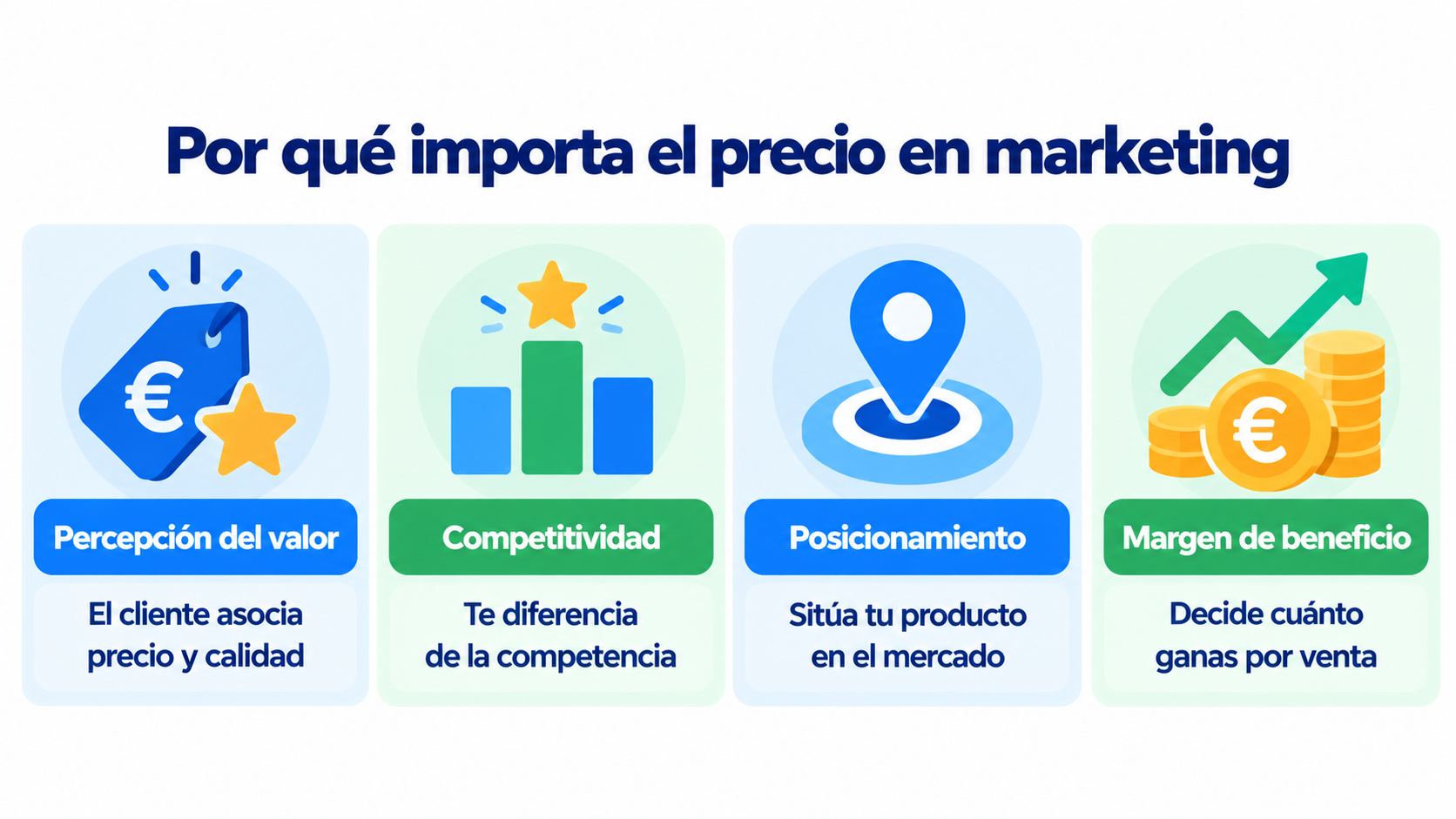
Importance of price in marketing
Price is a critical variable in marketing strategy for several reasons:
Perceived value
Consumers often associate price with product quality.
A high price may indicate a high quality product, while a low price may be perceived as a lower quality product.
Competitiveness
In a highly competitive market, price can be a very useful tool to stand out from the competition.
Lower prices can attract price-sensitive consumers, while higher prices can attract those seeking exclusivity and quality.
Positioning
Price helps position the product in the market.
For example, luxury products have high prices to maintain an image of exclusivity, while mass consumer products tend to have lower prices.
Profit margin
Price determines the company’s profit margin.
A well-established price can maximize profits without alienating consumers.
Communicate your prices and offers by email
Send your price updates and promotions to your whole list in minutes.
Factors that affect price
Determining the right price for a product or service is not a simple task.
There are multiple factors to consider, including:
Costs
These include the costs of production, distribution, marketing and any other costs associated with the product.
The company must ensure that the price covers these costs and generates a profit margin.
Demand
The demand for the product influences the price.
If demand is high, the company can set a higher price. If demand is low, it may be necessary to lower the price to stimulate sales.
Competition
Competitors’ prices also influence pricing.
The company should evaluate the prices of similar products in the market and adjust its price accordingly.
Marketing strategy
The company’s overall marketing strategy also affects pricing.
For example, a market penetration strategy may involve lower prices to attract a large number of consumers, while a skimming strategy may involve high prices to maximize revenue from consumers willing to pay more.
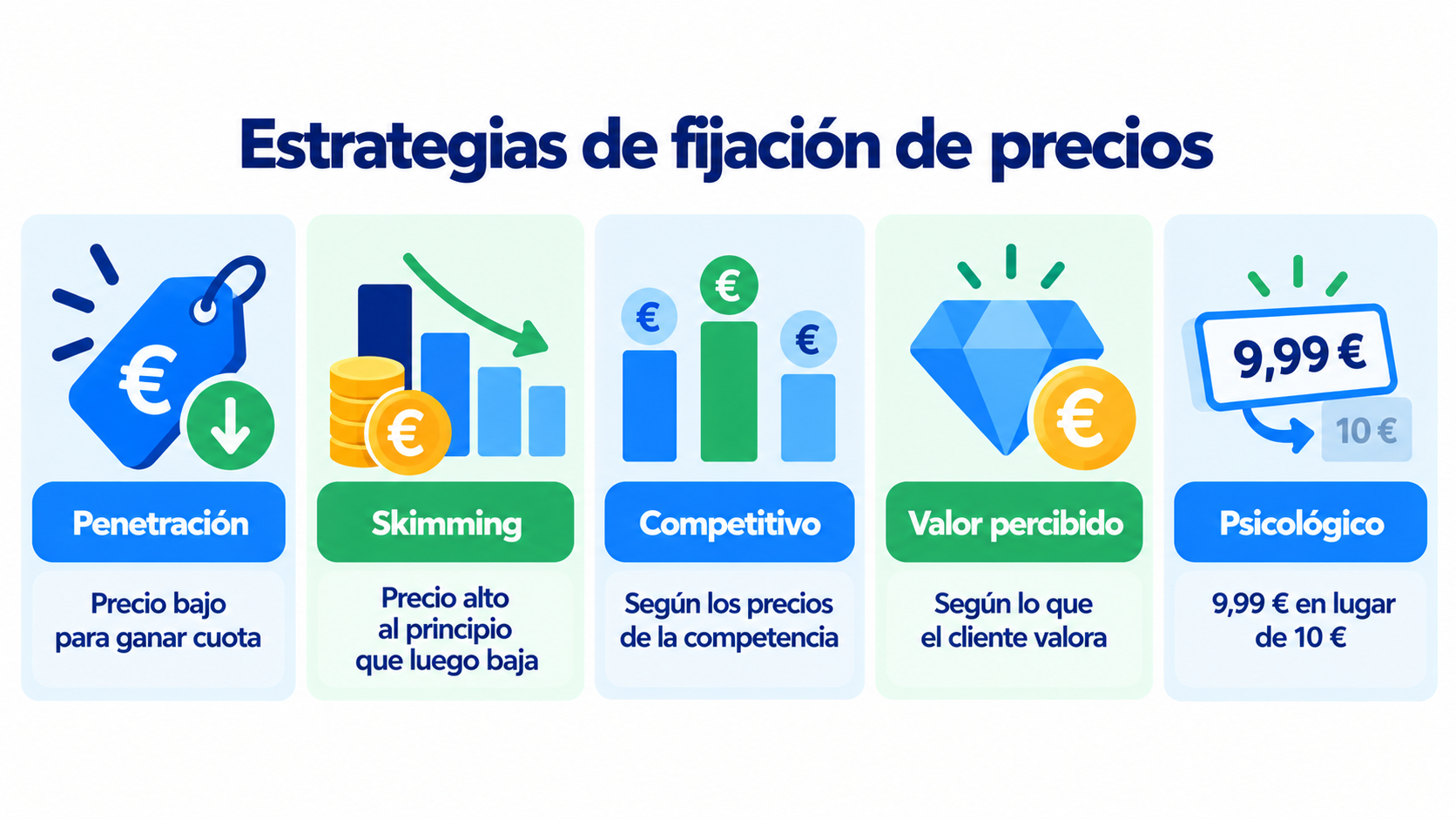
Pricing strategies
There are several pricing strategies companies can use, depending on their business goals and the market they operate in. If you want to work out yours step by step, here is how to price a product, with formulas and examples. These are the most common ones:
Penetration pricing
This strategy involves setting a low price to attract a large number of consumers and quickly gain significant market share.
It is ideal for highly competitive markets.
Price skimming
It involves setting a high price initially and then gradually lowering it.
This allows the company to maximize revenue from consumers willing to pay more at the beginning.
Competitive pricing
In this strategy, the price is set based on competitors’ prices.
The company can choose to match, beat, or undercut competitors’ prices.
Perceived value pricing
Pricing is based on the consumer’s perception of value, rather than on production costs.
This requires a thorough understanding of what consumers value in the product.
Psychological pricing
This strategy uses psychological techniques to influence price perception.
For example, setting a price of €9.99 instead of €10 can make the product seem cheaper.
The relationship between price and email marketing
Email marketing is a powerful tool that can influence price perception and, ultimately, purchasing decisions.
Through well-designed email marketing campaigns, companies can communicate special offers, discounts and promotions, which can affect the perceived value and price of the product.
For example, a company can use email marketing to announce a flash sale with significant discounts.
Not only does this strategy incentivize consumers to make a purchase, but it can also help the company move inventory quickly.
In addition, email marketing makes it possible to segment the audience and personalize messages, which can increase the effectiveness of pricing campaigns.
How Mailrelay helps you
In short, price is a key variable in marketing that directly affects a company’s perceived value, competitiveness, positioning and profit margins.
Determining the right price involves considering multiple factors, from costs and demand to competition and overall marketing strategy.
In addition, email marketing can be a powerful tool to influence price perception and consumers’ purchasing decisions.
By effectively integrating pricing and email marketing strategies, companies can maximize their revenue and build stronger, more loyal relationships with their customers.
With Mailrelay you can communicate your prices and offers to every customer:
- Segments to send each offer only to the people it suits, for example, customers who have already bought from a category.
- A/B tests to compare two offers or two subject lines before sending to the whole list.
- Automations, such as the abandoned cart email, to recover sales without lowering the price.
- Templates to announce a price increase in advance. The post how to price a product includes a sample email.
The free account includes 80,000 emails a month and up to 20,000 contacts.
Let your customers know about every promotion
Segment by interests or purchases and send each customer the offer that suits them best.
Frequently asked questions
What is price in marketing?
It is the amount of money the customer pays for a product or service. In marketing, it also includes how it is charged (installments, discounts, subscription) and the value the customer perceives.
Is price in marketing the same as price in “mercadotecnia”?
Yes. “Mercadotecnia” is the Spanish term used in some Latin American countries to refer to marketing. The concept of price is the same.
Why is price the only P that generates revenue?
Because product, place and promotion are costs for the company. Price is the only part of the marketing mix that brings money into the company.
What pricing strategies are there?
The most common are penetration pricing, price skimming, competitive pricing, perceived value pricing and psychological pricing.
How do you calculate the price of a product?
You start from the cost, add the margin you want to make, and compare it with the competition and with what the customer is willing to pay. The post how to price a product has the formulas step by step.