Demand analysis: what it is, how to do it and an example
Types of demand, methods and a step-by-step example
Demand analysis is the research process companies carry out to learn which types of products and services consumers in a specific market or niche are looking for, in order to create new business areas or adjust existing ones.
In other words, demand analysis is the foundation for making business decisions with a greater chance of success, since it takes into account market trends and the needs of potential customers.
What is demand?
In a marketing context, demand is the quantity of products and services that a group of people are willing to buy in order to satisfy their needs over a given period of time.
Types of demand
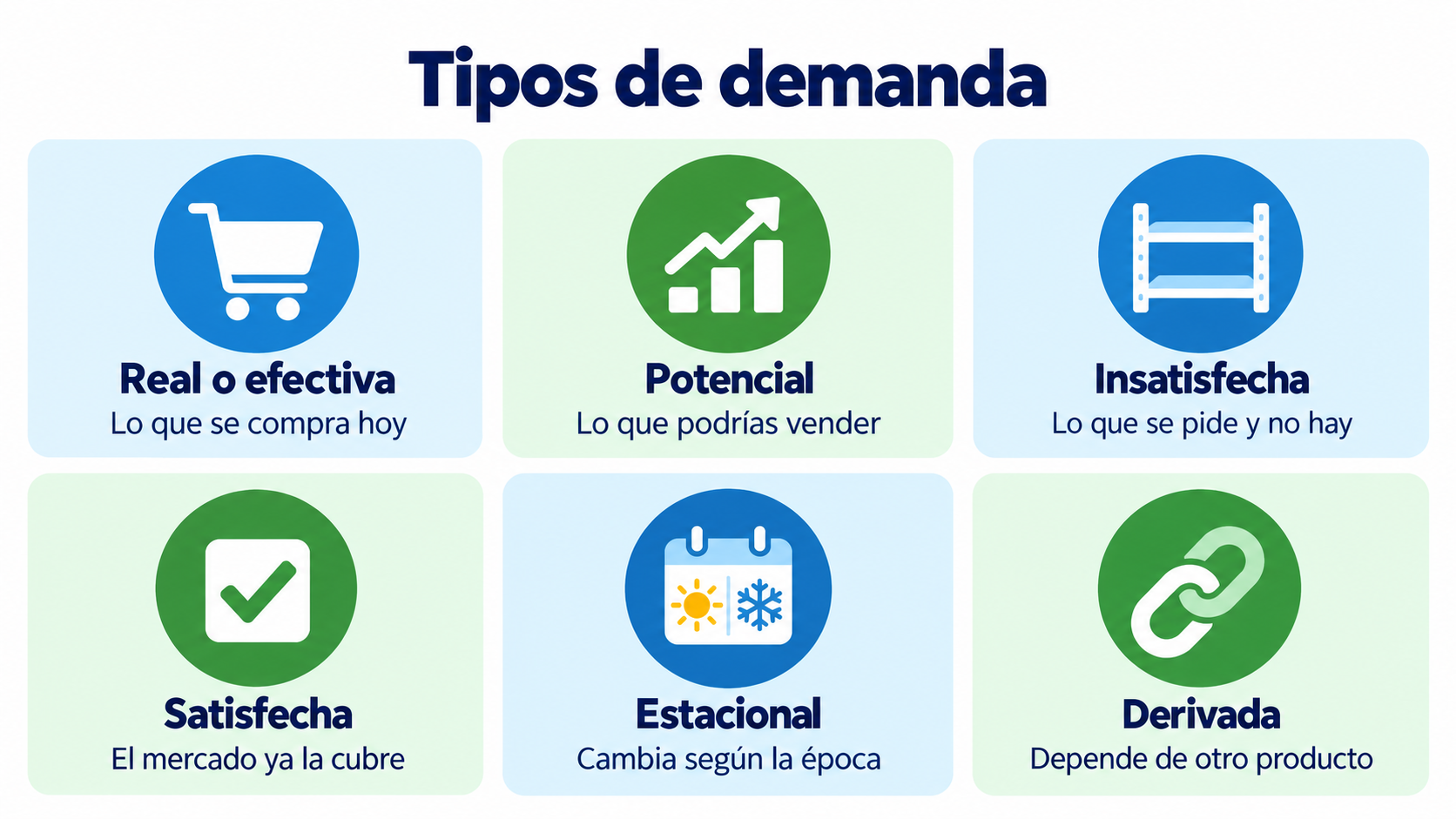
Not all demand is the same. Knowing the type helps you decide whether to launch, how much to produce and when to communicate.
| Type of demand | What it means | Example |
|---|---|---|
| Actual or effective | What people buy today | Your store’s sales last quarter |
| Potential | What could be sold if you reached your entire audience | Customers who fit your product and don’t know you yet |
| Unmet | What people want and the market doesn’t give them | Sold-out products or services with no offer in your area |
| Satisfied | The market already covers what is being asked for | A sector with many competitors and similar prices |
| Seasonal | Rises or falls depending on the time of year | Gifts at Christmas or sunscreen in summer |
| Derived | Depends on the demand for another product | Phone cases, which depend on how many phones are sold |
Test demand with your subscribers
Send a newsletter announcing something new and measure opens and clicks to find out what really interests your customers.
Benefits of demand analysis
Carrying out a demand analysis lets us take actions that help our business grow, because it brings us closer to the reality of the market and our customers.
For this reason, it’s worth highlighting the main benefits it brings, which include:
- It lets you plan production more effectively (increasing or decreasing it).
- It’s an excellent way to plan appropriate marketing actions.
- It helps you avoid oversizing the company or business.
- It reduces variable costs and even fixed costs.
- It improves process optimization.
- It adjusts stock or service to the current market.
- It reduces the risks of offering new products.
How to do a demand analysis
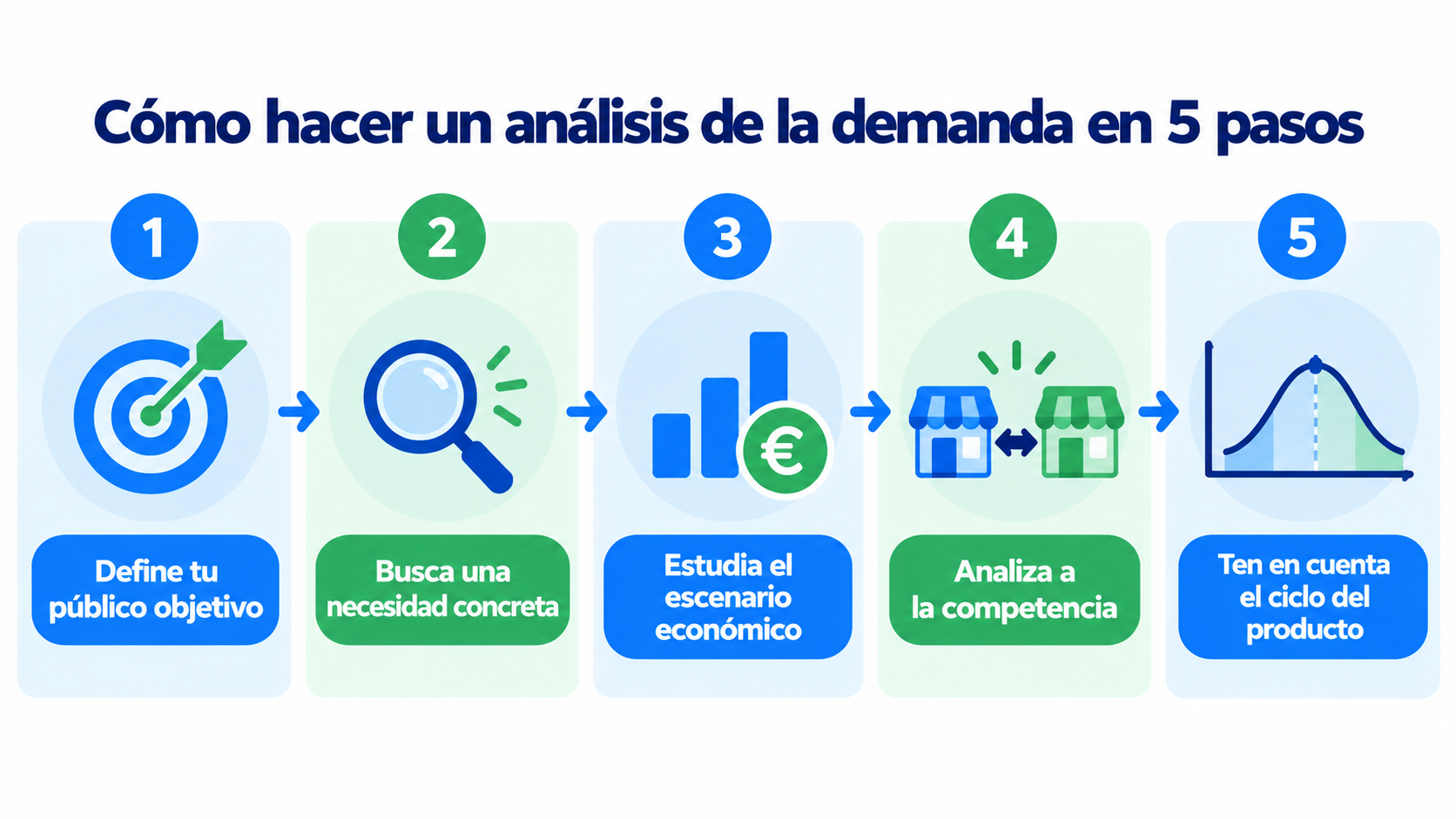
Since it’s a tool for creating new product launches or updating existing ones, demand analysis needs to be carried out with great care. There’s no single way to do a demand analysis, but here are the most important steps to consider when the time comes:
- Define your target audience. The first step is to define the audience you want to target. To do this, you can run satisfaction surveys and/or interviews with a specific niche so you can offer a product that meets a consumer demand.
- Products for a specific need. You should create a product that answers a very specific demand from a specific market niche. That way, consumers will show interest in it and be willing to buy it.
- Identify the economic climate. Based on it, you can predict whether the product or service will be within your target audience’s reach. Keep sociocultural and local factors firmly in mind to know whether or not it’s the right time to offer a new product.
- Study the competition. It may seem obvious, but it’s key that you identify your competitors (if there are any) and analyze products similar to yours, so that yours have noticeable advantages over theirs.
- Keep your product’s cycles in mind. Consider the cycles the product will go through: the emerging stage (where there’s high demand and low supply), the stable stage (where supply balances out with demand), and the decline stage (where supply exceeds demand).
Methods for analyzing demand
| Method | What it tells you | How to get started |
|---|---|---|
| Surveys and interviews | What your customer needs and how much they would pay | Ask your current customers by email or on your website |
| Your own sales data | What sells, when and to whom | Review sales by month, product and customer type |
| Google Trends | Whether interest is rising, falling or seasonal | Compare terms in your country over the last 5 years |
| Keyword research | How many people search for what you offer | Check the search volume for your product and its variants |
| Competitor analysis | What’s already on offer and what’s missing | Compare prices, reviews and gaps in the catalog |
| Test with your subscribers | Whether there’s real interest before launching | Send news or a pre-sale to your list and measure the clicks |
Demand analysis example
Fictional example. An online coffee store wants to launch a monthly subscription:
- Audience: customers who have bought coffee 3 or more times in the last year.
- Need: in an email survey, many say they run out of coffee before ordering again.
- Climate: the price of coffee has gone up, so the subscription offers a fixed price for 6 months.
- Competition: two stores offer it, but without a choice of roast. That’s the advantage.
- Test: an email to the list with a pre-sale and a second email to those who clicked. Based on the clicks and reservations, the store decides how many subscriptions to prepare.
Demand analysis in a market study
A market study analyzes the whole environment you’re going to sell in: demand, what competitors offer, prices and sales channels.
Demand analysis is the part that answers the most important question: are there enough people who want to buy this? If the answer is no, the rest of the study makes no sense.
That’s why it’s usually the first thing done. Next, you study the competition (a SWOT analysis can help) and set the price.
If you want to make money online, demand analysis is the first step.
How Mailrelay helps you
Your subscriber list is one of the fastest sources for measuring demand:
- Subscription forms with custom fields to ask about interests from sign-up.
- Segments to send news only to those it suits.
- A/B tests to compare two offers or two subject lines before deciding.
- Open and click statistics (in the free account and in Enterprise) to find out what really interests your audience.
The free account includes 80,000 emails a month and up to 20,000 contacts.
Send your campaigns for free with Mailrelay
Up to 80,000 emails per month and 20,000 contacts, with human support on all plans.
Frequently asked questions
What is demand analysis?
It’s the study a company carries out to find out which products or services its audience wants, how many and at what price. It’s used to decide what to launch, how much to produce and how to communicate it.
What types of demand are there?
The most common are actual or effective demand, potential, unmet, satisfied, seasonal and derived demand.
What’s the difference between demand analysis and a market study?
A market study is broader: it includes demand, competition, prices and channels. Demand analysis is one of its parts, and it’s usually the first.
What tools can you use to analyze demand?
Customer surveys, your sales data, Google Trends, keyword tools and tests with your subscriber list, such as a pre-sale by email.
How often should you do a demand analysis?
Before launching a product and, after that, at least once a year or whenever something important changes: prices, competition or buying habits.