Generation X: birth years, characteristics and how to reach them
The generation that grew up between cassette tapes and the internet, and how to talk to them so they listen
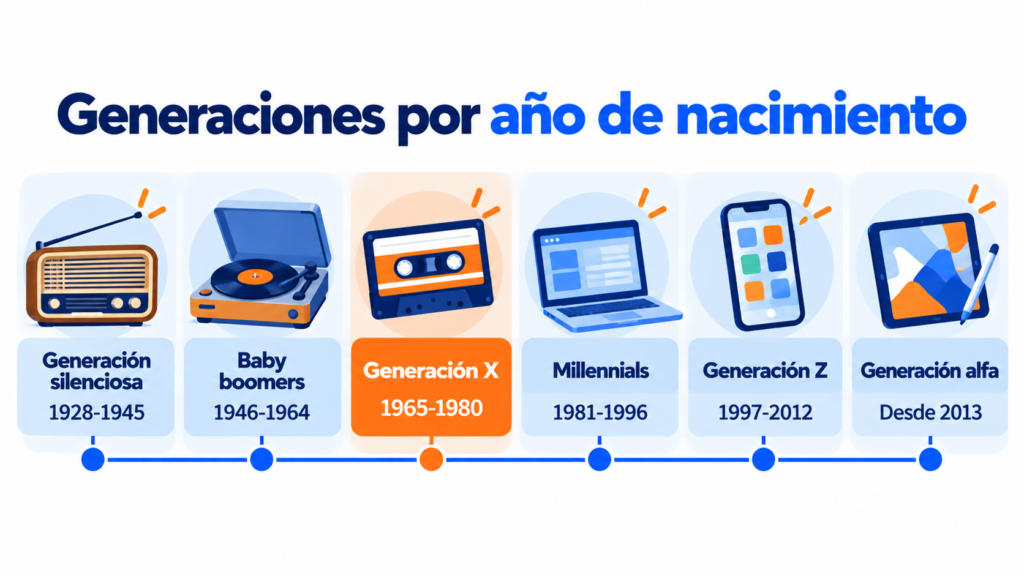
Generation X is made up of people born roughly between 1965 and 1980. It sits between the baby boomers and the millennials, and in 2026 its members are between 46 and 61 years old.
They grew up with television, cassette tapes and the first personal computers, and reached adulthood just as the internet was starting to spread. That’s why they know both the analog and the digital world well.
What is Generation X?
It’s the group of people born after the post-war baby boom, when birth rates fell in many Western countries.
The name was popularized by Douglas Coupland’s novel Generation X, published in 1991. The “X” reflects a generation that is hard to define, with no clear label.
In Spain it is often associated with the “EGB generation”, because many of its members went to school under the Educación General Básica (basic general education) system.
What years does Generation X cover?
There are no official dates, but the most widely cited reference comes from the US-based Pew Research Center:
| Generation | Birth years | Age in 2026 |
|---|---|---|
| Silent Generation | 1928-1945 | 81-98 years |
| Baby boomers | 1946-1964 | 62-80 years |
| Generation X | 1965-1980 | 46-61 years |
| Millennials (Generation Y) | 1981-1996 | 30-45 years |
| Generation Z | 1997-2012 | 14-29 years |
| Generation Alpha | From around 2013 | Under 14 |
Some authors shift these boundaries by a year or two, so it’s best to treat them as a guide.
Characteristics of Generation X
These are the traits usually attributed to this generation:
- Independence. Many grew up with both parents working outside the home and learned early on to fend for themselves.
- A bridge between analog and digital. They’re comfortable with email, social media and smartphones, but they clearly remember the world before the internet.
- Pragmatism. They value clear information, data and usefulness over promises.
- Skepticism toward advertising. They’ve seen a lot of it, and they distrust exaggerated messages.
- Work-life balance. They were among the first to demand it as something important.
- Purchasing power. They’re at a stage of job stability and usually make the household’s buying decisions, often on behalf of their children and their parents too.
These are useful generalizations for understanding the group, not rules that apply to every person.
Generation X, baby boomers and millennials
| Aspect | Baby boomers | Generation X | Millennials |
|---|---|---|---|
| Technology | Adopted it as adults | Grew up with the transition | Grew up with the internet |
| Preferred channel | Phone, email | Email, social networks like Facebook, WhatsApp | Smartphone, social media and messaging apps |
| Attitude toward advertising | More receptive | Skeptical, they ask for proof | Look for authenticity and reviews |
| When buying | Brand loyalty | Compare and look for value | Value the experience |
How to communicate with Generation X
If your audience is between 45 and 60 years old, these guidelines will help you:
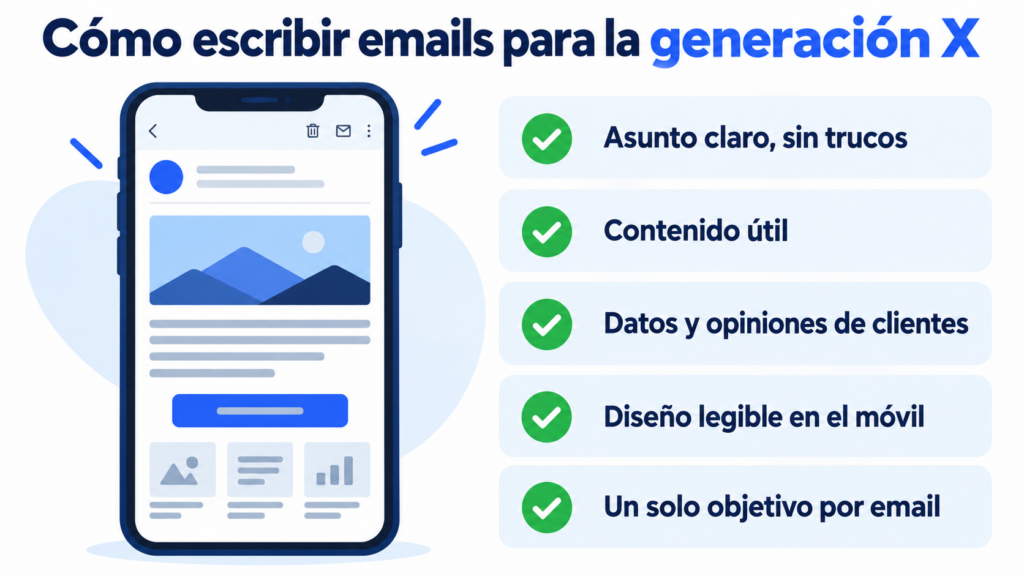
- Get to the point. Explain what you offer, how much it costs and why it’s a good choice.
- Provide proof. Data, customer reviews and guarantees work better than adjectives.
- Respect their time. Clear messages with a single goal that are easy to read on a computer or a phone.
- Use email. This generation uses it every day, at work and at home.
- Talk about their family. Many of their purchases are for their children or their parents.
Before launching a campaign, define your buyer persona carefully, including their age, interests and problems.
Is your audience between 45 and 60 years old?
Reach Generation X with clear, useful newsletters, segmented by age and interests with Mailrelay.
Generation X and email marketing
For this generation, email is a trusted channel: they use it for work, online shopping and everyday errands. These ideas will help you make the most of it:
- Useful newsletters, with guides, comparisons and news, rather than just offers.
- Clear subject lines that say what’s inside, with no tricks.
- Readable design, with a good-sized font and a layout that works on mobile. We explain it in our post on responsive email.
- Personalization with their name and with content based on their interests. You’ll find ideas in our post on personalization in email marketing.
- Loyalty programs, because they appreciate being recognized as good customers.
How Mailrelay helps you
With Mailrelay you can segment your contacts by age or any other data using custom fields, and send each group the message that suits it.
You design your newsletters with the drag-and-drop editor and send yourself a test before each send. Then you see the opens and clicks for each campaign in the statistics.
The free account lets you send up to 80,000 emails a month to 20,000 contacts, with chat, ticket and phone support.
Send your newsletters with Mailrelay
Up to 80,000 emails a month to 20,000 contacts with the free account, with chat, ticket and phone support.
Frequently asked questions about Generation X
What is Generation X? It’s the generation of people born roughly between 1965 and 1980, between the baby boomers and the millennials.
What years were Generation X born in? According to the Pew Research Center, from 1965 to 1980. In 2026 they are between 46 and 61 years old.
What are the characteristics of Generation X? Independence, pragmatism, skepticism toward advertising, an interest in work-life balance and ease with both analog and digital.
Why is it called Generation X? The name was popularized by Douglas Coupland’s novel Generation X (1991). The X refers to a generation with no clear label.
Which generation comes after Generation X? The millennials, or Generation Y, born between 1981 and 1996, followed by Generation Z.