
In a world where consumers are constantly bombarded with advertising, the art of standing out has become a task that is increasingly challenging for brands.
This is where guerrilla marketing comes into play, a strategy that seeks to create a significant impact by using unconventional tactics that are often surprising.
It originates from the term “guerrilla warfare”, which refers to non-traditional combat tactics.
Guerrilla marketing takes a similar approach, but in the field of advertising and promotion.
It’s a way to communicate a brand’s message so that it isn’t just seen or heard, but experienced and remembered.
Consumers are now more skeptical and demanding.
They filter out and skip content they consider irrelevant or intrusive.
Therefore, the need for unconventional strategies is imperative.
It’s not just about being seen, but about being remembered.
History of Guerrilla Marketing
The evolution of marketing has witnessed the introduction of many strategies and tactics over time.
Among these strategies, guerrilla marketing stands out for its boldness and its ability to surprise.
· Origins and evolution of the term:
The concept of guerrilla marketing is anchored in the term “guerrilla”, which is historically associated with the combat tactics of small armed groups.
These groups, facing larger adversaries with more resources, opted for unconventional strategies.
This idea was brought into the field of marketing by Jay Conrad Levinson in the 1980s with his groundbreaking book “Guerrilla Marketing”.
Levinson’s impact on the marketing world was revolutionary.
By proposing an unconventional approach, he opened a door for small businesses and entrepreneurs.
Giving them the tools to compete in a market dominated by large companies.
Guerrilla marketing has shown that creativity and strategy can be just as powerful as a large advertising budget.
· The transition from traditional tactics to disruptive strategies:
Since then, guerrilla marketing has gone beyond its original role as just a tool for companies with limited budgets.
Big brands have also begun to adopt it.
The reason is that ads in magazines, on TV and on the radio no longer have the same impact they used to.
Companies have seen the need to be disruptive and to create experiences that are more than simple messages: experiences that are memorable and even provocative.
Campaigns that generate emotion, surprise or even controversy achieve much greater resonance.

What is the first example of guerrilla marketing?
To give you an idea of what we can achieve with this technique, the first example is said to date from 1929, long before Jay Conrad’s book was published.
In this case, the brand is Lucky Strike, and the creator of the idea was Edward Louis Bernays, who sent the press an announcement about a feminist demonstration in which women would light the torch of freedom.
When the journalists arrived at the event, they found women (hired actresses) smoking Lucky Strike cigarettes. At the time, it was unthinkable for women to smoke in public, something that was photographed and published in every newspaper.

Illustration 1. Vintage Lucky Strike campaign
A surprise action like the one described in the previous paragraph can also fit within what we understand as guerrilla marketing: the goal is to get people talking about you and to turn advertising into a newsworthy event that attracts attention through journalists as well.
Characteristics of guerrilla marketing
Before explaining some of the characteristics of guerrilla marketing, it’s worth noting that not all of them need to be present in a single action:
- As we have seen above, creativity, ingenuity and originality matter more than big budgets.
- These are strategies carried out through unconventional channels and media. At least initially, even if we later want to attract the attention of those media.
- These are actions with a transgressive, daring character that seek to surprise the audience.
- As we mentioned, the intention is not based on sales, but on surprising users, moving them and getting them to keep that campaign in their memory. Leaving a mark on their minds and getting them to associate the brand with a positive strategy.

Basic Principles of Guerrilla Marketing
Guerrilla marketing is a marketing strategy known for its boldness, creativity and disruptive approach.
It’s not just a series of random tactics.
At its core, there are solid principles that guide these strategies and make them effective.
Below, we explore some of the most fundamental principles that define this unique approach to marketing:
· Creativity beyond budget:
In many cases, the most impactful marketing campaigns aren’t the ones with the biggest budgets.
Rather, they’re the ones that show boundless creativity.
Guerrilla marketing is characterized by its ability to maximize impact through innovation, and not necessarily through money.
This philosophy holds that a good idea, well executed, can have a far greater reach than a big-budget ad without a clear or genuine message.
· Focus on the target audience and their context:
Knowing your audience is fundamental in any marketing strategy.
But in guerrilla marketing, it’s an even greater necessity.
It’s not just about understanding who they are, but also where they are, what they do and the context in which they interact.
By identifying these aspects, you can design tactics that blend organically into their daily routines, creating a more direct and memorable impact.
The goal of guerrilla marketing isn’t just to reach the audience.
It’s also to resonate with them in such a way that the experience gets shared.
In the digital age, where social media plays a crucial role, a successful guerrilla campaign can go viral and reach massive audiences.
To achieve this, it’s essential to create experiences that people want to share, whether because they were surprised, moved or made to reflect.

Types of unconventional strategies
We’re going to introduce you to some of the most interesting guerrilla marketing techniques.
Keep in mind that the guerrilla marketing landscape is diverse, which allows businesses to select and customize tactics according to their goals and audience.
Let’s take a look.
· Ambush marketing:
This tactic consists of “ambushing” or taking advantage of an event, situation or platform that already has significant attention.
Without being an official sponsor.
For example, a brand could run marketing actions related to a major sporting event without being directly associated with it.
The goal is to capitalize on the event’s visibility and associate the brand with it indirectly.

Illustration 2. Red Bull, king of “ambush marketing”
· Invisible marketing:
This refers to strategies in which the marketing act is so intrinsically tied to the experience.
This way, the audience doesn’t realize they’re watching “advertising” until after the fact.
It’s a subtle, artistic form of marketing that seeks to blend into the consumer’s everyday life without being intrusive.
· Grassroots marketing, or bottom-up marketing:
This approach is based on the idea of building a campaign from scratch, relying on the community or a specific target group.
It often involves engaging the community directly and can include tactics such as word-of-mouth marketing, community events or local support campaigns.
· Surprise events and flash mobs:
Flash mobs are planned gatherings in which a group of people suddenly converges in a public place to perform an unexpected act, such as dancing or singing.
And then quickly disperses.
These surprise events aim to create an immediate impact that is also memorable, and they often go viral on social media.
· Advertising in unconventional spaces:
Instead of sticking to traditional media, this approach looks for unusual places to deliver a message, such as floors, elevators, bathrooms or even the back of purchase receipts.
The goal is to surprise consumers in their daily routine and make the message stand out because of its unexpected location.

The Role of Technology in Guerrilla Marketing
Technology has revolutionized the way we interact with the world and, as a result, the way brands connect with their audiences.
In the context of guerrilla marketing, technology has opened the door to innovative tactics and has magnified the reach and effectiveness of unconventional strategies.
Below, we explore some of the ways in which technology has influenced and boosted guerrilla marketing:
· Incorporating augmented and virtual reality:
Augmented reality (AR) and virtual reality (VR) offer immersive experiences that can take guerrilla campaigns to a new level.
With AR, digital elements can be overlaid on the real world, allowing brands to create surprising and personalized interactions.
VR, on the other hand, offers the possibility of immersing the user in a completely digital environment designed specifically to convey a message or tell a brand story.
· Social media and digital guerrilla:
Social media has transformed the dynamics of marketing.
In guerrilla marketing, platforms such as Twitter, Instagram or TikTok can be the perfect stage for launching viral campaigns.
Creative, authentic content that is in tune with audiences can be shared massively, amplifying the impact of a campaign with minimal investment.
· Gamification and engagement through mobile apps:
Gamification refers to the application of game mechanics in non-game contexts, such as marketing.
Through mobile apps, brands can create gamified experiences that encourage user participation, strengthen commitment and foster brand loyalty.
From simple games to challenges and rewards, gamification can be a powerful tool for connecting with audiences in a deep and lasting way.

Don’t confuse guerrilla marketing with …
If you’re not a marketing expert or haven’t researched the topic much, the concepts may leave you confused and you may not be able to tell exactly what guerrilla marketing is apart from other techniques.
Don’t worry!
We’re going to look at different techniques so you can tell them apart and know which characteristics are not shared with guerrilla marketing.
► Transmedia storytelling: the sum of all the parts
In this technique, the story we want to tell unfolds across different platforms, together building a coherent narrative. In this case, to understand what a brand wants to tell us, we have different “chapters” on different “channels” (book, podcast, film, ads, etc.).
What matters is that we’re talking about continuing the story in another format. That is, transmedia storytelling is not a book that becomes popular and is adapted for the big screen. In that case, the story is the same, and there is no need to use another format to find out how it continues or ends.
To define transmedia storytelling, Jeff Gómez, an expert in this technique and director of several transmedia projects, put forward eight key characteristics:
- The content must be created by one or more visionaries
- Transmediality must be taken into account from the start of the project
- The content must be distributed across at least three platforms
- It must be original and unique to each platform
- It shows a unique vision of the narrative world
- It avoids divisions or inconsistencies
- It integrates all the actors in the process
- And it involves the audience.
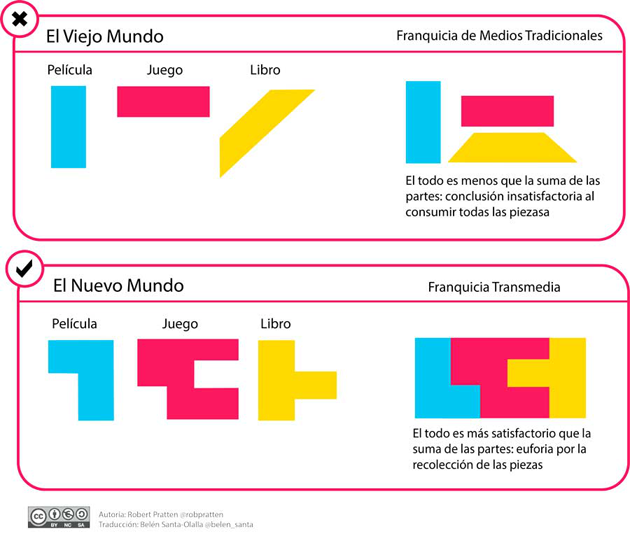
Illustration 3. Transmedia Storytelling
► Storytelling: What’s your story?
What we now know and conceptualize as storytelling has existed since the beginnings of marketing, advertising and brands. Storytelling is, basically, telling stories, more specifically our own.
Every business has a story to tell, a vision, a dream, a purpose. Sometimes this story isn’t visible to customers, who are unaware of this side of the brand.
Through storytelling, as a business, we tell a story, whether about ourselves or about what can be done with our products or services, in order to build greater empathy with our customers.
With this technique we’ll humanize ourselves, get closer to the customer and earn their trust (as long as the story is real, original and good!). Another advantage is that this advertising is easy to remember because of the feelings it evokes.
Some brands specialize in telling these stories because of the success they can have with this technique. A clear example, and one we all know, is the Swedish furniture brand Ikea.
They usually publish a story in the summer that moves the viewer and gets shared, and in it they simply show how their products can “change our lives”. Here you can see Terraza, the story they used in 2013 about a man and a duck.
► Intrusive marketing
The TV commercial is the clearest example of intrusive marketing. The idea is to spread your brand, gain notoriety and get customers to listen to you. It doesn’t segment the audience; instead, we target mass audiences in search of large volumes of sales.
Beyond that, intrusive marketing also includes ads in newspapers and magazines, advertising banners on the web, advertising at in-person events, press releases, advertising flyers that show up in our mailboxes, direct calls from companies, etc. In other words, any form of “more traditional” advertising that we didn’t ask for.
At this point you may think that, for example, witnessing a brand’s flash mob just because you happen to be passing through that same square is also intrusive.
The difference is that, with a flash mob, you can choose to go another way or pay no attention, or you may not even notice it at all.
Also, guerrilla marketing uses these techniques to try to bring a smile to the user’s face, whereas intrusive marketing is generally not well regarded by viewers.
If you don’t believe it, think about how many times you’ve changed the channel when your favorite show breaks for commercials.
► Inbound marketing
Precisely, the other side of the coin is inbound marketing, or attraction marketing.
With this technique, we want customers to be the ones who find us, moving away from intrusive techniques. The main advantage is that if a customer searches for you, it means they already know they have a need and that you can solve it, so the sales rate will be higher.
Inbound marketing is closely tied to content marketing, since it is through quality, relevant content aimed at a specific audience that customers come to us. Also, when we talk about inbound marketing, we’re already referring to online research, creating strategies on our blog, social media, SEO optimization, etc.
The main difference from guerrilla marketing is that the latter seeks to grab the customer’s attention and make an impact with breakthrough, direct, one-off actions. Inbound marketing, on the other hand, is a technique that requires patience, and we’ll see results in the medium to long term, since the main element is content in different formats.

Examples of successful guerrilla marketing campaigns
Now that we know what guerrilla marketing is, where we can do it, which techniques make it up and how it differs from other concepts in the marketing world, we’ll show you several examples that brands and companies have carried out to surprise their customers.
► Glee flash mob
We’ve been using a flash mob as our example throughout the article, so we couldn’t start the examples section any other way. They’re a phenomenon that truly became fashionable, and there are examples not only from well-known brands but even from amateur theaters, schools or non-profit groups.
Here we show you the Glee flash mob, carried out in 2009 in a shopping mall in Rome. With it, the series and the TV network FOX wanted to launch the season that would begin after the Christmas break.
They didn’t just bring together a group of dancers; they also took advantage of the time of year. Christmas, a time of shopping and gifts, gives us a mall full of customers. With this action they gained visibility in the media and millions of views on YouTube. You can watch the video here.
► Ambient marketing on benches: KitKat and Ikea
Two examples in one! Remember the technique known as ambient marketing? It’s about, as we told you at the start of the article, making use of common street elements. For example, a bench.
KitKat has played with these elements on several occasions, turning them into chocolate bars and inviting passersby to sit on them and take their “break”.
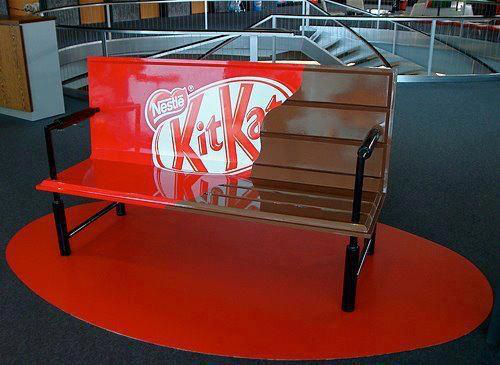
Illustration 4. KitKat example
Another brand that played with these familiar elements on streets and in parks was Ikea. The furniture brand furnished a simple bench with its products, adding cushions, tables, rugs, etc. With this, they showed how a bench could become a comfortable, cozy and even homey space.

Illustration 5. IKEA example
► Ambient marketing on crosswalks: McDonald’s and the gay pride flag
Another of the best-known ambient marketing campaigns in the world was carried out by McDonald’s. In this case, the fast-food chain took advantage of a crosswalk, making each stripe look like a french fry coming out of the brand’s typical packaging.

Illustration 6. McDonald’s example
The gay pride flag has also frequently been represented on crosswalks. The example we show you below took place in front of the Russian Embassy in Helsinki. It was a protest action in which several organizations and associations from the gay community spoke out against the anti-gay laws passed in Russia in 2013.
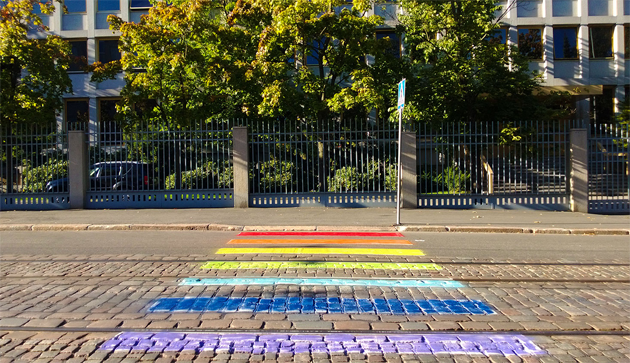
Illustration 7. Example of the gay pride flag in Russia
The idea has been repeated in different cities and by different groups. Even in Madrid, Manuela Carmena’s City Council proposed painting several of the capital’s crosswalks for World Pride 2017.
American Greetings is dedicated to sending cards and greetings for special occasions. On that basis, they took advantage of Mother’s Day to launch a special greeting, but this time through YouTube and social media. The video shows an interview with different candidates for the most important, and most difficult, job in the world. The campaign was launched in 2014 and, to this day, around Mother’s Day it keeps getting views and going viral.

Designing Your Own Guerrilla Campaign
Designing a successful guerrilla marketing campaign requires a combination of creativity, audience knowledge and adaptability.
While every campaign is unique, there are certain steps and principles that can serve as a guide for conceiving and executing disruptive and effective strategies.
Below, we take you through the process of designing your own guerrilla campaign:
· Steps for conceptualizing a guerrilla marketing campaign:
Identifying the target audience:
Before designing any strategy, it’s crucial to understand who it is aimed at.
Define the characteristics, interests and behaviors of your audience so that your campaign can connect in a genuine and effective way.
Setting clear goals:
What do you want to achieve with your campaign?
Whether it’s increasing brand visibility, promoting a new product or building loyalty, having clear goals will let you direct your efforts appropriately.
Creative brainstorming:
Take time to come up with unconventional ideas. Don’t be afraid to be bold and think outside the box. Bring your team together and foster an environment of limitless creativity.
Selecting and adapting tactics:
Based on your goals and your knowledge of the audience, select the guerrilla tactics that fit best and adapt these strategies to your brand and message.
Execution and monitoring:
Launch your campaign and monitor its progress.
Paying attention to the audience’s reactions will let you make adjustments in real time if necessary.
· Recommended tools and resources:
- Graphic design software such as Adobe Creative Suite or Canva to create eye-catching visuals.
- Augmented reality platforms such as ARKit or ARCore for immersive experiences.
- Social listening tools such as Brandwatch or Mention to monitor the online conversation and understand the audience’s reaction.
- Analytics and metrics platforms such as Google Analytics to evaluate traffic and conversion online.
Conclusion
Guerrilla marketing has established itself as a powerful tool for brands that want to break with convention and connect with their audiences in surprising and unexpected ways.
In a world saturated with advertising messages, these unconventional strategies stand out for their ability to make an impact and resonate deeply with the audience.
The key to success lies in authenticity, creativity and adaptability.
In the digital age, where technology expands the possibilities, guerrilla marketing keeps proving that a brilliant idea, executed the right way, can outdo any budget and leave an indelible mark on consumers’ minds.
These surprise actions work because they activate very powerful psychological triggers in those who witness them.