It doesn’t matter whether it’s an eCommerce store, a personal website, a company website or a blog where you express yourself and showcase your professional talent.
Ranking becomes one of the biggest priorities for anyone running an online business.
There are many ways to improve your position in search engines, and that is exactly what SEO is for, but there are different types of strategies you can apply to move up the rankings.
That’s why I think the most important thing is to truly understand what SEO is and, above all, to internalize how important it is for a business on the Internet.
From there, we need to understand that one of these types of strategy is precisely Off-Page SEO, one of the best-known types of SEO strategy and one of the most effective for improving web ranking, especially when it is done correctly.
But what is Off-Page SEO? How does it differ from On-Page SEO, and how can it help me?
These are questions we can all ask ourselves when we first hear about this type of SEO optimization, but don’t worry: here I’m going to teach you what Off-Page SEO is and everything you need to know about it.
We’ll even show you a couple of Off-Page SEO strategies and some tips you can apply to improve the ranking of your digital project in the main search engines.
· What is Off-Page SEO?
Let’s start with the most important thing of all: what is Off-Page SEO? If we get technical, we could say that Off-Page SEO refers to working on and optimizing the external factors of our site that affect its ranking.
Although, in reality, most of these external factors stem from one common point: “backlinks” and “link building”.
Therefore, we need to be clear about what backlinks and link building are.
· What are backlinks?
Backlinks is the term for external links that point to a given website, in this case the website of our digital project.
These external links can be of 2 types, DOFOLLOW and NOFOLLOW, both of which are important for Off-Page SEO, so it’s always important to keep a balance between both types of backlinks.
➢ DOFOLLOW: Dofollow links are basically the normal, default links we create with the HTML tag <a href=””>. These links usually tell Google’s robots and other search engines’ crawlers to visit the page and, therefore, they share their PA and DA with the website the backlink points to.
➢ NOFOLLOW: This is basically the opposite of a DOFOLLOW link; these links have a parameter in their HTML tag that tells Google’s robots not to follow the link, so they don’t pass on their “strength” to the destination page.
A NOFOLLOW link is created by adding the attribute ‘rel=“nofollow”’ inside the link’s HTML tag. The tag would then look something like Anchor Text.
These links were created to prevent spam, and they are mostly used in forums and similar sites.
At first glance it seems that dofollow links are the only essential ones for working on Off-Page SEO.
However, both nofollow and dofollow links are necessary for link building and Off-Page SEO, since both have their advantages and disadvantages. For example, overusing dofollow links could lead to a penalty from Google, which you’ll surely want to avoid.
· What is link building?
And since we’ve touched on it, let me briefly explain what link building is; it is simply, as the name says, the building of links, both external and internal, that help you work on Off-Page SEO and On-Page SEO.
Link building is a widely used technique that every webmaster should master, since it is very important for web ranking and for the growth of any web project.
Now that you know what backlinks are and what link building is, you know the basics of Off-Page SEO, since it works in relation to link building and backlinks.
Although there are other important factors in Off-Page SEO, such as advertising and social media, most of the work is done by link building and external links, so you should pay special attention to them when working on any SEO strategy.
· What is the difference between Off-Page SEO and On-Page SEO?
It’s always good to know the difference between Off-Page SEO and On-Page SEO, because if we want to succeed in ranking our website, we need to work hard on both types of SEO at the same time.
As its name suggests, Off-Page SEO basically consists of working on all the factors outside the page. As we’ve been discussing from the start, it involves link building, working on backlinks, organizing external links, working with social media, using paid advertising such as AdWords or Facebook Ads, and other factors.
On the other hand, On-Page SEO deals with everything related to the internal workings of our website.
This type of SEO focuses on page loading speed, internal link building, image optimization, content optimization, and other factors.
Both are important, and although they are not directly related, they do influence each other, and therefore they simultaneously affect your website’s ranking in search engines.
· Benefits of Off-Page SEO
Now that you know what Off-Page SEO is, let’s talk a little about the benefits it can bring to your digital project. Among the main benefits of Off-Page SEO are the following.
✓ It improves your ranking in search engines
This is the main benefit of Off-Page SEO. This type of SEO is especially effective at helping you climb up the rankings in Google and other search engines, because by using good Off-Page SEO strategies, you can get Google’s robot to take your website, and its relevance within your niche, more into consideration.
✓ You get quality traffic
Better ranking translates into more and better traffic, but organic traffic isn’t the only kind you can get with the help of Off-Page SEO.
By creating an effective link building strategy, you have the chance to attract traffic directly from pages within your niche whose visitors are exactly the ones you’re interested in.
In other words, you’ll bring in quality traffic from pages with greater authority and better traffic.
✓ You build relationships within the industry and your niche
One of the advantages of link building and Off-Page SEO in general is that it lets you build ties or working relationships with people and companies in the industry.
And even better, ones that work within your own niche. This will bring you many benefits in the future, more than it might seem.
✓ It helps you spread your content and your work
If you have an eCommerce store, a blog or a personal website, Off-Page SEO strategies become an excellent channel for getting more and more people to know your work, and by this I don’t mean only ranking or even traffic from link building.
There is also the option of getting your name out through advertising, through social media and many more SEO methods that will help your content and your work spread constantly online.
· 5 Off-Page SEO Strategies to Improve the Ranking of Your Digital Project
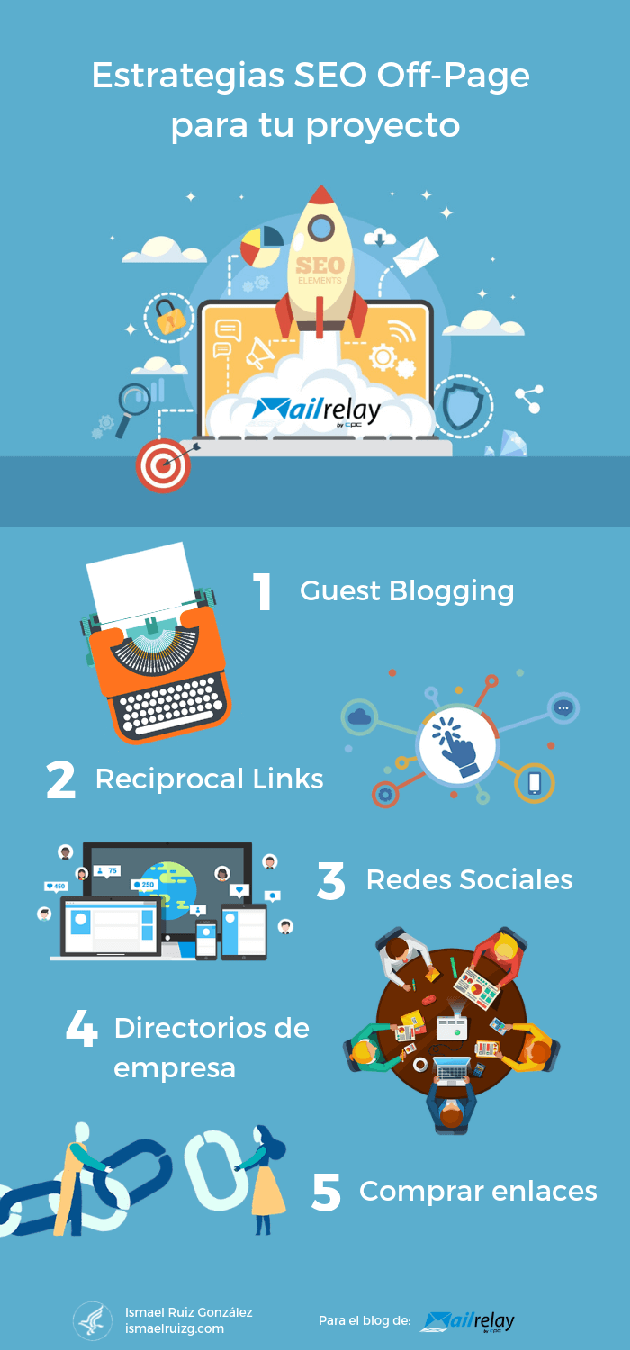
Image credits
https://www.freepik.es/vector-gratis/fondo-seo-estilo-plano_2028406.htm
https://www.freepik.es/vector-gratis/fondo-vintage-maquina-escribir_845419.htm
https://www.freepik.es/vector-gratis/ilustracion-concepto-redes-sociales_2806723.htm
https://www.freepik.es/vector-gratis/fondo-medios-comunicacion-social-estilo-plano_2028422.htm
https://www.freepik.es/vector-gratis/cartel-plano-vista-superior-reuniones-negocios_2873383.htm
https://www.freepik.es/vector-gratis/fondo-hombre-mujer-cadenas_1086772.htm
I’ve already told you a lot about what Off-Page SEO is, but now it’s time to get to the part we’re all interested in: the Off-Page SEO strategies to improve the ranking of your blog, eCommerce store, personal website or any digital project you’re just starting.
I’ll also give you some tips to keep in mind when using the strategies we’re about to show you.
Keep in mind that these strategies can be applied at the same time without any problem, as long as you don’t overdo the links, since having an indiscriminate number of backlinks can end up hurting your website.
That’s why it’s always a good idea to focus more on the quality of the links you use than on the quantity, since Google’s robot will always prioritize the quality and relevance of the content, or in this case of the links you use.
If you don’t know how to start your link building strategy, you can try Guest Blogging, which is basically being a guest author on someone else’s blog.
If you don’t understand what it’s about, let me explain in more detail.
Guest Blogging is a simple strategy through which you can get a link quickly and easily.
That said, it isn’t entirely free, since you’ll need to write an article on the site where you want to leave your link.
Of course, the article you write will depend entirely on the owner of the website where you’re going to publish it.
They will set the specific topic, the length of the article, and whether the type of link you’ll use is nofollow or dofollow. Of course, you can always reach an agreement that suits you both.
The main advantage of this Off-Page SEO strategy is that it allows you to build a working relationship with another webmaster in your niche, so you can probably share experiences, techniques and new methods with them, and there will always be the chance of earning a link or two with Guest Blogging.
● Tip
Don’t jump at the first option that comes along. We don’t mean you should be extremely demanding, but that you shouldn’t rush things.
Guest Blogging is one of the best methods because you can interact with people who have more experience in your niche or who have a website with much greater authority and better traffic than yours.
However, the opposite can also happen, and you may come across a website that, so to speak, is in a similar or worse situation than yours: little traffic, poor-quality or purchased traffic, and who knows what else. That’s why you need to study very carefully the website where you want to leave your link.
This is a very general tip, since you shouldn’t apply it only to Guest Blogging, but to any other link building strategy you use.
Another point you should keep in mind is that, as much as we’d all like to leave a link on the best sites in our niches, it’s going to be hard to get the most relevant blogs to let us trade a link for an article.
You can try, yes, but probably 95% of the time you ask, the answer will be a resounding NO.
That’s why I advise you to start with lesser-known blogs or sites. We’re not telling you to go for low-quality sites, but for sites with good Off-Page and On-Page SEO and decent metrics, or at least better ones than your site has.
2. Reciprocal Links (linking to each other)
This strategy is somewhat similar to Guest Blogging, since you’ll need to reach an agreement with another webmaster to carry it out.
However, it usually isn’t as hard as getting someone to let you write a guest article.
Reciprocal Links is a link building strategy in which two sites in the same niche link to each other. Of course, you’ll first need to reach an agreement with the owner of the other blog and set the parameters of the collaboration.
That is, which articles will be linked, how those articles will be written, among other things. Interestingly, both of you might write a guest article on each other’s site, or each of you might simply write a review of the other’s site on your own blog.
There are also cases, especially between colleagues, where they add each other on the home page, or at least a “friendly sites” section where links to other websites are included, to give an example. It will all depend on the collaboration that you and the other webmaster have agreed on.
● Tip
If you’re going to use reciprocal links, I recommend that the other site have some authority, or at least an authority similar to yours, if what you want is to improve your ranking.
Another thing to keep in mind is that you shouldn’t link irrationally. What we mean is that links should have a “reason” and be relevant to users.
Don’t link to an article about motorcycles if you’re talking about cars in yours. The link must be relevant if you want Google to see it positively, and, even more importantly, make sure the link that points back to your site does the same.

3. Social media for Off-Page SEO
Ok, what we’re about to tell you isn’t an Off-Page SEO strategy as such, but it is something you should take advantage of at all times if you want to improve the ranking and authority of your digital project.
Nowadays, social media has become one of the best tools for digital marketing, as it is a very effective way to promote your digital project and all the content on your website.
And, believe it or not, the advantages of social media also help increase your website’s authority: not only will it be a reliable source of traffic, but Google now gives some importance to your content on social media.
Whether it’s a post on Facebook, X (formerly Twitter) or Instagram, the views that content gets, regardless of the type, will give you greater relevance as an author in Google’s eyes, and as a result, your web project will have more authority and a better ranking.
That’s why it’s highly recommended to have a good presence on social media, and the more networks you use, the better.
Of course, you also have to consider the time you need to invest in each one to keep them active, as well as the financial investment it may involve, since if you don’t have time to maintain them or don’t know much about the subject, you’ll probably need an expert’s help, and for that you’ll need to spend a few euros.
● Tip
The only tip I’ll give you here is not to focus only on the most common social networks. There isn’t just Facebook, Twitter or Instagram; there are many social networks that can be extremely useful to you, such as YouTube, Google+ (although they say it will disappear in a few months), Tumblr, and others.
Curiously, Google+ is perhaps one of the social networks that most directly influences your ranking, so it’s advisable to learn to use it efficiently and include it in your Off-Page SEO strategies.

4. Get listed in business directories
Business directories are the kind of websites that generally collect the companies located in the same locality or region.
There are many business directories, and you can choose any of them to sign up for, even several at once.
This strategy is recommended when you have an eCommerce store that also has a physical location, since you can list the details of your physical store and not just your online store.
The backlinks you usually get on this type of site are mostly nofollow, so they don’t pass the directory’s authority on to your digital project.
However, it will help show Google that your links are “more natural”, reducing the risk of being penalized for link abuse.
● Tip
When you’re looking for a directory to list your business in, always make sure it isn’t completely riddled with spam, as this can be harmful to you.
Some are “premium”, so it will cost you a few euros to sign up for that type of directory, but the quality of the link will be much higher than those you’ll find for free out there.
Even so, you can always try to find a good directory with little link spam among the free ones, and if you have money to spare, then try the premium ones.
5. “Buying” links or backlinks
The name pretty much sums up the strategy, since backlink marketing is exactly this: buying and selling links.
There are companies that sell links or “reviews” on different sites with varying authority; although these are “less natural” links, they are quite useful for getting started, and you can also find excellent deals with these companies.
Some will even help you with campaigns not only on websites but also on social media, which will help you increase the amount of traffic.
● Tip
It’s a fast and effective method, yes, but you also need to be careful, because you have to make sure the company delivers what it offers and doesn’t place your links on sites that have nothing to do with your topic.
You should look for companies or people who give you the best possible terms and, if possible, let you write the review or article that will contain your link yourself.
That way you’ll have more control over how your link appears, and you can make sure the article has some relevance and isn’t just a rushed piece written to sell a link.
Remember that the relevance of the content, despite being part of On-Page SEO, can have a great effect on link building strategies and on Off-Page SEO in general.