Email emojis: which ones to use and how to add them to your subject line (copy and paste)
Emojis ready to copy, shortcuts for typing them and examples of subject lines that work

Emojis ready to copy, shortcuts for typing them and examples of subject lines that work
Want to add emojis to an email subject line? Copy them from the table below and paste them wherever you like.
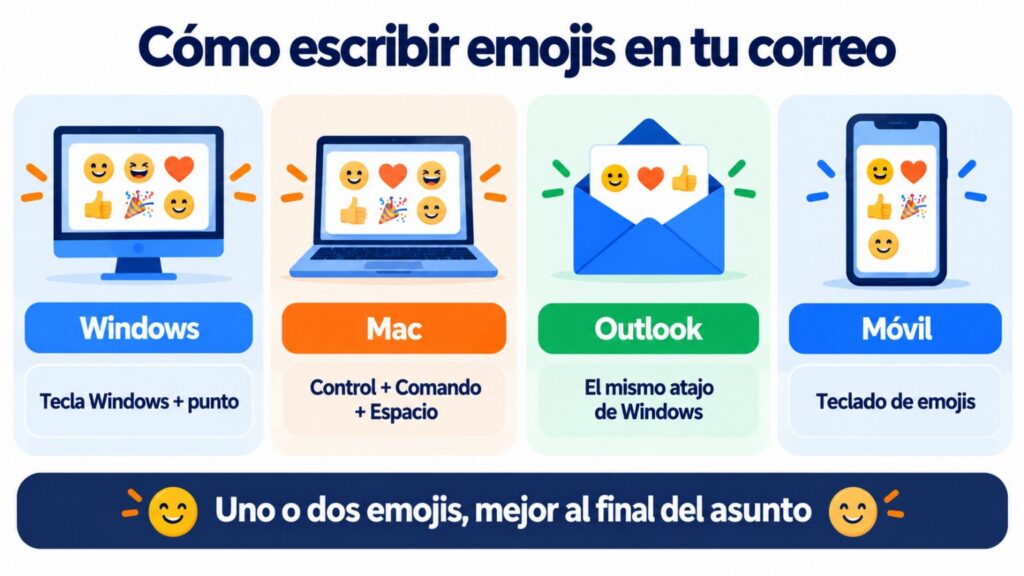
You can also use your computer’s keyboard shortcut: Windows key + period on Windows, or Control + Command + Space on Mac. Use one or two, ideally at the end of the subject line, and send a test email before sending it to your whole list.
In a digital world where inboxes fill up fast, making your emails stand out has become an art.
If you don’t have your own newsletter yet, first find out how to create a free newsletter and then add the finishing touch with these emojis.
Emoticons, or emojis, those little images that express emotions or ideas, can be the key to grabbing your recipients’ attention.
Select the emoji, copy it (Ctrl + C or Cmd + C) and paste it into the subject line or body of your email.
| Used for | Emojis |
|---|---|
| Greetings and welcomes | 👋 😊 🙌 ✨ |
| Offers and discounts | 🔥 💥 🏷️ 💸 |
| Dates and deadlines | 📅 ⏰ ⌛ 🗓️ |
| Notices and information | 📢 📌 ℹ️ ✅ |
| News and launches | 🚀 🆕 🎉 🎁 |
| Saying thank you | 🙏 💙 🤝 🌟 |
| Email icons | ✉️ 📧 📩 📨 📬 💌 |
| Shopping and shipping | 🛒 🛍️ 📦 🚚 |
| Ideas and tips | 💡 📝 👉 📖 |
| Food and celebrations | 🍕 ☕ 🥂 🎂 |
| Seasons and special dates | 🎃 🎄 ☀️ 🍂 |
| Important notices | ⚠️ ❗ 🔔 ⭐ |
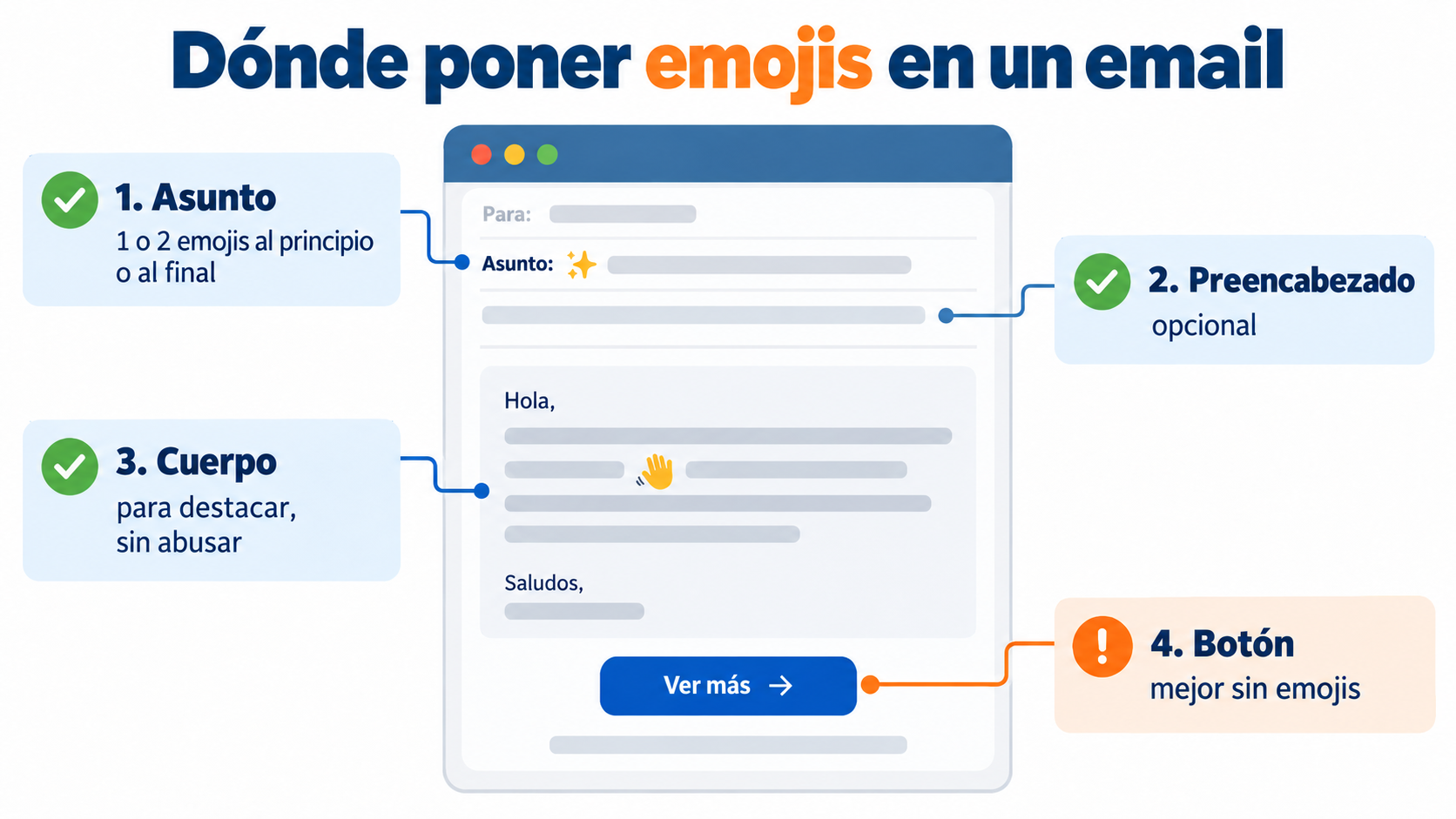
A tip: use one or two emojis at most, at the beginning or end of the subject line, and never in place of an important word.
Prefer faces made only of text, like (^_^)? Those are kaomojis, and there’s a table for copying them too.

Test whether emojis improve your opens
Send two versions of the subject line, with and without an emoji, to part of your list and keep the one that gets more opens.
Today, inboxes are packed and standing out is getting harder and harder.
This is where emoticons, or emojis, come into play.
These little images that express emotions or ideas can be the key to grabbing your recipients’ attention and making your emails more visible.
But where can you find the perfect emojis for your emails?
Here are some of the best sources of emoticons for your emails.
This site is Fsymbols, where you’ll find lots of free emoticons. It’s also very easy to use: just search for the emoticon, copy it and paste it into your mailing’s subject line.
So all we have to do is find the emoticon we like and click on it.
When we do, it tells us it has been copied to the clipboard.
All that’s left is to paste our emoticon when we create our newsletter.
We can add our email emoticons in two ways:
Then, depending on the email client, it will be displayed one way or another, for example in Gmail.
But that depends on the email client.
Another site where we can copy emoticons for our bulk emails is:
It’s just as easy: simply go to the site and click on an emoticon, and it will be copied to the clipboard.
And we can paste it into the email subject line the same way as before.
Emojipedia is basically an encyclopedia of emojis.
The advantage of this site is that it gives you the description and meaning of each emoji, which is very useful if you want to be sure of the impression you’re giving.
Emojipedia stays up to date with the latest emojis, so you can keep up with new trends.
GetEmoji is a simple but effective site for getting emojis.
All the emojis on GetEmoji are laid out on a single page, which makes them easy to find and copy.
You just need to browse, find the emoji you’d like to use and click to copy it.

Adding emoticons to your emails can bring a touch of personality and visual appeal that helps your messages stand out in a crowded inbox.
But how can you add these small but powerful symbols to your emails?
Here are two simple methods.
This is the simplest, most direct way to add emoticons to your email subject line.
On the websites we mentioned earlier, such as Fsymbols, i2Symbol, Emojipedia and GetEmoji, you can find the emoji you want to use, click on it to select it, and then simply copy it (Ctrl+C or Cmd+C) and paste it (Ctrl+V or Cmd+V) into your email subject line.
This method is quick and effective, and lets you choose from a wide range of emojis.
Some systems and platforms let you use codes to insert emojis.
These codes are usually made up of a series of characters that turn into the corresponding emoji when you type them.
For example, on some platforms, typing “:smile:” turns into a smiling face emoji.
It’s important to note that this method can be more complicated, and not all email systems recognize emoji codes.
So it’s a good idea to check that the emojis display correctly before sending the email.
Remember that, although emojis can make your emails more appealing, it’s also important to use them sparingly and appropriately to keep your communications professional and effective.
In the next section, we’ll look at why you should consider using emojis in your email subject lines.
If you don’t want to copy and paste, your computer has an emoji panel that opens with a keyboard shortcut. It works in the subject line, in the body of the email and in almost any text field.
| Where | How to open the emojis |
|---|---|
| Windows 10 and 11 | Windows key + period (or Windows key + semicolon) |
| Mac | Control + Command + Space |
| Outlook for Windows | The same Windows shortcut, with the cursor in the subject line |
| Outlook on the web and Gmail | Your system’s shortcut, or copy and paste |
| Mobile (Android and iPhone) | The emoji button on the keyboard |
In the panel you can search by keyword, such as “heart” or “gift”. Click on the emoji and it will appear wherever your cursor is.
With their ability to grab attention and convey emotions quickly and effectively, emoticons can be a powerful tool in your email marketing strategy.
But what are the specific reasons for including them in your email subject lines?
Three of the main benefits are:
Many brands use emojis in the subject line to make their emails stand out in the inbox. The effect depends on your list and your industry, so the best thing is to check it with an A/B test.
Emoticons can make your emails stand out in a sea of plain text, catching the recipient’s eye and sparking their curiosity.
When a relevant, eye-catching emoji appears in the subject line, the recipient is more likely to feel motivated to open the email and read its content.
Emoticons can not only increase your email open rates, but also boost engagement with your readers.
By using emojis in the subject line, you can convey a friendly, approachable tone that can encourage the recipient to interact with your email, whether by replying, clicking a link or taking the action you suggest.
In an inbox full of emails, making yours stand out can be a challenge.
Emoticons can be a great way to set your emails apart from the rest.
By providing a visual point of interest, emojis can help make your emails more recognizable and memorable for your recipients.
Remember that emoticons should be used in emails with care and thought.
In the next section, we’ll go over some important considerations when using emoticons in your emails.
These subject lines use the emoji to reinforce the message, not to replace it:
| Type of email | Subject line |
|---|---|
| Welcome | You’re now part of the community 👋 |
| Offer | 20% off the whole store until Sunday 🔥 |
| Black Friday | Our Black Friday starts today 🛍️ |
| Reminder | Your appointment is tomorrow at 10:00 ⏰ |
| New arrival | The new collection is here 🆕 |
| Birthday | Happy birthday, we have a gift for you 🎂 |
| Survey | Can you spare us a minute? 📝 |
| Last chance | Final hours for your discount ⌛ |
For more ideas, see our glossary entries on the email subject line, with tips for writing one, and on emoji, with their history and meaning.

Using emoticons in emails can offer many benefits, but it’s also important to keep a few key considerations in mind to make sure your messages are effective and professional.
Here are three important factors to consider.
Emoji subject lines and A/B testing in one dashboard
Write your subject lines, try them out with an A/B test and see the opens for each version in real time.
Not all email clients display emojis the same way.
Some may not support certain emoticons, which can make your emails look strange or incomprehensible to some recipients.
Before sending an email with emoticons, it’s a good idea to run tests to see how they display in different email clients.
Although emoticons can add a touch of personality and friendliness to your bulk emails, it’s also important to stay professional.
Overusing emojis can make your emails seem less serious or even childish.
Likewise, using inappropriate emoticons or emoticons out of context can cause confusion or even offend your recipients.
So it’s important to choose the emoticons you use carefully and make sure they fit the tone and content of your message. If you want to use humor without overdoing it, we explain when funny emails work and when it’s better not to joke.
There’s a chance that using emoticons in email subject lines could cause some email filters to mark them as spam.
This is because some spammers use emoticons to try to stand out in the inbox or to hide spam keywords.
So it’s a good idea to use emoticons sparingly and avoid combining them with other techniques that may be seen as spam, such as excessive use of capital letters or sensationalist words and phrases.
Screen readers read out the name of each emoji. A subject line with 🔥🔥🔥 sounds like “fire, fire, fire”. If accessible email matters to you, use few emojis and never in place of a word.
The preheader supports emojis too. If you already have one in the subject line, don’t repeat it in the preheader: one is enough.
Copy it from a table like the one in this article and paste it into the subject line. You can also open your computer’s emoji panel with Windows key + period or, on Mac, with Control + Command + Space.
In Outlook for Windows, place the cursor in the subject line or the body text and press the Windows key + period. Your system’s emoji panel will open and you can choose the one you want.
One or two at most. More emojis take space away from the message and make the email look less serious.
A well-used emoji won’t send your email to spam on its own. The problem arises when lots of emojis are combined with capital letters, exclamation marks and exaggerated urgency words.
No. Each system and email client draws them in its own way, and some older ones may show a square. That’s why it’s a good idea to send a test email before sending the campaign.
In this digital age, emoticons have become common in email communications, improving open rates and reader engagement.
We’ve explored several sources for finding emoticons and how to add them to our emails.
However, they should be used strategically and thoughtfully, taking into account factors such as compatibility with different email clients, a professional tone and the chance of messages being marked as spam.
In short, emoticons are a useful and powerful tool in email marketing when used correctly.
Using emojis well can improve your open rate, but it’s best to combine it with good copywriting techniques so the message is effective.
Newsletters that stand out in the inbox
Create your free account and send up to 80,000 emails a month to 20,000 contacts, with a template editor and statistics.
20 original, eye-catching subject lines for your emails
Examples of subject lines that get your emails opened.
How to exceed a 25% open rate
The changes to your subject line, sender and list that raise your open rate.
How to write better email copy
11 quick tips to make sure your emails get read and understood.
20 email marketing examples to copy
Examples with subject line, preheader, body text and button to adapt to your business.

Jose Argudo
CMO at Mailrelay. Writes about email marketing, copywriting and conversion for SMEs and entrepreneurs.