Eye-Catching Email Subject Lines: 20 Examples to Get Your Newsletters Opened
20 proven formulas, with examples to copy, to make your email the one that gets opened in a crowded inbox
20 proven formulas, with examples to copy, to make your email the one that gets opened in a crowded inbox
An eye-catching subject line is the one that gets your subscriber to open your email out of everything in their inbox. It’s short and specific, and it gives them a clear reason to open.
Here are 20 formulas with examples to copy, a table by type of email, what to avoid and how to test your subject lines.
The subject line is the title of your email: the first thing the subscriber sees, along with the sender and the preview text.
An eye-catching subject line isn’t the strangest or the longest one. It’s the one that, in a crowded inbox, gives that person a reason to open your email rather than another.
You’ll find the full definition and its parts in the glossary entry on the email subject line.
Subscribers decide at a glance whether to open, leave it for later or delete. Whatever you write has to be specific, genuine and interesting to the person reading it.
Most emails are read on mobile, where the subject line gets cut off sooner. Put the important part at the start of the sentence.
Don’t settle for the first one that comes to mind. Write five or six versions and keep the clearest, or test two with an A/B test.
Try to keep it between 30 and 50 characters, because many email clients cut off long subject lines.
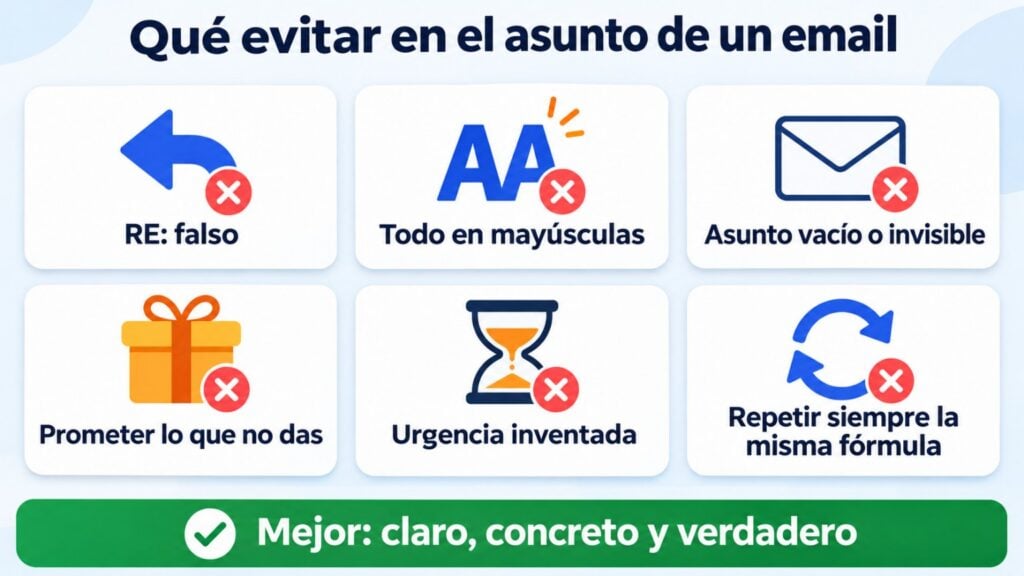
The subject line should make it clear what the email is about. If readers open it and find something else, they won’t open the next one.
Numbers grab attention and add structure: “5 ideas”, “3 minutes”, “20%”. Keywords sum up the topic of the email at a glance.
The subscriber’s name helps, but it has been used for many years and can go unnoticed. It works better when you combine it with other subject line styles.
More than the name, personalize the topic: send each group what interests them, with its own subject line.
A question, a fact or a specific promise sparks curiosity. Urgency works too, as long as it’s real.
If the offer ends on Sunday, say so. If it doesn’t, don’t make it up: readers notice and stop believing you.
The preview text (preheader) is the line that appears next to the subject line in the inbox. Use it to complete the subject line, not to repeat it.
For example: subject line “Your welcome guide is inside” and preheader “5 steps to get started in 10 minutes”.
The same subject line doesn’t work equally well for everyone. Segmentation lets you write a different one for each group.
When should your email subject lines be original, and when shouldn’t they? We already know the subject line can be the key that opens the door to the inbox. Or not. Originality plays a very important role: among dozens of emails, the one that’s different is the one that stands out. But be careful. If the reader doesn’t recognize your sender, an email that “tries too hard to be clever” may end up deleted straight away, because a very original subject line from a little-known sender breeds distrust. If your sender is well known, you have more room to be original. Just make sure it fits what your audience expects from you: not every audience reacts the same way to strange or surprising subject lines. If in doubt, run an A/B test with two subject lines and let your data decide.
Jose Argudo, CMO at Mailrelay
Adapt each formula to the actual content of your email. A subject line that promises something the email doesn’t deliver gets you one open and loses you a reader.
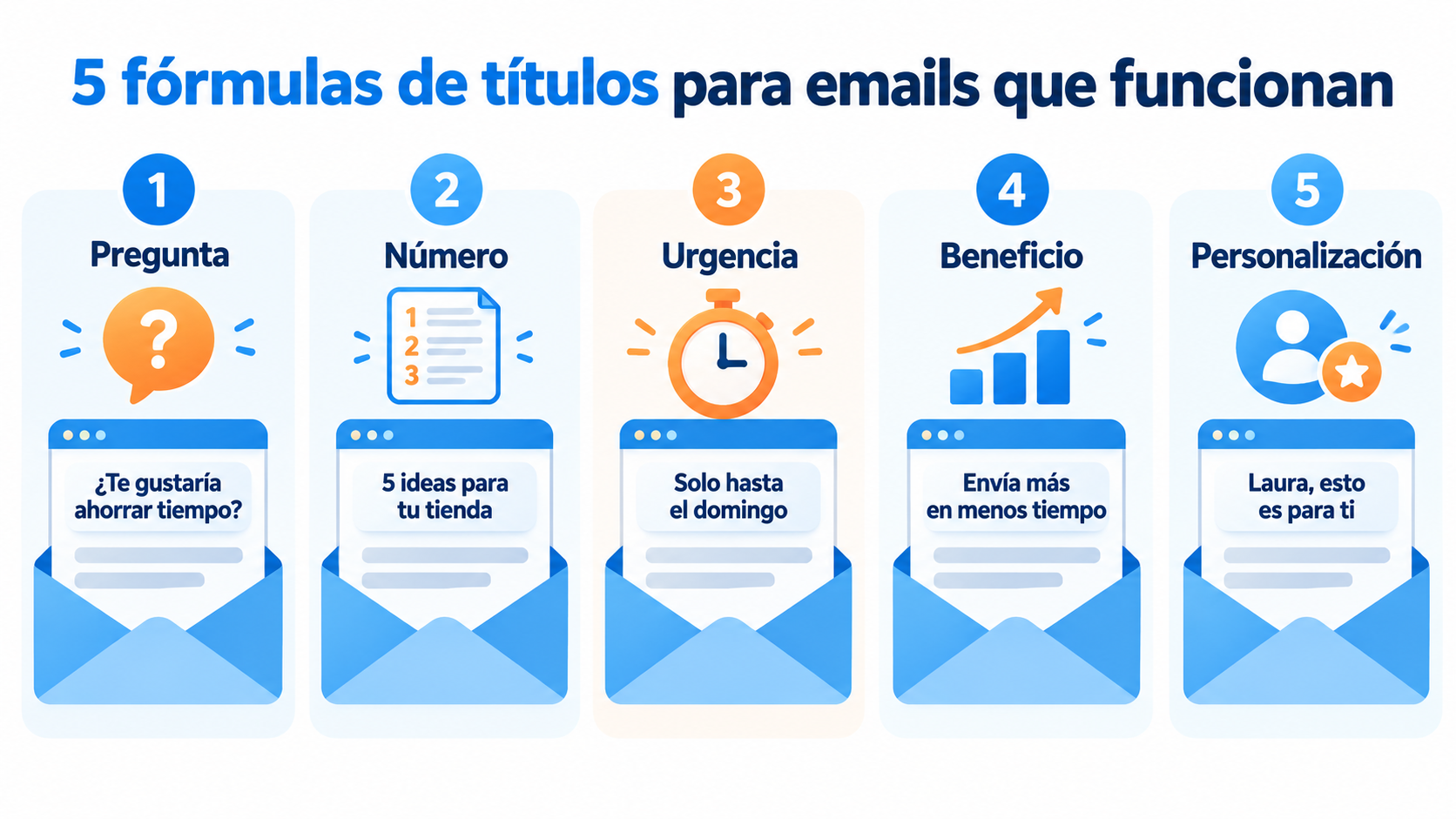
| Formula | Example | When to use it |
|---|---|---|
| Question | Would you like to cut your email sending time in half? | To raise a problem the reader has |
| Number | 5 templates for your next newsletter | Guides, lists and roundups |
| Real urgency | Until Sunday only: 20% off everything | Offers with a real deadline |
| Benefit | Send your newsletter in 10 minutes | When the result is clear |
| Personalization | Laura, your October report is ready | Individual emails or by segment |
| Curiosity | The mistake almost everyone makes in their first email campaign | Useful or surprising content |
Test your subject lines with an A/B test
Send two subject lines to part of your list and let Mailrelay send the one with the most opens to the rest.
A question that connects with a specific desire of the reader’s. Example: “Would you like to have your website ready before Christmas?”
Avoid anything generic or unattainable. “Would you like to be a millionaire?” doesn’t spark curiosity, it breeds distrust.
It works for offers with a genuine deadline. Example: “Today only: free shipping on all orders”.
Use it sparingly. If all your emails are “today only”, none of them are.
An action verb and a result. Example: “Get your first 100 subscribers this month”.
It promises arguments for a decision. Example: “3 reasons why your emails aren’t being opened”.
Figures make things concrete. Example: “7 subject line ideas for your December newsletter”.
An interesting fact grabs attention, as long as it’s true and you can cite the source inside the email. Example: “The stat about your industry you didn’t see coming”.
Example: “Ana, you’ll want to see this”. Measure the effect and combine it with other formulas so it doesn’t become predictable.
It answers a practical question. Example: “How to write a welcome email in 15 minutes?”
Useful when the reader already knows the product. Example: “New: the pocket version of your favorite notebook”.
It promises something practical and quick. Example: “Tips to make your product photos sell more”.
An emoji can make the subject line stand out in the inbox. Use one if it fits your brand, and don’t let it replace words. Example: “🎁 Your welcome gift is inside”.
A negative sparks curiosity. Example: “Don’t send your next newsletter without reading this”.
It opens a conversation and tends to get replies. Example: “Can I ask you what you’d like to read?”
One, at most. Example: “The new collection is here!” Several in a row sound like shouting.
Lean on someone the reader recognizes. Example: “What a nutritionist recommends for breakfast”.
A real customer’s words are more convincing than yours. Example: “‘I finally understand my numbers’: Marta’s story”.
Only if it’s real. Example: “12 places left for Thursday’s workshop”.
For genuine launches. Example: “We’re showing you before anyone else”. If it isn’t new, don’t sell it as if it were.
Example: “Sleep better starting tonight” works better than “New memory foam pillow”.
It breaks the monotony, especially on special dates. Example: “We asked our boss for a raise. He said yes: 20% off everything”. The limit is respect.
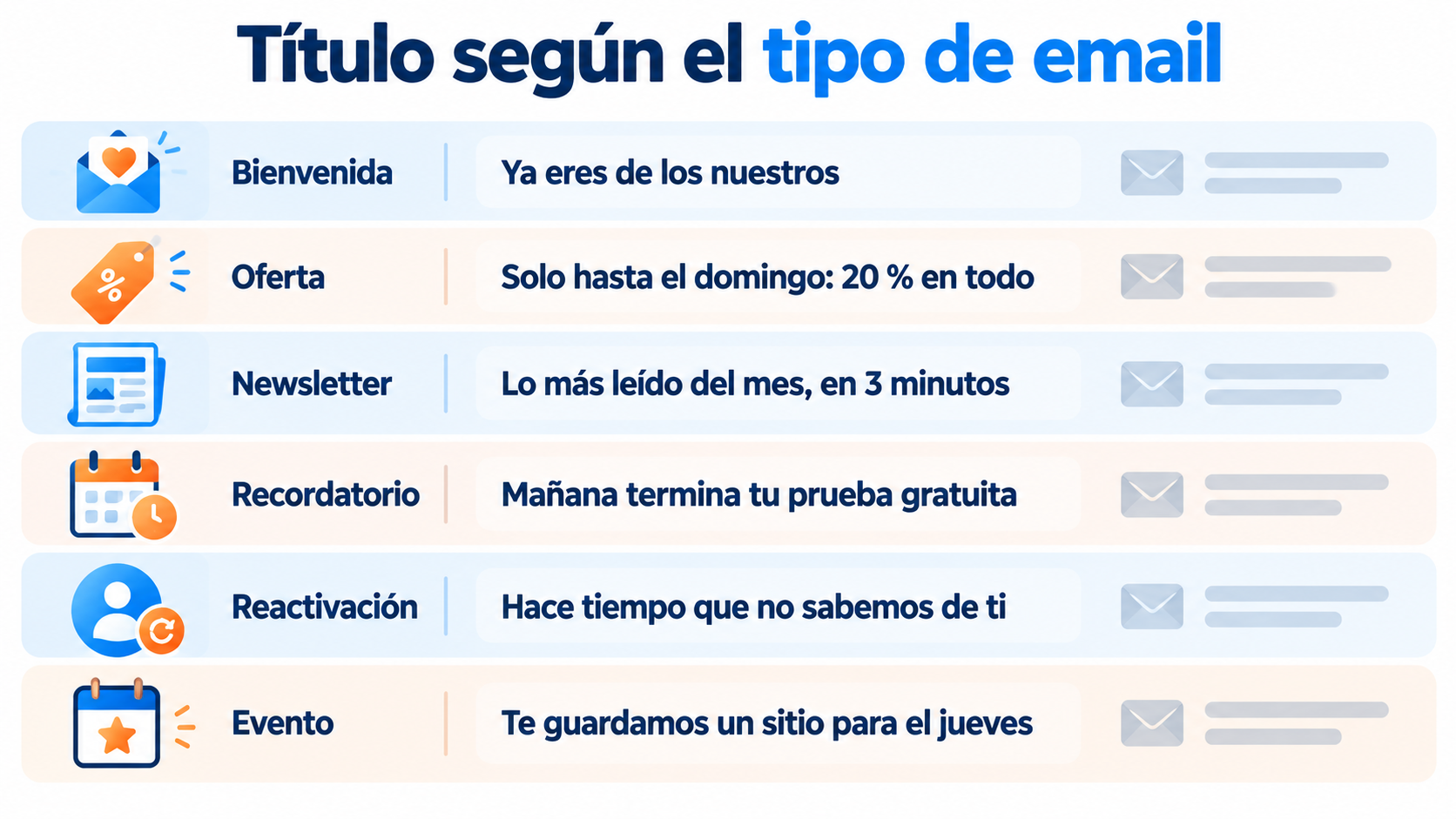
A good subject line depends on what you’re sending. Here are some ideas to adapt to your business:
| Type of email | Example 1 | Example 2 |
|---|---|---|
| Welcome | You’re one of us now, [Name] | Your welcome gift is inside |
| Offer | Until Sunday only: 20% off everything | What was on your wish list, now for less |
| Newsletter | 5 ideas for [topic] you can use today | This month’s top reads, in 3 minutes |
| Reminder | Your free trial ends tomorrow | Forgot something in your cart? |
| Re-engagement | We haven’t heard from you in a while | Shall we stay in touch? You decide |
| Event | We’ve saved you a seat for Thursday | Last call: only 10 places left |
Measure which subject lines get the most opens
See the opens and clicks for each campaign in real time and find out which subject lines work with your audience.
Individual words like “free” or “offer” don’t send an email to spam on their own. Filters look mainly at the sender’s reputation and at whether subscribers open or complain.
You don’t guess the best subject line, you test it. With Mailrelay’s A/B test, you send two versions to part of your list, and the winner goes to the rest.
Your next subject line, in a real campaign
Create your free account and send up to 80,000 emails a month to 20,000 contacts, with a template editor and statistics.
Between 30 and 50 characters is a good guideline. Fewer show on mobile, so put the important part at the start.
There’s no universal one. It depends on your audience and the type of email. That’s why it pays to test two versions with an A/B test and keep the one that gives you the best results.
They can make the email stand out in the inbox, especially in informal emails or on special dates. Use them in moderation and always alongside text.
It’s the text that appears next to the subject line in the inbox. It’s there to complete the subject line with one more detail that encourages people to open.
Yes, using the variables in your email marketing tool. It works better if you don’t use it in every email and combine it with other formulas.
Emojis in emails and newsletters: how to add them
How to use emojis in the subject line and body without them looking wrong in any email client.
How to exceed a 25% open rate
The changes to your subject line, sender and list that raise your open rate.
20 email marketing examples to copy
Examples with subject line, preheader, body text and button to adapt to your business.
How to write better email copy
11 quick tips to make sure your emails get read and understood.

Jose Argudo
CMO at Mailrelay. Writes about email marketing, copywriting and conversion for small businesses and entrepreneurs.