Follow-up email: what it is, when to send it and examples to copy
How to pick up an unanswered conversation without being pushy, with templates for every situation
A follow-up email is an email you send after a first contact to pick the conversation back up and get a reply or an action. In Spanish it’s called a correo de seguimiento.
You use it when a customer doesn’t reply to your quote, after a meeting or following a purchase. And it works: many replies come in on the second or third message, not the first.
What is a follow-up email?
It’s a message that continues an earlier exchange. It can be an individual email, like one a sales rep writes to a customer, or part of an automated sequence sent to hundreds of contacts.
Its goal changes depending on the moment: a reminder about something pending, answering a question, sharing new information or closing a topic. What doesn’t change is the format. It’s short, refers to the previous message and asks for just one thing.
Don’t confuse it with email tracking, which measures whether an email has been opened or read.
What is a follow-up email for?
It’s there so a conversation doesn’t get lost because someone forgot. Most silences aren’t a “no”: the recipient was busy, read your email on their phone or left it for later.
These are the most common uses:
| Situation | Goal of the follow-up | When to send it |
|---|---|---|
| Quote or sales proposal | Answer questions and close the sale | 2-3 business days later |
| Unanswered email | Remind them of the request without pressure | 3-5 days later |
| Meeting or call | Sum up agreements and next steps | The same day or the next |
| Purchase | Say thank you, ask for feedback or recommend | 3-7 days after delivery |
| Event or webinar | Send the recording and the next step | 24 hours later |
| Cold email | Get a first reply | 3-4 days later |
In B2B sales, it’s part of everyday work. A good follow-up guides the customer through the sales funnel without you having to start from scratch in every message.
When should you send a follow-up email, and how many?
There’s no single rule, but there is a guideline that works in most cases: two or three follow-ups, spaced further apart each time.
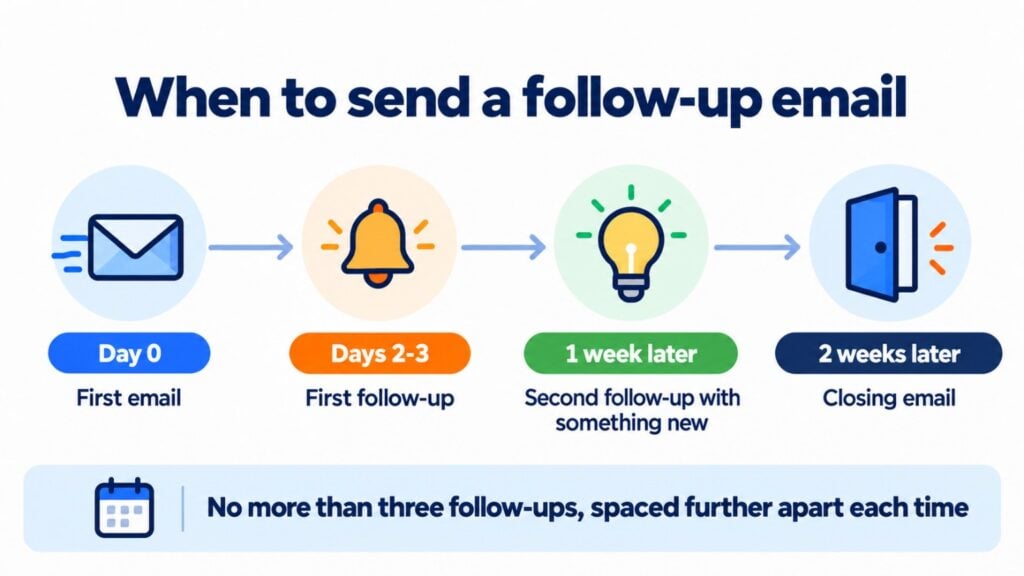
- First follow-up: 2 to 3 business days after the first email.
- Second follow-up: a week later, with something new (a fact, a case study, a date).
- Third, the closing one: about two weeks later. Let them know you won’t write about it again.
If there’s still no reply after the third, stop. Pushing further damages the relationship and can get you marked as spam, which hurts your deliverability.
That said, adjust the pace to the urgency. A quote that expires on Friday calls for a reminder sooner than a proposal with no deadline.
How do you write a follow-up email?
A good follow-up email can be read in under 30 seconds and has six parts.
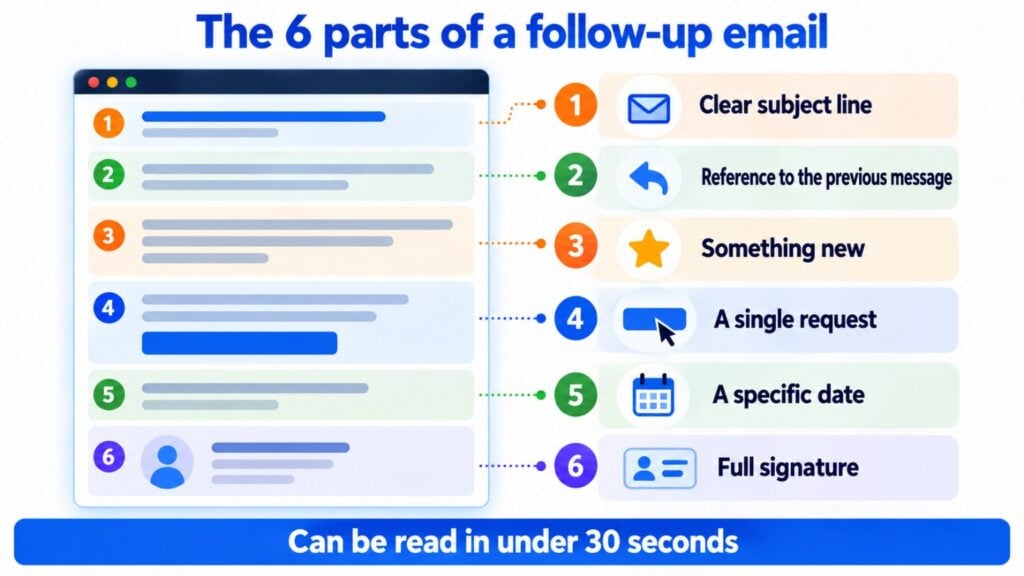
Let’s look at each one:
- Clear subject line. If it’s a one-to-one follow-up, reply in the same thread. If it’s a sequence, use a subject line that says what it’s about: “Your October quote”.
- Reference to the previous message. One line to give the reader context: “I wrote to you on Tuesday about…”.
- Something new. A fact, an answer to a likely question or a benefit you didn’t mention.
- A single request. A specific call to action: reply, book a call or confirm.
- A date. “Does Thursday at 10 work for a call?” works better than “whenever you can”.
- Full signature. Name, job title and phone number. Here’s how to create a good email signature.
Avoid opening with “Just checking whether…” or “Sorry to bother you”. They undercut your message before the reader gets to what matters.
Automate your follow-up emails
Schedule emails after a purchase, an event or a subscription and let them go out on their own. Free up to 80,000 emails a month.
Follow-up email examples
Here are five templates for the most common situations. Change the details in square brackets and adapt the tone to your customer.
Follow-up email for a quote
Subject: Your [service] quote: any questions?
Hi [name],
I sent you the quote for [service] on [day]. I wanted to know whether you’ve had a chance to review it.
If it helps, I can adjust the phases or the timeline to suit your team. The price is valid until [date].
Would a 15-minute call on [day] at [time] work for you?
Best regards,
[Signature]
Follow-up email when the customer doesn’t reply
Subject: Re: [original subject]
Hi [name],
I’m following up on my previous email. I know these are very busy weeks.
To make it easy, could you just tell me whether you’d like to move forward? A “yes” or a “not now” is all I need.
Thank you,
[Signature]
Follow-up email after a meeting
Subject: Summary of our meeting on [day]
Hi [name],
Thanks for your time today. Here’s a summary of what we agreed:
1. [Agreement 1]. 2. [Agreement 2]. 3. [Owner and date of the next step].
I’ll send you [document] by [date]. If I’ve missed anything, let me know and I’ll add it.
[Signature]
Post-purchase follow-up email
Subject: How are you getting on with your [product]?
Hi [name],
You received your order a few days ago. We hope everything arrived safely.
Could you take a minute to tell us what you think? It helps us improve and helps other customers decide. [Button: Leave my review]
If you have any problems, reply to this email and we’ll help you.
Closing email (the last follow-up)
Subject: Shall we close this topic?
Hi [name],
I’ve written to you a couple of times about [topic] and I don’t want to fill up your inbox.
I understand now isn’t the right time, so I won’t write to you about this again. If anything changes, I’m here.
Best regards,
[Signature]
As you can see, they all ask for just one thing and give the reader an easy way out. For more formal messages, see how to write a formal email.
What does “correo que antecede” mean?
“El correo que antecede” (the preceding email) is the previous email in the same conversation, the one that appears right below it in the thread. It’s a common phrase in formal follow-ups, especially in Mexico and Central America: “En seguimiento al correo que antecede…” or “Con relación al correo que antecede…”.
It’s equivalent to “regarding my previous email”. It’s correct, but it sounds very bureaucratic. In a sales email you can swap it for something friendlier: “I wrote to you on Tuesday about…”.
Manual or automated follow-up emails
One-to-one follow-ups, like the ones for a quote, are written by hand or from a sales CRM. But when the same message goes to many contacts, the logical thing is to automate it.
That’s the case for emails after a purchase, event reminders, welcome sequences, abandoned cart emails or payment reminders. Also lead nurturing emails, which guide a contact until they’re ready to buy.
In Mailrelay you can create these automations without coding. Every email includes the contact’s name or date thanks to custom fields. You send each segment what it’s interested in and measure opens and clicks in real time. With the free account you get up to 80,000 emails a month and expert support via chat, ticket and phone.
Follow up with thousands of contacts from a single account
Automations, segmentation and real-time reports, with expert support on every account. Start free with 20,000 contacts.
Frequently asked questions about follow-up emails
These are the questions that come up most often when someone is preparing their first follow-up.
How many days should you wait before sending a follow-up email?
Between 2 and 3 business days for the first one. If the matter is urgent, you can write the next day. If it isn’t, leave a week between the second and the third.
What subject line should you use for a follow-up email?
If you’re writing to a single person, reply in the same thread so they can see the context. In a sequence, use a subject line that says what the email is about, without “urgent” or capital letters.
How do you say follow-up in Spanish?
Follow-up translates into Spanish as “seguimiento”. A follow-up email is a “correo de seguimiento”, and doing a follow-up is “hacer seguimiento” with a customer or on a proposal.
What’s the difference between a follow-up letter and a follow-up email?
The goal is the same. A follow-up letter is more formal and is used in recruitment processes or administrative procedures. An email is shorter and more direct: it’s the usual format in sales and customer service.
Can follow-up emails be automated?
Yes, when the message is the same for many contacts: confirmations, emails after a purchase, reminders or automated emails in a sequence. Personalized sales follow-ups work better when written one by one.