Promotions and discounts: 15 types with examples and how to plan them to sell more
Which promotion to choose for your goal, how much to discount without losing margin, and how to announce it to your customers
Which promotion to choose for your goal, how much to discount without losing margin, and how to announce it to your customers
How many times have you launched a discount only to end up selling the same amount, but earning less? It happens to a lot of businesses. Promotions work, but only if you choose the right type, the right moment and the right discount.
In this guide you’ll find 15 types of promotions with examples, how to plan them step by step, and how to calculate the discount so you don’t lose money. At the end you’ll see how to announce them by email, with two templates you can copy.
A sales promotion is a temporary incentive that encourages people to buy now: a discount, a gift, free shipping or a perk for the customer.
It’s part of the “Promotion” P of the marketing mix, alongside advertising and communication. The difference is that advertising makes the product known, while a promotion gives people a reason to buy it right away. Together, these tools make up a company’s communication mix.
A discount is just one type of promotion. There are many others that don’t lower the price, such as gifts, bundles or loyalty points.
Before choosing a promotion, define what you want to achieve. Each goal calls for a different type:
| Goal | Promotions that fit |
|---|---|
| Win new customers | First-purchase discount, free shipping, welcome coupon |
| Increase average order value | Volume discount, bundles, free shipping over a minimum spend |
| Build loyalty | Points program, customer perks, birthday gift |
| Clear stock | Seasonal sales, 2-for-1, second item half price |
| Boost the low season | Flash sales, giveaways, limited-time discounts |
| Launch a product | Launch price, samples, gift with purchase |
| Get subscribers | Coupon in exchange for an email address, giveaways with sign-up |
Increasing your average order value (AOV) means raising how much each customer spends on each purchase.
This table sums up the 15 types. Below you’ll find each one with an example and when to use it.
| Type | Example |
|---|---|
| 1. Percentage discount | 20% off the whole store |
| 2. Fixed-amount discount | €10 off orders over €50 |
| 3. 2-for-1 or 3-for-2 | Take 3, pay for 2 |
| 4. Discounted second item | Second item half price |
| 5. Free shipping | Free on orders over €40 |
| 6. Gift with purchase | A toiletry bag with any perfume |
| 7. Bundles | Shampoo and conditioner together, for less |
| 8. First purchase | 10% off your first order |
| 9. Coupons and codes | SUMMER15 at checkout |
| 10. Flash sales | 30% off for 24 hours only |
| 11. Volume discount | 5% off 10 units or more |
| 12. Points program | 1 point per euro, redeemable |
| 13. Birthday | A gift on their birthday |
| 14. Referral | €10 for you and your friend |
| 15. Giveaways | A free month, raffled among subscribers |
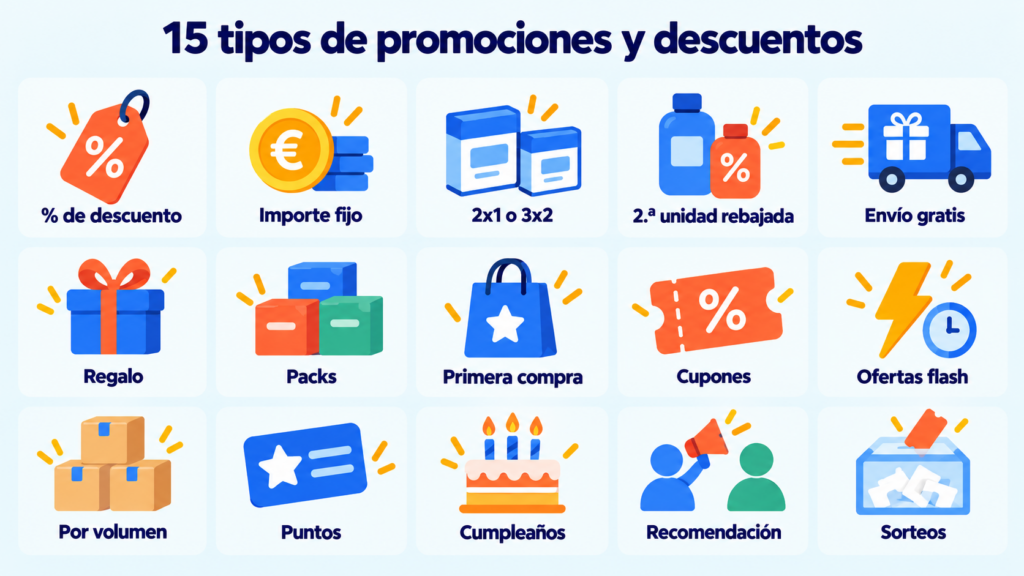
The best-known one: a percentage off the price, such as 20% off the whole store or a category. It’s easy to understand and to communicate.
When to use it: seasonal sales, dates like Black Friday, or products you want to move quickly. Keep an eye on your margin: 20% can eat up a good chunk of your profit (we do the math below).
A discount in euros, usually above a minimum spend: “€10 off orders over €50”.
When to use it: to increase your average order value. Customers add something extra to their cart to reach the minimum.
Customers get more units for the same price. It’s also known as BOGO (buy one, get one).
When to use it: products people buy often, or products you have a lot of stock of. It moves more units without making the unit price look lower.
“50% off the second item.” It’s a softer version of the 2-for-1: the real discount is 25% across both items.
When to use it: when you want to sell more units without giving a whole one away.
One of the incentives that carries the most weight in online shopping. It’s usually offered above a minimum order amount.
When to use it: in online stores, to reduce abandoned carts and increase average order value. Set the threshold slightly above your average order.
An extra product or a sample with a purchase. Customers see more value and you don’t touch the price.
When to use it: to introduce another product, or when you don’t want your brand associated with low prices.
Several products together for less than they cost separately. They’re also useful for cross-selling.
When to use it: for products that are used together, or to move a slower seller by pairing it with one that sells well.
An incentive that gets a visitor to make their first purchase, often in exchange for their email address.
When to use it: to win customers and subscribers at the same time. It fits well in a welcome email or a discount coupon popup.
A code the customer enters at checkout. It lets you limit who uses it and track where each sale comes from.
When to use it: email campaigns, social media or influencer collaborations. Use a different code for each channel.
Discounts that last a very short time, a few hours or a day. The urgency makes customers decide quickly. We cover them in more detail in flash sales.
When to use it: to boost sales during a slow period or on dates like Cyber Monday. Don’t overdo it: if there’s always a flash sale, it stops working.
The more the customer buys, the bigger the discount. It’s common in B2B and wholesale.
When to use it: when your cost per unit drops with volume and selling more at once pays off.
Customers collect points or perks with every purchase and redeem them later. It’s a long-term promotion.
When to use it: to bring customers back and build customer loyalty. It works best when customers see their balance often, for example in your emails.
A personal perk on the customer’s birthday. It’s simple and people really appreciate it.
When to use it: if you store your contacts’ dates of birth. You can automate it with a birthday email.
The customer invites a friend and both get a perk. That way, your customers bring you new customers.
When to use it: when your customers are happy and your product lends itself to recommendations.
A prize drawn among the people who take part, for example by subscribing or buying. They drive a lot of engagement for little cost.
When to use it: to get subscribers or build brand awareness. Publish clear official rules.
Announce your next promotion by email
With Mailrelay, reach your customers with a segmented message and measure how many of them buy.
These brands use promotions as part of their strategy, not as a one-off patch:
| Brand | Promotion | What you can learn |
|---|---|---|
| Zara | Sales twice a year | Fixed dates build anticipation and clear out seasonal stock |
| Amazon | Prime Day, since 2015 | A promotion can win you subscriptions, not just sales |
| Starbucks | Loyalty program with stars and free drinks | Rewarding repeat purchases brings customers back |
| IKEA | Perks and discounts for IKEA Family members | A discount can be the excuse to get customer data |
| Black Friday | A day of discounts that has turned into a week | If everyone discounts at the same time, you need to stand out with more than price |
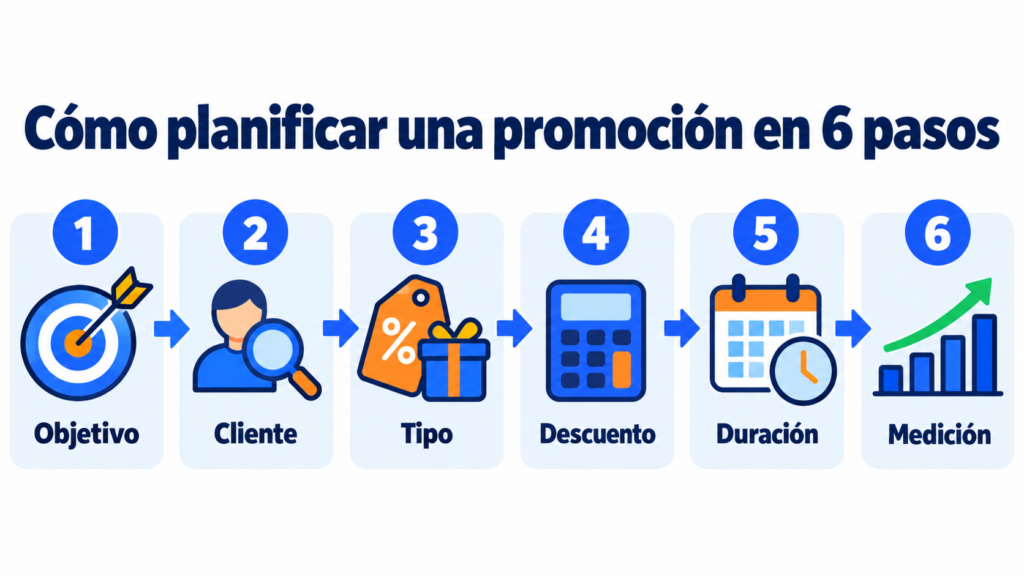
1. Set the goal. New customers, more sales, clearing stock or building loyalty. Just one main goal.
2. Know your customer. What they value and how they buy. A SWOT analysis helps you see which promotions fit your business and your competition.
3. Choose the type. Use the goals table above. If your customers value quality, a gift may work better than a discount.
4. Calculate the discount. Check how much more you’d need to sell to earn the same (we cover this in the next section).
5. Set the duration and conditions. Start and end dates, included products, minimum spend and whether it can be combined with other offers.
6. Measure the results. Sales, new customers, average order value and how many buy again afterwards.
A discount cuts your margin, so you need to sell more units to earn the same. The formula is simple:
Extra sales needed = discount ÷ (margin − discount)
For example, if your margin is 40% and you offer a 20% discount, you need to sell twice as much (0.20 ÷ 0.20 = 100% more) to earn the same as without the promotion.
| Your margin | 10% discount | 20% discount | 30% discount |
|---|---|---|---|
| 30 % | Sell 50% more | Sell 200% more | You lose money on every sale |
| 40 % | Sell 33% more | Sell 100% more | Sell 300% more |
| 50 % | Sell 25% more | Sell 67% more | Sell 150% more |
That’s why it’s best to start with moderate discounts or with promotions that don’t touch the price, such as free shipping or a gift.
A genuine previous price. In the European Union, when you advertise a price reduction, the previous price you show must be the lowest price you charged in the 30 days before.
Clear conditions. Duration, included products, limits and whether it can be combined with other offers.
Stock and staff. Make sure you have the product and the people to handle the rise in orders and questions.
Official rules. For giveaways and contests, publish who can take part, how the winner is chosen and what the prize is.
Email is one of the best channels for announcing a promotion: it reaches people who already know your brand and lets you personalize the offer. You’ll find more ideas in email promotions.
Segment. Don’t offer the same thing to everyone. With segmentation you can give a discount to people who haven’t bought in months and an exclusive perk to your best customers.
Nail the subject line. State the benefit and the deadline in a few words. More ideas in email subject line.
Announce, remind and close. One email at the start, a reminder halfway through and a last call before it ends.
Recover abandoned carts. A small discount in your abandoned cart email wins back sales you thought were lost.
Here are two templates you can adapt:
Subject: [Name], 20% off the whole store until Sunday
Hi [Name],
This week you get 20% off the whole store. Just use the code [CODE] at checkout.
The offer ends on Sunday at 11:59 pm.
[Button: View products]
Subject: Your 10% welcome discount is here
Hi [Name],
Thanks for subscribing. As a welcome gift, you get 10% off your first purchase with the code [CODE].
It’s valid for 15 days. If you have any questions, just reply to this email and we’ll help you.
[Button: Start shopping]
Automate your welcome and birthday coupons
Send the discount at exactly the right moment, without doing it by hand.
| Metric | What it tells you |
|---|---|
| Sales and revenue | Whether the promotion sold more than a normal period |
| Margin | Whether you earned more or less than without the promotion |
| New customers | How many bought for the first time |
| Average order value | Whether each customer spent more |
| Repeat purchases | How many bought again afterwards, without a discount |
| Code redemptions | Which channel or email brought in each sale |
Always compare against a similar period without a promotion. A good promotion doesn’t just sell on the day: it leaves you with customers who come back.
Discounting without doing the math. Selling more and earning less is the most common mistake.
Always being on sale. If customers know there’s always a discount, they’ll wait for the next one.
Confusing conditions. Fine print, codes that don’t work or unexplained limits lead to complaints.
Not telling your customers. Many promotions fail because hardly anyone hears about them.
Not measuring. Without data, you don’t know whether to repeat it or change it.
With Mailrelay you can announce your promotions to your list, segment your contacts and send your welcome or birthday coupon automatically. You can also schedule the announcement, the reminder and the last call, and measure opens and clicks for each send.
The free account includes up to 80,000 emails a month and 20,000 contacts, with human support on every plan.
Send your newsletters with Mailrelay
Up to 80,000 emails a month and 20,000 contacts for free, with human support on every plan.
A good promotion starts with a clear goal, continues with the type that fits best and a calculated discount, and ends with good communication and honest measurement. If you want to keep going, you’ll find more ideas in product promotions and in Cialdini’s 7 principles of persuasion.
These are the most common questions about promotions and discounts.
Percentage or fixed-amount discounts, 2-for-1 deals, discounted second items, free shipping, gifts, bundles, coupons, flash sales, volume discounts, points programs, birthday perks, referral rewards and giveaways.
A discount is a type of promotion that lowers the price. A promotion can also be a gift, free shipping or a perk that doesn’t touch the price.
One that lets you make money on the sales you expect to get. Work out how much more you’d need to sell with the formula: discount ÷ (margin − discount).
Just long enough to create urgency: from a few hours for a flash sale to one or two weeks for a seasonal campaign.
To your customers and subscribers, by email, with an announcement, a reminder and a last call. Back it up with social media and your website.

Jose Argudo
CMO at Mailrelay. Writes about email marketing, copywriting and conversion for small businesses and entrepreneurs.