
Adding a dose of humor to your email sends can make them more appealing to your subscribers. In this post, we’ll look at how and why we should send funny emails to our subscribers.
Humor is highly subjective.
What one person finds hilarious, another may find offensive or outdated. While some people will find a video of a guy falling off a chair hysterical, others will watch it with boredom. And more sophisticated humor, like satire or jokes that reference other topics, may not amuse everyone.
So we can say that:
Sending funny emails from our newsletter is not a sure path to success.
You run the risk of boring or annoying your subscribers, because not everyone finds the same things funny.
And that’s not the only reason.
Being funny and original – not just copying jokes from a famous comedian – is really hard! Sure, we can all crack a good joke now and then. But not everyone can make other people laugh at will.
What do we mean by something funny? Benefits and risks
When we say something is “funny”, we usually mean it makes people laugh or amuses them.
In the context of online marketing, a “funny” email or post can contain jokes, puns, amusing personal anecdotes, memes, or a tone and writing style that entertains.
Benefits of using humor in online marketing
- It builds a personal connection: Humor can help humanize your posts and create a more personal connection with your recipients.
- It grabs and holds attention: A funny post is more likely to be read and remembered than a purely informative or formal one. Humor can make your message stand out from the crowd.
- It lifts the mood: A good joke can brighten someone’s day. This can be especially useful if you’re sending an email about a dull or discouraging topic.
- It breaks the ice: Humor can be a great way to break the ice, especially when you’re starting a new business or professional relationship.
Risks of using humor in online marketing
- Humor is subjective: What’s funny to one person may not be to another. If your joke doesn’t land, it can make your post look unprofessional or even offensive.
- Humor can be misinterpreted: In written communication, where nonverbal cues are missing, there’s a greater risk of humor being misunderstood.
- Humor can distract from your main message: If your post is too funny, the recipient may forget why you were writing to them in the first place.
It’s important to weigh these benefits and risks when using humor in your posts and publications.
Always consider your audience and make sure your humor is appropriate and respectful.
And remember, if you’re ever in doubt, it’s better to err on the side of caution and avoid humor that could be misunderstood or offensive.

Why use funny emails?
Why give it a try? It’s hard and it can go wrong, so why bother?
Well, that’s something you have to decide for yourself, but if you’re sure that you:
- Know what kind of humor your subscribers like
- Can create something genuinely funny
- Are ready for a challenge

Then using humor in your sends can deliver great results, for several reasons. By definition, email marketing should provide value, and that value can take many forms:
1- Everyone likes to laugh
A subscriber we make laugh will feel a stronger affinity for our brand. If you can get your whole list laughing (or at least a good percentage of it), you’ll have run a very valuable email campaign.
2- Humor can give your subscribers another reason to open your funny emails
Think about it. Not everyone on your subscriber list will be interested in your next offer. But if subscribers expect to find a funny email, they’re more likely to open it. That means you’ll get better open rates. And you’ll stay top of mind.
3- Humor works really well online
There’s no denying it. I don’t know about you, but my Facebook and X (formerly Twitter) feeds are full of funny videos, images and jokes that people share with me and their other friends.
Most things that go viral are things that make us laugh
That’s another strong reason to send a funny email in our campaign.
4- Humor is easier to remember
Most advertisements that use humor are better remembered. Something similar can happen in our email campaigns: if we use humor well, people may remember our offers better.
That said, we want them to remember our brand or offer, not just the humorous element, so we need to make our corporate image clear.
Let’s find some inspiration!
If you’ve made it this far, I think you’re ready for the challenge of creating funny, entertaining emails.
Where do we start?
The best thing to do is look at other campaigns that have used humor, to find some inspiration.
► Use humorous copy (but carefully)
The first example is something of a cautionary tale. Take a look at this campaign that Marketo once wrote about.
It perfectly illustrates that what’s funny to some people is offensive to others.
The email’s subject line read “Pick you up at 7?”, and here’s what we found inside the email:
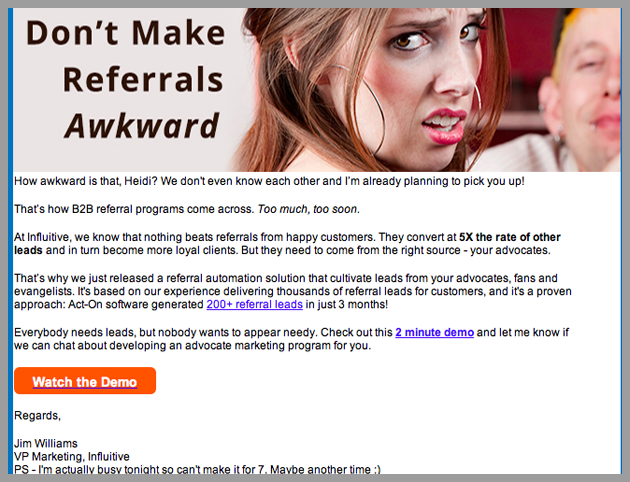
The copy creates humor through deliberate, exaggerated familiarity. It highlights how other B2B referral companies ask their customers for “too much, too soon”.
The Marketo blogger describes the campaign as “awesome” and “brilliant”. But the first comment on the post, from a copywriter named Rhonda, says “I found the content arrogant, I don’t think I’d like to receive this kind of message.”
Make sure your email copy suits your subscribers.
► Make a funny video for your email
It’s getting easier and easier to include video (or a link to a video) in your emails – and a video can feel more personal than text.
If you have a naturally good sense of humor, making a funny video may work better than writing text
Take a look at this example of a video in a follow-up email from FunnyBizz, a company that helps other businesses “harness the power of humor”.
In the video, the sender, Rachman, starts by saying it’s “a follow-up email to see if the guys and gals at Close.io still need help getting results”. Then two singers appear and start singing a song full of social media references. “No need to post it on Pinterest / I just want to know if you’re still interested”.
It may not be the funniest video in the world, but it shows creativity and a sense of humor – and that goes a long way.
► Use funny images and drawings in your emails
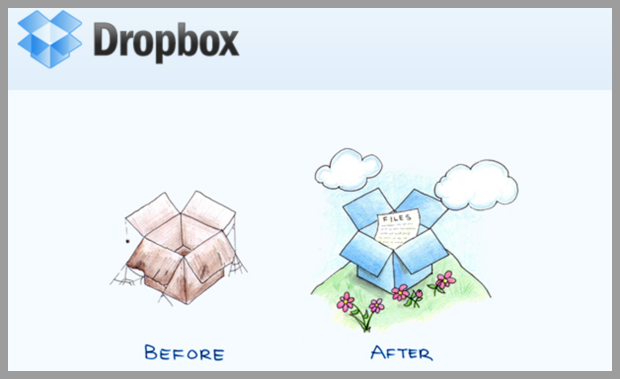
Many email campaigns include a large image. It’s a good place to add some humor. Visual humor tends to be simple and easy to understand.
You can use your own image, drawing or photo – although that can be expensive. The example below, from a campaign asking users to “come back to Dropbox”, shows in a fun way why it’s a good idea.
The internet is full of funny images, GIFs and memes.
Many of them are in the public domain, many others can be used in your email campaigns under a Creative Commons license, and others you can use by reaching an agreement with the creator. But make sure you don’t use copyrighted images without permission.
Ways to use humor in your emails
Humor can be a very effective tool for adding personality to your email communications.
Here are some of the ways you can bring a bit of humor into your emails:
- Jokes: A simple, lighthearted joke can be a great way to make someone laugh. Make sure the joke is appropriate for your audience and relates in some way to the content of your email.
- Personal anecdotes: Sharing a funny personal story can make your email more memorable and help build a personal connection with the recipient. An anecdote about something funny or embarrassing that happened to you can add a human touch to your email.
- Images or memes: Funny memes or images can be a great way to inject humor into an email. They should be relevant and appropriate for the context and the audience. Remember that a picture may be worth a thousand words, but it can also ruin your message if it’s misinterpreted!
- Puns and wordplay: A good pun can make people laugh while highlighting the message you want to get across. Well-crafted wordplay can be clever and show that you’ve taken the time to think about your email.
- Tone and writing style: The tone of your writing can make an email funny. Some people use a very formal tone for trivial topics to create a comic effect, for example. Don’t hesitate to play with language and experiment with different writing styles to find the one that best suits your message and your audience.
Remember that although humor can be a great tool, it’s important to use it carefully so you don’t offend or confuse your recipients.
Always consider your relationship with the recipient, their sense of humor and the context in which the message is received.
Above all, make sure the humor is relevant to your email marketing campaign
Finally, something you shouldn’t forget:
Even if you create a funny email marketing campaign, making people laugh is not your main goal
Your goal is to get a response to what your campaign actually offers. Humor is there to help, not as an end in itself.
That’s why you need to make sure the humor in your campaign is relevant to your brand and to what you offer. It’s not just about telling a joke, pasting in a funny image or using a humorous tone in your copy.
Make sure the call to action still takes center stage – however humorous the email is.
Good luck with your next campaign! Do you have more ideas for creating a funny, entertaining emailing to surprise your subscribers?

Jose Argudo
CMO at Mailrelay. Writes about email marketing, copywriting, and conversion for small businesses and entrepreneurs.