Mission, vision and values of a company: what they are, examples and how to write them
The three statements that explain who you are, where you’re going and how you work, with templates to write them

The three statements that explain who you are, where you’re going and how you work, with templates to write them
Could you explain in one sentence why your company exists? If you’re struggling, you’re not alone. Many small businesses run for years without having it written down, until it’s time to hire, launch a campaign or decide which project to prioritize.
That’s where a company’s mission, vision and values come in: three short statements that save you a lot of second-guessing. In this guide we explain what each one is, show you 10 examples from real companies and give you templates to write your own.
Mission, vision and values are the three ideas that define a company’s identity. The mission explains why it exists today, the vision describes where it wants to go, and the values set how it behaves along the way.
Together they form the foundation of a company’s strategy. They help you make decisions, explain your brand to customers and employees, and get the whole team pulling in the same direction.
This table sums up the difference between the three:
| Mission | Vision | Values | |
|---|---|---|---|
| Question it answers | Why do we exist? | Where do we want to go? | How do we behave? |
| Time | The present | The future, 5 to 10 years out | Always |
| Format | One concrete sentence | One inspiring sentence | 3 to 6 principles |
| Who uses it | Customers, team and partners | Mainly the team and investors | Everyone, day to day |
| Example | “We help small businesses sell by email” | “To be the preferred email tool for Spanish-speaking small businesses” | Approachability, transparency and simplicity |
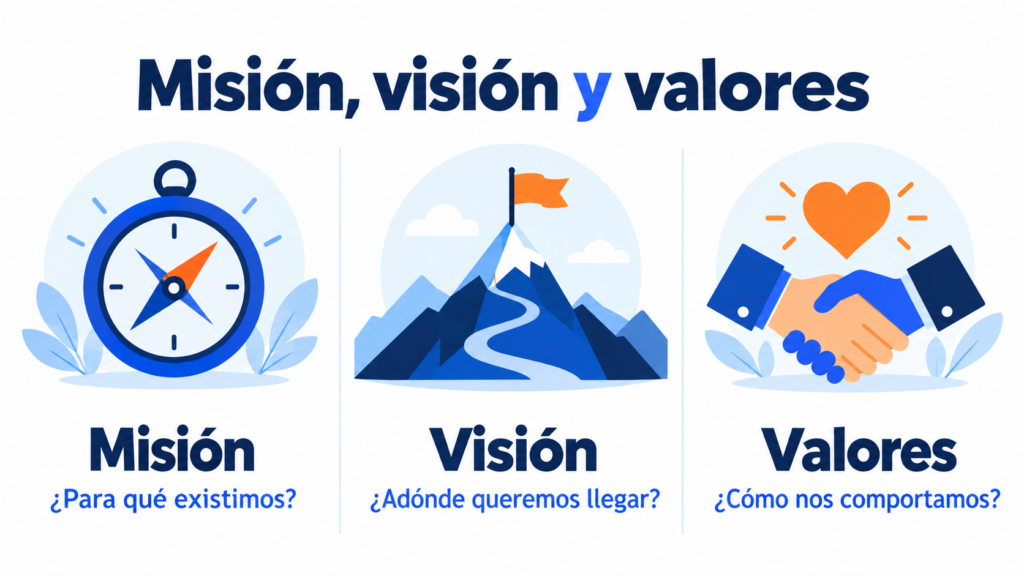
A company’s mission is the statement that explains its reason for being: what it does, for whom and what value it delivers. It’s about the present and what the company does every day.
A good mission answers three questions: what you offer, who you offer it to and what changes for that person thanks to you. It doesn’t have to be pretty. It has to be clear.
What is a company’s mission for? Making decisions. If you’re torn between two projects, your mission tells you which one fits best with who you are.
It also helps you explain your brand in a presentation, on your website or in your welcome email.
A company’s vision is the picture of what it wants to become in the future. It’s an ambitious long-term goal, usually five or ten years down the road.
If the mission is the engine, the vision is the destination.
It motivates the team, guides investment and lets you measure whether the company is moving in the right direction.
A useful vision is ambitious, but believable. “To be the best in the world” says nothing. “To be the leading English academy in Andalusia by 2030” does give you a direction.
A company’s values are the principles that guide how its people work and how they treat customers, employees and suppliers. They’re the part of the identity you can see in day-to-day decisions.
What matters isn’t the word, but the behavior. Many companies say “commitment” or “excellence”, but few explain what that means in practice. These are some of the most common values, with an example of how they show:
| Value | How it shows day to day |
|---|---|
| Transparency | You publish your prices and explain changes before making them |
| Customer focus | You answer every inquiry in less than 24 hours |
| Innovation | You set aside time every month to try out new ideas |
| Sustainability | You choose local suppliers and cut down on packaging |
| Teamwork | Important decisions are made after listening to everyone |
| Honesty | If a product isn’t right for the customer, you tell them |
| Approachability | You talk to your customers by name and without jargon |
| Quality | You check every order before shipping it |
Values are closely tied to corporate culture. If you want them to be followed, the team needs to see them in whoever is in charge.
In recent years, many companies also talk about their purpose. It goes one step beyond the mission: it explains what change the company wants to bring about in the world, beyond what it sells.
For example, a bike shop’s mission might be to sell and repair quality bikes in its neighborhood. Its purpose: to get more people moving around the city without polluting.
You don’t need all four concepts. For a small business, a clear mission, a realistic vision and a few values are usually enough. If your company has a strong purpose, it can take the place of the mission, as you’ll see in the case of Mercado Libre.
Tell your customers why you exist
With Mailrelay you can create a welcome email that introduces your brand from day one.
Examples help you understand the difference better than any definition. Here are ten well-known cases, from big international brands as well as Spanish and Latin American companies.
Mission: “to organize the world’s information and make it universally accessible and useful”. It works because it explains what the company does without talking about its products. That’s why it has worked for Search, Maps and Translate alike.
Mission: to empower every person and every organization on the planet to achieve more. It puts the focus on what the customer achieves, not on the software.
Mission: to accelerate the world’s transition to sustainable energy. It’s a good example of an ambitious purpose that guides everything, from the cars to the batteries.
Vision: to be Earth’s most customer-centric company. Its internal values, such as customer obsession, show in decisions like easy returns.
Vision: to create a better everyday life for the many people. It explains both what it sells (home furnishings) and who it sells to (everyone, at affordable prices).
Mission: to bring inspiration and innovation to every athlete in the world. And it adds a note that changes everything: if you have a body, you are an athlete. That way, its audience becomes anyone at all.
Mission: “We’re in business to save our home planet”, since 2018. The brand applies it to its products, its campaigns and how it distributes its profits.
Mission: to satisfy the food, personal hygiene, home care and pet care needs of “The Boss”, as it calls its customers. That vocabulary of its own reminds the whole workforce who they serve.
Mission: delicious and nutritious food in the hands of all. It’s short, concrete and explains its ambition to reach every store.
Purpose: to democratize commerce and financial services to transform the lives of millions of people in Latin America. It connects the business with a change it wants to bring about.
Notice what they have in common: they’re short sentences, they talk about the customer and they can be applied to real decisions.
And none of them needs grandiose words to work.
You don’t need an agency to write them. Get two or three people from your team together and look at what your customers think of you.
Then use these templates as a starting point. Write several versions, read them out loud and keep the simplest one.

Answer what you do, for whom and what they achieve thanks to you.
At [company name] we help [audience] [result they achieve] through [what you do and how you do it].
For example, for a language school: “At Academia Sol we help busy adults speak English with confidence through short classes in small groups with native teachers”.
Set a goal, a deadline and what will make you different.
By [year], we want to be [position you want to hold] for [audience] thanks to [what sets you apart].
Example: “By 2030, we want to be the leading English academy for adults in Andalusia thanks to a method that adapts to every schedule”.
Choose three to six values and explain each one with a behavior.
[Value]: [what we specifically do to live up to it].
Example: “Approachability: every student has a tutor they can message on WhatsApp or by email”.
Before you sign off on them, check that your team understands them without explanation and that your ideal customer recognizes themselves in them.
Bring your values to every customer
Send newsletters that are consistent with your brand and measure which messages connect best.
These are the most frequent mistakes, and how to avoid them:
| Error | Example | Better like this |
|---|---|---|
| Being too generic | “To offer the best service” | Say who you serve and what changes for them |
| Mixing up mission and vision | Talking about the future in the mission | The mission is today; the vision is tomorrow |
| Copying another company | Using a competitor’s mission | Start from what makes you different |
| Values without behavior | “Innovation”, and nothing more | Explain what you do to live up to it |
| Writing it and forgetting it | A framed poster in the office | Use it to make decisions and review it every year |
A good SWOT analysis before you start helps you avoid promising what you can’t deliver.
Having the statements written down isn’t enough: your customers need to feel them. Email is one of the best channels to do it, because it goes straight to people who already know you and it’s the foundation of relationship marketing.
In your welcome email, explain in two lines why your company exists. It’s the moment when a new subscriber is paying the most attention.
In your newsletter, show your values through actions: a sustainable project, a customer story or a decision you made to stay true to them. Storytelling works better than adjectives.
In the tone of every message, be consistent. If one of your values is approachability, write the way you’d talk to a customer in your store.
In your team’s email signature, you can include a short line from your mission. That way every email reinforces your branding.
And if your company sells to different audiences, segmentation lets you tell each group the part of your mission that matters most to them.
With Mailrelay you can share your mission and values with your customers consistently. You design your welcome email and newsletter with the editor, segment your list with custom fields and see in the statistics which messages get the most opens and clicks.
The free account includes up to 80,000 emails a month and 20,000 contacts, with human support by chat, ticket and phone.
Send your newsletters with Mailrelay
Up to 80,000 emails a month and 20,000 contacts for free, with human support on every plan.
A company’s mission, vision and values aren’t a box-ticking exercise. Written well, they help you make decisions, hire and explain your brand.
Start today: fill in the three templates, share them with your team and use them in your next email. Then review them once a year to make sure they still describe who you are.
These are the most common questions about a company’s mission, vision and values.
It’s the statement that explains why it exists: what it does, for whom and what value it delivers today.
The mission describes what the company does in the present. The vision describes what it wants to become in the future.
Between three and six. With more, the team can’t remember them and they lose their impact.
To make consistent decisions, motivate the team and explain the brand to customers, partners and investors.
Values rarely change. It’s a good idea to review the mission and vision once a year or whenever the company changes direction.

Jose Argudo
CMO at Mailrelay. Writes about email marketing, copywriting, and conversion for small businesses and entrepreneurs.