Marketing problems: the 10 most common in businesses and how to solve them
Why marketing doesn’t work for many small businesses, how to tell which problem you have and what to do to fix it

Why marketing doesn’t work for many small businesses, how to tell which problem you have and what to do to fix it
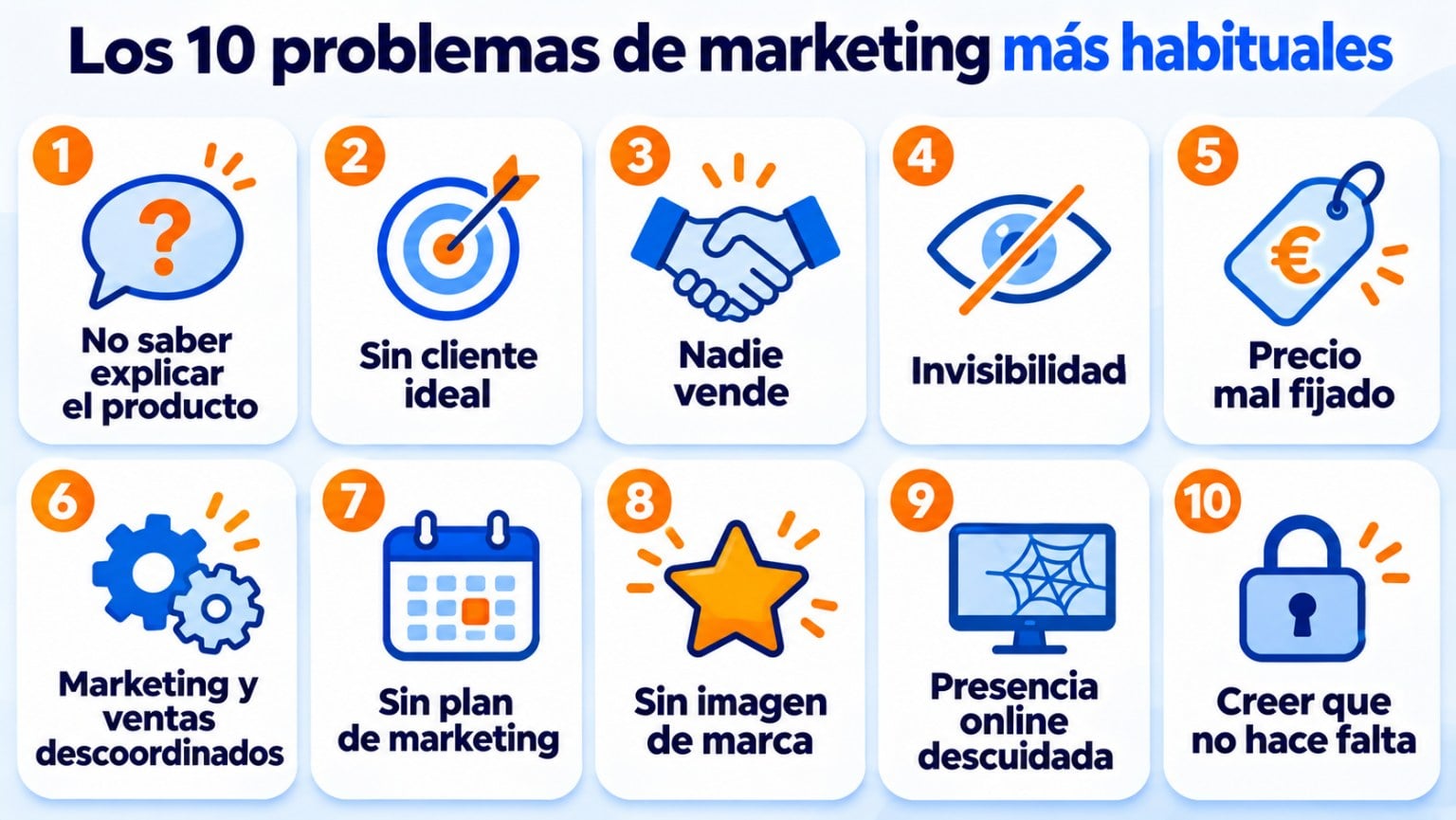
The most common marketing problems for small businesses and freelancers are not knowing how to explain the product, not being clear about the ideal customer and not planning.
Next come invisibility, pricing mistakes, poor coordination with sales and a neglected online presence.
Almost none of them are caused by a lack of budget. They are caused by using the budget you have badly, not measuring and improvising.
Most businesses in Spain are small businesses.
Many don’t have a marketing department and do it as best they can, among a thousand other tasks.
In this article you’ll find the 10 marketing problems that come up most often, the sign that gives each one away and how to solve it.
| Problem | Warning sign | First step to solve it |
|---|---|---|
| Not knowing how to explain the product | You talk about features and the customer doesn’t understand what they get out of it | Explain the benefit in one sentence |
| No clear segment | You target “everyone” | Define your ideal customer |
| Nobody sells | Only the salesperson sells, or nobody does | Train everyone on the team who deals with customers |
| Invisibility | Customers don’t know you exist | Choose one or two channels where your audience is |
| Wrong pricing | You sell a lot and earn little, or you don’t sell | Work out your minimum price before looking at the competition |
| Marketing and sales out of sync | You advertise what you don’t have or what’s out of season | Share a campaign calendar |
| No marketing plan | Everything is done on the fly | Plan the next three months |
| No brand image | Nobody can tell you apart from the competition | Define what makes you different |
| Neglected online presence | Outdated website or unanswered messages | Review your website and reply the same day |
| Believing you don’t need marketing | “My product sells itself” | Track where your customers come from |
If you run a business, you’ll very likely recognize yourself in some of these marketing problems. What matters is spotting them in time.
Avoid one of the most common marketing problems
Not having a direct channel with your customers is a common mistake. Mailrelay makes it easy to fix.
Knowing a product inside out doesn’t make you the best person to sell it.
You know how it’s made and what it’s made of, but the customer only wants to know what they get out of it.
Any product or service should be explained from the customer’s point of view. Does it save them time? Does it solve a problem for them? Does it give them peace of mind?
It helps to tell the difference between needs and wants. Sometimes customers buy based on what they feel, not on what they need.
How to solve it: write in a single sentence what problem your product solves and for whom.
Use it on your website, in your emails and when you serve customers in person.
Your product isn’t good because it’s yours. It’s good because your customers want to buy it.
Thinking that everyone is your customer is one of the most common mistakes when starting a business. If you talk to everyone, you convince no one.
A family law firm has nothing to offer an 18-year-old student.
A luxury car dealership won’t sell anything by handing out flyers outside a high school.
Defining your ideal customer gives you two advantages.
First, you learn the real size of your market and whether your city is enough or you need to sell further afield.
Second, you learn what that customer is looking for: price, quality, novelty, convenience or status. With that, you explain your product better and sell more.
How to solve it: describe your ideal customer by age, situation, problem and where they look for information. Then segment your campaigns based on that profile.
We tend to think that selling is the salesperson’s job.
But in a small business, everyone who deals with customers sells: the waiter, the shop assistant or the technician who does the installation.
Training the whole team to explain the product makes all the difference. And very few small businesses spend time on it.
If you have salespeople, let them do their job and reward those who stand out.
A good salesperson knows what to sell at each moment, builds loyalty and increases the average order value with cross-selling.
How to solve it: spend an hour a month explaining to your team what you sell, to whom and why.
Share the questions customers ask most often with everyone.
Making your business known is one of your first tasks. The problem usually isn’t advertising, but advertising on the wrong channel.
You can advertise in the local press, on local radio or TV, hand out flyers, write a blog, be on social media, organize an event or use email marketing.
Each channel works for a different type of business. An ad on regional TV makes no sense for a neighborhood shop.
A blog that isn’t updated brings no one in.
The first thing is to know what you want to achieve and where your audience is.
An ad for men’s products works better in a motoring publication than in a teen magazine.
Locally, mobile rules. When someone searches for “pharmacy open near me” or “emergency locksmith”, the winner is whoever has a complete Google Business Profile.
How to solve it: choose one or two channels where your ideal customer is and be consistent on them before adding more.
Price is marketing too. It has to seem fair to the customer and, at the same time, leave you a margin.
First, work out the price you need based on your costs. Your competitors may have different expenses, a different volume or better terms with their suppliers.
Then set your minimum price, below which you lose money even if you sell a lot.
You’ll find the methods in our guide on how to price a product.
Once your price is clear, it’s time to stand out.
A coffee costs almost the same in every café, but the service, the atmosphere and the speed decide which one fills up.
Competing on price alone is risky. Someone cheaper can always come along, and once you lower your prices it’s very hard to raise them again.
How to solve it: work out your minimum price and don’t go below it. Compete with something your competitors don’t offer: service, speed, a guarantee or specialization.
Every business has good months and slow months. Marketing has to keep pace with what you want to sell at each moment.
It’s more common than you’d think to advertise something while the business is closed for the holidays, or to promote one product while trying to sell another.
Many bars post their lunch menu at seven in the evening.
At that time they should be advertising what customers can have after work.
A garage shouldn’t advertise air conditioning recharges at the end of summer. A fashion store doesn’t sell bikinis at Christmas.
How to solve it: share a calendar with the whole team showing what needs to be sold each month.
A marketing calendar helps you keep track of key dates.
Coordinate marketing and sales with Mailrelay
Automate your email marketing campaigns so marketing and sales are always moving in the same direction.
Every business knows when it pays taxes or when it closes for the holidays. Few know what they’re going to promote next month.
A marketing plan tells you what to sell, to whom, through which channel and when.
Without one, everything is done on the fly and almost always too late.
Divorces rise after summer, so a family law firm should advertise at the end of August.
Gyms fill up in January, so it pays to attract members in December.
How to solve it: start with a simple plan for the next three months. There’s a free marketing plan template you can use to do it in an afternoon.
Every business has a reputation, good or bad. If nobody can tell you apart from the competition, you compete on price alone.
Your customers give you your reputation over time. But first you need a recognizable brand image: your style, the way you treat people, your after-sales service.
A garage that sticks to the quote it gives, or a lawyer known for being approachable, gets chosen for that reputation.
In a small business, the owner’s personal brand carries as much weight as the company’s.
How to solve it: define your value proposition in one sentence and repeat it the same way on your website, your social media, your emails and your store.
Today anyone can look up what you sell on their phone at any time.
If they can’t find you, or what they find looks abandoned, they go to the competition.
A good online presence isn’t an outdated website or a social media profile where you only post product photos.
It’s a website that works, a phone that someone answers and emails that get replies.
Taking a day to reply can cost you a sale.
Social media isn’t a home shopping channel either.
Think of it as a themed channel about your industry, where your products are the ads. And reply to messages and comments.
How to solve it: once a month, review your website, your contact details and your Google profile.
Set a maximum response time and stick to it.
“My product is so good it sells itself.” It’s one of the most expensive mistakes small businesses make.
No business survives without marketing.
Even if you don’t call it that, every time you serve a customer, set a price or post a photo, you’re doing marketing.
Many business owners conclude that their marketing problems can’t be solved because they ran one-off actions, at the wrong time and without measuring.
The problem wasn’t marketing, but how it was done.
How to solve it: ask every new customer how they heard about you and write it down. In a few months you’ll know which actions bring you customers and which don’t.
The biggest marketing problem for small businesses? After more than 20 years working in marketing with small businesses, I don’t think a lack of budget, on its own, is the main one. The main one is using that budget badly: putting it into actions that won’t generate a return just because competitors do them, not measuring what you do, and not planning for the long term, so you end up with one-off actions that lose their impact. Those are the real problems, not just a small budget. My advice: start small, with a clear goal, a channel you can measure and the consistency to improve every month.
Jose Argudo, CMO at Mailrelay
Bad marketing is made up of practices that not only don’t work but also damage your image or border on the unethical. These are the most common examples.
| Practice | Why it’s bad marketing |
|---|---|
| Misleading advertising | It promises what the product doesn’t deliver and destroys trust |
| Intrusive strategies | Pop-ups, spam or unwanted calls that annoy the customer |
| Lack of personalization | The same message for everyone, even if they’re not interested |
| Not researching the market | Launching campaigns without knowing the customer |
| Misuse of social media | Poor or offensive content, or never replying to anyone |
| Not respecting privacy | Using personal data without consent, which the GDPR also prohibits |
| Not measuring | Repeating campaigns without knowing whether they work |
In email marketing, the clearest example is sending to purchased lists or to people who haven’t subscribed.
Besides being illegal, it sinks your domain’s reputation.
Inefficient marketing isn’t necessarily unethical. It simply doesn’t deliver the expected results or costs more than it brings in.
Its causes are usually unclear goals, actions that don’t fit the strategy, money spent without a return or an audience that’s too broad.
Other causes are failing to adapt to market changes or not coordinating online and offline channels.
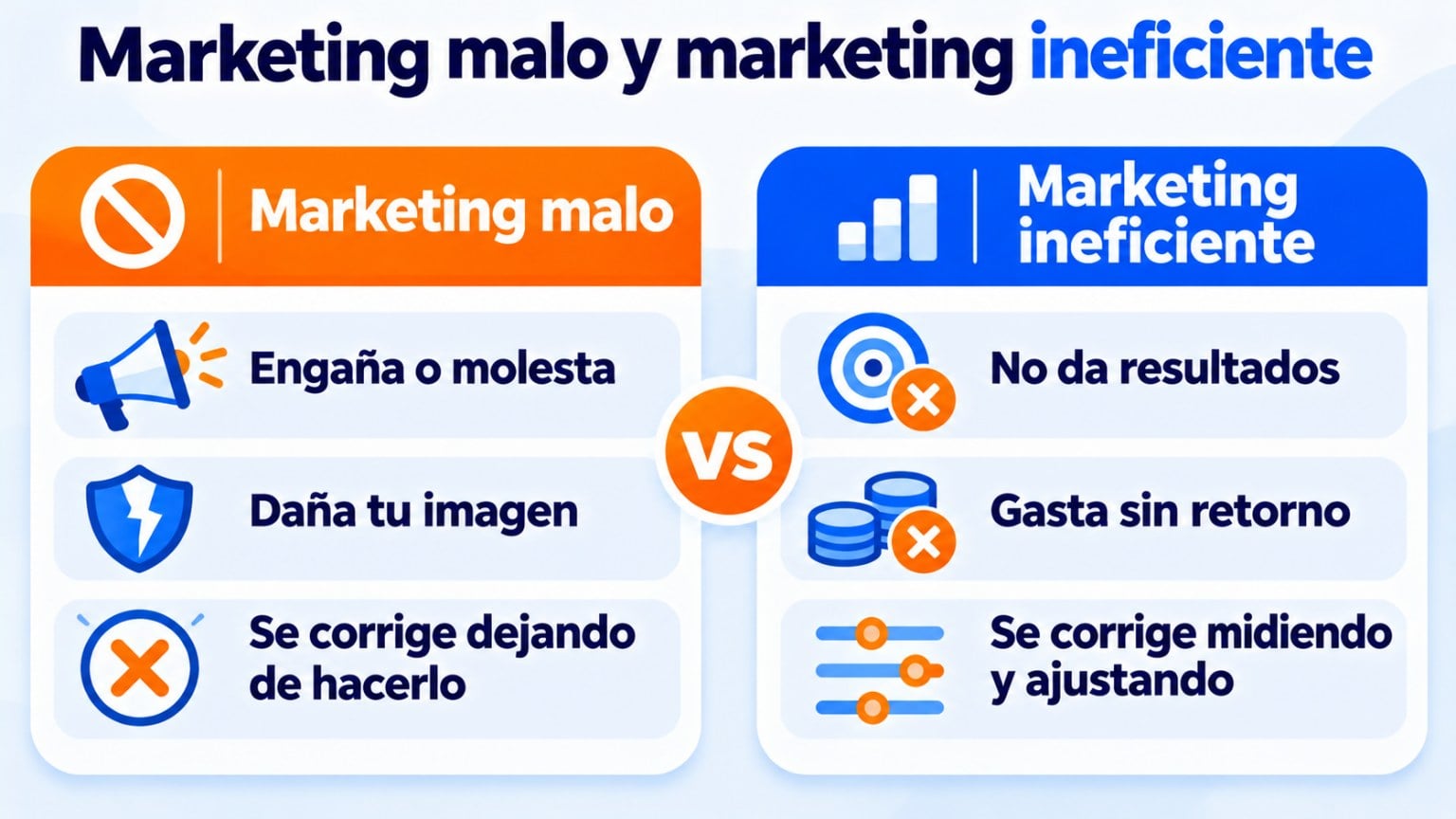
The practical difference is this: bad marketing is fixed by stopping it. Inefficient marketing is fixed by measuring and adjusting.
To measure, define one or two KPIs before each campaign and calculate their ROI.
A good marketing information system helps you keep the data at hand.
Email doesn’t solve everything, but it helps with several of the marketing problems on this list.
| Problem | How email helps |
|---|---|
| Invisibility | It keeps you present in the inbox of people who already know you |
| No clear segment | It makes you think about who you’re writing to and lets you segment |
| Out of sync with sales | You schedule each campaign for when it’s time to sell that product |
| No marketing plan | A sending calendar is a first plan |
| Believing you don’t need it | You can see which emails generate clicks and sales |
What’s more, your subscriber list belongs to you. It doesn’t depend on algorithms or on what ads will cost next month.
With Mailrelay you can build your list, segment it and send campaigns or automations without any design skills, using templates and a drag-and-drop editor.
The free account includes up to 80,000 emails a month and 20,000 contacts, with automations and human support.
It lets you start measuring without investing up front.
These are the most frequent questions about a small business’s marketing problems.
The most common marketing problem is not planning and not measuring.
Many small businesses run one-off actions without a clear goal and don’t know what brings them customers.
A lack of budget matters less than it seems.
The most common digital marketing problems are being on too many channels at once and not having a well-maintained website.
Others are not replying to messages, not segmenting and not measuring the results of each campaign.
It’s marketing that annoys, deceives or disrespects the customer: misleading advertising, spam, irrelevant messages or using data without permission.
On top of not selling, it damages your image.
Set a measurable goal before each action and compare the result with what it cost. Also ask your new customers how they heard about you.
Yes. Local SEO, content and email marketing cost little and work well for small businesses.
What matters is choosing a few channels and being consistent.
Solve your marketing challenges with Mailrelay
Add the email marketing tool you need to your team and avoid these problems.
Types of marketing: all 50 of them
What each type of marketing does and how to choose the ones that suit you.
Strategic marketing: what it is and its techniques
What it is, what benefits it brings and which techniques to use, with examples.
Market research: what it is and how to do it
How to get to know your market step by step before you decide.
What is email marketing
How it works, what you need to get started and how to measure whether your campaigns are getting results.

Jose Argudo
CMO at Mailrelay. Writes about email marketing, copywriting and conversion for small businesses and entrepreneurs.
Comments are closed.
This section which I saw here absolutely its so fantastic based on marketing section for now I just knowing that there is direct relations between my business and online service 👊