How to create a website for free: tools, steps and limits you should know
Which free tools are worth it, what they give you and what they don’t, and how to publish your website today without knowing how to code

Which free tools are worth it, what they give you and what they don’t, and how to publish your website today without knowing how to code
To create a website for free, choose a website builder with a free plan, such as Google Sites, Wix, WordPress.com or Carrd.
Then pick a template, add your text and images, and publish the website at the address the platform gives you. You don’t need to know how to code.
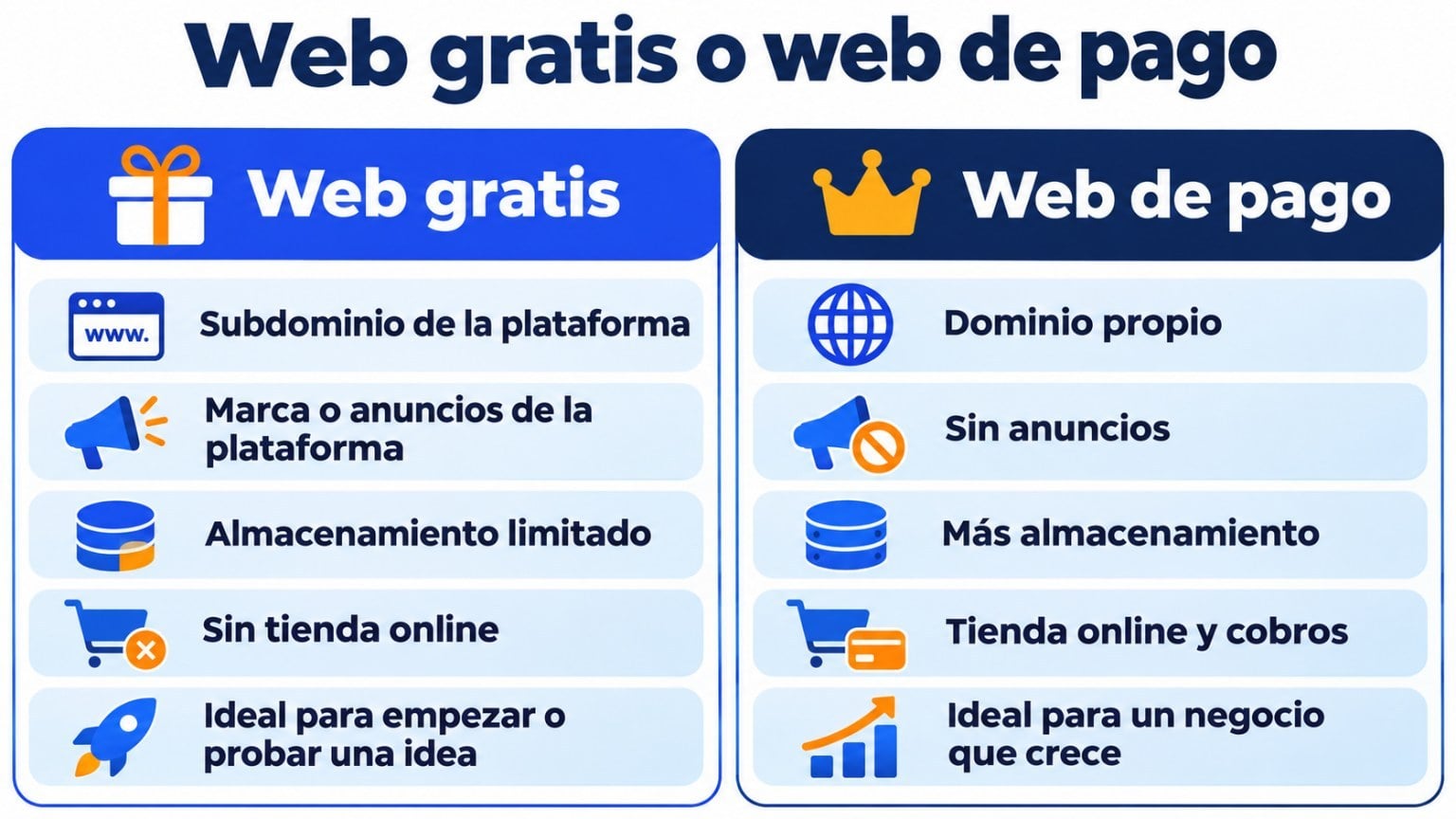
In exchange, the free version has limits: the address includes the platform’s name, it usually shows the platform’s branding or ads, and it doesn’t let you sell.
In this article you’ll find the best tools to create a website for free, what each one includes and the steps to publish it.
You’ll also see what your website can’t do without, when it makes sense to pay and how to turn visitors into customers.
Yes. You can create and publish a website without paying anything and keep it that way for as long as you like.
What’s free is the tool and the hosting.
What you almost always pay for is your own domain and removing the plan’s limits.
| Free | Paid | |
|---|---|---|
| Web address | Platform subdomain (yourbusiness.wixsite.com) | Your own domain (yourbusiness.com) |
| Platform branding or ads | Yes, on most | No |
| Storage | Limited | Large or unlimited |
| Online store and payments | No, or very limited | Yes |
| Advanced forms and integrations | Limited | Yes |
| Support | Basic | Priority |
For a personal website, a portfolio or testing an idea, the free version is usually enough.
For a business that wants to build trust, your own domain is the first upgrade worth paying for.
These are the most useful platforms today with a free plan that never expires. Prices are as of November 2026 and may change.
| Tool | Best for | Free address | Free plan limits | First paid plan |
|---|---|---|---|---|
| Google Sites | Simple websites, projects and internal pages | sites.google.com/view/… | Few templates and design options | None, it’s free |
| Wix | Business websites with a polished design | username.wixsite.com/… | Wix ad, little storage, no store | Light, €14 a month (billed annually) |
| WordPress.com | Blogs and websites that are going to grow | yourbusiness.wordpress.com | WordPress.com ads, no plugins | Personal, from €4 a month (billed annually) |
| Carrd | One-page websites | yourbusiness.carrd.co | Up to 3 one-page websites, Carrd branding, no forms | Pro, from $19 a year |
| Blogger | Personal blogs | yourbusiness.blogspot.com | Outdated templates and few features | None, it’s free |
Google Sites is Google’s website builder. All you need is a Google account, and you edit it by dragging blocks of text, images and videos.
It doesn’t show ads and it integrates with Drive, Docs and Calendar.
It’s the simplest option for an informational website or a project page.
Its weak point is design: it has few templates and fewer customization options than the rest.
Wix is one of the best-known website builders. It has hundreds of templates and a very flexible drag-and-drop editor.
It can also generate a first draft of your website with artificial intelligence from a description of your business.
On the free plan, the website shows a Wix ad and the address is a subdomain.
To use your own domain and remove the branding, you need a paid plan.
WordPress.com is the hosted version of WordPress, the system that powers a large share of the world’s websites.
It’s the best option if your website will have a blog or is going to grow.
The free plan shows WordPress.com ads and doesn’t let you install plugins.
Don’t confuse it with WordPress.org, which is free as software but requires you to get your own hosting.
Carrd is for creating one-page websites, such as a business card, a link-in-bio page or an event page.
It’s very quick to use.
The free plan allows up to three websites with Carrd branding, and forms are only available on the Pro plans.
Blogger is Google’s blogging platform. It’s free, lets you connect your own domain at no extra cost and has no limit on posts.
Its templates and features have become somewhat outdated. For a blog with ambitions, WordPress.com is a better option.
If that’s your case, see how to create a blog step by step.
Until 2024, Google Business Profile let you create a simple website. Google shut down that feature in March 2024.
It’s still free and very useful for showing up on Google Maps and in local searches. But it no longer replaces a website.
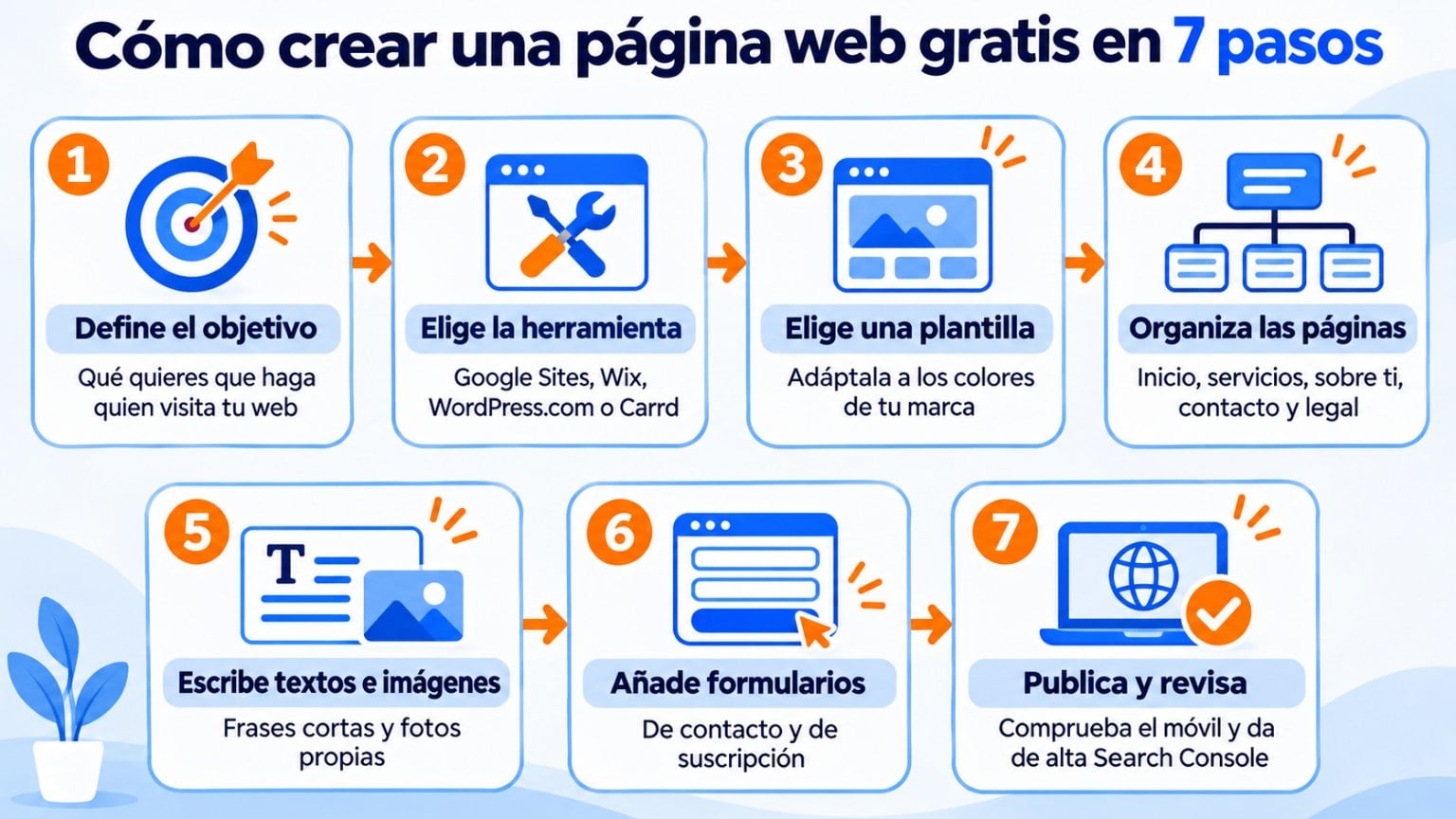
With any of these tools, the process is similar. You can have a first version published in an afternoon.
Before opening any tool, decide what you want the website to do: get people to call you, request a quote, subscribe or read your blog.
Also think about who is going to visit it and what they need to know to take that step.
Use the table above.
If in doubt: Google Sites for something very simple, Wix for a business and WordPress.com if you’re going to publish content often.
Pick a template designed for your type of business and change the colors and fonts to match your brand.
A simple template that’s well adapted is better than a spectacular one that doesn’t look like you.
A small website usually needs five pages: home, services or products, about you, contact and legal pages.
On the home page, explain in one sentence what you do and who it’s for, and add a clear button to what you want the visitor to do.
Write with what your customer is looking for in mind, not what you want to say.
Use short sentences and headings that can be understood at a glance.
Use your own photos whenever you can. If not, turn to free stock image sites and check their license.
A contact form makes it easy for people to get in touch. A subscription form lets you win back people who visit your website and leave.
Most visitors don’t buy on their first visit. If they subscribe, you can write to them again with news and offers.
Turn your website visitors into subscribers
Add a Mailrelay form to your website and grow your list from day one.
Check the website on mobile, test all the links and publish it. Then add the website to Google Search Console, which is free.
That way you’ll know which searches people find you through and whether Google has any problems reading your pages.
Even if it’s free, a business website has to meet some minimum quality and legal requirements.
| Element | Why it matters |
|---|---|
| What you do and who it’s for, on the home page | Visitors decide in seconds whether to stay |
| Visible contact details | It’s what people who are already interested look for most |
| Mobile-friendly design | Most visits come from mobile devices (responsive design) |
| Legal notice | Mandatory in Spain if the website has an economic activity (LSSI) |
| Privacy Policy | Mandatory if you collect personal data, for example in a form (GDPR) |
| Cookie notice | Mandatory if you use non-technical cookies, such as analytics or advertising cookies |
| Loading speed | A slow website loses visits and rankings on Google |
If you don’t know where to start with the legal pages, ask a professional for advice. It’s better than copying them from another website.
A free website is a good start. These are the signs that it’s time to pay:
Your own domain usually costs between €10 and €20 a year.
Register it in your name even if you’re not using it yet, so nobody else takes it.
Publishing the website is the first step. For it to deliver results, it needs to get visits and turn them into contacts.
Give each page a title and a description that include what your customer is looking for. Write content that answers their questions.
A free website can rank on Google. What matters most is the quality of the content and the experience of the people who visit it.
If you have a local business, link to your website from your Business Profile.
It’s free and it’s the fastest way to show up on Google Maps.
Put the link in the bio of your profiles and share every new piece of content. Social networks bring visits, but reach depends on their algorithms.
Most people who visit your website never come back.
A subscription form or a pop-up with a good reason to sign up changes that.
With your own subscriber list, you no longer depend on Google or social networks to talk to them again.
Email goes straight to their inbox.
Your website brings visits. Email brings them back
Send news and offers to people who already know you with Mailrelay’s free account.
With Mailrelay you can add subscription forms to your website, whatever tool you used to build it.
If you don’t have a website yet, or want a page for a specific campaign, you can create free landing pages without coding.
Contacts go straight into your list, and from the same dashboard you send them a welcome email, newsletters or automations.
The free account includes up to 80,000 emails a month and 20,000 contacts, with automations and human support.
These are the most common questions when creating a website for free.
It depends on the type of website. Google Sites is the simplest and has no ads.
Wix offers more design options. WordPress.com is better for blogs and websites that are going to grow.
Almost never. Free platforms give you a subdomain with their name. Some paid plans include the domain free for the first year.
Blogger lets you connect a domain you’ve bought without paying anything more for the platform.
Yes. Builders like Wix generate a first draft of your website from a description of your business.
Then you need to review the text and adapt it. What AI generates is a starting point, not the final version.
Yes, it can rank. Google values content and user experience, not whether you pay for the platform.
Your own domain helps people trust your website more and click on it.
Generally, no. Online stores and payments are usually on paid plans.
If you only want to receive orders or bookings, you can start with a form and a good email system.
Create your landing page and your subscriber list for free
No coding, and from the same dashboard you use to send your emails.
How to create a blog step by step
From choosing the platform to getting your blog ready for email marketing.
Free CRMs in Spanish: 8 options
What each free plan really includes to organize your contacts.
Stock image sites
Where to find photos for your website and your newsletters, and which license to check.
Subscription form
What it is and how to use it to turn your website visitors into subscribers.

Jose Argudo
CMO at Mailrelay. Writes about email marketing, copywriting and conversion for SMEs and entrepreneurs.