What is a blog and what is it for: meaning, types, parts and examples
What it is, what it’s for today and how to start your own, even if you’ve never written online

What it is, what it’s for today and how to start your own, even if you’ve never written online
A blog is a website, or a section of a website, where articles are published regularly, ordered from newest to oldest.
It’s used to share knowledge or opinions, attract visits from Google and build a relationship with readers.
Does it make sense to start a blog when there are social networks, newsletters and AI answers? It depends on what you want it for.
In this guide you’ll find exactly what a blog is, what parts it has, what it’s for today, what types there are and how to create your own step by step.
Turn your readers into subscribers
Add a Mailrelay form to your blog and send a newsletter with your new articles.
A blog is a website where you publish articles regularly, which are sorted by date and which readers can comment on. Each article is called an entry or post.
The word comes from the English weblog, a “log on the web”. Jorn Barger used the term in 1997, and in 1999 Peter Merholz jokingly split it into “we blog”.
That’s where blog came from, and from there came blogger, blogging and blogosphere.
In Spanish it’s written blog, without italics, and its plural is blogs. The RAE (Royal Spanish Academy) includes it in its dictionary.
If you’re wondering what a blog is and how it differs from other websites, the answer is its pace: it’s updated frequently. It can be personal or belong to a company, cover any topic and publish text, video or audio.
There are many types of blogs, but almost all of them share some features: they publish regularly, sort articles by date, group them by topic and let readers take part.
These are the parts you’ll find in almost any blog:
| Part | What it’s for |
|---|---|
| Header | Shows the blog’s name or logo |
| Menu | Leads to the categories and main pages |
| Entries or posts | The articles, with title, date and author |
| Categories and tags | Group articles by topic |
| Sidebar | Brings together search, featured articles or subscription |
| Comments | Let readers share their opinions and ask questions |
| Subscription form | Sends an email alert for every new article |
| Footer | Includes contact details, legal notice and social networks |
Every blog is a website, but not every website is a blog. The difference lies in how the content is organized and how often it changes.
| Blog | Corporate website | Social network | |
|---|---|---|---|
| Content | New articles every so often | Fixed pages that rarely change | Short, continuous posts |
| Order | From newest to oldest | By section (company, services, contact) | Decided by the algorithm |
| Goal | Inform, attract visits and build community | Present the company and sell | Interact and gain reach |
| Ownership | Yours | Yours | The platform’s |
Many companies combine the two: a corporate website with a blog inside it. That way the website stays alive and every article is a new way in from Google.
A blogger is the person who writes and manages a blog. They choose the topics, write the articles, publish them regularly and reply to readers.
Don’t confuse it with Blogger, with a capital B: that’s a free Google platform for creating blogs.
A blog helps you attract people interested in what you do and earn their trust before they buy from you or hire you.
How you use it depends on your goal. These are the five most common uses.
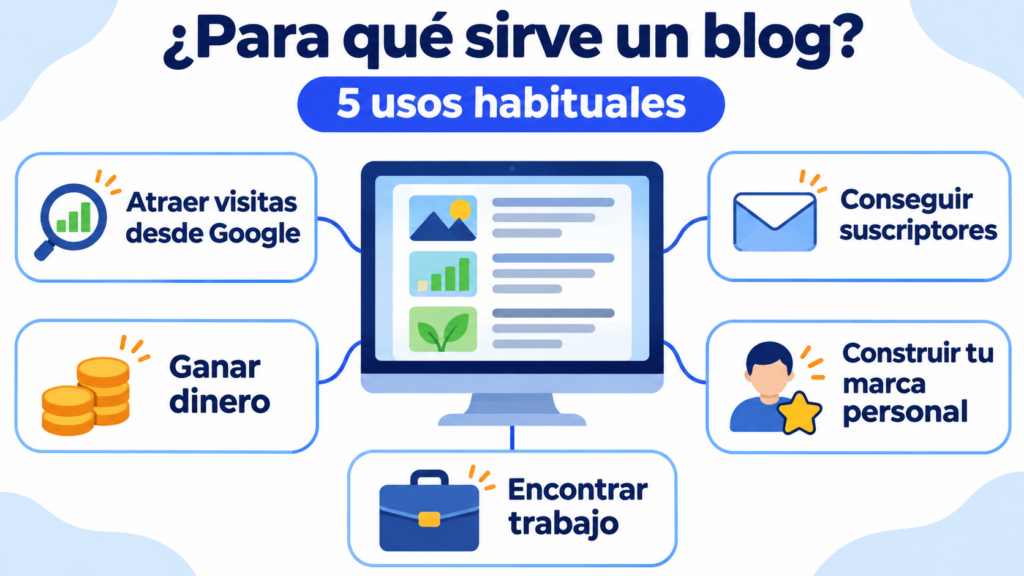
A company website has few pages and they hardly ever change. Each blog article is one more page that can appear on Google for a different search.
If you write about your customers’ real questions, you’ll attract people who don’t know you yet.
To choose your topics, it helps to do keyword research and follow the principles of content marketing.
A blog can generate income, but not overnight.
The most common ways are selling your own products or services, affiliate marketing (you earn a commission on every sale that comes through your links) and advertising.
You’ll find every option explained in how to monetize a blog.
Few people leave their email in exchange for nothing.
On a blog it’s easier: if an article has helped them, they’ll gladly accept a template or a guide in exchange for subscribing. It’s what’s known as a lead magnet.
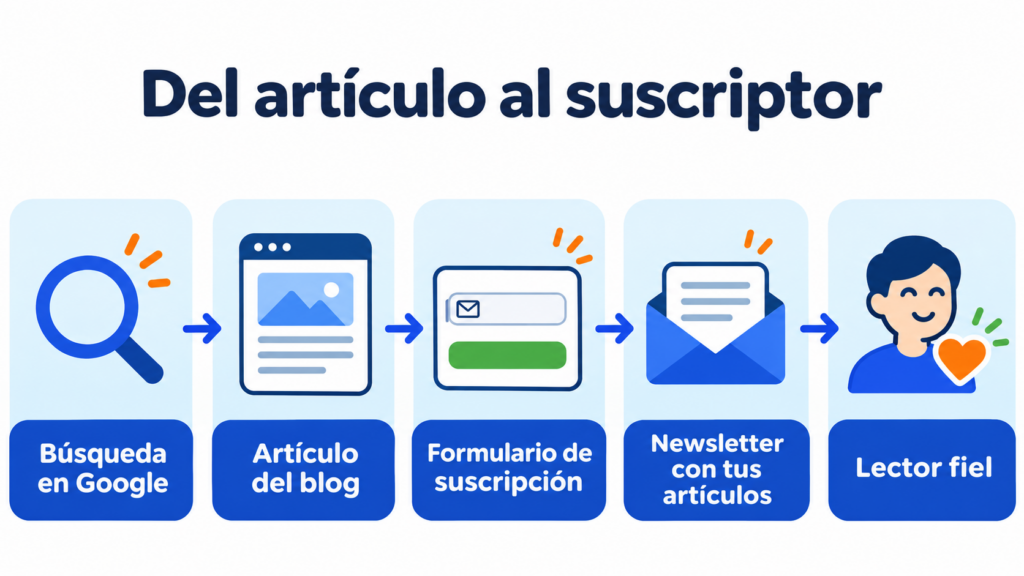
Those subscribers are yours. Then you can send them your newsletter with useful content, not just offers, so they don’t unsubscribe.
Your blog and your newsletter, always connected
Let your subscribers know about every new article with Mailrelay: up to 80,000 emails a month for free.
A blog is the best proof of what you know. Each article shows how you think and work, something a social media profile or a résumé can’t do.
Over time, people will start to see you as a reference in your field.
Many companies search for candidates on Google before calling them. If the first thing they find is a well-kept blog about your specialty, you have an edge over the rest.
It works especially well in marketing, communication, design or programming, where your work can be shown.
Does it still make sense to start a blog? The answer is: it depends. If you only want it to drive traffic, that’s probably hard today, because AI answers have reduced the visits that reach websites and, by extension, blogs. However, it does help you explain your product or service, have content for your social networks and your newsletter, and strengthen your brand. Besides, even if AI reduces traffic, it has to get its information about you from somewhere, and ideally that should be first-hand: from your blog and your website. So write what only you can tell, like your experience, your data or your real cases, and make the most of every visit to get readers to subscribe to your newsletter. That way you’ll depend less on Google and AI.
Jose Argudo, CMO at Mailrelay
Blogs can be classified by who writes them and for what purpose. These are the five most common types.
The author shares their experiences, ideas and opinions on the topics that interest them. It’s the oldest type of blog and the one most similar to a diary.
Here the goal is to make yourself known as a professional. The author writes about their specialty to gain prestige and win clients, contacts or a job.
It’s a company’s blog. It publishes useful content for its potential customers, product news or success stories.
Its goal is to attract visits and build trust in the brand. A well-made corporate blog is also a form of branded content.
It covers a broad topic, such as marketing or technology, and divides it into categories. It attracts a large audience, but competes with big media outlets.
It focuses on a very specific topic, such as specialty coffee or mountain biking. It has a smaller audience, but one that is more loyal and easier to convert.
By format, there are also video blogs, photo blogs and audio blogs, which today coexist with podcasts.
| Type | Who writes it | Main goal |
|---|---|---|
| Personal | One person | Share experiences and opinions |
| Personal brand | A professional | Gain prestige and clients |
| Corporate | A business | Attract visits and build trust |
| General topic | One person or a team | Attract a large audience |
| Niche | One person or a small business | Attract a specific, loyal audience |
A blog opens up many opportunities, but it also takes time. Before you start, it’s worth being clear about both sides.
| Advantages | Disadvantages |
|---|---|
| Attracts visits from Google without paying for ads | Results take months to arrive |
| Builds your personal or company brand | Takes consistency to publish regularly |
| Lets you capture subscribers and customers | You have to maintain the website and its security |
| The content is yours and doesn’t depend on an algorithm | You need to write well or invest in copywriting |
| You can monetize it with products, affiliate marketing or advertising | Competition is high on many topics |
A blog without a strategy ends up abandoned within a few months. Before you write, answer four questions.
What do you want it for? Choose one main goal: visits, subscribers, customers or personal branding. It will help you decide everything else.
Who are you writing for? Describe your ideal reader, your buyer persona: what they know, what worries them and what they search for on Google.
What are you going to talk about? Make a list of topics based on your customers’ questions and real searches.
Prioritize content that will still be useful a year from now, what’s known as evergreen content.
How often are you going to publish? One good article every two weeks is better than three weak ones a week. What matters is consistency.
And once you’re up and running, measure. Google Search Console tells you which searches you appear for, and Google Analytics which articles are read most and which ones bring in subscribers.
WordPress is the most widely used: according to W3Techs, it runs 40.2% of all websites in the world (October 2026). You have two options:
If you’re serious about it, the second option is the one to go for. Blogger, Wix and Substack are simpler alternatives to get started, with less control. You’ll find more options in tools for creating a blog.
Creating a blog is easier than it seems. The hard part is keeping it going. These are the steps to get off on the right foot.
If you want the complete guide, including how to set up WordPress, you’ll find it in how to create a blog step by step.
Decide what you’re going to write about and why. A blog to find a job isn’t the same as one to sell your products.
Who do you want to reach? Picture a specific person, with their questions and problems. You’ll write better if you know who you’re writing for.
WordPress is the most complete option. Blogger and Wix are simpler, but with fewer options.
Look for a short, memorable name related to your topic. Check that the domain is available before you decide.
Make a list of 10 or 15 topics your reader searches for on Google. Organize them in a calendar and decide how often you’re going to publish.
Each article should answer a specific question. Use clear headings, short paragraphs and images that make things easier to understand. Knowing the basics of copywriting will help you.
Share every article on your social networks and add a subscription form so your readers get the new ones by email. That way you don’t rely only on Google to bring them back.
The best way to understand what a blog is, is to read a few. These three have been publishing for years and are good examples of each type.
The IE Business School professor has been writing daily since 2003 about technology, innovation and society. It’s one of the most widely read personal blogs in Spanish and an example of consistency.
A digital marketing consultant, she uses her blog to share guides and templates about her specialty. The blog feeds her brand and her training and consulting services.
Yes, the one you’re reading. We publish email marketing guides, templates and case studies for small businesses.
Each article answers a real question from people who send campaigns, and every reader can subscribe to the weekly newsletter with the new articles.
Once you’re clear on what a blog is and what you want it for, you don’t need many tools to get started. With these four, you’ve got the basics covered.
A clean, fast design that’s easy to read on mobile. WordPress themes cover this without the need for a developer.
Buttons to share each article on LinkedIn, WhatsApp or X. Most WordPress themes already include them, or you can add them with a free plugin.
A subscription form in the sidebar, at the end of each article or in a pop-up window.
Remember that the GDPR requires you to explain what you’ll use the data for and to ask for clear consent. With double opt-in, you also make sure the email address is real.
Google Search Console and Google Analytics are free and tell you what works and what doesn’t.
Email is the channel that turns a passing reader into a loyal one.
Google can change its algorithm and social networks can stop showing your posts, but your subscriber list is yours. We explain it in owned, paid and earned media.
With Mailrelay you can connect your blog and your newsletter hassle-free:
The free account includes up to 80,000 emails a month and 20,000 contacts, with human support on every plan. If you’re comparing platforms, there’s a comparison in newsletters for bloggers and creators.
Send your campaigns for free with Mailrelay
Up to 80,000 emails a month and 20,000 contacts, with human support on every plan.
These are the most searched-for questions about what a blog is.
It’s a website where articles are published regularly, ordered by date. It can be personal or belong to a company, and it usually lets readers comment.
It comes from the English weblog, which means “log on the web”. Over time it was shortened to blog, and Spanish uses it as is.
It’s a blog in which a person shares their experiences, ideas and opinions, without a main commercial goal.
It differs from a personal brand blog in that the latter aims to make the author known as a professional.
The most common are the personal blog, the personal brand blog, the corporate blog, the general-topic blog and the niche blog. By format, there are also video blogs, photo blogs and audio blogs.
Yes. WordPress.com, Blogger and Wix have free plans. They’re limited, though: they don’t let you use your own domain and they have fewer options. For a professional blog, it’s best to get hosting.
How to monetize a blog: 17 ways to make money
How much you can earn with a blog and which methods work best.
How to send your blog posts by email
How to have your subscribers receive every new article automatically.
What is keyword density
How many times to repeat a keyword and how to avoid keyword stuffing.
What is evergreen content
How to write articles that keep attracting visits over time.

Jose Argudo
CMO at Mailrelay. Writes about email marketing, copywriting and conversion for small businesses and entrepreneurs.